AI-Powered Nutrition: Revolutionizing Dietary Guidance for Enhanced Well-Being


There is a particular hollow that arrives somewhere around week three of using a personalized nutrition app and tracking every meal. The app is working — your protein numbers are good, the macros are in range, your fasting glucose curves are flattening — and yet the act of opening the app before each bite has begun to feel like a different kind of relationship with food than the one you were trying to build. I see it in clients often, and the AI nutrition tools of 2026 are quietly making it more common. That is not a reason to dismiss them. It is a reason to be careful about which questions the tools are good at answering and which ones belong somewhere else.
This guide takes the personalized nutrition landscape of 2026 seriously, both as a technology layer and as a psychological one. I am a licensed clinical social worker, not a registered dietitian. The dietary specifics in this guide are sourced from peer-reviewed nutrition science rather than from my own clinical scope, and any reader with a clinical condition — diabetes, an eating disorder history, pregnancy, kidney disease, an active GLP-1 prescription, anything where what you eat is part of a treatment plan — should treat what follows as background reading for a conversation with their own RD or physician, not as a substitute for that conversation. The psychological observations are mine.
What I can tell you well, and what this guide is built around: how AI nutrition actually personalizes (omics, CGM, LLM prompting), which 2026 tools are worth knowing about and which are cautionary tales, where the peer-reviewed evidence says these tools genuinely fall short, what the GLP-1 era is asking of meal-planning technology, and where the line falls between using these tools as helpful structure and using them in a way that erodes your relationship with eating.
How AI Nutrition Actually Personalizes
"Personalized nutrition" is a term that has stretched to mean almost anything since 2024. The honest definition in 2026, drawing on the 2026 MDPI Nutrients systematic review on generative AI in precision nutrition (which identified 21 eligible studies, all published after 2024), is the use of computational models trained on individual data — what you eat, what your blood does after meals, what your genome says, what your gut microbiome looks like, what your activity load is — to generate dietary recommendations that vary across people rather than across age-and-sex categories.
The 2026 NIH PMC review on AI-driven personalized nutrition groups the data layers AI uses into five "omics":
- Genomics — fixed genotype data (e.g., LCT for lactose intolerance, CYP1A2 for caffeine metabolism, MTHFR for folate).
- Metabolomics — small molecules in blood, urine, or saliva that reflect current metabolic state.
- Proteomics — protein-level signals of inflammation, recovery, and chronic disease risk.
- Microbiomics — your gut microbial community, sampled and sequenced from stool.
- Transcriptomics — gene expression patterns, an experimental layer mostly active in research settings.
The two layers most consumer-facing AI tools actually use today are genomics (via SNP-array fitness DNA panels) and what you might call "behavioral omics" — calorie logs, photo-based food recognition, glucose response from a CGM. The deeper layers exist mostly in clinical trials and direct-to-consumer research products.
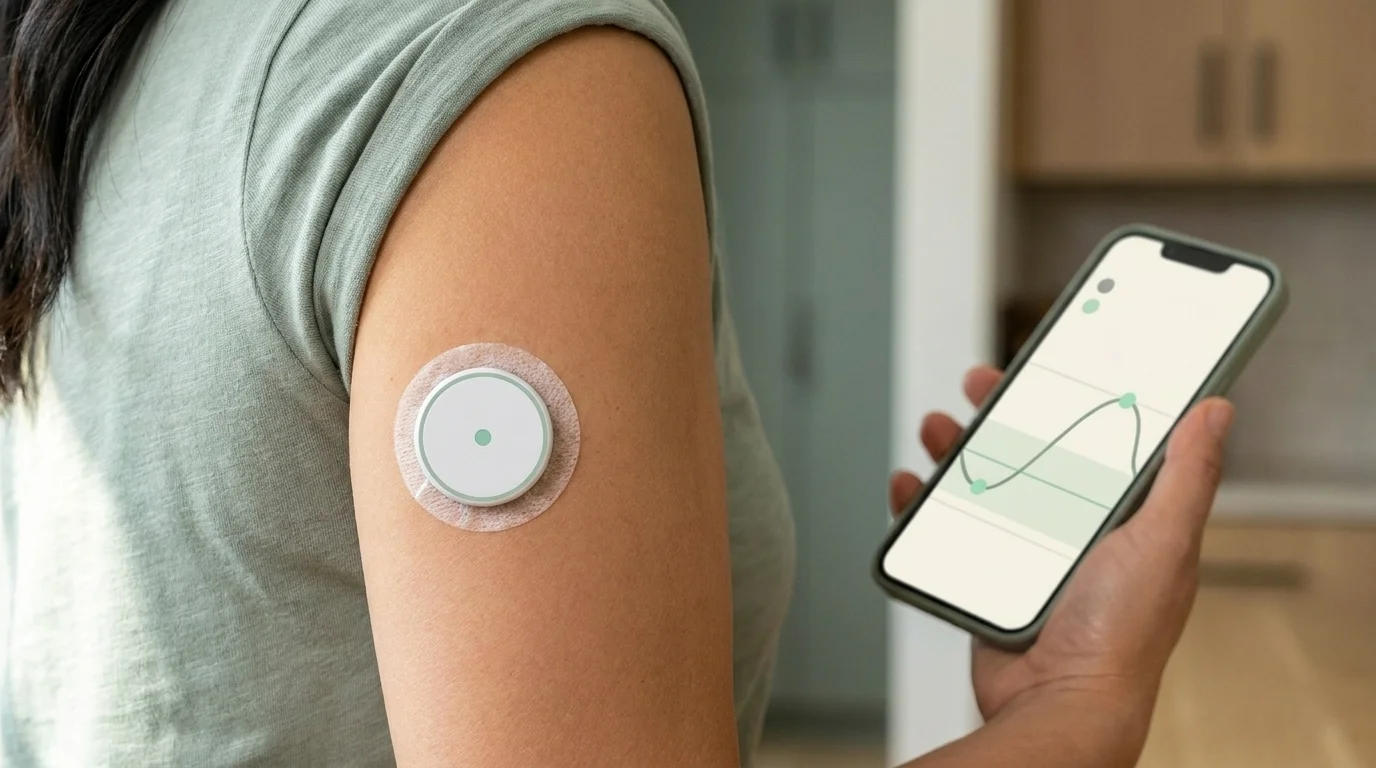
The CGM (continuous glucose monitor) layer is the one with the cleanest 2026 evidence. The PMC 2025 systematic review on CGM-based lifestyle interventions in type 2 diabetes reports that CGM-based feedback reduces HbA1c by 0.28% and increases time-in-range by 7.4% versus control arms. The arXiv 2025 paper on ML models for metabolic subphenotyping shows that high-resolution CGM data can predict insulin resistance and beta-cell function from oral-glucose-tolerance-test responses. The ZOE PREDICT 1 methodology — 394 participants, roughly 4,500 standardized meals plus 5,500 free-living meals — established that CGM signals are stable enough to use as a personalized-nutrition input for non-diabetic populations.
The honest framing on the science: AI nutrition is more than a buzzword in 2026, but the validated layer of personalization that consumers can actually access sits in a narrower zone than the marketing implies. CGM-driven personalization is real for diabetic and insulin-resistant populations; SNP-based personalization is real for a short list of well-replicated genes; behavioral logging is useful as feedback but only as good as the data you give it.
Best AI Nutrition Apps in 2026
The consumer landscape moved fast in 2025 and 2026, and several of the tools an article published a year ago would have led with are either acquired, banned, or repositioned. Here is the 2026 status update with the tools that still matter.
| Tool / app | What it is | 2026 status |
|---|---|---|
| Caloria | Endocrinologist-designed app for GLP-1, diabetes, PCOS, menopause users | Launched January 2026; passed 20,000 downloads in months (PR Newswire) |
| MyFitnessPal | Calorie + macro logging with AI-assisted recognition | Acquired Cal AI in March 2026; now integrates Cal AI's photo-recognition tech (Welling) |
| Cal AI (standalone) | Photo-based calorie tracker | Banned from Apple App Store on April 16, 2026; cautionary tale on photo-calorie accuracy claims |
| Weight Watchers GLP-1 Med+ | WW's rebuilt program for users on GLP-1 medications | Launched December 2025 with AI app features (HIT Consultant) |
| ZOE | CGM-driven personalized nutrition with home blood-test biomarkers | Established CGM-based personalization at consumer scale; clinical-research credibility |
| Lumen | Metabolism-tracking device measuring breath CO2 to estimate fuel use | Established consumer presence; metabolic-flexibility framing |
| ChatGPT / Claude / Gemini | General-purpose LLMs prompted for meal planning | Increasingly used; accuracy varies by prompt quality and model (limitations covered below) |
| Cronometer | Detailed nutrient tracking (micronutrients beyond macros) | Stable consumer app; preferred by users wanting deeper micronutrient detail |
A clinical-honesty note on this table before going further. None of these tools is a substitute for medical nutrition therapy if your eating pattern is part of treatment for a chronic disease, an active eating disorder, a high-risk pregnancy, or a complex medication regimen. AI tools can be useful structure for healthy adults exploring their own behavior. They cannot replace a registered dietitian's individualized clinical judgment, and any tool that markets itself as "your AI dietitian" is doing exactly what every wellness category does when it overreaches its actual scope.
Related Article: Democratizing Wellness Tech: Ensuring Equal Opportunities for Digital Health Adoption
How to Prompt an AI for Meal Planning
This is the section the popular consumer guides spend most of their words on, and the one I treat with the most caveats. ChatGPT, Claude, and Gemini can generate plausible-looking meal plans. They cannot do medical nutrition therapy. What they can do reasonably well is propose meal structures for a healthy adult who already understands their own dietary preferences, doesn't have a relevant medical condition, and is treating the AI as a recipe-and-shopping-list generator rather than a clinical advisor.
If you want to use an LLM this way, a few prompt structures that tend to produce more useful output:
- The constrained-plan prompt. "Create a five-day dinner plan using Mediterranean diet principles, with at least 25 grams of protein per meal, each under 600 calories, using ingredients available at a US grocery store. Include a consolidated shopping list at the end."
- The leftover-friendly prompt. "I have these ingredients: list. Plan three dinners that use them efficiently. Note which dinner should be made first and what leftovers carry to the next day."
- The dietary-restriction prompt. "I am vegetarian and avoid added sugar. Build a week of lunches that hit 30 grams of protein each and take under 15 minutes of active prep. List total prep time per meal."
- The shopping-list-from-recipe prompt. "I want to make specific recipe. Generate a shopping list with quantities, and tell me what I can swap if a particular ingredient is unavailable."
Two prompt structures to avoid entirely, in my opinion as a clinician: any prompt that asks the LLM to plan around a medical condition the LLM does not have your full chart for ("plan a diet for my high blood pressure" — get a real dietitian for this); and any prompt that asks the LLM to count macros or calories for photographed food without acknowledging that this estimate is, on the best current evidence, often substantially wrong (covered in the next section).
Where AI Gets Nutrition Wrong (Peer-Reviewed)
This is the section the cheerleader blogs skip. The peer-reviewed evidence on AI-generated meal plans is more measured than the marketing implies, and the gap matters for anyone considering using these tools for anything more than recipe inspiration.
The 2025 Wiley Journal of Human Nutrition and Dietetics study by Onay et al. compared ChatGPT-generated diets to dietitian-planned diets for chronic-disease scenarios. The ChatGPT diets had measurable deficiencies against nutrient targets and, in several cases, included contraindicated foods — items that should not appear in a meal plan for the specific clinical condition the prompt was about. That is not a finding to glance past. For chronic-disease nutrition, the LLM was incorrect in clinically meaningful ways.
The 2025 PMC chatbot calorie-accuracy comparison found that Gemini deviated from calorie targets by more than 20% in over 50% of generated meal plans. Translated to the consumer experience: if you ask an AI for a 2,000-calorie day, more than half the time the output will be off by 400+ calories in one direction or the other. That is consequential for people pursuing specific calorie targets and a near-perfect way to introduce noise into a tracking practice that was already only as accurate as the data going into it.
The honest synthesis: AI tools are useful as meal-structure and recipe-discovery aids for healthy adults who can sanity-check the output. They are not yet accurate enough to be relied on for medical nutrition therapy, for precise calorie targeting, or for any clinical scenario where the wrong food can have a clinical consequence. The Cal AI Apple App Store removal in April 2026, which followed accumulated questions about photo-calorie accuracy claims, is the consumer-side correlate of the same problem.
Related Article: The Fusion of Wellness Tech and Fashion: Wearable Innovations Revolutionizing Health and Style
GLP-1 and AI Meal Planning
The single largest 2026 use case driving consumer adoption of AI nutrition tools is the GLP-1 medication era — Ozempic, Wegovy, Mounjaro, Zepbound, and the broader semaglutide/tirzepatide class. The challenge these medications introduce is not weight loss per se. It is the abrupt and substantial reduction in appetite that makes adequate protein, micronutrient density, and meal pleasure harder to maintain. The clinical literature increasingly groups GLP-1 nutritional support under three priorities: managing GI side effects, preventing nutrient deficiencies as intake drops, and preserving muscle and bone mass through adequate protein and resistance training.
The 2026 AI nutrition tools have responded. Caloria, an endocrinologist-designed app launched in January 2026, was built explicitly for the GLP-1 era and reports more than 20,000 downloads in its first months (PR Newswire) — driven heavily by users on weight-loss medications who need a tool oriented around "eat well while appetite is suppressed" rather than "eat less." Weight Watchers rebuilt its program around a GLP-1 Med+ track with AI app features in December 2025 (HIT Consultant).
The clinical caveat is the one to put in bold: if you are on a GLP-1 medication, the AI app does not replace your prescriber's monitoring schedule, does not catch the muscle-mass loss that can show up in DEXA but not on the scale, and is not authorized to advise on dose-related symptom management. The right use of these tools alongside a GLP-1 prescription is as a meal-structure aid that helps you hit protein and micronutrient targets while your appetite is reduced — under the supervision of the clinician who prescribed the medication.
The Psychological Cost of Constant Tracking
This is the section I would write whether or not anyone else does, because it is the section nearest to my actual clinical scope. There is a real psychological cost to constant calorie tracking that the AI nutrition marketing does not acknowledge, and it deserves a careful read.
The act of logging every meal recruits the attention-monitoring networks of the brain in a way that, for most people most of the time, is mildly useful — feedback you can use. For a subset of people, the same act becomes the trigger for a pattern that has clinical names: orthorexia (the preoccupation with "clean" or "healthy" eating that begins to crowd out social and emotional flexibility around food), restrictive eating disorders (anorexia nervosa, atypical anorexia, OSFED — other specified feeding and eating disorders), and the harder-to-name spectrum of disordered eating that sits in the gray zone between normal eating and a clinical presentation. The tools do not cause the underlying vulnerability. They can amplify it, and they can prolong it.
The signals worth watching for in your own practice with these apps: the tool stops being feedback and starts being judgment. The numbers start to feel like a verdict on your day. You find yourself avoiding social meals because you cannot log them accurately. You start to feel anxious before opening the app rather than curious. You start logging in ways that minimize what you ate. You spend more time arranging food for the photo than eating it. Any one of those is a signal to step back from the app, not a signal to use it more carefully.
For people with current or past eating disorders, including the substantial subset who have not been formally diagnosed but recognize the pattern in their own history, calorie-tracking apps are generally not recommended as a self-care tool. The right move is to talk to a therapist or registered dietitian with eating-disorder training before adopting one. The 988 Suicide and Crisis Lifeline is available 24/7 if you are in crisis; the National Eating Disorders Association helpline is available for non-crisis eating-disorder support. Both are appropriate first calls if what shows up when you start tracking is more than feedback.
For everyone else, the question worth holding is what the tracking is for. If the AI app is helping you build a clearer relationship with how your body actually responds to food, that is good information. If it is replacing that relationship with a feed of numbers, the tool has stopped serving the goal.

Privacy, Ethics, and Algorithmic Bias
The privacy concerns with AI nutrition tools deserve a more specific treatment than the original version of this article gave them. Three distinct issues worth knowing.
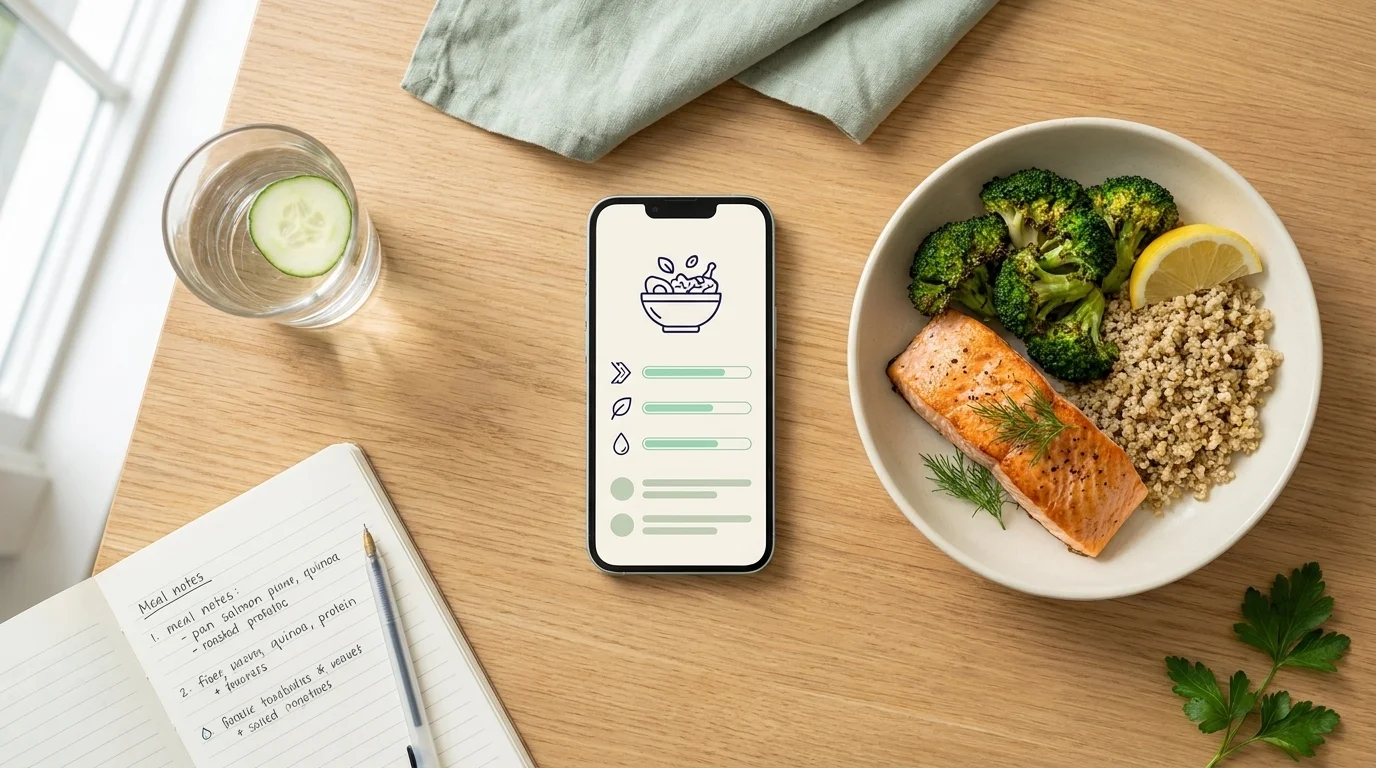
Your food log is medical data. What you eat, when you eat, your glucose curves, your weight trends, your menstrual cycle if tracked, your medication-timing patterns — these are health information in the clinical sense, even when the app is consumer-facing and not bound by HIPAA. The 2026 NIH PMC review on AI-driven personalized nutrition explicitly flags the inadequacy of US consumer health-data protections for the granularity of data AI nutrition tools now collect. Read the privacy policy before you log a single meal.
Algorithmic bias is documented. The same PMC review identifies meaningful misclassification of Asian and Latin American cuisines in computer-vision food-recognition systems trained on Western-cuisine-heavy datasets. The practical effect is that a photo-based calorie tracker is systematically less accurate for some foods than others, and the gap maps onto culturally specific dishes. This is not a small footnote. It is a structural limitation worth weighting against any tool's accuracy claims.
Data sharing varies meaningfully across providers. Some apps retain your data indefinitely, share with research partners, and sell access to anonymized datasets. Others delete data on account closure and refuse partner sharing. The category is unregulated enough that two apps in the same category can sit on opposite ends of this practice. Read the data-retention and data-sharing terms before adopting.
The honest framing: the regulatory gaps are real, the bias is documented, and the data is more sensitive than the consumer experience suggests. Use these tools by choice, not by default, and choose providers whose privacy and data-handling practices you have actually read.
When to Use a Real Dietitian Instead
There is a short, clear list of situations where the right next step is not an AI app but a registered dietitian, a credentialed therapist, or a physician. The list:
- You have an active chronic disease where eating is part of treatment — type 1 or type 2 diabetes, kidney disease, IBD, MAFLD, an active oncology diagnosis, an active cardiovascular condition.
- You are pregnant, breastfeeding, or trying to conceive.
- You are on a GLP-1 medication, a thyroid medication, an antiretroviral, an immunosuppressant, or any medication with documented food interactions.
- You have a current or past eating disorder, or you recognize a pattern in your own history that may not have been diagnosed but feels familiar reading the section above.
- You are caring for a child whose feeding patterns concern you.
- You have a complex food allergy or anaphylaxis history.
- You have lost or gained more than 10% of your body weight in the last six months without intending to.
- You have unexplained GI symptoms, persistent fatigue, or other symptoms a meal plan cannot diagnose.
For any of those, the AI nutrition tool is a possible adjunct to a real care relationship. It is not the care relationship itself. A registered dietitian (RD or RDN) is licensed to provide medical nutrition therapy and can bill insurance for clinical care; a credentialed mental health clinician (LCSW, LPC, LMFT, psychologist) is licensed to provide eating-disorder treatment when that is the relevant question. Both are reachable through your primary care clinician's referral or through the search tools at the Academy of Nutrition and Dietetics and the National Eating Disorders Association directories.
Related Article: Digitizing Wellness: Navigating the Future of Health and Wellness in the Digital Age
A Plainspoken Note on Tracking, Care, and Curiosity
If you have read this far, I will tell you what I tell clients who ask me about the AI nutrition tools. The tools work best as structured curiosity. You are curious about what your body does after a meal — track for two weeks and look at the patterns. You are curious about whether a higher-protein breakfast actually changes your afternoon energy — design a small experiment with the app's structure and pay attention. You are curious about whether a sleep-protective dinner approach moves your morning glucose — use the tool to set up the comparison and watch what happens. That is the right register for the tools: short, specific, curiosity-driven, with an off-ramp built in.
The tools work worst as continuous self-surveillance. The 365-day streak. The number that becomes a verdict. The app you open before each bite because you have stopped trusting yourself to know what your body needs. None of that is a failure of meditation or self-discipline. It is a sign that the tool has outgrown its useful scope and that the relationship with eating wants to be rebuilt on something steadier than an algorithm.
If you are pursuing nutrition because it is part of treatment for an illness, please talk to a real dietitian. If what shows up around food is bigger than a habit question, please talk to a therapist. Both of those professions exist for exactly this. Therapy and dietetic care are not luxury items — they are forms of self-care, and they are the right level of intervention for the situations the AI tools genuinely cannot serve.
The tools can be useful. The tools are not the relationship. The relationship with how you eat, with your body, with the food on your plate is older than the apps, and it will outlast them.
Frequently Asked Questions
There is no single best app — the right tool depends on the use case. Caloria (launched January 2026) is purpose-built for users on GLP-1 medications, diabetes, PCOS, and menopause. MyFitnessPal absorbed Cal AI's photo-recognition tech after acquiring it in March 2026. Weight Watchers GLP-1 Med+ (launched December 2025) is built around the GLP-1 era. ZOE remains the strongest consumer-facing CGM-driven personalization platform. ChatGPT and Claude are useful for meal-structure prompting but should not be used for medical nutrition therapy. None of these tools replaces a registered dietitian if you have a clinical condition.
No, and the peer-reviewed evidence is direct on this. The 2025 Wiley Journal of Human Nutrition and Dietetics study by Onay and colleagues compared ChatGPT-generated diets to dietitian-planned diets for chronic-disease scenarios and found the ChatGPT diets had measurable deficiencies against nutrient targets and included contraindicated foods in several cases. ChatGPT can be useful for healthy adults wanting meal-structure ideas or recipe inspiration. It cannot do medical nutrition therapy, and it cannot replace a registered dietitian's individualized clinical judgment for any condition where eating is part of treatment.
Less accurate than the marketing implies. A 2025 NIH PMC chatbot calorie-accuracy study found Gemini deviated from calorie targets by more than 20% in over 50% of generated meal plans. Cal AI itself was banned from the Apple App Store on April 16, 2026, after accumulated questions about its photo-calorie accuracy claims. The honest version: photo-based calorie estimates are useful for directional feedback, not precise targets, and they are systematically less accurate for cuisines underrepresented in the training data (the 2026 PMC review on AI personalized nutrition documents misclassification of Asian and Latin American dishes specifically).
Personalized nutrition is the use of individual data — what you eat, your blood-glucose responses, your genome, your gut microbiome, your activity load — to generate dietary recommendations that vary across people rather than across age-and-sex categories. The 2026 MDPI Nutrients systematic review identified 21 generative-AI personalized-nutrition studies, all published after 2024. The validated layer for non-clinical consumers in 2026 includes CGM-driven personalization (HbA1c reduction of 0.28%, time-in-range increase of 7.4% in clinical populations) and a short list of well-replicated genetic markers; everything else is still preliminary.
It can help, with important caveats. The GLP-1 era introduced a meaningful population that needs meal-planning support — appetite is suppressed, but protein and micronutrient targets and muscle-mass preservation are non-negotiable. Caloria was built specifically for this use case and has gained traction since its January 2026 launch. Weight Watchers GLP-1 Med+ launched in December 2025 with AI features for the same population. None of these apps replaces the monitoring schedule of your prescribing clinician, none catches the muscle-mass loss that can show up on DEXA without showing up on the scale, and none is authorized to advise on dose-related symptom management.
Less protected than you might assume. The 2026 NIH PMC review on AI-driven personalized nutrition explicitly flags the inadequacy of US consumer health-data protections for the granularity of data these tools now collect — what you eat, when, your glucose curves, your weight trends, your menstrual cycle if tracked, your medication-timing patterns. HIPAA generally does not apply to consumer-facing wellness apps. Read the data-retention and data-sharing terms before adopting any tool, prefer providers that delete data on account closure and refuse third-party sharing, and treat your food log as the medical-grade data it is.
For most people, occasional tracking is mildly useful feedback. For people with current or past eating disorders — or with a personal history of disordered eating that may not have been formally diagnosed — calorie-tracking apps are generally not recommended as a self-care tool and can amplify a pattern that already exists. Signals worth watching for: the numbers begin to feel like a verdict on your day; you avoid social meals because you cannot log them accurately; you start to feel anxious before opening the app rather than curious. If those signals describe your experience, step back from the app and talk to a therapist or a registered dietitian with eating-disorder training. The 988 Suicide and Crisis Lifeline and the National Eating Disorders Association helpline are appropriate first calls.
Check Out These Related Articles
AI-Powered Personalized Fitness: Revolutionizing Workout Regimens Through Data-Driven Insights
Revolutionizing Patient Care: The Impact of Data Analytics in Health and Wellness

The Technological Future of Holistic Healing: Innovations Reshaping Well-Being Practices