The Healing Power of Visual Arts: How Art Therapy Enhances Mental Well-Being


There is a version of this topic that I want to gently push back on before we start. You have probably read that art "heals," that picking up a paintbrush is a soothing balm for the mind. Some of that is true and some of it blurs two very different things together: making art as self-care, which almost anyone can do at home, and art therapy, which is a credentialed clinical profession. Both are worthwhile. They are not interchangeable, and the difference matters most for exactly the people most likely to go looking — those managing real distress.
So let me take the question seriously and answer it the way I'd want a client to hear it: what art therapy actually is, what the research genuinely shows (including where it is thin), how it works, what you can try yourself, and where the line is between a helpful hobby and clinical care.
What is art therapy, really?
Art therapy is a mental health profession in which a credentialed therapist uses art-making, the creative process, and applied psychological theory within a therapeutic relationship to support a person's health. That is close to the American Art Therapy Association's own definition, and the operative word is relationship: a board-certified art therapist (the credential is ATR-BC) plans sessions toward specific therapeutic goals, selecting materials and interventions to fit the person in front of them.
A quick disambiguation, because the search results muddy it: this article is about visual and creative art therapy — drawing, painting, sculpting — not Accelerated Resolution Therapy, an unrelated treatment that shares the "ART" initials.
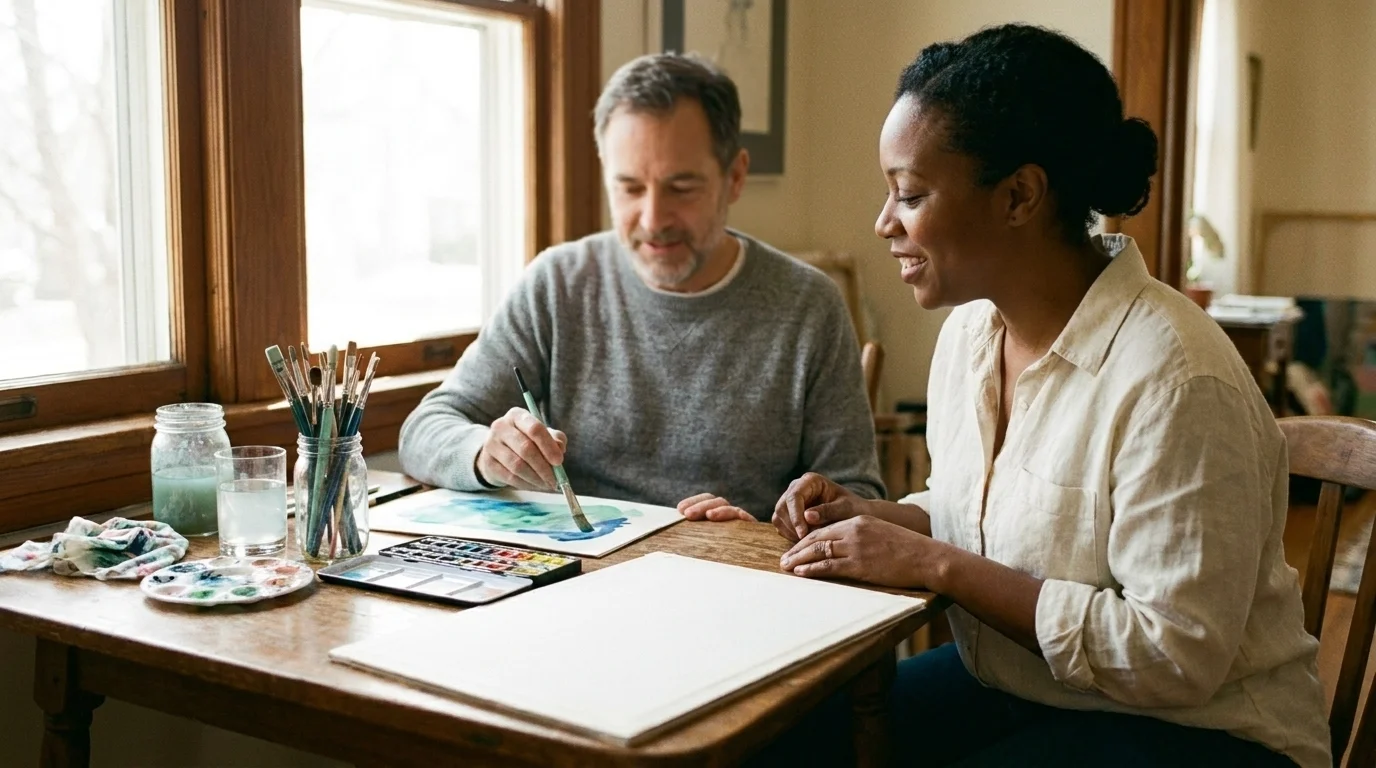
Here is the distinction I draw for clients: coloring a mandala on your couch is genuine self-care, and it is good for you. It is not art therapy. Art therapy is what happens when a trained clinician uses that same creative act, deliberately, as part of treatment. Knowing which one you need is the whole point of the rest of this piece.
Does art therapy actually work? What the research says
The honest answer is: the evidence is promising, real, and more modest than the enthusiastic version you usually read — and I'd rather tell you that than oversell it.
The most-cited single finding is encouraging. In a 2016 Drexel University study, cortisol — the body's main stress hormone — dropped in 75% of participants after just 45 minutes of art-making, regardless of artistic skill. As the lead researcher, Girija Kaimal, put it, "no matter a person's skill level, taking time to make art is likely to reduce their stress hormone levels." That last part is the part I most want you to keep: skill is not the variable.
The physiological story got sharper in 2025. A first-of-its-kind biomarker study at the Courtauld Gallery found that viewing original artwork (not making it) was associated with a 22% drop in cortisol, a 30% drop in the inflammatory marker IL-6, and a 28% drop in TNF-α — measurable changes in the body, not just self-reported mood. It is a small study (50 adults), and it is about looking at art rather than therapy, but it moves "art is good for you" from a feeling toward something you can measure.
Now the part the cheerful explainers skip. The largest pooled review of art therapy itself — Saragih and colleagues' 2024 meta-analysis of 69 randomized trials and roughly 4,200 participants — found a small-to-moderate benefit (a standardized effect of 0.38), and the authors were candid that most of the included studies were low quality. A 2025 meta-analysis focused on anxiety, pooling 35 studies and over 3,000 adults, similarly found a real reduction in anxiety symptoms but rated the evidence as very low quality.
So: there is a genuine signal here, across stress, anxiety, and depression. There is also a genuine need for better studies. Both things are true, and a wellness piece that tells you only the first is not being straight with you.
How it works in your brain
When the mechanism is this consistent, it is worth a word on why. The leading neuroscience account, reviewed in 2024, points to the emotion-regulation circuitry — the interplay between the prefrontal cortex and the amygdala — and to shifts in the brain's default-mode network, the system that hums along during rumination and self-referential worry.
In plainer terms: the focused, absorbing, non-verbal act of making something gives the parts of the brain that loop on distress a different job to do. This is the same family of mechanisms behind mindfulness, which is why art-making so reliably produces that "lost track of time" quiet. The creative process is, in effect, a form of affect regulation you do with your hands.
Art therapy activities you can try at home
You do not need a therapist — or any talent — to get the self-care benefits of creative expression. A few practices practitioners commonly use, none requiring more than basic supplies:
- Mandala drawing. Filling a circular pattern is meditative and structured, which makes it forgiving if a blank page feels intimidating.
- An emotion color wheel. Assign colors to what you're feeling and fill a page accordingly — a simple way to externalize a mood that's hard to name in words.
- Working with clay. The tactile, physical resistance of clay is grounding, and it engages the body in a way drawing doesn't.
- Collage. Cutting and arranging images sidesteps the "I can't draw" block entirely and is good for sorting through a jumble of feelings.
- A vision or feelings board. Less about the future-manifestation version and more about giving shape to what matters to you right now.
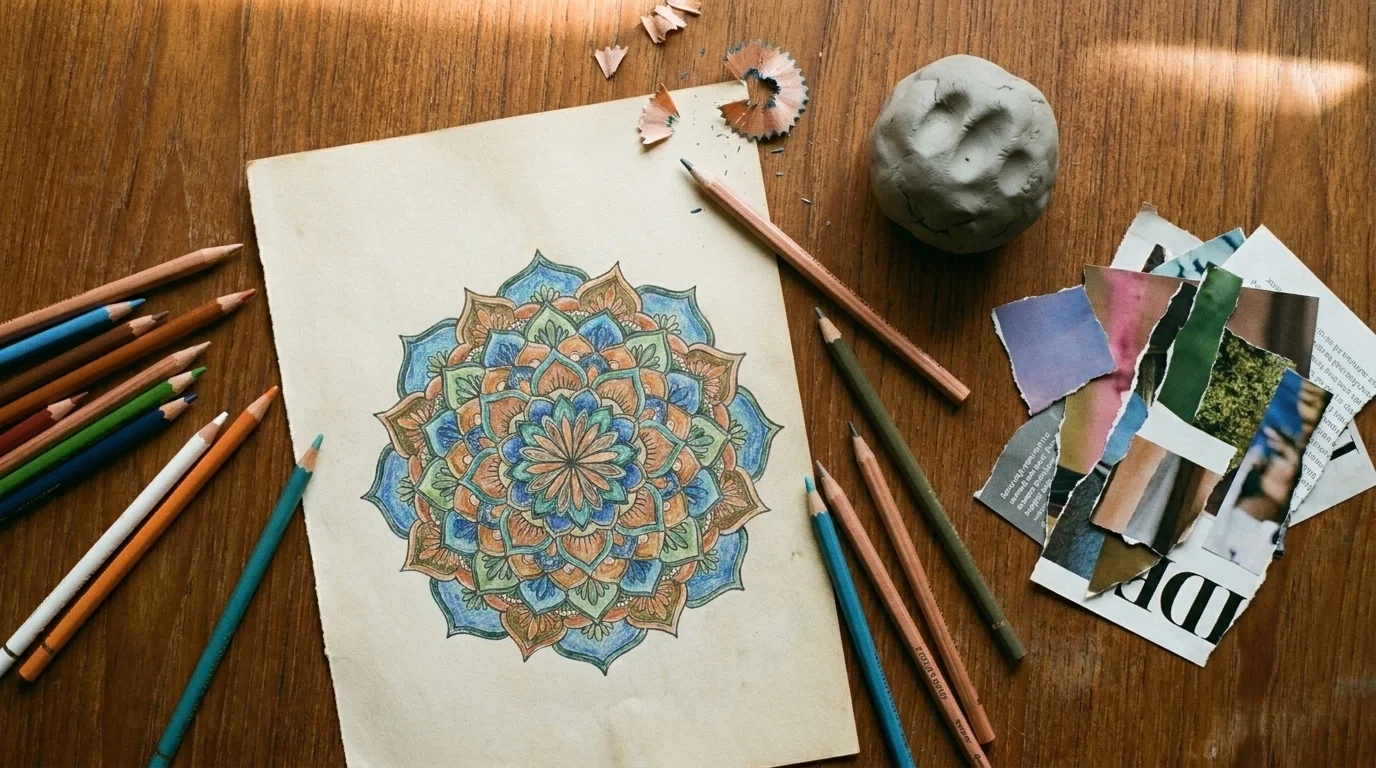
The instruction I give is the same one I give for meditation: do five real minutes rather than commit to an hour you'll quietly abandon. And let go of the outcome. The cortisol study found the benefit came from the process, not the product — a finished piece you dislike is still a session that helped you.
When self-care isn't enough
This is the line I most want you to take seriously, because it is exactly where well-meaning wellness writing tends to go quiet.
Making art at home is a genuine good. It can take the edge off a hard week, ground you, and give difficult feelings somewhere to go. But if what you are managing is a diagnosed condition — clinical depression, an anxiety disorder, the aftermath of trauma — a coloring book is a support, not a treatment. That is not a knock on creativity; it is the same reason a daily walk is good for your heart and also not a substitute for cardiac care when you need it.
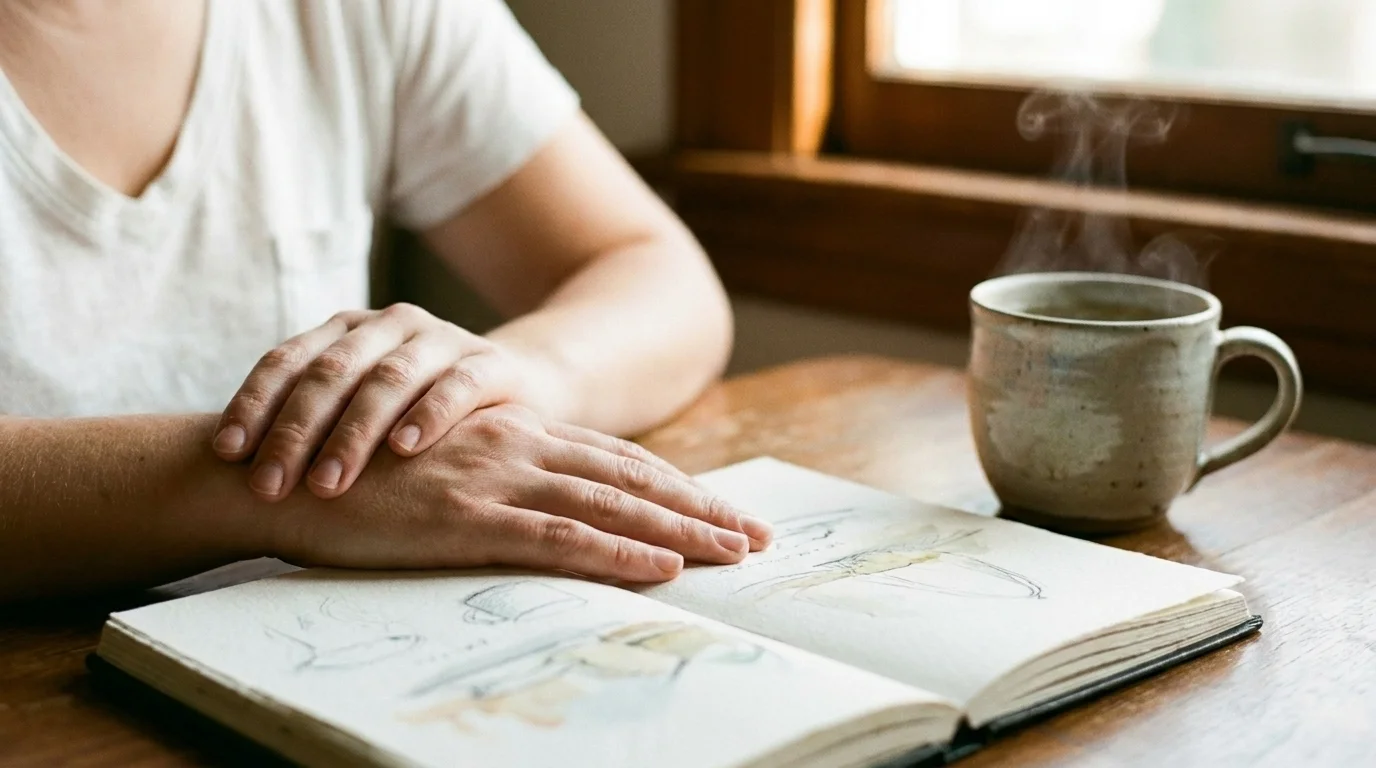
If creative self-care isn't touching what you're carrying, that is not a failure of effort or imagination. It is information — a sign to bring in a professional, whether that's a credentialed art therapist, a regular therapist, or your doctor. Therapy is not the opposite of self-care; it is one of its forms, and it is not a luxury. And if you are in crisis, please don't reach for a paintbrush first — contact the 988 Suicide and Crisis Lifeline (call or text 988 in the US) or your local equivalent.
Art is one of the oldest things humans do to make the inside of a life bearable. The research is finally catching up to what the impulse always knew — with the honest footnote that we still have better studies to run. Make the art. Just know what it can carry, and what it can't.
Frequently Asked Questions
Art therapy is a mental health profession in which a credentialed therapist (ATR-BC) uses art-making and the creative process within a therapeutic relationship to support a person's health. It is distinct from casual art-making done as self-care, which is beneficial but not a clinical treatment.
Research is promising but mixed. A 2024 meta-analysis of 69 randomized trials found small-to-moderate benefits, and lab studies show measurable cortisol and inflammatory-marker reductions — but the authors note most studies are low quality, so more rigorous trials are needed.
No. A 2016 Drexel University study found cortisol dropped in 75% of participants regardless of artistic skill. The benefit comes from the creative process, not the finished product.
Art-making appears to lower physiological stress: a Drexel study found cortisol fell in most participants after 45 minutes of creating art. It offers a non-verbal outlet that helps the brain's worry circuitry shift focus and unwind.
Visual art lets people communicate complex feelings without words. With a trained art therapist, that nonverbal expression can be used deliberately to explore and process difficult emotions — externalizing what's hard to say aloud onto paper or canvas.
Because it engages the body, emotions, and cognition together — the tactile act of making, the emotional content it surfaces, and the regulation it supports — rather than treating the mind in isolation. It complements, but does not replace, other mental-health care.
Creating art provides an outlet for self-care and a sense of achievement and self-efficacy. Practiced regularly, that can build confidence and emotional regulation, though it works best alongside professional support when someone is managing a diagnosed condition.
It can help. A 2025 meta-analysis of 35 studies found a real reduction in anxiety symptoms, though the evidence quality was rated low. For diagnosed anxiety or depression, treat creative activity as a support alongside professional treatment, not a substitute.
The focused, absorbing nature of art-making naturally induces a present-moment, non-judgmental state — the same family of mechanisms behind mindfulness. That quiet focus is part of why the creative process supports emotional regulation.
A wide range of people — including those experiencing stress, anxiety, depression, or emotional difficulty, and especially those who find it hard to express feelings in words. It can be adapted across all ages, from children to seniors.
Common modalities include drawing, painting, sculpting and clay work, collage, and coloring or mandala work. A credentialed art therapist selects the activity to fit the person's therapeutic goals; at home, the same activities can be used as self-care.
Yes. It can be adapted for children, adolescents, adults, and seniors, with materials and approaches tailored to developmental stage and personal experience, making it an inclusive option.