The Transformative Power of Community-Led Wellness Initiatives


Most writing about community wellness stays at the altitude of the word "empowerment" and never lands. It tells you that communities helping communities is a good thing — which is true, and also not useful. What I want to do here is the opposite: name real grassroots wellness programs, tell you what each one actually does, and show you the numbers, because the numbers are better than the slogans would lead you to expect. There is even a formal name for the clinical version of this idea now. In January 2026 the WHO Western Pacific office and The Lancet launched a series on social prescribing — clinicians referring patients to non-clinical, community-based activities — a practice now documented in 31 countries. The bottom-up has become the recommendation.
What grassroots wellness actually is
Grassroots wellness is health improvement led from the bottom up — designed and run by community members themselves rather than handed down by an institution. It overlaps with what the WHO calls social prescribing, which it describes as connecting people "to non-clinical services and supports that address social needs, such as those related to loneliness, housing instability and mental health."
The mechanism underneath is not mysterious, and as a clinician I find it the least surprising part. People follow through on health changes far more reliably when there is a relationship and a small accountability attached — someone who notices whether you showed up, someone whose own experience resembles yours. That relational layer — why belonging itself supports health — is a whole subject of its own, and it is the one I would point you to a companion piece on supportive communities for. Here, I want to stay on the structures: the programs people build to put that mechanism to work.
Six community-led models with real numbers
This is the part the original version of this article promised and never delivered — it had a "case studies" heading with no actual cases. Here are six, each one real, named, and measured.
Community health workers (CHWs). These are trusted local people — often sharing the language, neighborhood, and lived experience of those they serve — trained to bridge residents and the health system. They are not new; CHWs have been part of US healthcare for over 70 years, and roughly 60,000 work in the country today. What has changed is the evidence. The ASTHO evidence summary reports CHW program returns of $3 to over $15 per dollar invested, with documented drops in acute-care use, and a 2025 Milbank Quarterly study showed one evidence-based program scaling across five sites with significant reductions in acute care. As the Penn LDI researchers put it, CHWs' "lived experiences and trust-building qualities make them uniquely equipped to improve access to care and increase uptake of preventive services."
The Blue Zones Project. A community-wide initiative that reshapes the shared environment — food policy, walkability, social networks — rather than nagging individuals. In Fort Worth, Texas, the project tracked a 6.1-percentage-point drop in adult smoking and an estimated $81 million a year in health-care savings, and the city climbed from 185th to 58th of roughly 190 US communities on a national well-being index. The lever here is the surroundings, not willpower.
The YMCA Diabetes Prevention Program. A CDC-recognized lifestyle-change program delivered through local YMCAs. In a New York State cohort, participants lost an average of 4.2% of body weight; the underlying Diabetes Prevention Program research found that reaching 5–7% weight loss plus regular activity cut type-2 diabetes risk by 58–71%. This is one of the clearest examples of a clinical-grade intervention delivered at the community level.
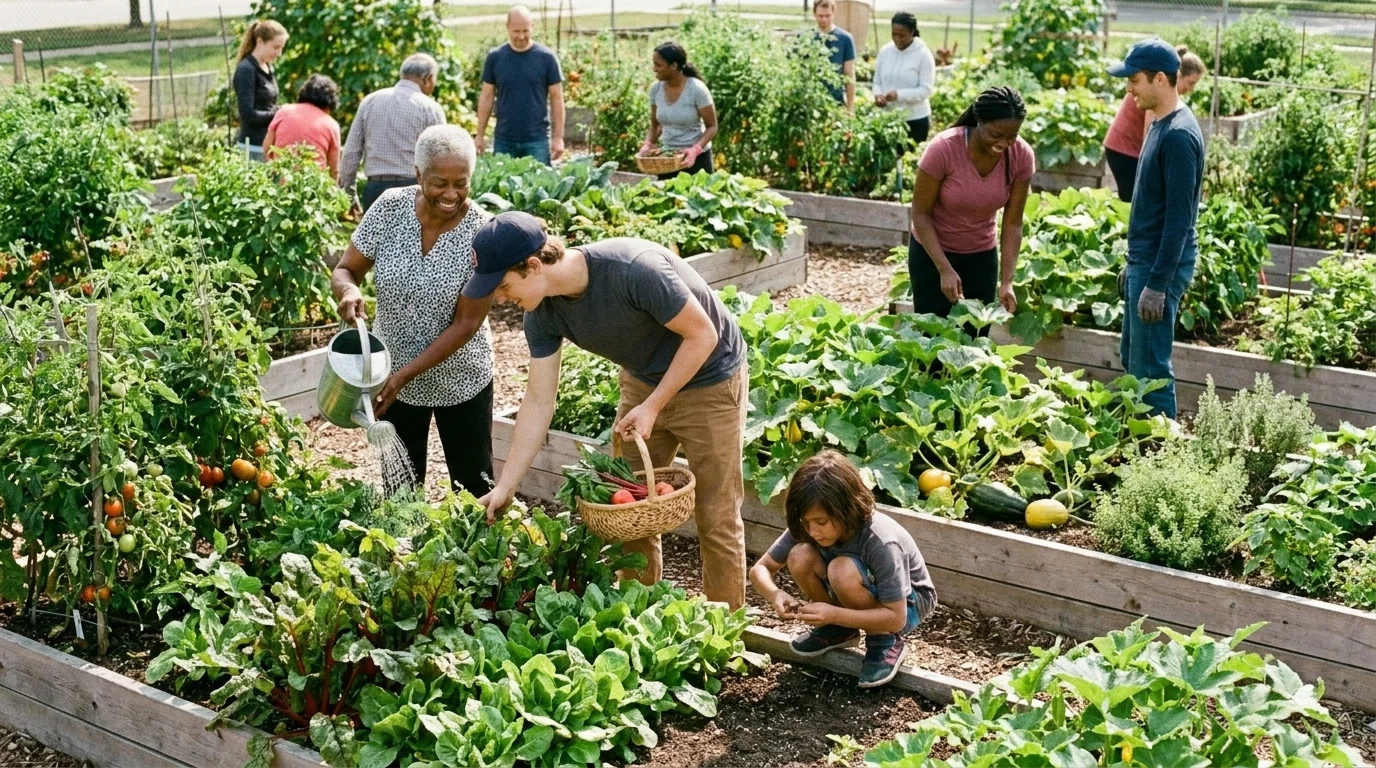
The Friendship Bench. This is the one closest to my own field, and the one I find most moving. In Zimbabwe, grandmothers were trained to deliver structured problem-solving talk therapy from park benches. In a cluster randomized trial published in JAMA, 14% of the Friendship Bench group still had depression symptoms at six months, against 50% in the control group. It has since scaled to thousands of trained lay workers and served hundreds of thousands of people, with pilots in the US, UK, and beyond. Lay people, properly trained and supervised, moved a clinical outcome that far. That should change how we think about who can help.
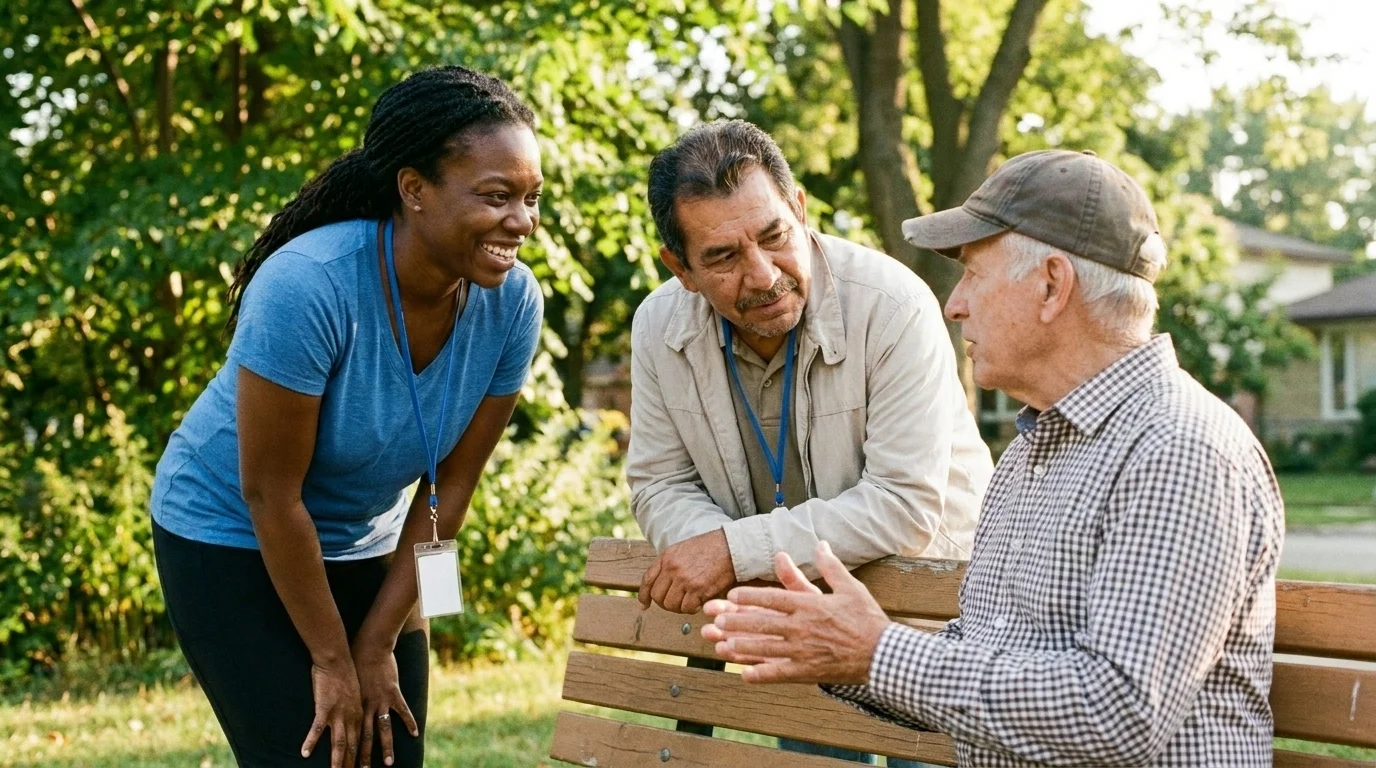
Community gardens. Shared growing spaces that bundle several health levers at once — fresh produce, physical activity, time outdoors, and regular contact with neighbors. They are among the most common forms social prescribers refer people to, precisely because they do more than one thing at a time.
Faith-based health ministries. Programs run through congregations — blood-pressure screenings, walking groups, health education — that reach people inside an existing structure of trust. For communities that are wary of formal healthcare, the trusted setting is often what makes the difference between a program that is offered and one that is used.
A necessary caveat, because honesty serves you better than enthusiasm: the evidence is strong for the established models above and still maturing for the broader social-prescribing umbrella. UK cost-benefit work reports roughly £4.90 to £5.36 returned per £1, but effects on loneliness at eight-week follow-up have been small-to-moderate. Promising is not the same as proven. I would rather you know which is which.
Evidence at a glance
| Model | Who runs it | A cited outcome |
|---|---|---|
| Community health workers | Trained local residents, via health systems & nonprofits | $3–$15+ returned per $1; reduced acute-care use (ASTHO) |
| Blue Zones Project | Whole-community coalitions | Fort Worth: ~$81M/yr saved; smoking down 6.1 pts (Blue Zones) |
| YMCA Diabetes Prevention Program | Local YMCAs (CDC-recognized) | 58–71% lower type-2 diabetes risk at 5–7% weight loss (CDC) |
| Friendship Bench | Trained lay "grandmother" counselors | Depression symptoms 50% → 14% at 6 months, JAMA RCT (LSHTM) |
| Community gardens | Neighborhood volunteers | Bundles produce, activity, and social contact (common social-prescribing referral) |
| Faith-based health ministries | Congregations | Reaches trust-wary populations inside an existing structure |
How to start or join one
You do not need to found anything to benefit from this. Joining is the more common, and usually the better, first move. Here is the realistic path, in the order I would actually take it.
- Look before you build. Most communities already have something. Start with your local YMCA, your county or state health department's community-wellness page, a faith organization, or a librarian — librarians know what exists. The program you want may already meet on Thursdays.
- If you are starting one, pick a real need first. Not "wellness" in general — one specific, observed problem (no walking group for seniors, no fresh produce within a mile). The named models above all started narrow.
- Anchor to existing trust. Partner with an institution people already rely on — a clinic, a school, a congregation. Trust is the scarce resource; borrow it rather than building it from zero.
- Choose one thing you can measure. Attendance, pounds of produce, blood-pressure readings, sign-ups. A program that tracks one number honestly will outlast one that promises everything.
- Recruit for follow-through, not charisma. The Friendship Bench worked because trained, supervised lay people showed up consistently. Consistency is the active ingredient.
Where this lands
Grassroots wellness earns the word "transformative" only when it stops being a slogan and becomes a specific program with a name, a need, and a number. The models that work — community health workers, Blue Zones, the YMCA's diabetes program, the Friendship Bench — are not transformative because they are inspiring. They are transformative because someone measured them and the numbers held up. If you are looking for where to put your own time, that is the test worth applying: not how good the mission statement sounds, but whether anyone is counting, and whether the count is real.
Frequently Asked Questions
Grassroots wellness is health improvement led from the bottom up — designed and run by community members themselves rather than top-down institutions — through programs like community health workers, community gardens, and faith-based health ministries. It overlaps with what the WHO calls social prescribing.
Named, evidence-backed examples include community health worker programs, the Blue Zones Project, the CDC-recognized YMCA Diabetes Prevention Program, Zimbabwe's Friendship Bench, community gardens, and faith-based health ministries.
Look first — most communities already have programs through the YMCA, health department, or faith organizations. To start one, pick a single observed need, anchor it to an institution people already trust, recruit volunteers for consistency, and choose one number to measure.
The established ones do, with hard numbers: community health worker programs return $3–$15 per dollar invested, the YMCA Diabetes Prevention Program cuts type-2 diabetes risk 58–71%, and Zimbabwe's Friendship Bench cut depression symptoms from 50% to 14% in a JAMA randomized trial. Broader social prescribing shows promise but its evidence is still maturing.