
Holistic Healing Horizons: Cultural Perspectives on Resilient Wellness Practices


If you have ever felt that something in your family was older than you — a way of bracing for bad news, a grief that arrived before you had a reason for it, a tightness that seems to predate your own life — you are describing the thing that ancestral healing tries to address. It is not a mystical idea. It is the recognition that the things that happen to a family can be carried forward, in the body and in the culture, and that cultures have spent generations building ways to carry them differently. Roughly 170 of the world's countries report that large portions of their populations use some form of traditional healing, so this is not a fringe practice. It is most of the planet, doing in community what many of us are trying to do alone.
What is ancestral healing?
Ancestral healing is the work of tending to inherited patterns of harm — trauma, displacement, loss — using practices rooted in cultural and familial tradition rather than starting from scratch with each generation. The World Health Organization defines traditional medicine broadly: codified or non-codified systems of knowledge and practice that pre-date biomedicine and have evolved from experience-based origins. Ancestral healing is the slice of that world concerned with what gets passed down.
I want to be careful with a word here, because the wellness internet is not. "Inherited" does not mean "magical," and it does not mean "doomed." It means something more interesting and more workable, which is where the science comes in.
How inherited trauma actually gets passed down
Here is what is actually happening, in plain terms. Trauma can shape not just memory but the body's stress-response machinery, and there is evidence that some of those changes leave biological marks the next generation can inherit. The most-cited research comes from Rachel Yehuda's group, which found that offspring of Holocaust survivors with parental PTSD showed altered methylation of the FKBP5 gene — part of the system that regulates the stress hormone cortisol. In plain language: a parent's overwhelming experience appears able to tune a child's threat-response sensitivity before that child has lived anything overwhelming themselves.
This is the claim that nearly every article on the subject makes and almost none source. It matters that it is sourced, because it changes the register. You are not "carrying your ancestors' pain" in a poetic sense you can never verify. You may be carrying a more sensitive stress system, which is a thing you can actually work with — through the same evidence-based approaches that help with any heightened threat response, and, where it fits, through cultural practice that does some of that regulation in community.
The traditions people actually mean
When an article says "ancient healing wisdom" and then names nothing, it has told you nothing. Here are the traditions most people are gesturing at, with one concrete practice each.
Traditional Chinese Medicine and Ayurveda
Traditional Chinese Medicine organizes health around balance and includes acupuncture, herbal formulas, and movement practices like tai chi and qigong — of which tai chi has strong randomized-trial evidence for balance and falls prevention in older adults. Ayurveda, the roughly 3,000-year-old system from the Indian subcontinent, classifies people by constitutional type and treats with diet, herbs, and daily routine. The practical scaffolding of both — consistent rhythm, movement, attention to sleep and food — is the part with the best evidence. Hold the metaphysics as cultural context, not clinical fact.
Native American and African traditions
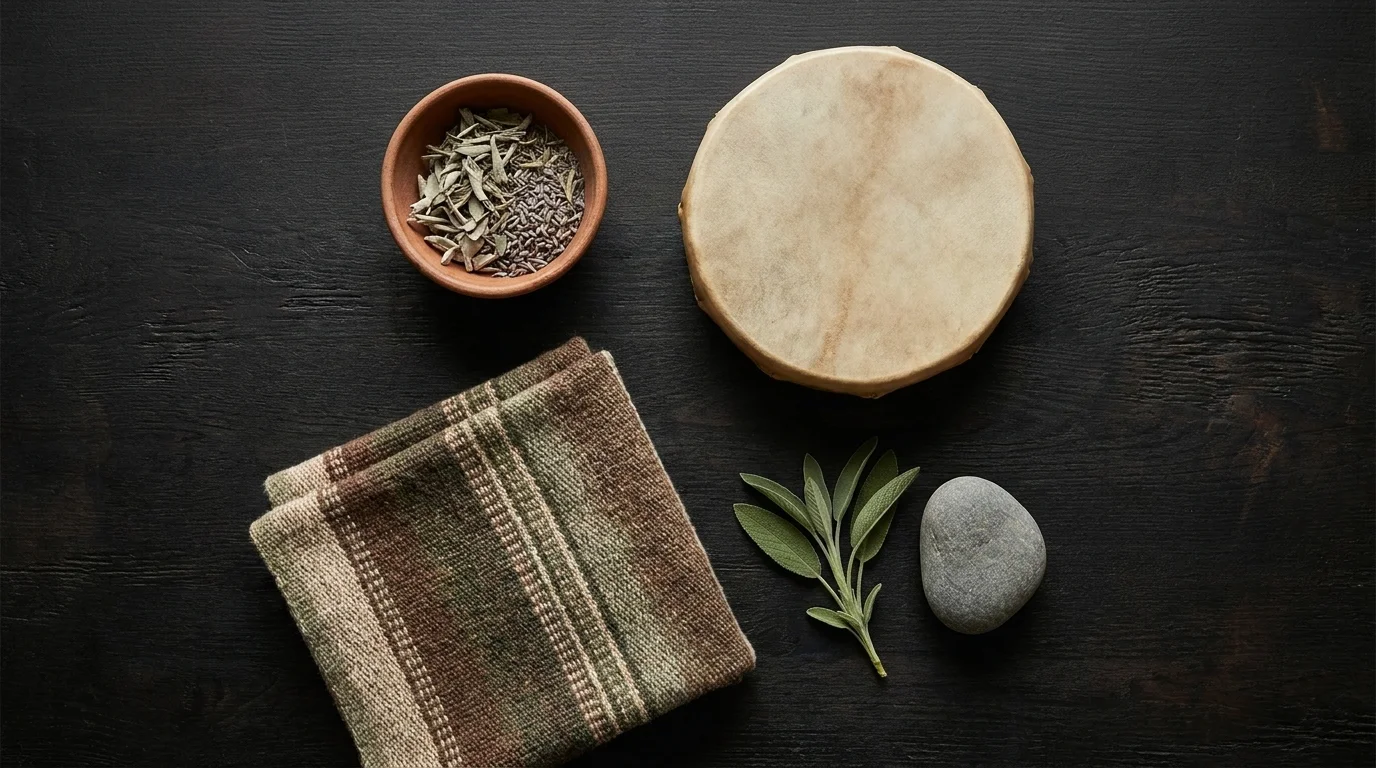
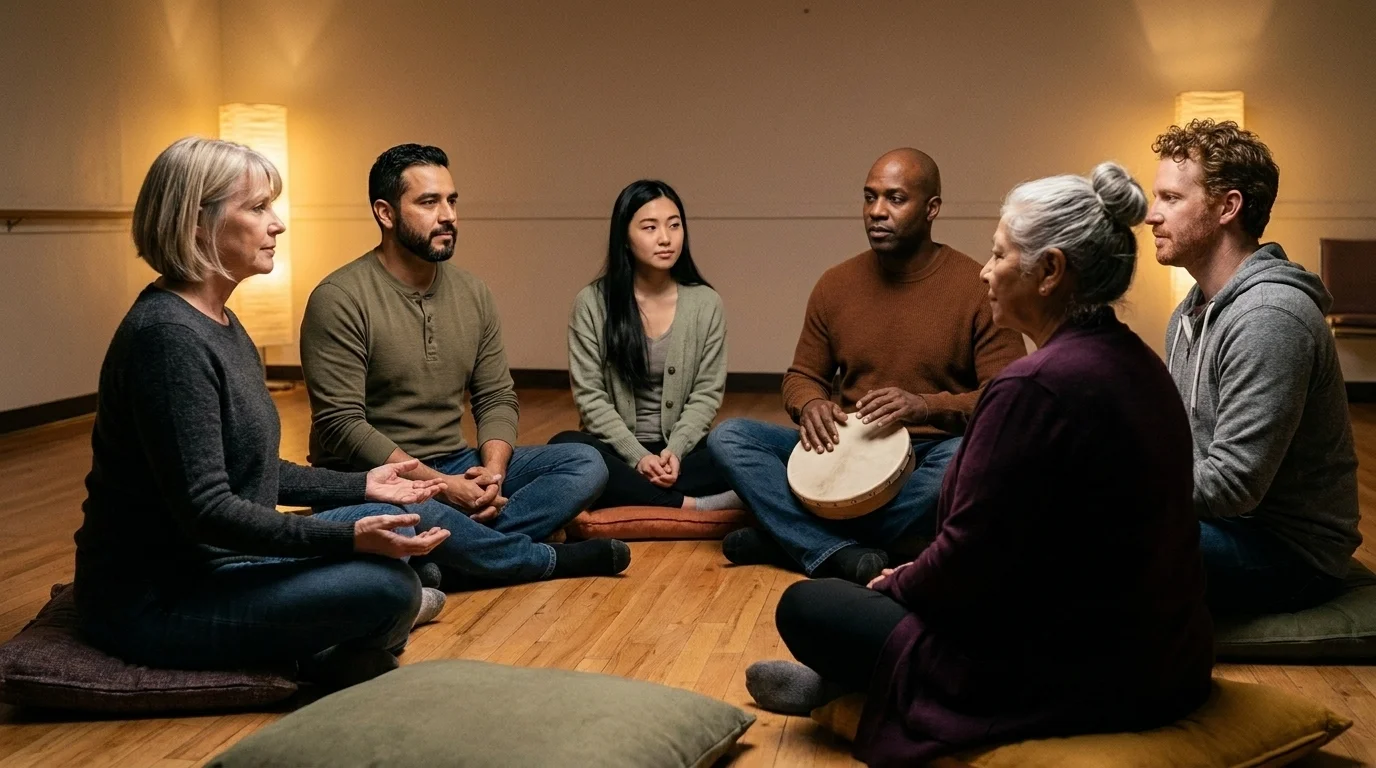
Across many Native American nations, communal ceremonies — the sweat lodge, drumming, talking circles — are healing practices, not metaphors for them; they regulate the nervous system through heat, rhythm, and witnessed speech. Across the African diaspora, ritual, drumming, and ancestor-honoring ceremonies serve a similar function: locating an individual's distress inside a community that holds it. The mechanism is the same one I'll come back to below — these are technologies of co-regulation.
Curanderismo and Hawaiian practice
Curanderismo, the folk-healing tradition of Mexico and the Latin American diaspora, treats body, spirit, and social relationship as one system, with the curandera often working through story, ritual, and relationship as much as through herbs. In Hawaiʻi, a 2025 study documented practices like oli (chant), mālama ʻāina (caring for the land), and kūkākūkā (deep, deliberate discussion) as mechanisms of intergenerational-trauma recovery. None of these is interchangeable with the others, and that matters more than the wellness market admits.
Why these practices work (the mechanism)
This is the section most articles skip, and it is the one that turns "these practices are valuable" into something you can actually believe. Two mechanisms do most of the work.
The first is the nervous system. Rhythmic, repetitive activity — drumming, chanting, slow synchronized movement, controlled heat and breath — tends to shift the body toward parasympathetic, "rest and digest" activity and away from the threat state. This is the same vagal-tone story behind why slow breathing calms you; tradition got there by feel, centuries before anyone measured it.
The second is other people. A great deal of trauma's damage is isolation — the conviction that what happened to you is yours alone and unspeakable. Communal practice breaks that directly. A peer-reviewed account of a Muskowekwan First Nation healing journey describes resilience built through shared cultural participation, not solitary effort. Co-regulation — calming alongside other regulated bodies — is a real physiological phenomenon, and community ritual is one of the oldest delivery systems for it.
It sounds too simple to work. The regulation is real anyway.
How to begin ancestral healing respectfully
Because this topic is culturally loaded, "how to start" has to include "how not to take." A few honest guidelines:
- Start with your own lineage. The most defensible entry point is the heritage you actually belong to. If that thread feels cut, that severance is itself part of what you are healing — and naming it is more useful than borrowing someone else's ritual to fill the gap.
- Learn the context before the technique. A practice extracted from its meaning is just a gesture. If you are drawn to a tradition that is not yours, learn its history and engage living, credentialed tradition-holders or community settings rather than a weekend-certified version of it.
- Distinguish uncomfortable-but-workable from clinical. Sitting with grief, doing a remembrance practice, building a daily rhythm — these are self-care questions. Flashbacks, dissociation, panic, or symptoms that interfere with daily life are clinical questions, and they call for a licensed clinician, not only a ceremony.
Where this fits with modern care
The honest framing, and the current institutional one, is complement, not replacement. At its Second Global Summit on Traditional Medicine in December 2025, the WHO advanced a Global Traditional Medicine Strategy built on stronger evidence, better regulation, and integration with health systems — culturally rooted healing used alongside biomedical care, reported by 170-plus member states, not instead of it.
So let ancestral healing do what it does well — restore rhythm, belonging, and meaning, and metabolize grief in community. Let medicine and therapy do what they do well. If what surfaces when you go looking into your family's history is more than you can hold alone, that is not a failure of the practice. It is exactly the moment to bring in a clinician. Therapy is not the opposite of cultural healing, and it is not a luxury — it is one of its forms. And if you are in crisis, please reach the 988 Suicide and Crisis Lifeline in the U.S., or your local equivalent, before anything else.
Frequently Asked Questions
Various cultures utilize unique therapeutic techniques for trauma recovery, such as Native American sweat lodge ceremonies and African tribal rituals. These practices are rooted in ancestral wisdom and provide valuable insights into resilience, helping individuals heal from trauma while fostering cross-cultural appreciation.
Traditional healing approaches, like traditional Chinese medicine and Ayurvedic practices, focus on balance and holistic well-being. By integrating these methodologies into modern wellness routines, individuals can enhance their physical, emotional, and mental resilience, effectively adapting to life's challenges.
Community support plays a crucial role in nurturing resilience across cultures. Through collective rituals, communal gatherings, and mutual aid networks, shared cultural values strengthen individual and collective resilience, fostering connections and a sense of belonging during challenging times.
Cultural traditions often contain stories that illustrate spiritual strength during hardship. These narratives, passed down through generations, inspire individuals by showcasing the tenacity of their predecessors. Embracing such stories can help individuals navigate adversities with grace and fortitude.
Embracing ancestral wisdom from diverse cultures allows individuals to understand the connection between trauma recovery and cultural heritage. This understanding fosters personal healing and promotes awareness of different cultural practices that contribute to overall well-being and resilience.
Holistic healing encompasses multi-cultural insights, traditional healing methods, community support dynamics, and spiritual fortitude. By exploring these diverse perspectives on wellness practices, individuals can embark on a transformative journey towards personal well-being that transcends cultural boundaries.
Inherited trauma has measurable biological markers. Research on the offspring of Holocaust survivors found altered methylation of the FKBP5 gene, part of the cortisol stress-response system (Yehuda et al., Biological Psychiatry), linking ancestral stress to descendants' stress sensitivity. The practices that address it are real techniques of nervous-system regulation, not magic.
Start with your own heritage, learn a tradition's cultural context before adopting any practice, and engage living tradition-holders or community settings rather than extracting rituals out of context. Avoiding appropriation is part of the healing — and serious trauma symptoms call for a licensed clinician, not only a ceremony.
Yes. The WHO's 2025-2034 Traditional Medicine Strategy recognizes culturally rooted healing as a complement to biomedical care, used in combination by populations across 170-plus member states. The framing is complement, not replacement — and anyone in crisis should contact the 988 Suicide and Crisis Lifeline or their local equivalent.