
The Power of Emotional Intelligence in Health and Wellness Leadership


Most writing about emotional intelligence in leadership frames it as a way to get more out of a team — softer management for harder results. That framing is not wrong, but in the health and wellness world it misses the more interesting half. As a clinician who spends my working hours with burnout, what I notice about emotionally intelligent leaders is not only that their teams do better. It is that the leaders themselves last longer.
The numbers are worth stating carefully, because this field is full of stats that get garbled in repetition. Daniel Goleman's competency research is often quoted as "emotional intelligence accounts for 67% of leadership effectiveness." That is not what it says. The actual finding is that 67 percent of the competencies that differentiate star performers from average ones are emotional competencies — a more specific and more defensible claim. And the upside is real: a Catalyst survey of about 900 US employees found that those with highly empathic senior leaders reported 61% higher creativity and 76% higher engagement than those with less empathic ones.
What is emotional intelligence in leadership?
Emotional intelligence in leadership is the capacity to recognize, understand, and regulate emotions — your own and others' — and to use that awareness to guide how you lead. It is usually organized into four domains.
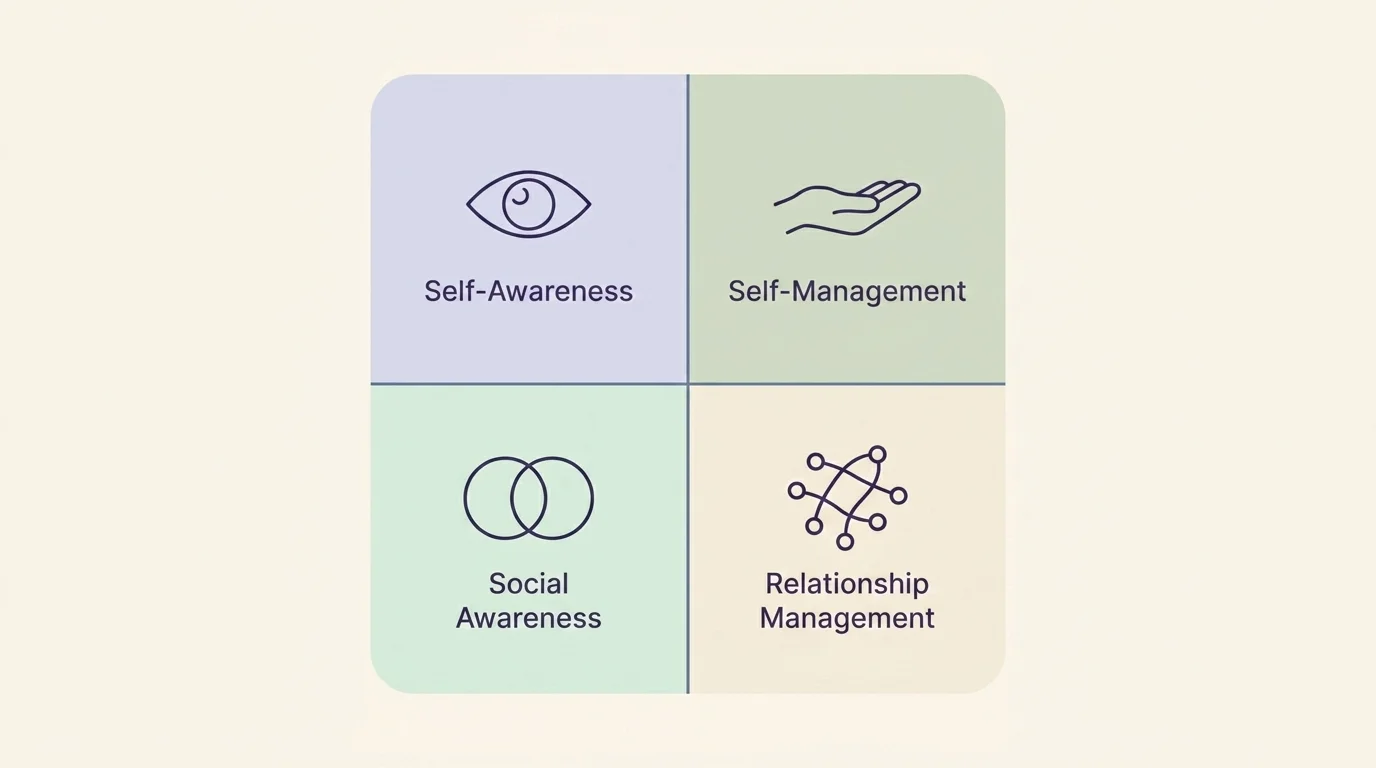
- Self-awareness — noticing your own emotional state accurately and in real time, including the moments it's about to drive a decision. This is self-awareness in leadership, and it is the pillar everything else rests on.
- Self-management — regulating that state rather than acting straight from it. Closely tied to what gets called mindful leadership: the small pause between feeling and responding.
- Social awareness — reading the room, and reading the person in front of you. This is where empathy in leadership lives.
- Relationship management — using all of the above to build trust, handle conflict, and move a group toward something.
If that sounds like the same skill set a good therapist uses, it is. The four domains are not a corporate invention; they describe how any human being navigates other human beings well.
Why it matters more in wellness leadership
Emotional intelligence shows up across leadership research, but it concentrates in healthcare. A 2023 hybrid review of 104 peer-reviewed articles found the hospital and healthcare sector was the second most-studied context for emotional intelligence in leadership, accounting for nearly 17% of the studies — behind only education. Its authors concluded that "emotionally intelligent leaders improve both behaviors and business results and have an impact on work team performance."
The reason is not mysterious. Wellness and clinical work is emotional labor by definition. A leader who can't regulate their own state under pressure transmits that dysregulation straight into a team that is already absorbing other people's distress all day. A leader who can regulate it becomes, in a real physiological sense, a source of co-regulation — a steadier nervous system the rest of the team can borrow from on a hard shift.
Emotional intelligence as burnout protection
Here is the part the corporate guides structurally cannot reach, and the reason this matters for a wellness audience specifically: emotional intelligence does not only make a leader better at managing others. It protects the leader's own well-being.
The freshest synthesis available makes this explicit. A 2026 comprehensive review in Human Resource Development Review, examining 101 empirical studies, organized the outcomes of leader emotional intelligence into three categories — leadership behavior, leader well-being, and performance. Pulling "leader well-being" out as its own outcome, rather than folding it into team results, is a meaningful shift. It says, at the level of the evidence base, that this skill is partly self-protective.
The clinical literature backs this where it is most needed. Across 2025 studies of nurses and nurse managers, higher emotional intelligence is linked to significantly lower burnout and higher work engagement, with burnout acting as the mechanism that connects the two. Resilient leadership, in other words, is not grit or stoicism. It is emotional regulation practiced often enough that turbulence doesn't deplete you the way it used to.

I want to be careful with one distinction, because I make it with clients all the time: the ordinary exhaustion of a demanding role is uncomfortable but workable, and emotional intelligence genuinely helps with it. Clinical burnout — the kind with depersonalization, dread, and a hollowing-out that a good weekend doesn't touch — is not a skills gap, and it is not solved by getting better at self-awareness. That is a signal to get support, not to lead harder.
How to develop your emotional intelligence as a leader
The good news, and it is well-established, is that emotional intelligence is trainable — it is not a fixed trait you either have or don't. Studies report that targeted training measurably improves leadership capability, though I'd treat the precise percentages you'll see floating around as directional rather than gospel. What reliably moves the needle is unglamorous and concrete:
- Name it to tame it. The single most evidence-backed regulation tool is affect labeling — putting an accurate word on what you're feeling before you act on it. Neuroimaging work has shown this quiets the brain's threat response within seconds. In a meeting, that can be as small as silently noting "I'm defensive right now" before you reply.
- Solicit real feedback. Self-awareness has a blind spot by definition; 360-degree feedback or even one trusted colleague who will tell you the truth closes part of the gap.
- Practice the pause. This is where mindfulness earns its place — not as emptying your mind, but as building the half-second between a trigger and your response. Five real minutes a day beats twenty you'll abandon by Thursday.
- Listen to understand, not to reply. Most people in a position of authority listen for the moment they can start talking. Reversing that is the most concrete version of empathy there is.
None of these requires a retreat or a certification. They require repetition, which is the part people quietly skip.
What this looks like in practice
A concrete example, since the abstraction can blur. A clinic lead notices a normally reliable nurse has gone short-tempered and quiet over two weeks. The low-EI response is to read it as an attitude problem and address the behavior. The high-EI response starts a step earlier: the leader notices their own irritation (self-awareness), sets it aside rather than leading with it (self-management), recognizes that a sudden personality shift usually means something is happening underneath (social awareness), and opens a private, genuinely curious conversation rather than a correction (relationship management).
Same situation, two completely different outcomes — one likely ends in a resignation, the other often surfaces a fixable problem. That gap, repeated across a hundred small moments, is what the research is actually measuring.
A closing thought, and I'll flag it as my own view rather than a finding: as more of the analytic and technical parts of leadership get handed to software, the part that stays stubbornly human — reading people, steadying a room, knowing when someone needs a conversation rather than a memo — is exactly where a leader's value concentrates. Emotional intelligence has been called a soft skill for so long that the name undersells it. In a wellness organization, it is closer to the core competency, and the reassuring thing is that it can be built.
Frequently Asked Questions
Emotional intelligence lets leaders recognize and regulate their own emotions while reading and responding to others'. In wellness and clinical settings it builds trust, supports better decisions, and — research increasingly shows — protects both the leader's and the team's well-being.
Self-awareness, self-management, social awareness, and relationship management — the four core domains a leader develops to perceive, regulate, and respond to emotions effectively.
Through accurate affect labeling (naming a feeling before acting on it), 360-degree feedback, mindfulness practice to build the pause between trigger and response, and listening to understand rather than to reply. Studies report targeted EI training measurably improves leadership capability.
Healthcare is the second most-studied context for leadership emotional intelligence. In 2025 nursing research, higher EI is linked to lower staff burnout, higher work engagement, and better outcomes — and a 2026 review names leader well-being as its own outcome of EI.
Resilient leadership is less about grit than about emotional regulation practiced often enough that pressure stops depleting you. Leaders who can steady themselves model that regulation for a team and reduce the burnout that drives turnover.