Physical Fitness Traditions from Around the World


There are more types of martial arts in active practice today than any single survey can do justice to. Roughly 200 million people practice some form of martial art globally, per WodGuru's 2024 industry analysis, making this one of the more widely held physical practices on earth. About 18 million of those are Americans, according to Storm Taekwondo's analysis of US Census participation data. The dietitian in me notices something that the fitness-marketing industry largely does not: the categories of "martial art," "movement discipline," and "fitness practice" do not map cleanly. A weekly Tai Chi class in a community center, a Capoeira roda in São Paulo, an MMA gym in Las Vegas, and a parkour group running rooftops in Lyon are all sometimes called "fitness," but they are answering different questions about what a body is for.
This piece is a careful survey of 14 globally significant martial arts and movement traditions — what they are, where they come from, what the published research says about them as physical-fitness modalities, and which one might fit which goal. I am writing as someone who has read the trials, knows what a small RCT can and cannot prove, and has watched too many "ancient warrior workout" pieces flatten these traditions into wellness aesthetic. The dates, the dosages, and the effect sizes are here. So is the honest answer that the best martial art for you is mostly the one you will actually attend.
A comparison table of 14 traditions
| Tradition | Region | Type | Contact | Beginner-friendly (1–5) | Equipment | Best for |
|---|---|---|---|---|---|---|
| Karate | Japan / Okinawa | Striking | Light–Full | 4 | Gi, optional sparring gear | Discipline, cardio, kids |
| Taekwondo | Korea | Striking (kicks) | Light–Full | 4 | Dobok, sparring gear | Flexibility, kicks, cardio |
| Muay Thai | Thailand | Striking | Full | 3 | Gloves, shin pads | Cardiovascular, conditioning |
| Judo | Japan | Grappling (throws) | Full | 3 | Gi | Strength, falls, throws |
| Brazilian Jiu-Jitsu | Brazil / Japan | Grappling (ground) | Full (light strikes off) | 3 | Gi or no-gi | Problem-solving, strength |
| Tai Chi | China | Internal / low-impact | None | 5 | None | Balance, older adults |
| Kung Fu (Wushu) | China | Striking + forms | Variable | 3 | Variable | Tradition, athleticism |
| Krav Maga | Israel | Self-defense hybrid | Light–Full | 3 | Minimal | Practical self-defense |
| Kalaripayattu | India (Kerala) | Striking + weapons | Variable | 2 | Traditional weapons | Cultural depth, mobility |
| Capoeira | Brazil | Movement + music | Light | 4 | None | Agility, community |
| Sumo | Japan | Grappling (pushing) | Full | 1 | Mawashi belt | Cultural sport |
| Mongolian Bökh | Mongolia | Grappling (jacket) | Full | 2 | Traditional jacket | Strength, heritage |
| Yoga (as movement) | India | Internal / posture | None | 5 | Mat | Mobility, breath, recovery |
| Parkour | France | Movement / locomotion | None | 3 | Minimal | Cognitive + cardio |
Two things to read from this table. First, the "best for" column is not a ranking — it is a notation of what each tradition has been most studied or shown to deliver, and the wrong tradition for the wrong goal is wasted training time. Second, the beginner-friendliness scores are observed median, not a verdict — most of these traditions have entry-level programs that scale the practice down for new students. A 2 on this scale is "expect more time learning the protocol before you feel like you're getting a workout."
What the research actually says about martial arts as fitness
Let me be specific about what the evidence supports, because the SERP for this topic is full of vague claims and very few effect sizes.
The cleanest recent trial is the 2025 Frontiers in Sports and Active Living study on Bajiquan, a Chinese striking art. The protocol was 30 adult participants training 8 weeks, 5–6 sessions per week, 2 hours per session. The outcomes after 8 weeks: +14% cardiovascular endurance, +24.4% core strength, -8.6% body fat, -10.1% visceral fat, with effect sizes in the d=1.10 to 1.27 range — meaning large, not modest, changes. That is real data and worth knowing, but it is also a small trial of one art at an intense training volume, and generalizing it to "all martial arts at any training volume" is the kind of move the marketing copy makes and the careful reader should not.
For older adults specifically, the 2022 PMC scoping review of hard martial arts for adults 60–83 — covering 240 participants across six studies — found consistent improvements: strength gains of 9.3 to 34 percent, balance gains of 20.5 percent, aerobic endurance gains of 13.4 percent, and flexibility gains up to 316.7 percent (in a Judo cohort). The review identified a minimum effective dose: 60 to 90 minutes per session, at least twice a week, for at least 11 weeks. That dosage information is the most actionable single finding in the recent older-adult martial arts literature.
For parkour specifically, a 2025 study in the European Journal of Sport Science reframed parkour training as an "open-skill cognitive training" practice — meaning that the constantly changing demands of obstacle navigation produce measurable gains in spatial awareness, attentional control, and cognitive flexibility on top of the more obvious cardiovascular and strength benefits. This is one of the cleaner examples of a movement discipline producing brain-side effects that the standard treadmill cannot.
What the evidence does not clearly show: that any single martial art is the "best" for fitness, or that traditional arts are categorically superior to modern hybrid training for general health, or that the cultural framing matters more than the training volume. The mode matters less than the consistency, the volume, and whether you actually keep showing up.
Related Article: Pacific Island Paradigm: Infusing Indigenous Wisdom into Holistic Healing Practices
Asian striking traditions
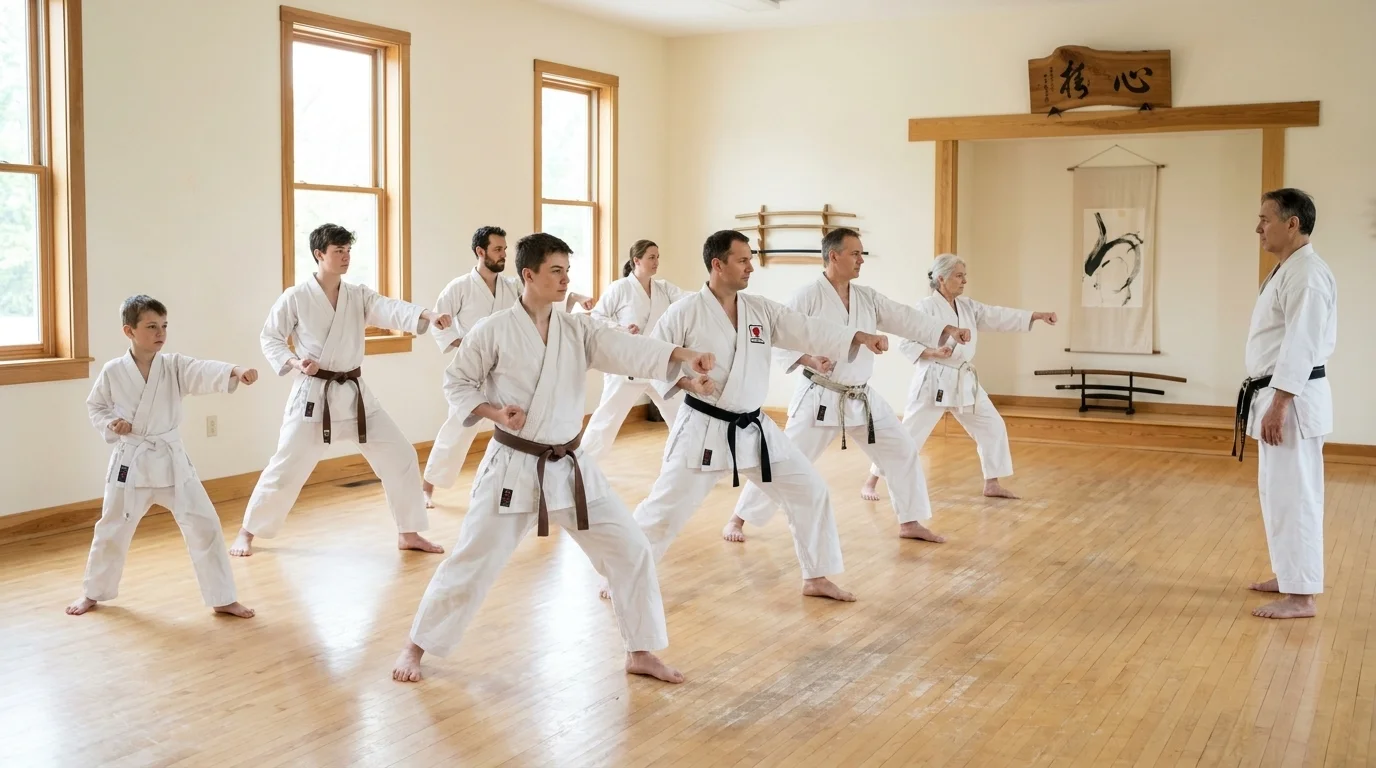
Karate is the most-practiced martial art in the United States, accounting for roughly 35% of US martial artists per Storm Taekwondo's analysis. Its origin is contested between Okinawan and mainland Japanese histories. As a fitness practice, karate trains stance, hip rotation, and timed striking, with cardiovascular load varying widely by school — full-contact Kyokushin schools produce conditioning gains comparable to any combat sport, while traditional point-sparring schools deliver more discipline-and-control training.
Taekwondo is the Korean kick-focused art, included in the Olympics since 2000. It combines large flexibility demands with explosive kick training. Most of the worldwide growth in martial arts participation over the last 30 years has been in Taekwondo, partly because of its child-friendly belt structure.
Muay Thai is the Thai national art and has over 10 million global practitioners per Storm Taekwondo. As a fitness modality, it is among the most cardiovascularly demanding of the striking arts — clinch work, kicks, knees, and elbows produce sustained high heart-rate intervals. The Thai training tradition runs roadwork, shadow boxing, pad work, and clinch sparring in long sessions. It is not for the joint-injury-cautious, but it is one of the most efficient cardiovascular conditioners on this list.
Asian grappling traditions
Judo is the Japanese throwing art and an Olympic sport since 1964. The 2022 older-adults scoping review specifically called out Judo for producing the largest flexibility gains (up to 316.7 percent) in older participants. The fall-training (ukemi) translates to real-world fall protection in aging populations, which is a clinically meaningful outcome that gets too little attention in mainstream coverage.
Brazilian Jiu-Jitsu (BJJ) is the Japanese grappling art that took root in Brazil under the Gracie family in the early 20th century and exploded globally after the early UFC events. Its ground-focused practice trains problem-solving under pressure as much as physical strength, and the live-rolling format means most practitioners get a meaningful workout from their first class.
Sumo wrestling is, formally, both Japan's national sport and a martial art recognized by the Nihon Sumo Kyokai. It has roughly 90,500 monthly US searches per the keyword data — a high cultural-interest tradition with limited Western participation. The dietary, ritual, and stable-life dimensions are intrinsic to the practice and do not translate as a casual fitness option; sumo as practiced is a lifestyle, not a class you attend twice a week.
Mongolian Bökh is the Mongolian wrestling tradition, practiced for thousands of years and central to the annual Naadam festival. As a fitness practice for outsiders, it is rare outside Mongolia, but the grappling tradition itself is one of the world's oldest and most physically demanding.
Related Article: Embracing Cultural Diversity in Health and Wellness: Insights and Practices from Around the World
Asian internal traditions
Tai Chi is the Chinese internal martial art with more than 60 million practitioners in traditional Chinese martial arts overall per Storm Taekwondo. Internal arts emphasize breath, structure, and slow movement, and Tai Chi specifically has the strongest evidence base of any martial art for older-adult balance, fall prevention, and chronic pain management. If you are looking for a practice you can do at 75, this is the one with the most peer-reviewed support.
Kung Fu (Wushu) is the Chinese umbrella term for hundreds of distinct schools — Shaolin's external forms, Wing Chun's compact striking, Bajiquan's explosive close-range work (the same art studied in the 2025 Frontiers trial). Picking "kung fu" is choosing a category, not a discipline; the differences between schools within Kung Fu are larger than the differences between, say, Karate and Taekwondo.
Kalaripayattu is the Indian martial art from Kerala, traced to roughly the 3rd century BCE, which makes it one of the oldest continuously practiced martial arts on record. It combines striking, grappling, weapons training, and a distinct fluid-movement vocabulary that has shaped both yoga's posture-based traditions and the choreography of Kerala's classical performance art. Outside India it is rare; in Kerala it is increasingly taught as cultural heritage as much as combat.
Yoga as movement practice belongs in this survey, even though most yoga in the West has been recoded as wellness rather than martial art. The Indian asana traditions developed alongside Kalaripayattu and share specific postural lineage with it. As a fitness modality, the published evidence on yoga is extensive — small but consistent benefits for low back pain, flexibility, balance, and stress markers. It is the most beginner-friendly entry on this list and the most cardiovascularly limited.
Latin American traditions
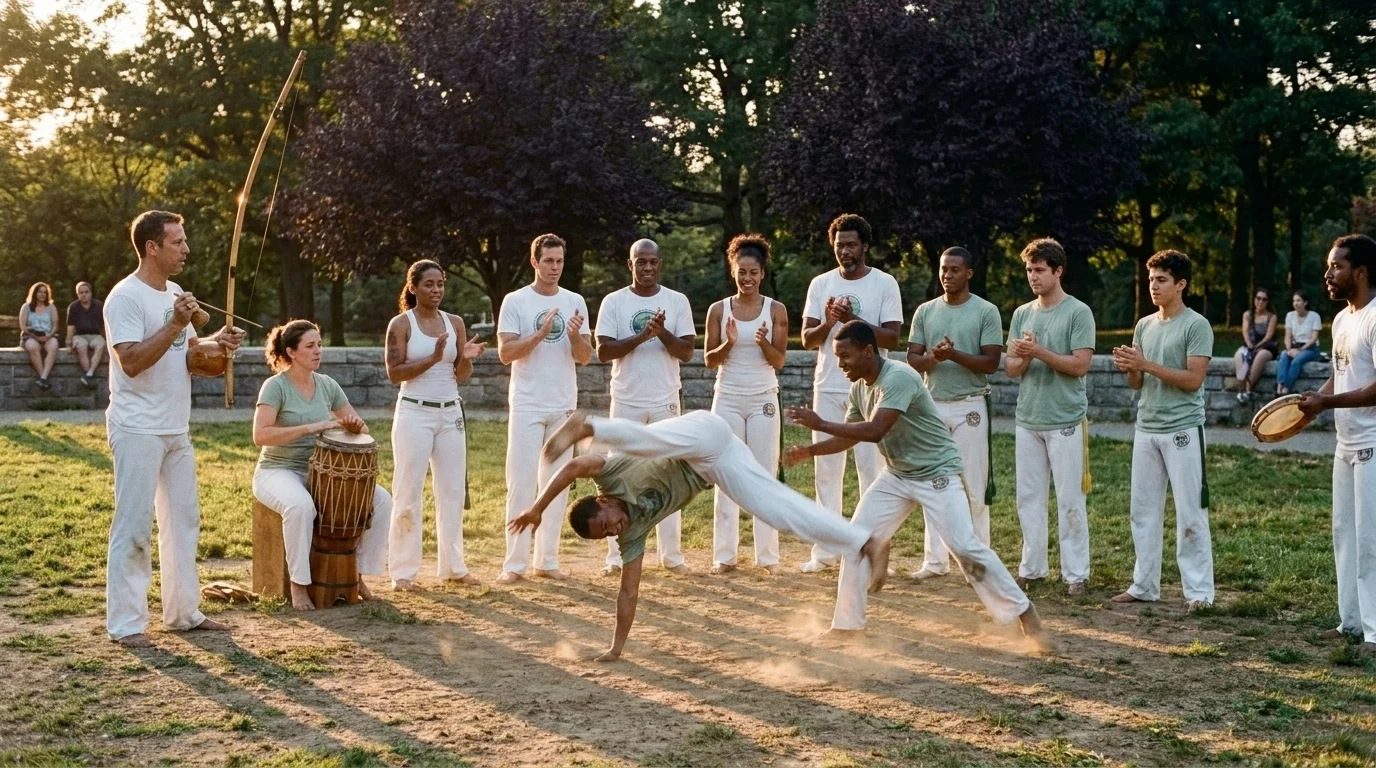
Capoeira is the Afro-Brazilian movement art that emerged among enslaved Africans in colonial Brazil. The accurate cultural history is worth getting right: capoeira's practitioners developed it as both self-defense and disguised resistance, it was outlawed in Brazil in 1892 after independence, and the modern Capoeira Regional style that most Western practitioners learn was systematized by Mestre Bimba (Manuel dos Reis Machado) in the early 20th century to bring the practice back into legal recognition. The integration of music (the berimbau, the atabaque), call-and-response singing, and the roda (the circle of practitioners and musicians around which the game happens) is not aesthetic decoration. It is the practice.
As fitness: capoeira is one of the more agility-and-balance-demanding traditions on this list, with a substantial cardiovascular component. Beginner-friendly. Community-anchored.
Movement disciplines and modern hybrids
Parkour developed in the suburbs of Paris in the late 1980s and 1990s, named by David Belle from his father Raymond Belle's military parcours du combattant (obstacle course training). It is sometimes excluded from martial arts surveys because it has no opponent and no strikes. It is included here because the bodily skills it trains — efficient running, vaulting, climbing, controlled landings — overlap substantially with the conditioning that martial arts develop, and because the 2025 European Journal of Sport Science research documented cognitive gains specifically attributable to the open-skill demands of obstacle traversal.
The energy profile is essentially HIIT — short bursts of high-intensity locomotion alternating with brief recovery — producing meaningful excess post-exercise oxygen consumption (the "afterburn" measured in real EPOC studies, not the marketing version). Real injury risk is a feature of the practice and a reason most beginners should train at established gyms before attempting outdoor runs.
Krav Maga is the Israeli self-defense system developed by Imi Lichtenfeld and adopted by the IDF in the late 1940s. It is the closest thing on this list to a pure self-defense protocol — strikes, throws, and ground work organized around realistic scenarios rather than competitive sport. As a fitness modality, the cardiovascular load varies widely by school but tends to be high, and the conditioning emphasis matches modern HIIT structurally.
Combat Sambo and Sanda are the modern hybrid systems gaining traction in 2026 cross-training programs, per MyMMANews's 2026 industry coverage. Sambo is the Soviet-developed grappling-and-strikes system; Sanda is the Chinese full-contact striking sport. Both are increasingly cross-trained by MMA practitioners.
Which tradition is right for you?
Six short prompts. None of these is the final answer; each is the cleanest empirical starting point.
- If you want low-impact and intend to practice into your 70s and beyond: Tai Chi has the strongest balance, fall-prevention, and chronic-pain evidence base of any martial art.
- If you want maximum cardiovascular conditioning per session: Muay Thai or full-contact Karate produce the highest sustained heart-rate loads.
- If you want strength, problem-solving, and falls-protection training: Brazilian Jiu-Jitsu or Judo, with Judo specifically supported by the older-adult flexibility data.
- If you want brain-side cognitive training alongside the workout: Parkour's open-skill research is the most direct evidence base.
- If you want practical self-defense, not sport: Krav Maga's scenario-based curriculum is the most direct fit.
- If you want cultural depth and community: Capoeira or Kalaripayattu — both ground their fitness practice in deeper cultural transmission than the sport-focused traditions.
- If you have not exercised in years and want a low barrier to entry: Yoga as movement practice, then add one of the above when you have a base.
Related Article: Global Nutrition Habits and Philosophies: A Cross-Cultural Analysis
Martial arts past 60
The older-adult literature is more consistent than most surveys make it look. The 2022 PMC scoping review of 60-to-83-year-olds training hard martial arts (Taekwondo, Judo, BJJ) found gains of 9.3 to 34 percent in strength, 20.5 percent in single-leg balance, and 13.4 percent in aerobic endurance over training periods averaging 11 to 16 weeks. The protocol the studies converged on — 60 to 90 minutes per session, at least twice a week, for a minimum of 11 weeks — is the closest thing to an evidence-based prescription in this space.
A practical addition: Tai Chi has the largest evidence base of any martial art for older-adult falls prevention specifically, and is the entry point most clinical falls-prevention programs use. If you are 65 and looking for a starting point, Tai Chi twice a week for 12 weeks is a reasonable on-ramp, and you can add a harder discipline (Judo with experienced ukemi coaching, Karate at a senior-friendly school) once the base is in place.
As with any new physical practice at any age, if you have heart disease, joint replacements, blood pressure concerns, or chronic conditions, talk with your clinician before starting — particularly before committing to a full-contact discipline. That is general health advice that applies to every practice on this list. Most schools will work with appropriate medical clearance, and many traditions have entry-level programs explicitly designed for older beginners.
A note before you sign up
A practical observation from years of writing about fitness behavior change: the best martial art is the one you will actually attend, on a Tuesday in the second week of February, when it is cold and you are tired. Cultural fit, location, schedule, instructor style, and price all weigh more than the abstract question of which tradition has the strongest VO2max literature. Visit two or three schools across two or three different traditions before committing. Watch a class. Talk to a student. Take a beginner session if it is offered. The fitness benefits in the research literature were observed in people who kept showing up. The math does not work otherwise.
And the cultural framing matters. If you are training a tradition that emerged from a specific community — Kalaripayattu in Kerala, Capoeira in Afro-Brazilian communities, Bökh in Mongolia, Muay Thai in Thailand — there is a difference between training it with attention to the lineage and training it as a generic workout. Both will improve your cardio. Only the first will give you the cultural transmission the tradition was built to carry.
Frequently Asked Questions
Martial arts fall into five practical categories: striking (Karate, Muay Thai, Taekwondo), grappling (Judo, BJJ, Sumo, wrestling), internal or low-impact (Tai Chi, Aikido), weapons-based (Kendo, Kalaripayattu), and hybrid systems mixing striking and grappling (MMA, Krav Maga, Sambo). Movement disciplines like parkour sit alongside these as related physical-fitness traditions. Globally, about 200 million people practice some form of martial art.
It depends on the fitness goal. For maximum cardiovascular conditioning, Muay Thai and full-contact Karate produce the highest sustained heart-rate loads. For strength and full-body work, BJJ and Judo deliver. For low-impact older-adult fitness, Tai Chi has the strongest balance and falls-prevention evidence. A 2025 Frontiers study of 8 weeks of Bajiquan (Chinese striking) produced 14% cardiovascular gains, 24.4% core-strength gains, and 8.6% body-fat reductions — large effect sizes for a relatively short intervention.
Parkour is not a combat martial art — there is no opponent and no strikes — but it shares martial arts' emphasis on body control, environmental awareness, and disciplined training. A 2025 European Journal of Sport Science study tied parkour training specifically to gains in spatial awareness, attentional control, and cognitive flexibility, adding a brain-health dimension that complements the obvious cardiovascular and strength benefits.
Yes. Sumo is a Japanese grappling martial art with a competitive sport dimension, distinguished by ritualized ceremony, sanctioned diet, and stable life. It is recognized as a martial art by Japan's Nihon Sumo Kyokai and appears in Wikipedia's List of Martial Arts. The lifestyle, diet, and training architecture are intrinsic to the practice in a way that does not translate easily to a part-time fitness pursuit.
Kalaripayattu, from the Indian state of Kerala, is widely cited as one of the oldest continuously practiced martial arts, with origins traced to roughly the 3rd century BCE. Wrestling traditions including forms of Mongolian Bökh and the precursors to Sumo also date to similar or earlier eras but in less continuously documented form. Continuous practice plus lineage transmission gives Kalaripayattu its claim.
Yes. A 2022 PMC scoping review found that adults aged 60 to 83 training hard martial arts (Taekwondo, Judo, BJJ) for 60 to 90 minutes twice a week for at least 11 weeks gained 9.3 to 34% in strength, 20.5% in single-leg balance, and 13.4% in aerobic endurance. Lower-impact traditions like Tai Chi have the strongest evidence base for falls prevention in older adults specifically. With clinician clearance, most schools will work with appropriate medical considerations.
Capoeira is an Afro-Brazilian movement art combining acrobatics, kicks, and dance to music played on traditional instruments including the berimbau. It emerged among enslaved Africans in colonial Brazil, was outlawed in Brazil in 1892 after independence, and was systematized into the modern Capoeira Regional style by Mestre Bimba (Manuel dos Reis Machado) in the early 20th century. As fitness, it trains agility, balance, and cardiovascular endurance, and the community structure of the roda (the circle of practitioners and musicians) is intrinsic to the practice rather than aesthetic decoration.
Kalaripayattu, traced to roughly the 3rd century BCE in Kerala, combines striking, grappling, weapons training, and fluid-movement work that has shaped both yoga's posture traditions and Kerala's classical performance art. The training builds mobility, balance, and proprioception. It pairs with Ayurvedic practice in Kerala. Outside India the practice is rare; inside Kerala it is increasingly taught as cultural heritage as much as combat.
Approximately 200 million people practice some form of martial art globally as of 2024, including more than 60 million in traditional Chinese martial arts, over 10 million in Muay Thai, and 18 million in the United States across all disciplines. Karate is the single most-practiced style among US martial artists, accounting for roughly 35% of US participation.
Check Out These Related Articles

Aesthetic Harmony: Integrating Design Principles with Holistic Wellness Concepts
Navigating Holistic Wellness: Embracing a Well-Balanced Lifestyle for Beginners
Japanese Zen Embodied: The Art of Integrating Mindfulness into Everyday Life