
Grounding Techniques For Anxiety


When a client is mid-spiral in my office — heart pounding, thoughts sprinting toward every worst case — I don't reach for a worksheet on the neuroscience of fear. I hand them something to do with their hands and their senses in the next ten seconds. That is what grounding techniques for anxiety are: fast, portable coping tools that pull your attention out of the "what if" loop and back into the concrete present. As a licensed clinical social worker, I teach these grounding exercises for anxiety to nearly everyone I see, because they work in the moments you need them most — in a meeting, in bed at 2 a.m., in a slow checkout line. In the guide below I'll walk you through the exact anxiety grounding techniques I actually reach for, which one to use for which kind of anxious moment, and the recent research showing they measurably calm an acute spike. No theory dump. Just tools you can use before you finish reading.
What Are Grounding Techniques for Anxiety (and How They Calm Your Nervous System)
Grounding techniques are simple sensory or physical exercises that interrupt anxious spiraling by anchoring your attention to the present moment, calming the fight-or-flight response. Cleveland Clinic puts it plainly: they are "simple strategies that help calm your anxiety by focusing on the here and now".
Here is what is actually happening when they work. Anxiety is, in part, your threat-detection system running rehearsals of a future that has not arrived. Grounding gives that system a different job. When you deliberately flood your attention with present-moment sensory input — what you can see, feel, and hear — you occupy the same mental bandwidth the worry was using, and the fight-or-flight response has less room to escalate. It is not magic and it is not suppression. It is redirection.
For years the honest answer to "does this really work?" was thin. As recently as its 2025 update, Healthline's own guide still says outright that "there's little research explaining how grounding techniques work". That is starting to change. A 2025 study in Teaching and Learning in Nursing tested the five-senses protocol — the same sequence as 5-4-3-2-1 — and reported the share of high-anxiety students dropping from 23% to 4% after the exercise. And a 2023 meta-analysis in Scientific Reports pooled 12 randomized controlled trials of 785 adults and found breathwork significantly lowered both stress and anxiety.
One honest limit before we go further: grounding calms an acute spike. It is a first-line tool, not a treatment for an anxiety disorder. If your anxiety is frequent, overwhelming, or shrinking your life, that is a clinical question, not a self-care one — please talk to a licensed professional. The rest of this guide is organized the way I actually use these tools with clients: by when to reach for which, not as one flat list. If you want more everyday stress relief practices, the whole category builds on this foundation.
Which Grounding Technique Should You Use Right Now? A Therapist's Decision Map
Match the tool to the moment: cold-water plus 5-4-3-2-1 for panic, the 3-3-3 rule for late-night overthinking, temperature grounding for dissociation. The technique that works is the one that fits the state you're actually in, so here is the map I keep in my own head.
| Your state right now | The tool I reach for | Why it fits |
|---|---|---|
| Mid-panic attack | Cold water, then 5-4-3-2-1 | A physical shock interrupts the loop faster than a mental exercise |
| Overthinking at 2 a.m. | 3-3-3 rule or a slow body scan | Low-effort; works lying down, in the dark |
| Dissociation / feeling unreal | Temperature + physical grounding | Strong body signals pull you back in |
| Anxious in public | Discreet fists-and-feet | Nobody around you can tell |
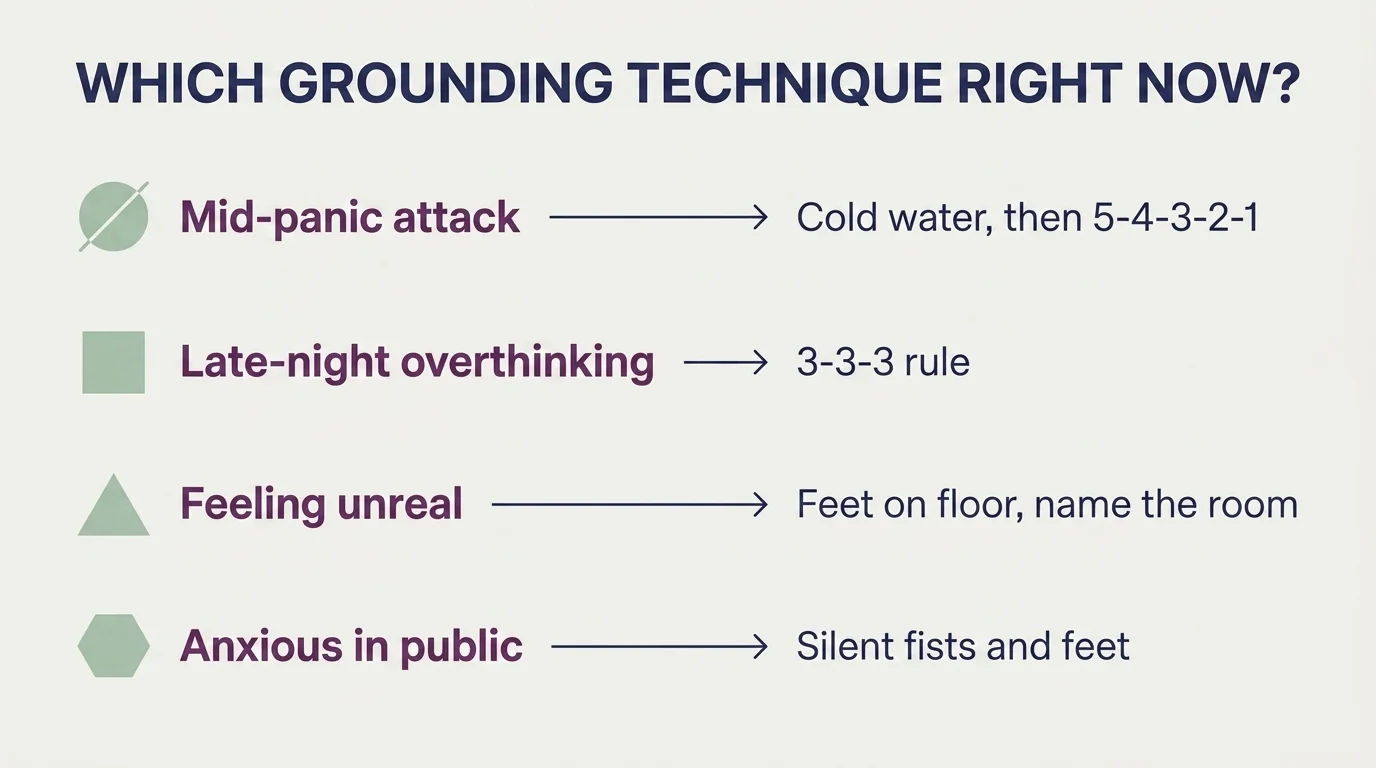
Mid-panic attack
When someone is mid-panic — chest tight, breath shallow, the certainty that something is very wrong — I don't start with a mental exercise. I start with a physical shock. Hold an ice cube, run your wrists under cold water, or press a cold drink against your face. Then, once the cold has your attention, run 5-4-3-2-1 (full steps in the next section). The strong sensory input interrupts the fight-or-flight loop faster than trying to think your way calm, which is nearly impossible when your body is convinced it's in danger. The cold isn't a distraction from the panic. It's a louder signal than the panic.
Overthinking at 2 a.m.
The 2 a.m. spiral is its own animal. You're not in acute panic; you're lying in the dark while your brain relitigates the day and forecasts tomorrow. For this I reach for the gentlest tools — the 3-3-3 rule (name three things you see, three you hear, move three parts of your body) or a slow head-to-toe body scan. Both work lying down, in the dark, without sitting up or turning on a light. The goal here isn't to "win" against the thought. It's to give your attention somewhere quiet to rest until sleep can find you again.
Dissociation / feeling unreal
Sometimes anxiety doesn't speed you up — it makes the room go far away, like you're watching your life through glass. That floaty, unreal feeling is dissociation, and mental exercises tend to slip right off it. What helps is emphatic physical and temperature input: hold something cold or deeply textured, press your bare feet into the floor and feel the pressure, and say the date and the name of the room out loud. You're giving your nervous system undeniable evidence of where and when you are. Name it plainly: "It's Tuesday. I'm in my kitchen. My feet are on the floor."
Anxious in public
Not every anxious moment lets you splash water on your face. In a meeting, on a train, in the checkout line, I coach discreet grounding nobody can see: clench your fists hard for five seconds and release, press your feet into the floor, and run a silent 5-4-3-2-1 with your eyes open. No one around you can tell you're doing anything at all. If you tend to spiral in one specific setting, practicing a technique when you're calm — so it's automatic under pressure — makes all the difference. For more on steadying yourself in daily life, the stress relief category has more to work with.
The 5-4-3-2-1 Grounding Technique (the One to Learn First)
If you learn only one grounding tool, make it this one. The 5-4-3-2-1 technique grounds you by naming five things you see, four you feel, three you hear, two you smell, and one you taste. It walks your attention down through the senses, one rung at a time, until you're firmly back in the room.
Here is exactly how I coach it:
- 5 — see. Name five things you can see, out loud or in your head. Be specific: "the chipped blue mug, a crack in the ceiling, my left shoelace, the streetlight, the dog's ear."
- 4 — feel. Four things you can physically feel: the chair against your back, your socks, the cool tabletop, your own breath at your nostrils.
- 3 — hear. Three sounds: a fan humming, traffic outside, your own swallow.
- 2 — smell. Two things you can smell — coffee, soap on your hands. If you can't find two, name two smells you love.
- 1 — taste. One taste: gum, the last sip of coffee, or just the inside of your mouth.
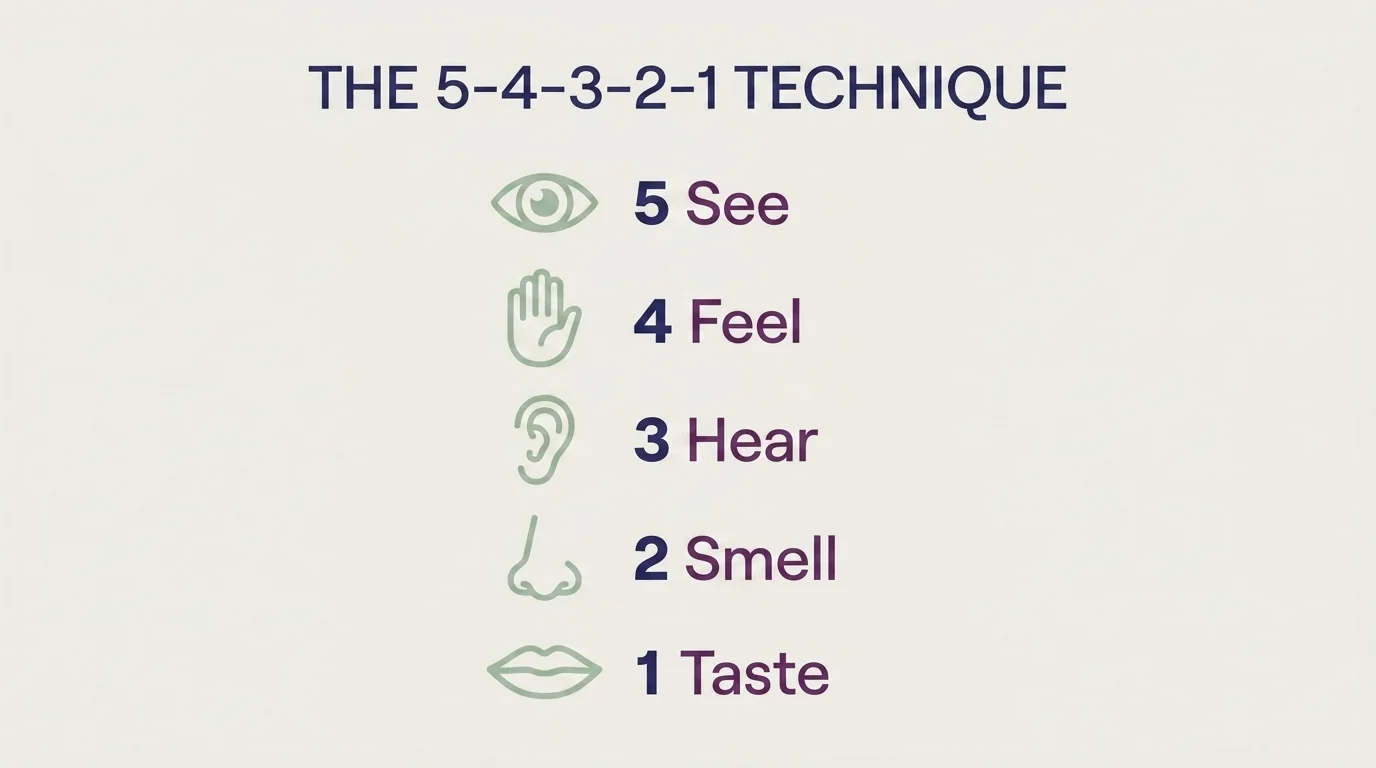
This is the same "five senses technique" some clinicians and researchers use by another name — and it's the protocol the 2025 nursing study put to the test, cutting its high-anxiety group from 23% to 4%. When I coach it, I tell people two things: go slow, and actually say each item — under your breath is fine. If you reach "1 — taste" and you're still not settled, start another round. The point isn't to finish. The point is to stay with your senses long enough for the spike to pass.
Named Grounding Methods, Contrasted: Box Breathing, 4-7-8, 3-3-3
Anxiety searches are full of named "rules," and it helps to see them side by side so you can grab the right one under pressure. Box breathing (4-4-4-4) steadies a racing heart; 4-7-8 helps you wind down; the 3-3-3 rule is the fastest reset. Here's how I keep them straight:
| Method | The pattern in one line | When I reach for it |
|---|---|---|
| Box breathing | Inhale 4, hold 4, exhale 4, hold 4 | A racing heart you want to steady |
| 4-7-8 breathing | Inhale 4, hold 7, exhale 8 | Winding down for sleep |
| 3-3-3 rule | 3 things you see, 3 you hear, move 3 body parts | The fastest reset when you can't focus |
| 5-4-3-2-1 | Name 5 see, 4 feel, 3 hear, 2 smell, 1 taste | Pulling attention off anxious thoughts (see above) |
The breathing methods aren't folk remedies, either. The 2023 Scientific Reports meta-analysis I mentioned earlier — 12 trials, 785 adults — found breathwork produced significant reductions in stress and anxiety. Here are the two I teach most.
Box breathing (4-4-4-4)
Box breathing is the one I'd hand almost anyone first, because it's clinician-simple and hard to get wrong. Breathe in through your nose for a count of four, hold for four, breathe out for four, hold for four — that's one "box." Run four or five boxes. The even, deliberate rhythm gives a galloping heart something steady to follow, and the brief holds slow your breathing without your having to force it. I use it before hard conversations, not just during panic. It's the most portable tool in this whole guide: no props, nothing to remember but a square.
4-7-8 breathing
The 4-7-8 pattern is box breathing's bedtime cousin. Inhale quietly through your nose for four, hold for seven, and exhale slowly through your mouth for eight. The long exhale is the active ingredient — a slow out-breath nudges the body toward its rest-and-digest state, which is why this one is my go-to for winding down at night rather than for an acute daytime spike. Start with three or four rounds; if the seven-count hold feels like too much at first, shorten everything proportionally and build up over a week or two.
The 3-3-3 rule earns its place by being the easiest to remember: name three things you see, three you hear, and move three parts of your body. It's the one to teach a kid, or to use when you're too rattled to run the full 5-4-3-2-1 (whose steps are just above). For more everyday breathing and relaxation practices, the stress relief category goes deeper.
More Grounding Techniques by Category (Sensory, Physical, Mental, Soothing)
Beyond 5-4-3-2-1, grounding techniques fall into four buckets — sensory, physical, mental-cognitive, and soothing — so you can pick what fits the moment. The four named methods above (5-4-3-2-1, box breathing, 4-7-8, and the 3-3-3 rule) are techniques one through four; here are more, numbered so you can see the whole toolkit at a glance. Keep the ones that click and ignore the rest — nobody uses all of them.
Sensory grounding
Sensory tools work by giving your senses something vivid and immediate to latch onto.
- Hold an ice cube — or run cold water over your wrists — until the cold is all you can think about.
- Smell something strong — coffee grounds, citrus peel, a dab of peppermint oil.
- Handle a textured object — a ridged key, a smooth stone, the seam of your jeans — and describe it in detail.
- Savor a strong flavor — a sour candy, a mint, a slice of lemon — and notice every part of the taste.
Physical grounding
Physical tools remind you that you have a body, and that it is here.
- Press your feet flat into the floor and feel the ground pushing back.
- Clench and release your fists — squeeze for five seconds, then let go, and notice the difference.
- Stretch or shake out your arms, rolling your shoulders and loosening your neck.
- Take a slow, mindful walk, matching your breath to your steps.
- Wrap both hands around a warm mug and let the heat anchor you.
Mental / cognitive grounding
Cognitive tools occupy the same mental machinery the worry is trying to use.
- Count backward from 100 by sevens — it's just hard enough to crowd out rumination.
- Name categories — five animals, five cities, five cars — until your mind has something concrete to do.
- Recite something you know cold — your address, an old phone number, song lyrics, a poem.
- Describe a routine task step by step, as if teaching it — how you make coffee, tie your shoes, or start your car.
Soothing / self-kindness grounding
Soothing tools are for after the spike, when what you need isn't distraction but a little kindness.
- Picture a safe place in real detail — a beach, a grandparent's kitchen, a trail you love.
- Offer yourself one kind sentence — "This is hard, and I'm doing the best I can right now." Self-compassion is a skill you can practice, not a personality trait you're stuck without.
- List three things you're looking forward to, however small — dinner, a show, Friday.
- Rest a hand on your heart and take a few slow breaths, the way you'd steady a friend.
Your Printable Grounding Quick-Reference (Screenshot This)
Here's the whole toolkit condensed into a card — the one I'd give a client to keep in their wallet. Screenshot it, or save it to your phone's lock screen, so a calming tool is one glance away the next time anxiety spikes.
| When you feel… | Reach for |
|---|---|
| A full panic attack | Cold water, then 5-4-3-2-1 |
| A racing heart | Box breathing (4-4-4-4) |
| Overthinking at night | 3-3-3 rule or 4-7-8 breathing |
| Unreal / dissociated | Feet on the floor + name the room |
| Anxious in public | Silent fists-and-feet |
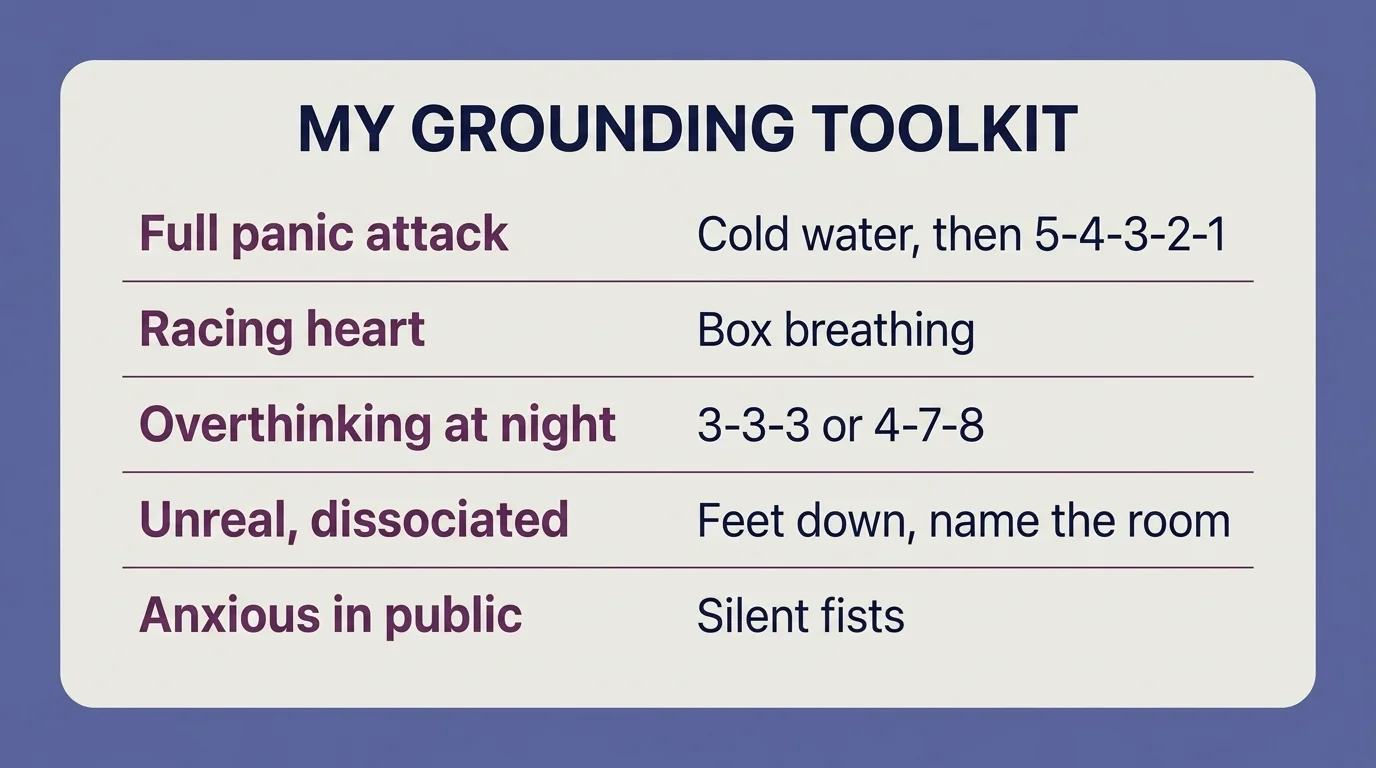
Keep it somewhere you'll actually find it in the moment. The best grounding technique is the one you can remember when your thoughts are moving too fast to think — and a card in your pocket does the remembering for you.
Building Your Grounding Toolkit
You don't need to memorize all twenty-one of these. Pick the two or three grounding techniques for anxiety that fit your most common anxious moments — the 2 a.m. spiral, the pre-meeting nerves, the checkout-line dread — and practice them when you're calm, so they're automatic when you're not. Grounding is a genuine first-line tool, but it isn't a replacement for care: if your anxiety is frequent or overwhelming, please reach out to a licensed professional, and if you're ever in crisis, contact the 988 Suicide and Crisis Lifeline. Try one technique today, and explore more stress relief tools whenever you need them.
Frequently Asked Questions
The five best-known grounding techniques for anxiety are 5-4-3-2-1 (name 5 things you see, 4 you feel, 3 you hear, 2 you smell, and 1 you taste), box breathing, the 3-3-3 rule, cold-water or temperature grounding, and a physical reset like clenching and releasing your fists. Start with 5-4-3-2-1 — it's the one most clinicians teach first.
The 3-3-3 rule for anxiety is simple: name three things you see, three sounds you hear, and move three parts of your body. It's a faster, easier-to-remember cousin of the 5-4-3-2-1 technique, made for moments when you're too anxious to run the full sequence and just need a quick reset.
Yes. A 2025 five-senses study cut the share of high-anxiety students from 23% to 4%, and a 2023 meta-analysis of 12 trials found breathwork significantly lowers stress and anxiety. Grounding won't cure an anxiety disorder, but it reliably calms an acute spike — and if anxiety is frequent or overwhelming, see a licensed professional.
In an acute panic attack, pair a physical shock — hold an ice cube or splash cold water on your face — with the 5-4-3-2-1 technique. The strong sensory input interrupts the fight-or-flight loop faster than a purely mental exercise, because it's nearly impossible to think your way calm once your body believes it's in danger.
To calm anxiety fast, pick one grounding tool and do it now — box breathing (in 4, hold 4, out 4, hold 4) to slow a racing heart, or 5-4-3-2-1 to pull your attention off anxious thoughts. Thirty to sixty seconds of focused sensory input is usually enough to take the edge off a spike.