Healthcare Solutions


The enhanced subsidies that made Affordable Care Act coverage cheap expired at the end of 2025, and the people who cover health policy for a living spent the winter running the same grim arithmetic. Here is the part the sticker-shock coverage skips: even now, you have more real, affordable healthcare solutions than the headlines admit, and getting access to healthcare without insurance is a solvable problem, not a dead end. The uninsured rate sits at 8.3% of Americans — about 28 million people, and 2026 has made coverage harder, not easier. But most of the options below are not favors. Several are legal obligations, written into federal rules, that hospitals and clinics would rather you not know in detail. What follows is a plain map of every practical way to get care without insurance — and a quick way to find the one that fits your situation this week.
Why Getting Care Feels Impossible in 2026 — and How to Choose Your Solution
You have more options than you think: community clinics, sliding-scale fees, telehealth, prescription discounts, and hospital charity care can all deliver affordable care without insurance.
Start with why this year feels worse, because the feeling is grounded in policy, not imagination. When Congress let the enhanced ACA subsidies lapse, KFF projected roughly 5 million fewer people would enroll in marketplace plans in 2026 than in 2025, and the Congressional Budget Office estimated Medicaid changes could add up to 10 million more uninsured over a decade. The affordable-access problem is growing on purpose — the result of specific votes, not a natural disaster. It is no surprise that two-thirds of Americans now worry about affording health care.
The barriers to healthcare access are worth naming plainly, because the solutions map onto them: cost, no insurance, and — for millions — geography and broadband. The gap is also not evenly distributed. In 2025, more than 1 in 5 Hispanic adults aged 18 to 64 (21.9%) were uninsured, against 11.3% of Black adults, 8.5% of white adults, and 4.9% of Asian adults. This is a health-equity problem before it is a personal-budget problem. It also means paying cash changes the medicine itself: as Dr. Ateev Mehrotra, a physician and researcher at Brown University, put it, "If my patient tells me, 'Doc, I'm gonna have to pay for this out-of-pocket,' I'm gonna make a different risk calculus." None of that means going without care.
Which solution fits your situation
Match the problem to the door:
- Need routine or ongoing care but have no insurance → a community health center (FQHC), where fees slide with your income.
- Fully uninsured with no regular doctor → a free or charitable clinic.
- Can't afford your prescriptions → discount cards and big-box $10-generic programs.
- Rural, homebound, or short on time → telehealth, or direct primary care for a flat monthly fee.
- Hit with a big hospital bill, or facing one → ask for the cash rate and apply for charity care.
- Low income, especially with kids → check Medicaid and CHIP before you assume you don't qualify.
The rest of this guide is those doors, one at a time, with the rule that makes each one work. If you want the wider context on the policy fight behind all of it, peppino's wellness and healthcare access coverage tracks it.
Solution 1 — Community Health Centers (FQHCs): Sliding-Scale Care That Can't Turn You Away
Community health centers (FQHCs) offer full medical, dental, and mental-health care on a sliding scale — and legally can't deny you for inability to pay.
This is the workhorse, and the numbers are not small. Federally Qualified Health Centers serve about 52 million patients a year across roughly 1,400 to 1,500 centers, charging on a sliding scale tied to income. They are not a stripped-down version of care; they provide primary care, dental, behavioral health, and often pharmacy under one roof. If your situation is "I need a regular doctor and can't afford one," this is the first door.
The reason it works is a federal rule, not a clinic's goodwill — worth knowing so you can insist on it. Centers that take federal funding must operate a sliding-fee program and cannot turn you away because you can't pay.
How sliding-scale fees work
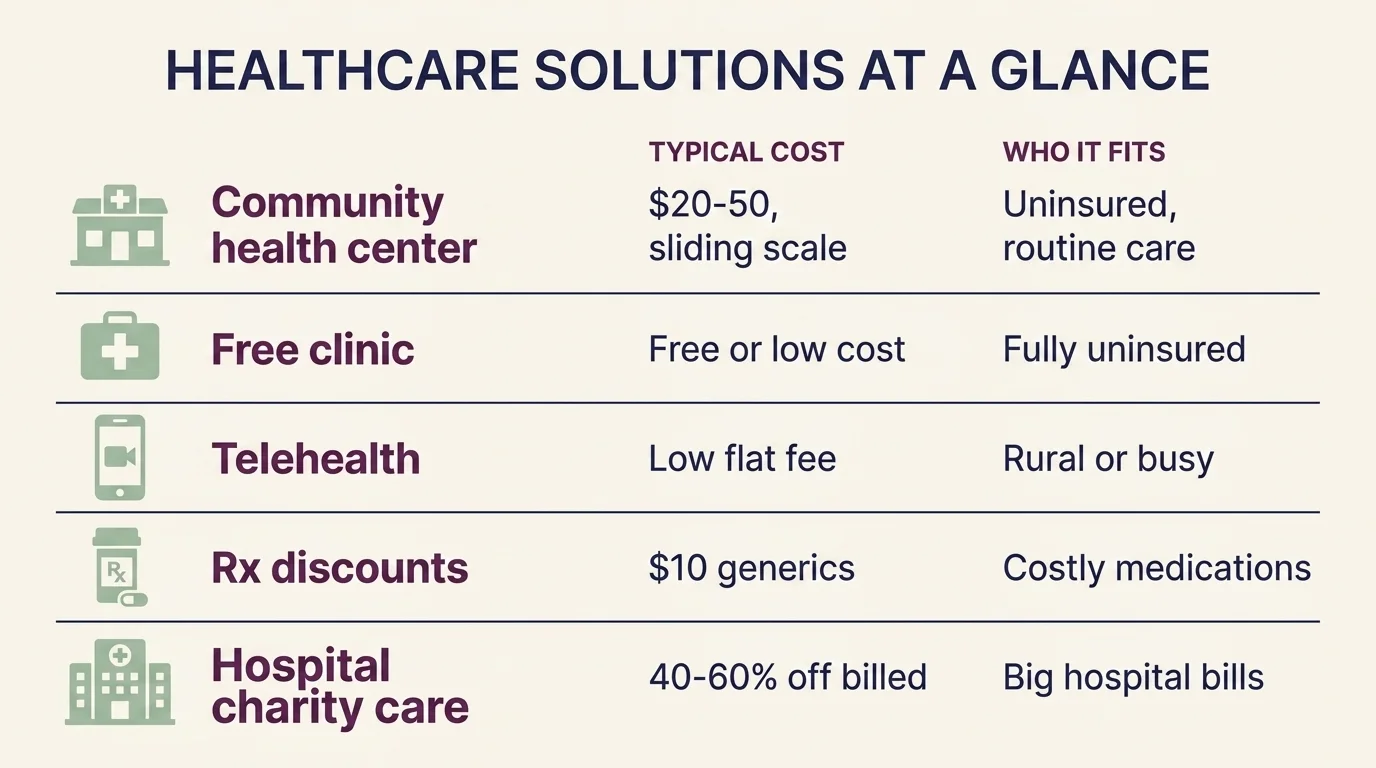
The mechanism is specific enough to hold a clinic to. Under HRSA's sliding-fee rule, patients at or below 100% of the Federal Poverty Guideline get a full discount, and those between 100% and 200% of the guideline get a partial discount on a set schedule; the enrollment lasts 12 months, and centers may not deny care for inability to pay. In practice, many visits run $20 to $50, and some are free. Bring proof of income when you enroll — pay stubs, a tax return, or a benefits letter — so they can place you on the right tier.
To find one, use HRSA's "find a health center" locator and enter your ZIP code. If you're weighing the cost of a regular provider against everything else, this is also where peppino's affordable healthcare access reporting starts. The people this fits: anyone uninsured, underinsured, or on a low income who needs care they can count on, not just once.
Solution 2 — Free & Charitable Clinics
The NAFC network runs more than 1,400 free and charitable clinics offering medical, dental, and pharmacy care at little or no cost to the uninsured.
Where FQHCs slide the fee down, free and charitable clinics often remove it entirely. The National Association of Free & Charitable Clinics counts a network of 1,400-plus free and charitable clinics and pharmacies, typically serving people at 100% to 300% of the Federal Poverty Level, with many services free or nominal. These are usually volunteer- and donation-run nonprofits — a different model from the federally funded FQHC, and a useful second option if there's no health center near you or you're fully uninsured with no regular provider.
Eligibility varies by clinic, so check before you go. Most will ask for a photo ID and some proof of income or residence to confirm you fall inside their range; keep the paperwork simple and call ahead about what a specific clinic requires. To locate one, use the NAFC clinic locator and enter your ZIP code — it lists nearby clinics and the services each actually offers, which is not uniform.
Who it fits: people who are fully uninsured, don't have a regular doctor, and want care at little to no cost. The trade-off is availability — free clinics can have limited hours and waitlists — but for basic and preventive care, they are one of the most direct ways to be seen without a bill.
Solution 3 — Slash Your Prescription Costs
Even without insurance, discount cards and big-box pharmacies cut drug prices sharply — many 90-day generics cost about $10, and coupons drop cash prices further.
The retail price of a prescription is closer to an opening bid than a fixed number, and paying it without checking is how uninsured patients overspend. Walmart, Target, Costco, and Mark Cuban's Cost Plus Drug Company sell many 90-day generics for around $10, and discount services such as GoodRx, SingleCare, and WellRx cut cash prices further — often below what an insured copay would be. Name them as what they are: free-to-use comparison tools, not sponsors, and worth checking against each other because the lowest price moves by drug and by pharmacy.
A short routine saves the most money. Before you fill anything, compare three numbers: the pharmacy's cash price, the coupon price from a discount service, and — if you have any plan at all — your copay. Ask the pharmacist directly whether a discount card beats the counter price; they can usually tell you on the spot. For expensive brand-name drugs with no generic, look up the manufacturer's patient-assistance program, which many drugmakers run for people who qualify by income. The GoodRx guide to low-cost care is a reasonable starting map for the discount landscape, with the standard caveat that it is also a company selling a product.
Solution 4 — Telehealth & Direct Primary Care
Telehealth and direct primary care both deliver low-cost care outside the clinic — video visits from home, or a flat monthly fee that skips insurance entirely.
These are the two levers the government and clinic directories tend to miss, and they close real gaps — as long as you know where they don't reach.

Telehealth: care from home (and its limits)
Telehealth is often cheaper than an in-person visit and reaches people a clinic never will — rural patients, caregivers, anyone who can't take half a day off to sit in a waiting room. But the vendor pages that sell it skip the part that matters for access. A 2025 scoping review in JAMIA Open found that roughly 40% of telehealth visits still require out-of-pocket payment, 23% of rural adults lack reliable broadband (against 2% of urban adults), and 37% of adults over 65 report discomfort with video-calling technology. Telehealth widens access for some and quietly leaves out the people with the worst connectivity — which tends to be the same people with the worst access to begin with.
One limit is worth stating plainly, because it is a safety issue and not a footnote: a video visit complements in-person care, it does not replace it. It cannot examine a body, and it is no substitute for a clinician's hands-on diagnosis for anything serious. Nothing in this guide is a diagnosis or a treatment plan — for a medical emergency, call 911 or go to an emergency room.
Direct primary care: a flat monthly fee
Direct primary care (DPC) is the model insurance advertisers rarely mention because it routes around them. It is a flat monthly membership to a primary-care practice covering routine, chronic, and acute care, paid out of pocket — no insurance, no per-visit billing. For someone who wants an ongoing relationship with a doctor without buying a full plan, it can be a genuinely affordable middle path. Read the membership terms first: DPC usually covers the primary-care relationship, not hospital stays, specialists, or expensive imaging, so it works best paired with one of the safety nets above rather than as your only coverage.
Solution 5 — Hospital Charity Care & Self-Pay Negotiation
Every nonprofit U.S. hospital must offer financial assistance, and self-pay cash rates often run 40–60% below the billed price — you just have to ask.
This is the highest-value solution and the one buried deepest, because it lives on finance and legal sites, not wellness ones. The billed price on a hospital statement is close to a fiction — a chargemaster number almost no one actually pays — and the discounts are large enough to change what you owe by thousands.
Ask for the cash-pay rate
Ask for the self-pay or cash rate before care whenever you can, because it is often 40% to 60% below the billed price, and you can request an itemized bill under the price-transparency norms that followed the No Surprises Act. Cynthia Cox, a senior vice president at KFF, is blunt about it: "Always ask — you might be able to qualify for a significant discount." An itemized bill also lets you catch duplicate or incorrect charges, which are common enough to be worth the phone call.
Apply for hospital charity care
Charity care is not a courtesy; it is a condition of a nonprofit hospital's tax exemption. Every nonprofit U.S. hospital must offer a financial-assistance policy, and free care is common up to 200% of the Federal Poverty Level, with discounts often reaching 300% to 400% FPL — a family of four earning under roughly $128,600 may qualify. Hospitals are not required to advertise it well, and mostly don't. So request the financial-assistance policy by name, apply in writing, and do it even after a bill has arrived. If you owe money now, this is the sequence: ask for the itemized bill, apply for charity care, then negotiate whatever remains.
Solution 6 — Check If You Qualify: Medicaid, CHIP & the Marketplace
Before paying out of pocket, check Medicaid and CHIP eligibility — many families qualify for free or low-cost coverage they assume they can't get.
Paying cash is a fallback, not a first move, and plenty of people pay it while eligible for coverage they never applied for. Medicaid and CHIP cover low-income adults and children, and — unlike marketplace plans with their limited open-enrollment window — they generally accept applications year-round. If your income has dropped, if you've lost a job, or if you have kids, run the eligibility check before you assume the answer is no.
The 2026 context makes this more urgent, not less. With enhanced subsidies gone, marketplace coverage is pricier this year, which is exactly the moment to confirm whether you qualify for public coverage instead of guessing. Start with the official eligibility checkers rather than a broker: HealthCare.gov and your state's Medicaid agency are the two places to confirm what you actually qualify for. It takes an afternoon and can replace every other option on this list.
Solution 7 — Prevention: The Cheapest Care of All
The most affordable healthcare is the care you never need — free screenings, sliding-scale checkups, and everyday habits prevent the bills that break budgets.
There is a reason the finance-page solutions above all involve managing a cost after it has landed: an untreated problem is the most expensive kind. A blood-pressure check or a screening caught early at a community health center costs a fraction of the emergency-room visit it prevents, and the FQHCs and free clinics in this guide provide preventive services on the same sliding scale as everything else. Prevention is not a lecture about willpower; it is the one lever that lowers the bill before it exists.
The unglamorous habits still do the most work — sleep, movement, food you can afford, and showing up for the free screening instead of skipping it. None of that closes a coverage gap on its own, and it is not a substitute for treatment when you're sick. But in a year when policy has made care harder to reach, using preventive care while you have access to it is the closest thing to a discount you control. Affordability and wellness are not separate projects. They are the same fight.
Your Healthcare Solutions Start Here
Getting affordable care without insurance is genuinely harder in 2026 — that is a policy outcome, not a personal failing — but it is far from hopeless. You now have the full map of healthcare solutions, from community health centers and free clinics to prescription discounts, telehealth, and hospital charity care, plus the rule that makes each one work. The point of knowing the rule is that you can insist on it.
Do one thing this week. If you need a provider, enter your ZIP code into HRSA's find-a-health-center tool or the NAFC clinic locator and find one option near you. If a bill is already looming, call and ask for the cash rate and the charity-care policy by name — and remember that none of this replaces a clinician when something is actually wrong. For the wider policy story behind all of it, follow peppino's more on wellness and healthcare access. Affordability and wellness are the same fight, and this year it is worth having.
Frequently Asked Questions
Community health centers (FQHCs) and 1,400+ free and charitable clinics provide care on a sliding scale or free — many visits run $20–50 or nothing, based on your income, and FQHCs can't turn you away for inability to pay.
A community health center or free clinic on a sliding scale, or telehealth or direct primary care for a flat low fee — many visits are $20–50 or free. Ask for the self-pay cash rate up front.
Often yes. Ask for the self-pay or cash rate, which is frequently 40–60% below the billed price, request an itemized bill, and check nonprofit hospitals' charity-care policies.
Use HRSA's find-a-health-center tool for FQHCs and the NAFC clinic locator (1,400+ free and charitable clinics) — enter your ZIP code to see local options and the services each one offers.
FQHCs are federally funded, charge a sliding scale, and can't deny care for inability to pay; free and charitable clinics (NAFC) are volunteer- or nonprofit-run, typically serve people at 100–300% of the Federal Poverty Level, and are often fully free.