
Compassionate Innovations: Person-Centered Approaches to Holistic Healthcare


There's a question that, in my experience as a clinician, changes a care visit more than almost any intervention: "What matters to you?" Not "what's the matter with you" — what matters. The difference between those two questions is, more or less, the whole subject of this article. Patient-centered care and its broader cousin, holistic or whole-person healthcare, are the names for a shift away from treating a diagnosis and toward treating the person who has it. It sounds soft. The evidence says it isn't.
This is a plain-language guide to what patient-centered care actually means, the recognized principles behind it, how it differs from person-centered care, and what the research shows about whether it works. I'll keep the warmth — it's the point — but ground it in named frameworks and real numbers, because a person deciding how to advocate for themselves or a loved one deserves both.
What Patient-Centered Care Actually Means
Patient-centered care is healthcare organized around the patient's values, preferences, and stated needs — with the patient as an active partner in decisions rather than a passive recipient of them. The phrase isn't marketing; it has a recognized definition and, importantly, a named set of principles that distinguish it from a vague promise to "care more."
The 8 Principles of Patient-Centered Care
The most widely used framework comes from the Picker Institute. Its eight principles of patient-centered care are concrete enough to hold a health system accountable:
- Timely access to care and information
- Treatment by trusted, competent professionals
- Continuity of care and smooth transitions between settings
- Involvement of family and caregivers, when the patient wants it
- Transparent communication and genuine support for self-care
- Respect for patient preferences and shared decision-making
- Empathy and emotional support
- Attention to physical comfort and the care environment
What I find useful about this list, clinically, is that it turns "compassion" from a feeling into a checklist you can actually evaluate. Did the transition between your hospital and your home doctor go smoothly? Were your preferences asked about, or assumed? Those are answerable questions.

Patient-Centered vs. Person-Centered Care
These terms get used interchangeably, and the distinction is worth getting right — the same way "boundaries" gets flattened in everyday use until it stops meaning anything. The current consensus: patient-centered care focuses on you in your role as a patient — often around a specific, frequently chronic condition — with the goal of a functional life, while person-centered care frames your whole life context, including social and economic factors, with the goal of a meaningful one.
They aren't rivals. They share the same nine themes — empathy, respect, engagement, relationship, communication, shared decision-making, a holistic focus, an individualized focus, and coordinated care. The simplest way to hold it: patient-centered care asks how to treat your condition well; person-centered care asks how the treatment fits the life you're actually living. A good care team does both.
Does It Actually Work?
This is where I want to show my work, because "be more compassionate" is easy to say and easy to ignore unless it changes outcomes. It does.
A 2021 study of 5,199 inpatients found that those receiving patient-centered care were about 4.2 times more likely to report improved physical health and about 5.6 times more likely to report improved mental health — and that the approach measurably reduced unnecessary prescriptions and readmission cycling. Broader analyses report that patient-centered care has been associated with roughly 18% fewer hospital admissions and 36% fewer readmissions, with one program seeing a 25% drop in 30-day readmissions.
The cost case follows. With the US all-cause readmission rate around 14.56% and CMS estimating roughly $17 billion a year spent on avoidable hospital visits, an approach that meaningfully reduces readmissions isn't only kinder — it's economically serious. Compassion, it turns out, has a return on investment, which is the argument that tends to move institutions that the moral case alone doesn't.

Whole Person Health, in Practice
The holistic end of this spectrum now has real institutional backing, not just lifestyle-blog enthusiasm. NIH's National Center for Complementary and Integrative Health has reframed its strategy around "whole person health," stating plainly that focusing on a single disease or body part will not be sufficient to solve major health problems. And the Department of Veterans Affairs operationalized it: the VA's Whole Health model opens not with a symptom checklist but with that question — "what matters to you?" — and builds a personal health plan across behavioral, lifestyle, and social-support domains from the answer.
That's the move from theory to practice. Whole-person care isn't a vibe; it's a structured plan that starts from the patient's own goals.
What It Looks Like in Real Life
Concretely, patient-centered care shows up in changes that sound small and aren't: flexible maternity visiting hours so a partner can stay, individualized pain-management plans instead of a default prescription, and recovery plans tailored to a patient's actual home life rather than a standard discharge sheet. In nursing, it's the care plan written with the patient about their priorities, not just charted for them.
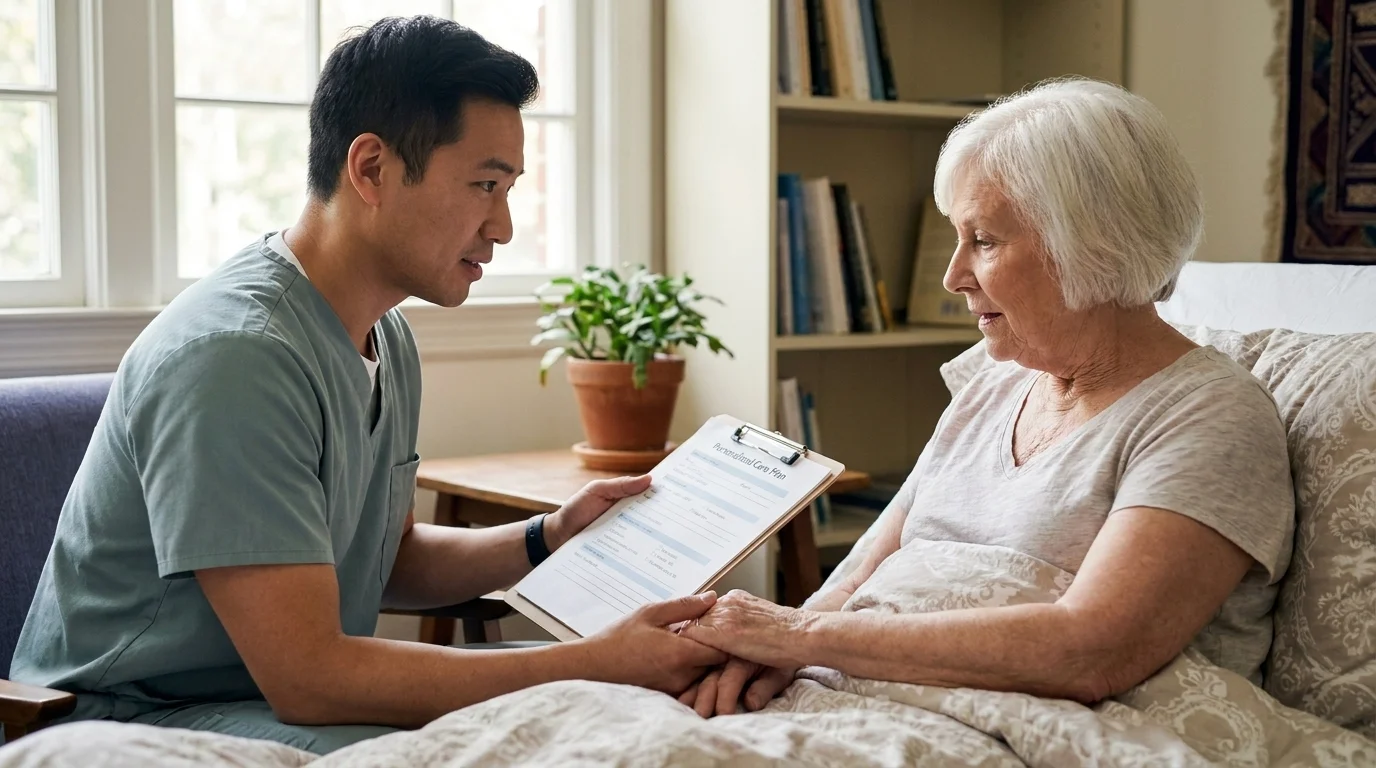
A related lever is patient engagement — the tools and habits that let people participate in their own care, from shared-decision-making conversations to apps that help track symptoms between visits. Engagement is where the principles stop being a philosophy and become a daily practice, for clinician and patient alike.
A Note on How to Use This
One honest caveat, in keeping with how I talk to clients: this is educational, not personal medical advice. It describes how good care is designed — it can't tell you what's right for your specific situation. The best use of these ideas isn't to self-diagnose or to grade your providers from a distance; it's to bring them into the room. You're allowed to ask "what matters to me here?" out loud, to request shared decision-making, to ask about the transition between care settings. If you're navigating a diagnosis or a hard care decision, these principles belong in a conversation with your own clinician or care team — and asking for that kind of care is not demanding. It's the standard the evidence supports.
The Heart of It
Strip away the frameworks and the statistics and what's left is simple, which is usually a sign something is true: people heal better when they're treated as people. The principles give clinicians a structure, the data gives institutions a reason, and the whole-person models give all of it a place to start — but the engine underneath is still that first question. Care that begins with "what matters to you?" and means it isn't a soft alternative to good medicine. It increasingly is good medicine.
Frequently Asked Questions
Both put the individual first and share themes like empathy, respect, and shared decision-making. The usual distinction: patient-centered care focuses on you in your role as a patient — often around a specific condition — aiming for a functional life, while person-centered care frames your whole life context, including social and emotional factors, aiming for a meaningful one.
The Picker Institute's eight principles are: timely access to care; treatment by trusted professionals; continuity and smooth transitions; involvement of family and caregivers; clear, honest communication with support for self-care; respect for your preferences and shared decisions; empathy and emotional support; and attention to physical comfort and environment.
It's an approach — championed by NIH's NCCIH and the VA's Whole Health program — that looks beyond a single diagnosis to your whole life: physical, emotional, social, and behavioral. The VA model often begins with a simple, powerful question: 'What matters to you?'
The evidence is strong. A 2021 study of 5,199 inpatients found those receiving patient-centered care were about 4.2 times more likely to report improved physical health and 5.6 times more likely to report improved mental health, and broader analyses link the approach to roughly 18% fewer admissions and 36% fewer readmissions.
Bring the principles into the room: ask for shared decision-making, state your preferences and what matters most to you, ask how transitions between care settings will be handled, and invite a family member or caregiver if you want one. Asking for this kind of care isn't demanding — it's the standard the evidence supports. For your specific situation, talk it through with your clinician or care team.