
Universal Wellness: Empowering Marginalized Communities Through Digital Inclusion


On June 1, 2024, the Affordable Connectivity Program ran out of money. The $14.2 billion federal subsidy had been paying part of the internet bill for roughly 23 million low-income households; Congress let it lapse. What happened next is the cleanest illustration of digital health equity you will find — what "digital inclusion" actually means once you stop treating it as a slogan and start treating it as a line item. An estimated five million households cut their internet service entirely. About 40 percent of former enrollees said they cut back on food to keep the connection. And 36 percent of them simply stopped using telehealth.
That last number is the one worth sitting with. A subsidy ends in Washington, and a measurable share of poor patients quietly drop out of digital medicine. This is the territory the wellness industry likes to call "digital inclusion," a phrase warm enough to sell a mission statement. The more useful term — the one the research literature and the regulators have settled on — is digital health equity, and the more useful question is the one this article will keep asking: who got left offline, and who is supposed to pay to fix it?
What digital health equity actually means
The field has a working definition, and it is worth quoting precisely rather than paraphrasing into mush. Digital health equity means "equitable access to digital healthcare, equitable outcomes from and experience with digital healthcare, and equity in the design of digital health solutions," per Richardson and colleagues writing in npj Digital Medicine. Three parts: can you get to the tool, does it work as well for you as for anyone else, and were people like you considered when it was built. Most "wellness app for underserved communities" press releases address the first part and ignore the other two.
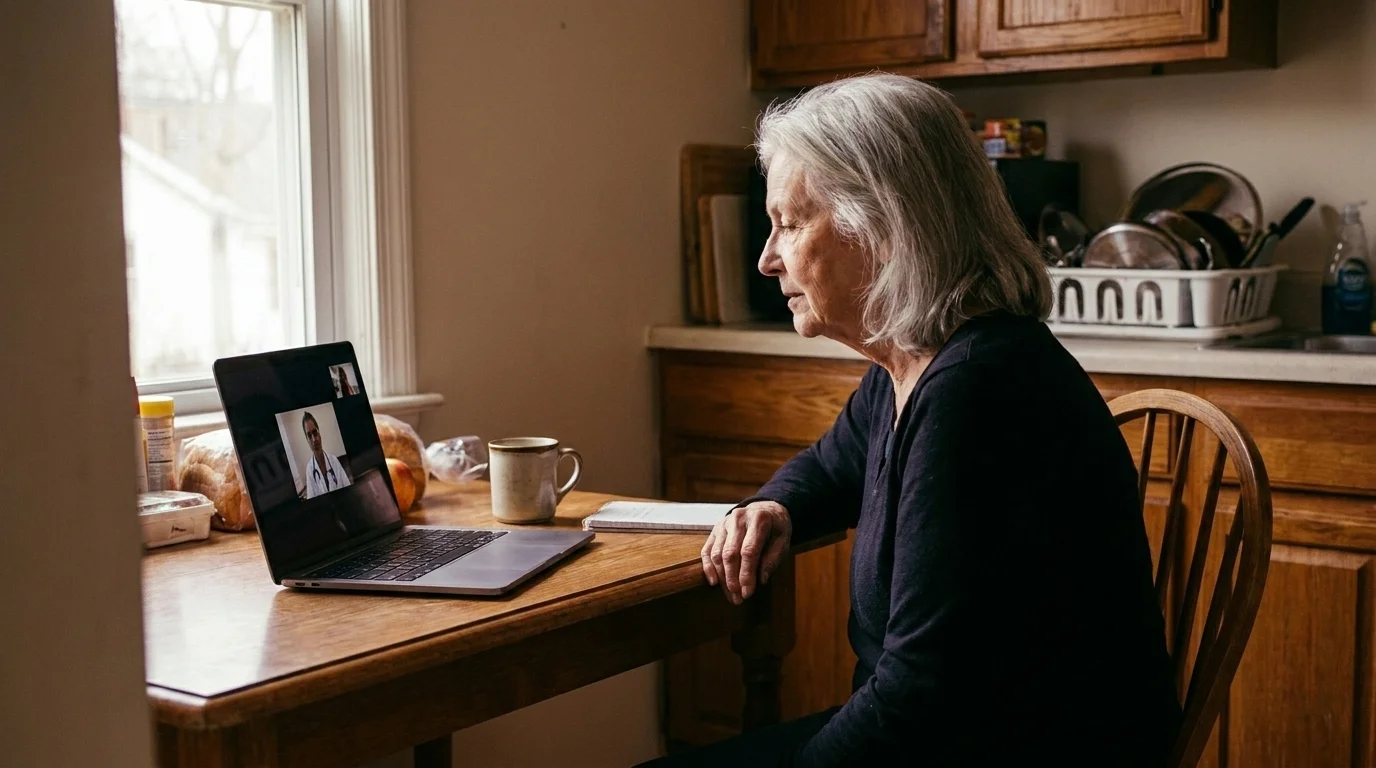
The reason the distinction matters is that access without the other two pieces produces exactly the kind of program that looks progressive on paper and helps the people who needed the least help. A patient portal that assumes a fast home connection, a recent smartphone, and English-language fluency is technically "available" to everyone and usable by a subset. That gap is not an accident of rollout. It is a design choice, and design choices have owners.
The digital determinants of health
If you want the organizing framework — and the competitors who actually rank for this topic all use one — it is the digital determinants of health, or DDoH. Richardson's group defines these as "conditions in the digital environment that affect a wide range of health, functioning, and quality of life outcomes and risks," operating across four levels: the individual, the interpersonal, the community, and the societal. A WHO Europe and LSE analysis went further and counted them, identifying 127 health determinants altered by the digital age, 37 of which are specifically digital.
The point of a framework like this is not academic tidiness. It is that it forces you to stop blaming individuals. When a 72-year-old misses a video visit, the individual-level story is "she isn't tech-savvy." The DDoH story is that her broadband, her device, the interface, the reimbursement rules, and the absence of anyone whose job is to help her log on are all determinants — and most of them sit above her pay grade and outside her control.
Who got left offline: the barriers, with numbers
The barriers to digital health are not mysterious, and they are not evenly distributed. Broadband adoption in 2024 ran at 92 percent for households earning at least $100,000 and 57 percent for those earning under $30,000 — a 35-point gap that maps almost perfectly onto who can and cannot keep a telehealth appointment.
Geography compounds income. In Medically Underserved Areas, 74.7 percent of households have a broadband subscription versus 85.2 percent elsewhere, and counties with low broadband also had 12 percent fewer outpatient care centers and 48 percent fewer diagnostic labs. The places with the worst internet are the same places with the fewest clinics. The digital divide in healthcare is not a separate problem layered on top of the access problem; it is the access problem, moved online. Home-broadband by race and ethnicity in 2021 tracked the same fault lines — 81 percent for Latino households, 83 percent for Black, 87 percent for white, 88 percent for Asian.
Then there is literacy, which the field has finally started to measure instead of assert. A 2025 international study in JMIR put mean digital health literacy at 29.2, with 28.2 percent of the sample scoring below 26 and older adults consistently lower. A patient who cannot confidently navigate a portal is not "non-compliant." They are on the wrong side of a measured, population-level gap.
Telehealth for underserved populations
Telehealth is where these abstractions become a missed appointment. It is the single most concrete use case for digital health equity, and the disparities are documented rather than theorized. During COVID-19, Black, Latinx, and Indigenous patients, non-English speakers, and low-income patients had measurably less telemedicine access than non-Hispanic white patients. The pandemic was supposed to be telehealth's great democratizing moment. For the populations a telehealth program would claim to serve, it widened the gap it was sold as closing.
This is why the ACP's collapse belongs at the center of any honest treatment of telehealth access for underserved populations. The subsidy was the connectivity floor under a lot of those visits. Remove it, and 36 percent of former enrollees stop showing up to the video appointment — not because they decided medicine could wait, but because the internet became a choice against groceries.
When the tools themselves deepen the gap
The most uncomfortable part of digital health equity is that the technology can widen disparities even when access is solved, because the tools are built on data that underrepresents the people they are deployed on. The canonical example: a widely used healthcare risk-prediction algorithm systematically underestimated the needs of Black patients by using prior healthcare spending as a proxy for how sick someone was — which only works if everyone has had equal access to care, which is the whole thing we are trying to fix. Dermatology AI trained mostly on lighter skin tones underperforms at detecting skin cancer in darker skin from the same source.
Ask the follow-the-money version of the question and it gets sharper: whose data was in the training set, who signed off on shipping the model without checking, and who eats the cost when it gets a darker-skinned patient wrong. "The algorithm decided" is not an answer. Somebody decided what the algorithm learned from.
What actually closes the gap
The good news is that the interventions are not speculative, and they have names. Digital navigators — staff or trained community health workers whose job is to get patients onto the device and into the portal — are a documented intervention with defined competencies in primary care, not a buzzword. Device-lending programs, multilingual platform design, and provider digital-literacy training round out a toolkit that competitors describe and most wellness blogs reduce to "targeted outreach."

What unites the credible interventions is that they treat connectivity, devices, and human help as infrastructure to be funded, not as personal virtues to be cultivated. The WHO's Dr. Natasha Azzopardi-Muscat put it plainly in March 2026: equity in digital health "cannot be achieved through isolated actions but requires a coordinated, whole-system approach."
So here is the stake, stated the way I would state it about any wellness-access initiative: a digital health program that hands a slick app to people who already have fast broadband and a current phone, while the subsidy that kept poorer patients online is allowed to die in committee, is not closing the divide. It is a feature for the people who were never on the wrong side of it. The serious version of digital health equity is not which app is in the patient portal. It is whether the connection, the device, and the person who helps you use them survive the next budget cycle.
Frequently Asked Questions
Equitable access to digital healthcare, equitable outcomes and experience from it, and equity in how digital health tools are designed — so technology narrows rather than widens health disparities (Richardson et al., npj Digital Medicine).
Conditions in the digital environment — broadband access, devices, digital literacy, and inclusive design — that affect health outcomes across individual, interpersonal, community, and societal levels.
When the ACP internet subsidy ended in June 2024, 36% of former enrollees stopped using telehealth, and broadband adoption is 57% for households under $30K versus 92% over $100K — directly limiting access to digital care.
Digital navigators, device-lending programs, multilingual platforms, provider digital-literacy training, and equity-by-design, including bias monitoring for health AI.