Literary Healing: Nurturing Mental Fortitude Through the Wellness Benefits of Reading and Writing


People ask me for books for mental health more often than they ask for almost anything else, usually at the end of a session, half-apologizing, as if wanting something to read between appointments were a small request. It isn't. The practice of using reading and writing to support psychological health has a name — bibliotherapy — and it has more evidence behind it than most people assume. What it doesn't have, in most of the lists you'll find online, is a clinician telling you which book is right for what you're actually carrying. That's the gap I want to fill here.
So this isn't a ranked list of the most popular titles. It's the smaller, slower version of what I'd say if you were sitting across from me: what the research actually shows, the handful of books I reach for and who each one is for, and how to read and write in a way that does something rather than just passing the time.
Is bibliotherapy actually evidence-based?
Short version: yes, with caveats I'll be honest about.
Bibliotherapy is the structured use of reading — usually self-help or psychoeducational material, sometimes fiction — to support mental health, often alongside therapy rather than instead of it. A December 2025 systematic review in Frontiers in Psychiatry pooled the modern trials and found a moderate effect on depressive symptoms — a standardized mean difference of –0.52 (95% CI –0.89 to –0.15). In plain terms, that's not a miracle and it's not nothing; it's a real, measurable nudge in the right direction.
The prevention data is more striking. In one trial cited in that review, the two-year incidence of new-onset depression was 3% among people who used bibliotherapy, compared with 14% for a group-CBT condition and 23% for the control group. And it's cheap: the same review estimates a cost of roughly $8 per participant. That accessibility is part of why the UK's "books on prescription" scheme, Reading Well, has lent more than 4.3 million books since 2013, with 90% of borrowers saying it helped and 89% of health professionals saying they valued it. In the UK's NICE guidelines, guided self-help including bibliotherapy sits at Step 2 of care for mild-to-moderate depression — early, accessible, before more intensive treatment.
Here's the part the listicles leave out, because it doesn't sell books: the evidence is stronger for adults than for adolescents. Across the long-term trials in that 2025 review, adult studies showed symptom reductions while several adolescent trials did not reach significance. Reading is a genuine tool. It is not a substitute for treatment when someone needs treatment, and I'd rather you know that going in.

The books I reach for, by what you're carrying
I'm not going to hand you forty titles. A long list is its own kind of avoidance — it lets you feel productive without choosing anything. These are the ones I come back to, grouped by what a reader is usually working on. Pick by the need, not the bestseller rank.
When the weight is trauma or a body that won't settle
The Body Keeps the Score by Bessel van der Kolk is the one almost everyone has heard of, and for good reason — it gives people language for why a difficult event can live in the body long after the mind has "moved on." A caution from my chair: it can be activating to read alone if your own trauma is fresh, so it's best for the reader who is already in some kind of support, or who can pace themselves and put it down.
When you're stretched thin and can't say no
Set Boundaries, Find Peace by Nedra Glover Tawwab is the book I recommend most for burnout and over-functioning. It's concrete and unsentimental, and it's good for the reader who keeps "holding boundaries" and feeling betrayed when other people don't honor them — because, as I often say, a boundary is a decision about what you will do, not a rule you impose on someone else.
When depression is making everything quiet and flat
For depression, I tend to point people toward Reasons to Stay Alive by Matt Haig — a memoir, not a manual, and many of the clients I've suggested it to have found it steadying precisely because it isn't trying to fix them. For readers who want to understand the context around low mood rather than only the chemistry of it, Lost Connections by Johann Hari is a thoughtful companion. Read these as company, not as a diagnosis.
When you want a story, not a self-help book
Fiction counts. The Bell Jar by Sylvia Plath is a hard, honest portrait of depression that many readers find clarifying — best for someone who is stable enough to sit with difficult material and who finds recognition more useful than reassurance.
When you're navigating the system itself
If the hard part right now is how to get help — for yourself or someone you love — the NAMI guide You Are Not Alone by Ken Duckworth is the most practical map I know of for understanding diagnoses, treatment, and how to actually move through the mental-health system.
How to read so it actually helps
This is the step almost nobody talks about, and it's the one the research is clearest on. That 2025 review found that guided bibliotherapy — reading paired with some structure, often CBT-informed, sometimes with a therapist or a group — outperforms just reading on your own, and that group-based reading with structured discussion shows the strongest long-term preventive effects.
You can borrow that structure without a clinic. A few things that make reading therapeutic rather than passive:
- Read with a question, not just for distraction. Before you open the book, name one thing you're trying to understand. "Why do I shut down after conflict?" gives your brain a frame to fit the material into.
- Stop and reflect, on paper, every chapter or two. A sentence or two — "this part landed because…" — turns reading into processing.
- Talk about it with one person. A friend, a partner, a therapist, a book group. The structured-discussion effect is real.
- Go slowly, and put it down when it's too much. Pacing is not weakness; it's how you keep the material workable instead of overwhelming.
Expressive vs. positive writing: which to use when
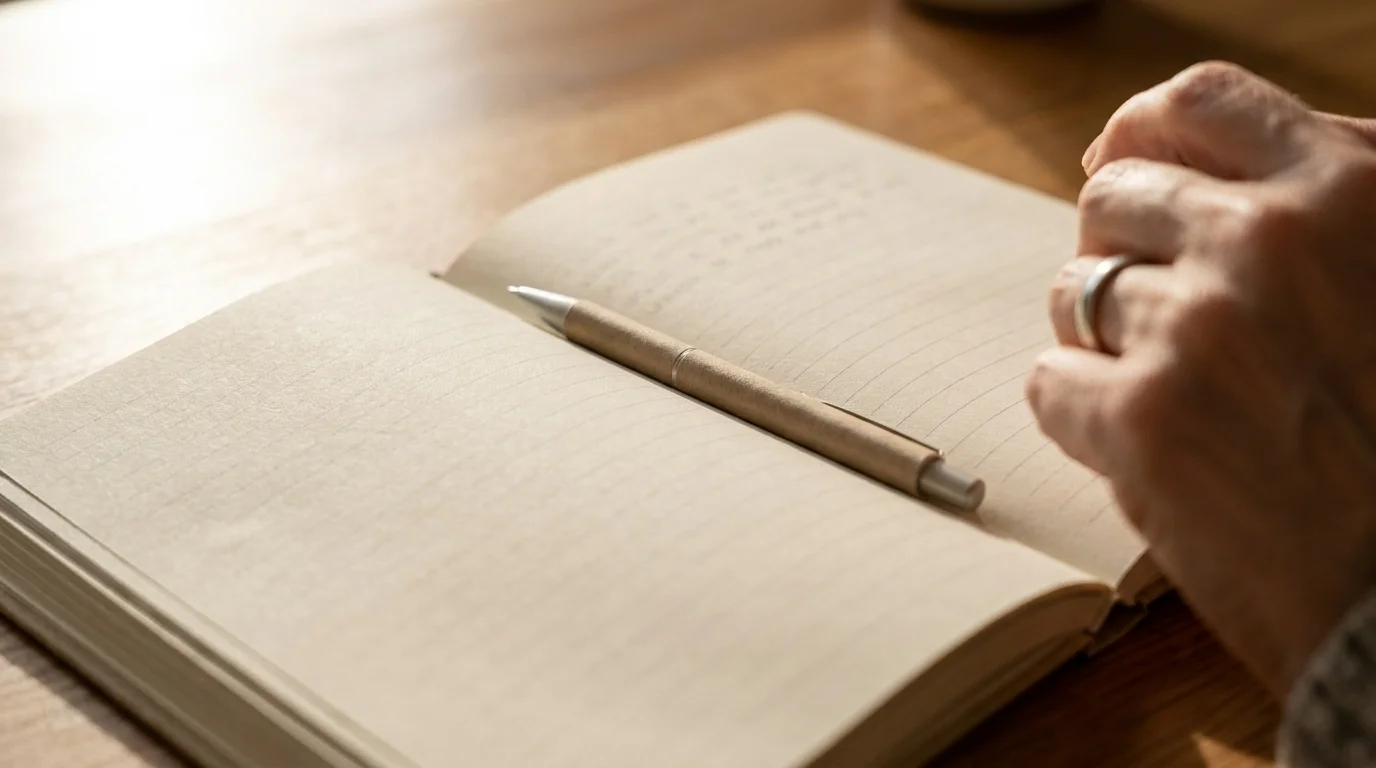
The writing half of this gets flattened into one piece of advice — "just journal it out" — and that advice is only half right. A 24-trial meta-analysis by Lai and colleagues (1,558 participants, 2023) found something more useful: the type of writing matters, and it should match the moment.
Positive writing — focusing on a good experience, what you're grateful for, or how you grew through something — was better at reducing negative emotions and raising positive ones in the general population (a mean difference of –0.46 for negative-emotion reduction and 0.41 for positive-emotion gain). Expressive writing — writing rawly about a difficult event — was more useful for cognitive processing in clinical patients. So if you're having a rough but workable week, lean positive. If you're trying to make sense of something hard, expressive writing earns its place.
A few prompts that map onto that split:
- Positive, for everyday mood: "Describe one moment today that went better than I expected, in detail."
- Positive, for perspective: "Write about a difficult time I came through, and one thing it taught me I still use."
- Expressive, for processing: "Write about what's weighing on me right now, without editing, for ten minutes — no one else will read this."
- Affect labeling, for the 3 a.m. version of this: one sentence naming what you feel and what it's about. Simply putting the feeling into words has been shown, in neuroimaging work by Matthew Lieberman and colleagues, to quiet the brain's threat response — it sounds too simple to work, and it works anyway.
When a book isn't the right tool
I want to be careful about the line I'm always careful about with clients: there's a difference between uncomfortable but workable and clinical and needs support. A book can be a steadying companion for a hard season. It is not the right primary tool when you're not sleeping or eating, when the low mood has lasted weeks and flattened everything, or when you're having thoughts of not being here. None of that is a failure of reading. It's a signal to bring in a person.
Therapy is not a luxury, and reaching for it is not an admission that the books didn't work. If you're in crisis, please contact the 988 Suicide and Crisis Lifeline (call or text 988 in the US) or your local equivalent — and then, when you're steadier, the right book will still be there.

Frequently Asked Questions
Therapist-favored picks include The Body Keeps the Score (van der Kolk) for trauma, Set Boundaries, Find Peace (Tawwab) for burnout and over-functioning, and the NAMI guide You Are Not Alone for navigating the system. Choose by the need you're actually working on, not by popularity.
Yes, with limits. A December 2025 systematic review found a moderate effect on depressive symptoms (SMD -0.52), NICE recommends guided self-help including bibliotherapy at Step 2 for mild-to-moderate depression, and the UK's Reading Well scheme has lent 4.3M+ books since 2013. Guided reading works better than unguided, and the evidence is stronger for adults than adolescents.
It's a grounding technique: name three things you can see, three sounds you can hear, then move three parts of your body. It interrupts an anxious spiral by re-anchoring your senses in the present, and it pairs well with longer-form reading or writing work.
It helps, but the type matters. Research shows positive writing (gratitude, growth, good moments) lifts mood best for everyday stress, while expressive writing (writing rawly about a hard event) better helps process difficult experiences. Match the method to the moment.