
Unveiling Trailblazing Visionaries in Mental Well-Being: The Overlooked Leaders Shaping Psychosocial Health Narratives


If you have ever wondered how to become a mental health advocate, the honest starting point is to correct the picture in your head. Most people imagine someone with a title — a psychiatrist, a famous campaigner, someone whose work belongs in a documentary. That image is not just wrong; it is the thing that stops most people from starting. Here is the more useful truth, and it comes from one of the field's leading nonprofits: becoming a mental health advocate, in Mental Health America's words, "doesn't require a formal process, and you don't need any special qualifications. It simply means that you show up in the world and take actions to promote mental health." So if that question has stopped you — how to do this without going back to school — this guide is the slow, plain answer: what advocacy actually is, and how you can start this week.
Why advocacy matters right now
The need is not abstract, and it is not improving on its own. According to Rula's 2026 mental health trends report, 60% of U.S. adults say mental health has become more important to them — and yet 52.6% have never tried a service like talk therapy or psychiatry, with about a third reporting high financial stress as a barrier. Over the same period, anxiety rose 9.3% and depression 10.6%, and among young adults aged 18 to 25, 15.9% had a major depressive episode — about twice the overall adult rate.
I want to name what that gap actually is. Awareness is up; access is not. Advocacy is simply the work of closing that gap — sometimes through policy, more often through the small, ordinary acts that make it easier for the person next to you to reach for help.

What mental health advocacy actually is
Mental health advocacy is any action that promotes mental health or supports people who live with mental health conditions — fighting stigma, improving access to care, and making space for honest conversation. That is the whole definition. It does not require a license, a platform, or a perfect personal story. The distinction worth holding onto is this: advocacy is not the same as being someone's therapist. You are not diagnosing, treating, or fixing anyone. You are making the path to real care shorter and less lonely.
The four kinds of advocacy (and what each looks like)
Advocacy is vague until you break it into types. Here are four, with concrete examples of each, so you can find the one that fits your life.
- Self-advocacy — asking for what you need and modeling that it's allowed: naming a mental health day without apology, telling your doctor the full truth, learning your insurance's coverage.
- Peer support — using your own lived experience to walk alongside someone else. This one has real evidence behind it: a systematic umbrella review found that peer support reduces re-hospitalization and inpatient days and improves self-efficacy and recovery. Showing up as someone who has been there is not a lesser form of help. It is a studied one.
- Community advocacy — sharing a resource, correcting a stigmatizing comment, starting or joining a support group, organizing a fundraiser or an awareness walk.
- Systemic / policy advocacy — contacting an elected official, signing or circulating a petition, writing to a newspaper, or backing the campaigns of organizations like the National Alliance on Mental Illness (NAMI) and Mental Health America.
Most people start at the top of that list and move down as they find their footing. None of these is more "real" than the others.
How to start advocating this week
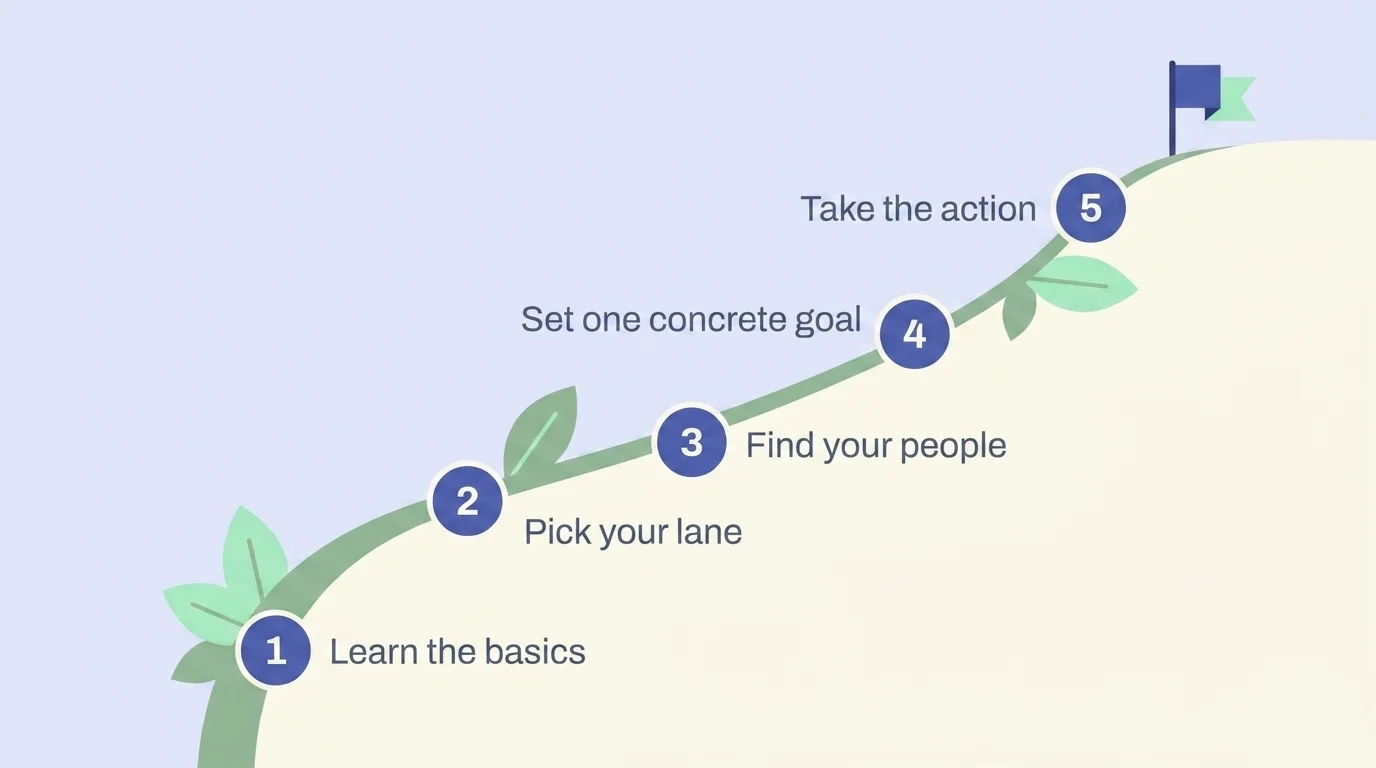
You do not need a five-year plan. Mirroring the path organizations like Mental Health America lay out, here is a short, doable version:
- Learn the basics. Read one credible source on a condition you care about — NAMI and MHA both publish plain-language guides.
- Pick your lane. Choose one of the four types above. One is enough.
- Find your people. Follow a real organization (NAMI, MHA, or a campus or workplace group) so you're not doing this alone.
- Set one concrete goal. Not "raise awareness" — something you can finish, like sharing one resource a week, attending one meeting, or learning your employer's mental health benefits.
- Take the action. Then do it again next week. As MHA puts it, "sharing your story can fight stigma, build connections, and inspire change."
It sounds too small to matter. It matters anyway. Advocacy is mostly the accumulation of small, repeated, unglamorous acts.
Advocating at work — and the stigma gap
Work is where many people first practice advocacy, and the data shows exactly where the friction is. The 2026 NAMI-Ipsos Workplace Mental Health Poll found that 75% of employees think discussing mental health at work is appropriate — but only 57% feel comfortable actually doing it with their manager. The earlier 2025 NAMI poll found that just over 20% of employees receive any training on mental health conditions, and two in five worry that bringing it up would hurt their career.
That gap between "it's appropriate" and "I feel safe doing it" is precisely where everyday advocacy lives. You don't close it with a grand gesture. You close it by being the person who answers honestly when asked how you are, who shares a resource in a team channel, or who quietly asks HR what the mental health benefits actually cover — because only about half of employees know.
When you're advocating for someone else
A specific, hard situation: someone you love clearly needs help and won't get it. Advocacy here is not coercion. Lead with listening rather than fixing. Offer options without pressure. Share a concrete, low-stakes entry point — a warmline, a text line, a single appointment — rather than demanding they overhaul their life. And keep the door open, because readiness rarely arrives on our schedule.
There is a line worth being careful about. Supporting someone is a self-care-adjacent act; a crisis is a clinical one. If someone is in immediate danger or talking about suicide, that is not a moment for gentle encouragement — connect them to emergency help right away.
If you want to make it a career (a short note)
Everything above requires no credential. The paid path is a separate lane: roles like peer support specialist or community health worker, and a growing set of advocate certifications and micro-credentials emerging in 2026. If a career is your goal, look into certification and lived-experience peer roles. If it isn't, you can skip this entirely — advocacy was never gated behind a job.
Where to actually start
If you take one thing from this: you are already qualified to begin. Pick one organization to follow — NAMI, Mental Health America, or Active Minds — and one small action this week. That is advocacy.
One last note, because I always make it. Advocating for others is not a substitute for caring for yourself, and therapy is not a luxury — it is one of the forms self-care can take. If you or someone you're supporting is in crisis or thinking about suicide, please contact the 988 Suicide and Crisis Lifeline (call or text 988 in the US) or your local equivalent. Showing up for mental health includes showing up for your own.
Frequently Asked Questions
Lesser-known leaders in mental health advocacy include grassroots activists and community organizers who work tirelessly to support individuals facing mental health challenges. Their contributions often go unnoticed, yet they play a crucial role in creating supportive environments and dismantling stigma within their communities.
No. Advocacy requires no formal qualifications — you can start by sharing your story, educating yourself, or supporting an organization like NAMI or Mental Health America. A degree or certification only matters if you want the paid-career path, such as a peer support specialist role.
Talk openly when it feels safe, share resources, and push for training. Only about 20% of employees get any mental-health training, and 75% say discussing it at work is appropriate — yet just 57% feel comfortable doing so (NAMI 2026). Closing that gap is everyday advocacy.
Examples include sharing your story, contacting legislators, joining a fundraiser or awareness walk, correcting stigmatizing language, starting or joining a support group, or volunteering with a nonprofit like NAMI or Mental Health America.
Lead with listening rather than fixing, share options without pressure, and connect them to a low-stakes entry point like a warmline or crisis text line. Keep the door open. If someone is in immediate danger, contact emergency help or the 988 Suicide and Crisis Lifeline right away.