Breaking Through the Noise: Combatting Misinformation in Nutrition and Wellness


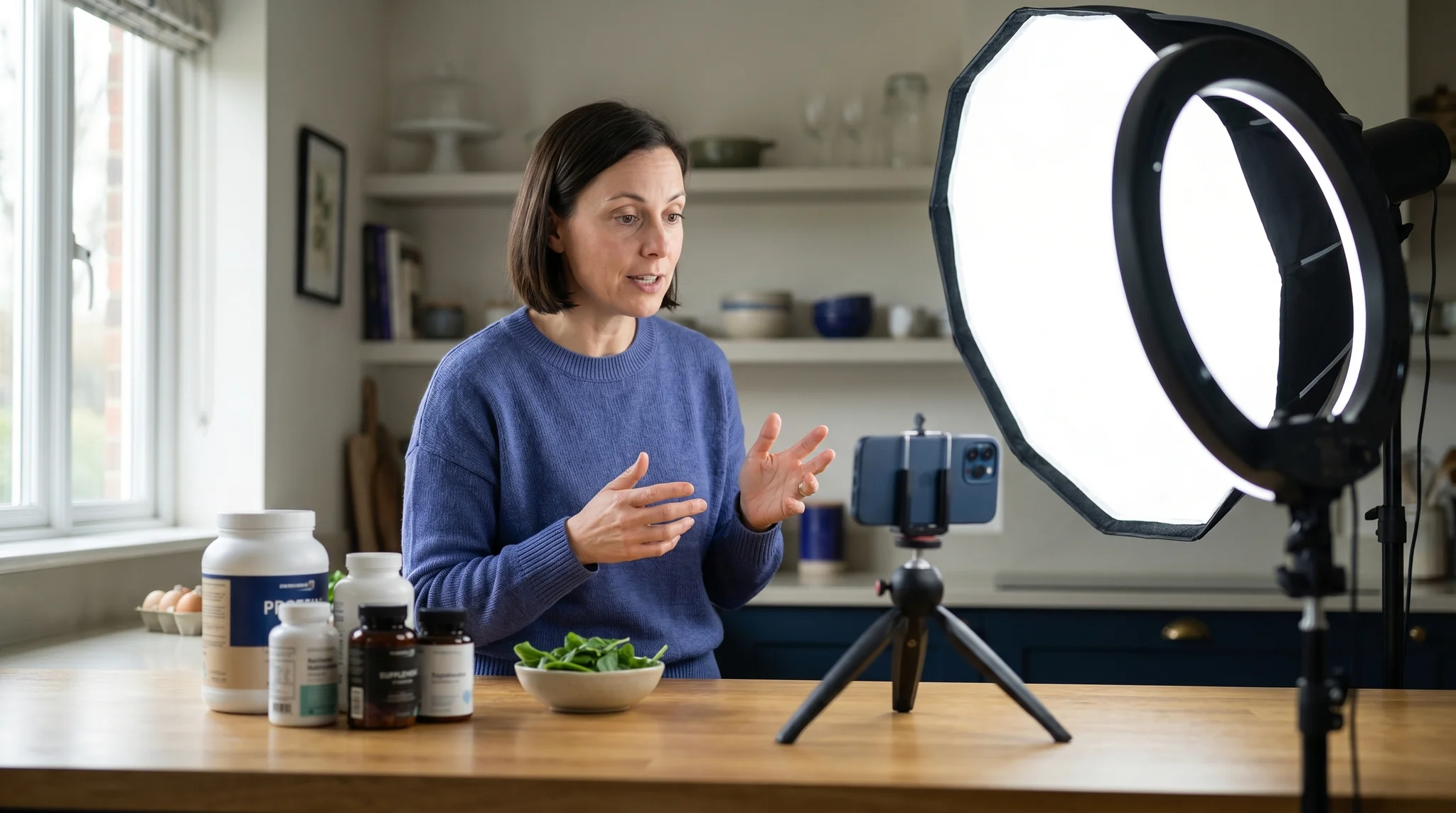
A friend texts you a screenshot at 11 p.m.: a wellness influencer, very confident, very lit, explaining that seed oils are quietly wrecking your metabolism and the only fix is the supplement linked in their bio. You want to know if it's true. That instinct — to check before you change dinner — is the whole game. Most nutrition myths don't survive a careful look, but they don't need to survive. They need to spread, and right now the spreading is a business.
That's the part the older "infodemic" framing missed. The problem isn't only that inaccurate advice exists online; it's that a measurable, profit-driven distribution system pushes it to millions. A June 2025 report from the Rooted Research Collective and Freedom Food Alliance analyzed 53 social-media "super-spreaders" with a combined reach of roughly 24 million followers. Nearly one in five presented themselves as credentialed without verifiable qualifications, and 96% had a direct financial incentive — a supplement, an affiliate link, a coaching program — tied to the advice they gave (NutraIngredients). As Alice Millbank, the collective's chief scientific officer, put it: super-spreaders "exploit that confusion by recounting their emotive and personal stories and providing dangerously simple answers dressed up as hacks, often driven by profit, not science."
So this isn't a lecture about why misinformation is bad. It's the tool I'd hand a patient: a way to vet a claim in thirty seconds, the current data on where bad advice actually lives, and a plain-language debunk of the myths worth unlearning in 2026.
How do you spot nutrition misinformation?
You don't need a nutrition degree to filter most of it. You need a short checklist and the willingness to run a claim through it before you act. Here are the red flags I look for first.
- It promises a quick fix or a "detox." Your liver and kidneys already detoxify your body continuously; no tea, juice, or cleanse improves on that. A claim built on speed ("drop 10 pounds in a week") is selling urgency, not nutrition.
- It demonizes a single food or whole food group. "Never eat X" is almost always oversimplified. Dietary patterns over weeks and months drive health outcomes — not one ingredient you ate on Tuesday.
- It cites no science, or cites a single dramatic study. One small trial is a starting question, not a conclusion. Look for whether the claim reflects a body of evidence (a systematic review or meta-analysis) or a lone outlier.
- It uses anecdote as proof. "It worked for me" is a hypothesis, not data. Personal transformation stories are persuasive precisely because they bypass the question of whether the effect generalizes.
- The person making the claim profits from it. If the same post that diagnoses your problem also sells the solution, the financial incentive is itself a red flag — and, per the 2025 super-spreader data, that's the norm at the top of the feed, not the exception.
Now run a real 2026 claim through it. "Seed oils are toxic — switch to beef tallow." Quick fix? It's framed as a single villain (flag), it demonizes an entire food category (flag), it leans on anecdote and outrage rather than trials (flag), and the loudest accounts pushing it tend to sell tallow products or carnivore programs (flag). Four flags. That doesn't make every concern about ultra-processed food invalid — it means this specific claim is built like marketing, and the actual evidence on linoleic acid points the other way.

Can you trust TikTok for nutrition advice?
Usually not without checking the source first — and the numbers are stark. A February 2025 peer-reviewed study in Nutrients analyzed TikTok's "#WhatIEatinaDay" content and found that only 36% of videos were completely accurate, 19% were completely inaccurate, and a striking 41% couldn't be classified as true or false at all because they were purely anecdotal (News-Medical, DOI 10.3390/nu17050781).
The credential gap explains a lot of that. In the same study, only 5% of the creators were registered dietitians and 4% were nutritionists, while 32% were general health and wellness influencers — and the dietitians produced by far the most accurate posts (42% entirely accurate). Other platforms look no better: an analysis cited by National Geographic found that 86% of influencer nutrition posts on Instagram cited no scientific source and 45% contained inaccuracies, while 97% of popular weight-loss, muscle, and detox supplement videos on TikTok offered no scientific evidence at all (National Geographic).
What makes this genuinely hard to navigate is that the bad and the good are interleaved. "Often there was a mixture of misinformation and accurate information, which can make it very challenging," noted Emily Denniss of Deakin University, whose research mapped the quality of online nutrition content. The takeaway isn't "delete the app." It's: when a nutrition video moves you to buy something or cut something, pause and check who's talking before you act.
RD vs. nutritionist vs. influencer: how to read credentials
"Registered Dietitian" is a protected credential. To use the letters RD (or RDN), a person completes an accredited program, a supervised practicum, a national board exam, and ongoing continuing education through the Commission on Dietetic Registration. "Nutritionist," in most places, is not protected — depending on the state, anyone can use it. And "wellness coach" or "health influencer" certifies nothing about nutrition science at all.
Here's the part people find surprising: "just ask your doctor" is reasonable but incomplete, because roughly 75% of U.S. medical schools lack required clinical nutrition coursework (National Geographic). Most physicians are excellent at diagnosis and treatment and were simply never trained in depth on diet. For a specific nutrition question — managing blood sugar, a new restriction, eating around a diagnosis — an RD is the person whose entire training is that question. Evidence-based nutrition advice has a paper trail and a name attached to it. If you can't find either, treat the claim as unverified.
The nutrition myths worth unlearning in 2026
A useful feature of this field is that the myths themselves shift. Some of the diet myths that dominated a decade ago have flipped direction entirely, and 2026 expert round-ups now spend as much energy defending foods as debunking them (Abbott Nutrition News).
- "Detox diets clear out toxins." They don't, and they never did. Your liver and kidneys handle detoxification; a juice cleanse mostly clears out your wallet and, briefly, your glycogen and water weight.
- "Dietary cholesterol from eggs is dangerous for everyone." For most people, saturated fat and overall dietary pattern affect blood lipids far more than the cholesterol in an egg. Eggs are back on the "let it go" list of myths for 2026.
- "Seed oils are toxic." This is the era's loudest new myth, and from where I sit it runs the evidence backward. The foods being demonized — canola, soybean, sunflower oils — are the ones mainstream nutrition science has long treated as better for your heart than the saturated fats people are being told to swap back to. You can cook with whatever you enjoy; you don't need to fear canola.
- "A bigger calorie deficit is always better." Very large deficits tend to cost you muscle, energy, and adherence, which is why crash diets so reliably rebound. Sustainable change beats severity.
Notice what these corrections have in common: each replaces a dramatic single-food verdict with a boring, durable truth about overall pattern. That's almost always the shape of the real answer.
Related Article: The Alchemy of Essential Oils: Unveiling the Science Behind Aromatherapy’s Therapeutic Effects
Why these myths spread — and stick
If the evidence is this clear, why do the myths keep winning? A 2026 narrative review in Clinical Nutrition ESPEN laid out the drivers in plain terms: nutrition myths persist for psychological reasons (we crave simple, controllable answers), social reasons (we trust people who look like us more than institutions), commercial reasons (someone profits), and media reasons (outrage and certainty travel faster than nuance) (ScienceDirect).
The commercial driver is the one I'd weight most heavily as a consumer, because it's the most predictive. When 96% of the biggest spreaders profit from their own advice, "follow the money" isn't cynicism — it's a screening tool. Regulators and platforms are slowly building enforcement around health claims, but that machinery moves slowly, and it will always lag the next viral hack. Your own filter is the part you control today.
Fad diets: the high-volume cousin of misinformation
Fad diets are where myths get packaged into a program with a name and a buy button. The current crop — strict carnivore, extreme keto, raw-milk advocacy — recycles the same red flags: a single villain food group, dramatic before-and-afters, and a product or membership attached. The pattern to remember is that the more rigidly a diet eliminates whole categories of food, the more it depends on you not asking what the actual evidence says about that elimination. Restriction feels like discipline; for most people, over time, it mostly predicts the rebound.
The usable takeaway
You can't out-read the entire feed, and you don't have to. Keep the checklist close, default to evidence-based nutrition sources with a name and a citation attached, and ask one question before you change anything: who benefits if I believe this? Most nutrition myths fall apart the moment you do. And for the decisions that actually matter — a chronic condition, a medication, a real dietary change — that conversation belongs with your own clinician or a registered dietitian, not a stranger's "what I eat in a day."
Frequently Asked Questions
Often no. A 2025 Nutrients study found only 36% of TikTok nutrition videos were fully accurate and just 5% came from registered dietitians. Verify the creator's credentials before acting on anything you see.
Quick-fix or "detox" promises, demonizing a single food, eliminating whole food groups, no cited science, anecdotes used as proof, and anyone selling the supplement they're recommending.
Nutritional misinformation refers to false or misleading claims about diet and health that circulate online. It poses significant risks as it can confuse consumers, lead to poor dietary choices, and potentially harm health. With the vast amount of information available, distinguishing credible sources from unreliable ones is crucial for making informed decisions about nutrition.
Identifying popular diet myths involves scrutinizing claims that promise quick fixes or drastic weight loss without scientific backing. Look for evidence-based information and consult reputable sources. Common myths include detox diets and extreme calorie restrictions, which often lack support from credible research. Educating yourself on nutrition can help you discern fact from fiction.
Both consumers and healthcare professionals play vital roles in combating nutritional misinformation. Consumers need to critically evaluate health information, while healthcare professionals should advocate for evidence-based practices and share accurate guidance. Collaborative efforts between these groups can enhance public understanding and promote a trustworthy environment for health information.
Fostering a truthful wellness community requires promoting transparency, accountability, and ethical sharing practices among influencers and content creators. Encouraging open discussions about health topics and supporting evidence-based messaging can build trust. Additionally, educating the public on how to evaluate sources enhances collective efforts toward creating an informed community focused on well-being.
Social media significantly influences nutrition information by serving as a platform for sharing trends, advice, and personal experiences. However, this can lead to the spread of misinformation if users do not critically assess the credibility of the content. Responsible content creation prioritizing accuracy is essential to ensure that the information shared promotes genuine wellness practices.
Check Out These Related Articles

The Gut-Brain Connection: Unveiling the Impact of Gut Microbiota on Mental Health

Microbiome Insights: Revolutionary Findings on Gut Health and Its Impact on Mental Well-Being
Redefining Nutritional Science: The Role of Epigenetics in Personalized Dietary Recommendations