
Career Development in Mind-Body Wellness: Fostering Mental and Physical Harmony


If you are reading this, you are probably tired of your current job, you keep getting served wellness-coach ads in your feed, and you want to know whether becoming a holistic wellness coach is a real career or a Pinterest fantasy. I am a registered dietitian, I work in the same broader practitioner ecosystem, and I can tell you the honest answer is: it is a real career, the salary range is wider than the marketing suggests, and the one variable that matters most is whether you pursue board certification.
That is the line worth opening with, because it is the line most career guides bury. According to the Integrative Nutrition 2026 industry brief, non-board-certified health and wellness coaches earn a median of around $62,000, while board-certified (NBC-HWC) coaches earn a median of around $97,000 — a roughly $35,000 premium tied to one credential. Everything else in this guide hangs off that fact. The global health-coaching market sits at $24.1 billion in 2026 and is projected to reach $35.6 billion by 2030, a 10.2% compound annual growth rate, and the broader healthcare and social-assistance sector that contains it is forecast to grow 8.4% through 2034 (BLS data via Integrative Nutrition). So yes, the work is real. The question is which lane fits, what it costs, and how long it takes.
What a Holistic Wellness Coach Actually Does
A holistic wellness coach partners with clients on behavior change across the full life context — sleep, nutrition, movement, stress, relationships, and the practical logistics that make any plan stick or fall apart. The work looks like a structured intake interview, collaborative goal-setting, weekly or biweekly sessions for several months, and check-ins about what is and is not working between sessions. Coaches do not diagnose disease, do not treat mental health conditions, do not prescribe, and do not bill insurance as the primary mechanism for getting paid. That scope sounds restrictive on paper and turns out to be liberating in practice — most chronic-disease prevention work is behavior change, and the coaching frame is genuinely good at moving the dial there.
The "holistic" qualifier in this title is doing real work. It signals that the coach treats food, movement, and mindset as a coherent system rather than three siloed prescriptions. In integrative medicine clinics and corporate wellness programs, the holistic coach is increasingly the person who threads the medical recommendations together for the patient's actual week, which is why the role has been growing even as adjacent generic-coaching searches have cooled. The Cleveland Clinic's health and wellness coach explainer makes the same point in clinical terms: the coach role is distinguished from a dietitian, physical therapist, or counselor by partnering on behavior change rather than delivering clinical service.
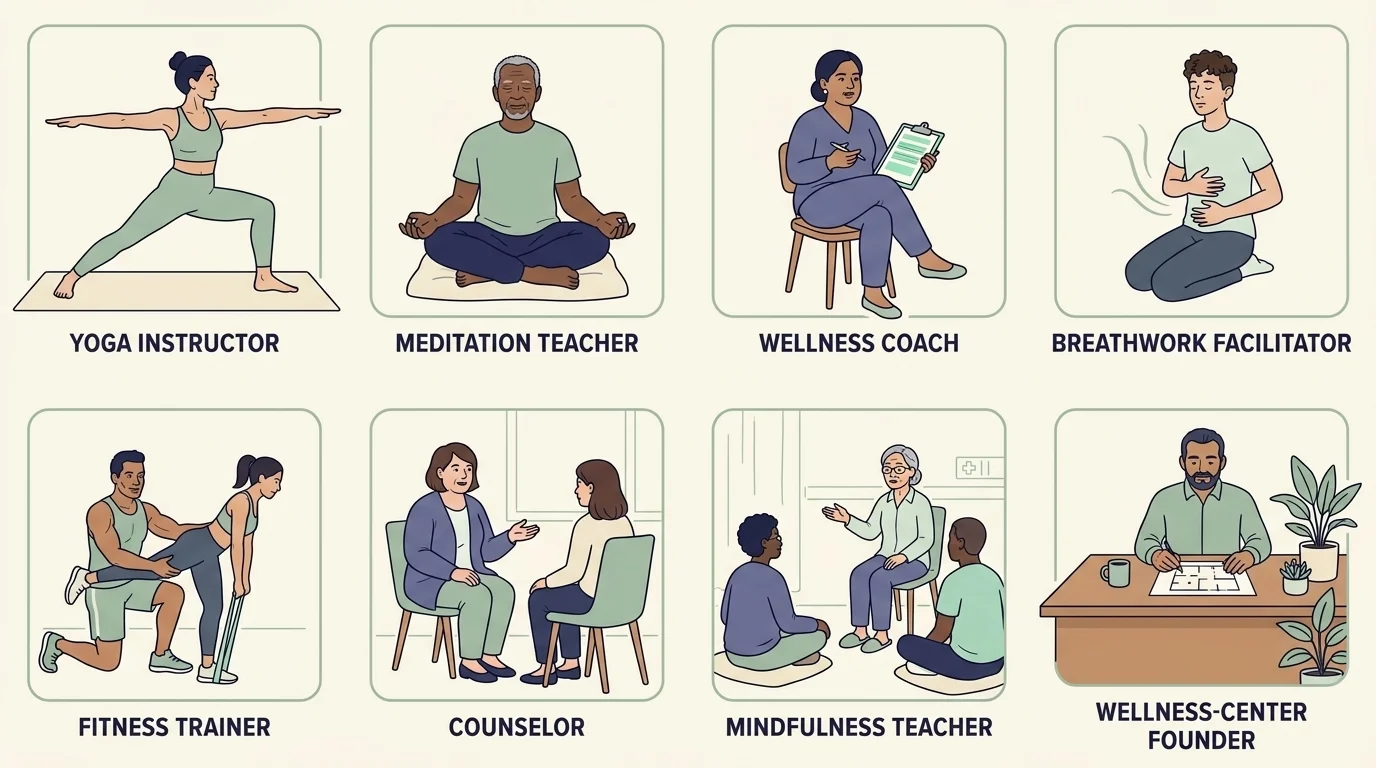
What this article calls "mind-body wellness careers" is really a family of eight related roles. The wellness coach sits at the center; the other seven — yoga instructor, meditation teacher, mindfulness teacher, breathwork facilitator, holistic fitness trainer, emotional wellness counselor, and wellness-center founder — sit alongside it with different credentialing paths, different income models, and different scope-of-practice rules. Picking the right one matters more than picking any of them quickly.

Eight Mind-Body Career Paths Compared
This is the table no competitor publishes in one place — credential body, typical cost, time-to-credential, US median salary band, and whether the work realistically runs remote. Use it to narrow your options before reading the deeper sections below.
| Career path | Primary credential | Typical training cost | Time to credential | US median salary (2026) | Remote-friendly |
|---|---|---|---|---|---|
| Holistic wellness coach | NBC-HWC (via NBHWC-approved program) | $3,000–$15,000 | 6–12 months | $47k (cert) → $62k (median) → $97k (board-cert) | Yes |
| Yoga instructor | RYT-200 / RYT-500 (Yoga Alliance) | $2,500–$4,000 | 1–3 months intensive | $40k–$60k full-time; per-class rates | Hybrid |
| Meditation teacher | IMTA-certified or lineage-specific training | $2,500–$8,000 | 6–18 months | $35k–$70k (heavily mixed-income) | Yes |
| Mindfulness / MBSR teacher | MBSR Teacher Certification (Brown / UMass Mindfulness Center) | $5,000–$10,000 | 1–3 years (cohort-based) | $50k–$85k (often institutional) | Hybrid |
| Breathwork facilitator | GPBA or CCBP (modality-specific) | $2,000–$6,000 | 6–12 months | $30k–$70k (mostly self-employed) | Yes |
| Emotional wellness counselor | LPC, LCSW, or LMFT (state license) | $30,000+ (master's) | 2–3 years post-undergrad | $55k–$85k (BLS counseling category) | Hybrid |
| Holistic fitness trainer | NASM-CPT / ACE + holistic specialty | $700–$2,500 | 3–6 months | $40k–$70k | Hybrid |
| Wellness-center founder | Business credentials + clinical credentials of services offered | Highly variable | 1–3 years to open + scale | -$20k year one to $120k+ at scale | Partial |
A few honest reads on this table. Coaching is the only path on it where the credential itself moves your salary by ~$35,000 — most of the others have flatter income curves that depend more on client volume than credential tier. Counseling is the path with the highest barrier to entry (a master's degree and a state license) and the most clearly scoped clinical work; if mental health diagnosis and treatment is what calls you, this is the path, and the rest of the article is not. Yoga has the lowest barrier and the wildest income range — a $3,000 200-hour certificate can be a hobby credential or, with effort and luck, the start of a full studio career. The wellness-center founder row is honest about the entrepreneurship reality: year one almost always loses money.
Related Article: Transformative Potential of Psychedelic Therapy: Breakthroughs in Mental Health Treatment Paradigms
How Much Holistic Wellness Coaches Earn
Salary data for this role is fragmented across aggregators, and the numbers diverge enough that any single source is misleading. Here is the honest cross-section for 2026.
| Source | Reported average (2026) | Notes |
|---|---|---|
| Integrative Nutrition (non-board-certified median) | $62,000 | Mid-career national median for coaches without NBC-HWC credential |
| Integrative Nutrition (board-certified median) | $97,000 | NBC-HWC credentialed coaches; the credential premium is real |
| Glassdoor | $64,884 | Mid-career skew |
| Salary.com (Feb 2026) | $55,500 (~$27/hr) | DC $61,400 / CA $61,200 / MA $60,400 regional adjusters |
| Simply.Coach (Mar 2026) | $47,264 | Certified coaches; most reported earning $36k–$52.5k |
| ZipRecruiter (May 2026) | $36,479 | Pulls in part-time and entry-level listings; lowest of the set |
| Integrative Nutrition — private rate | $100/session typical; $500+ top | Self-employed range; what you charge clients, not what you earn after taxes/no-shows |
A few things to read carefully from this table. The aggregator spread (ZipRecruiter $36,479 → Glassdoor $64,884) is mostly an artifact of which job postings the platform indexes — ZipRecruiter captures more part-time and entry-level roles, Glassdoor more salaried mid-career roles. The board-certified premium is the more important signal: if you graduate from an NBHWC-approved program and pass the board exam, you have moved your expected earnings to around $97,000. If you do not, the realistic landing zone is mid-$50s to mid-$60s depending on whether you are salaried or self-employed.
The private-practice numbers deserve a clarification I rarely see explained: $100 per session is a billed rate, not take-home. After no-shows, cancellations, business expenses, marketing time, and taxes, working solo coaches frequently report effective hourly rates that are lower than they expected when they set their session price. The IIN figure of $500-plus per session at the top end is real but reflects coaches with established brand presence, often years deep, frequently with adjacent products like books or programs doing the heavy income lifting.
How to Become a Holistic Wellness Coach
The path is well-defined enough that the following six steps cover most candidates, with the timeline mostly determined by whether you choose part-time or intensive training.
- Choose your modality. Wellness coaching is the broadest path and the one with the clearest board credential. If your interest is genuinely in yoga, meditation, mindfulness, breathwork, fitness, or counseling, the rest of this list shifts accordingly — go back to the comparison table and pick the row whose credential and scope match your work.
- Pick an accredited program. For coaching, the National Board for Health and Wellness Coaching (NBHWC) publishes an approved training program directory. Approved programs are what makes you eligible for the NBC-HWC board exam. Per the 2026 Integrative Nutrition guide, tuition typically runs $3,000 to $15,000, with self-paced online programs concentrated in the $6,000 to $8,000 range. IIN currently lists tuition between $3,495 and $5,995.
- Complete training. Programs run 6 to 12 months for coaching. Build in time for the practicum requirements your program specifies — most include supervised coaching sessions before graduation.
- Sit the board exam. The NBC-HWC exam requires graduating from an approved program plus completing 50 coaching sessions before sitting. This is the step that unlocks the salary tier difference; do not skip it if you intend to coach full-time.
- Handle the business side. Liability insurance, an LLC or sole-prop registration, client intake forms, a HIPAA-compliant scheduling platform if you are taking insurance-adjacent work, and clear scope-of-practice language on your website. Coaching is not state-licensed in the US, but several states regulate the title "counselor" or "therapist" — keep yours clearly off those.
- Build a practice. Decide your mix: private clients, corporate wellness contracts, integrative-clinic employment, online platform work, or a hybrid. According to IIN's career venues breakdown, working coaches are now placed in doctor's offices, hospitals, gyms, wellness centers, spas, schools, corporate, and private online practice — the venue choice meaningfully changes day-to-day work.
The realistic timeline from "I am going to do this" to "I have my first paying client" is 9 to 18 months. The first 6 to 12 are training; the next 3 to 6 are exam, business setup, and client acquisition. Programs that promise "certify in 8 weeks" exist; they are almost never NBHWC-approved, and the credential they produce does not unlock the $97k board-certified salary tier.
Related Article: The Healing Art of Sound Therapy: Harnessing Vibrational Frequencies for Holistic Wellness
The Adjacent Paths in Brief
The other seven lanes deserve more than a table row, even if they do not need a full essay each. Here are the honest summaries.
Yoga Instruction
Yoga teaching is the lowest-barrier entry into the mind-body practitioner ecosystem. The Yoga Alliance RYT-200 credential is the de-facto standard for studio hiring; the more advanced RYT-500 is mostly relevant for teacher-training instructors. Training runs $2,500 to $4,000 over one to three months of intensive instruction. The income reality: per-class rates at most studios sit at $25 to $60, with full-time studio teachers in the $40,000 to $60,000 range and private-session teachers occasionally well above that. Yoga teaching is also the path most commonly paired with another mind-body credential — coach plus yoga, or counselor plus yoga, is a common practical combination.
Related Article: Uncovering Herbal Wisdom: Harnessing the Power of Traditional Remedies for Holistic Well-Being
Meditation Teaching
The International Mindfulness Teachers Association (IMTA) is the closest the meditation space has to a unifying credential; many serious teachers also train within a specific lineage (Tibetan, Zen, Theravāda, Insight Meditation Society). The work runs from one-on-one teaching to group sits to corporate mindfulness contracts. Income is more variable than coaching — many meditation teachers blend teaching with other practitioner work because pure meditation-teaching incomes can run thin outside major metros and established sanghas.
Mindfulness and MBSR Teaching
Mindfulness-Based Stress Reduction is the specific evidence-based program developed at the University of Massachusetts Medical School and now codified through the Brown Mindfulness Center and UMass-affiliated training pathways. MBSR teacher certification is a structured one- to three-year process and the credential is recognized in hospital wellness programs, university health centers, and corporate mindfulness contracts. The credential pulls more salaried institutional work than pure meditation teaching does, which is why the income band sits higher.
Related Article: Unraveling the Power of Herbal Remedies: Integrating Nature's Healing Wisdom into Daily Life
Breathwork
Breathwork is the newest of these lanes from a credentialing perspective, which is a polite way of saying the credential landscape is genuinely messy. The Global Professional Breathwork Alliance (GPBA) and the Coach Certification Body for Professionals (CCBP) are two of the more established credentialing bodies; many practitioners hold modality-specific certifications (Holotropic, Pranayama, Wim Hof–derived, transformational). Most breathwork practice is self-employed group facilitation and one-on-one sessions, with income heavily dependent on geography and audience-building skill. The clinical research base on breathwork is real but narrower than the marketing suggests — treat outsized health claims with the same skepticism you would apply to any supplement that says "supports" or "promotes" without naming a study.
Emotional Wellness Counseling
This is the path that requires the sharpest disambiguation, so let me be direct. Counseling that diagnoses, treats, or manages mental health conditions requires state licensure — typically an LPC, LCSW, or LMFT credential earned through a master's-level program plus supervised practice hours. That is a 2- to 3-year post-undergraduate commitment, costs tens of thousands in tuition for most candidates, and is regulated by your state's licensing board. Unlicensed "emotional wellness coaching" is a real practice category but its scope is narrower than counseling — coaches do not diagnose, treat, or prescribe. If you want to do clinical mental health work, pursue licensure. If you want to do behavior-change coaching adjacent to mental health, the wellness-coach path is correctly scoped and the path I would recommend a friend pursue.
Holistic Fitness Trainer
This lane combines a standard personal-training credential (NASM-CPT, ACE, ACSM are the most widely recognized) with additional training in a holistic specialty such as corrective exercise, functional movement, breathwork integration, or nutrition coaching. The base credential runs $700 to $2,500 and three to six months; the holistic add-ons stack on top. Most working holistic trainers are gym-employed, contract-based, or running their own studio space; the income range tracks the broader personal-training market with a modest premium for credentialed specialty work.
Wellness-Center Founder
This is not a career path in the credential sense — it is a small-business path that combines whatever credentials the services you offer require. Founding a wellness center realistically takes 18 to 36 months from concept to operating profitability and meaningful capital (lease, build-out, insurance, payroll, marketing). The honest version of this path: very few practitioners open a center as their first move. Most start as solo practitioners, build a client base over three to five years, and then expand into multi-practitioner space once revenue and team make it possible.
Remote and Online Practice
The single largest change in this field since the pandemic is that essentially all eight roles can now be delivered remotely. According to the IWA Coaching 2026 industry brief, e-learning in the coaching and holistic-practitioner space is growing at roughly 14% annually, and somatic, lifestyle-medicine, and emotional-wellness coaching are all being delivered globally over Zoom and secure platforms. Yoga, breathwork, meditation, and mindfulness teaching all have established online delivery formats. Counseling, which is regulated by state, is the most constrained — telehealth counseling exists but is bounded by the licensure rules of the state where the client is located.
For a career switcher, the practical implication of remote-first delivery is that you can train, get certified, and run your first six to twelve months of practice without leaving your current city, your current housing, or in many cases your current part-time job. That is genuinely new since the pandemic and is the single biggest reason the career-change calculus for this work has shifted from "quit and move" to "train alongside your current job."
Choosing Your Lane
If you have read this far, you have probably narrowed it to two or three of the eight paths. The questions I would walk a friend through before they wrote a tuition check are: Does the credential you are picking match where you actually want to work — clinical setting, integrative clinic, corporate wellness, studio, private online practice? Have you talked to at least two practitioners who are doing the version of the work you are considering, including a frank conversation about their actual income two and five years in? Are you prepared to spend the first 9 to 18 months training and building before the salary numbers in this guide become real for you? And do you have a realistic plan for the months between certification and a full client roster?
Behavior change is what these careers all do, one way or another. The work is real, the credentials matter, the salary is genuinely higher with board certification, and the lane that fits you matters more than the lane that sounds glamorous. If you cannot picture yourself doing the day-to-day work — the intake forms, the missed sessions, the slow client acquisition, the continuing-education hours — for several years, the credential will not carry the career. If you can, this is a reasonable use of the next twelve months, and the field is in better economic shape than it has been in a decade.
The credential is the start of the work. It is not the work.
Frequently Asked Questions
Choose a modality from the eight mind-body career paths, enroll in an NBHWC-approved program (typically 6 to 12 months, $3,000 to $15,000), complete required practicum sessions, then sit the NBC-HWC board exam after completing 50 coaching sessions. For adjacent roles, pursue the credential that matches your path: RYT-200 for yoga, IMTA for meditation, GPBA or CCBP for breathwork, MBSR Teacher Certification through Brown or UMass for mindfulness.
US averages range from $47,000 (Simply.Coach, certified coaches, Mar 2026) to $64,884 (Glassdoor) to $97,000 for board-certified (NBC-HWC) coaches per Integrative Nutrition's 2026 industry brief — roughly a $35,000 premium tied to the board credential. Private-practice rates run $100 to $500+ per session (billed, not take-home).
Health and wellness coaching itself is not state-licensed in the US — certification is what employers and clients verify, and the NBC-HWC board credential moves your earnings into the higher tier. Counseling roles, by contrast, do require state licensure (LPC, LCSW, or LMFT) and a master's-level degree, and are scoped to diagnose and treat mental health conditions — work coaches are not authorized to do.
Yes. Most NBHWC-approved programs (including IIN, IAWP, Health Coach Institute, Emory, and Harvard Lifestyle Medicine) deliver fully online, and the post-2020 norm is to run client sessions over Zoom or HIPAA-compliant platforms. E-learning in this space is growing at roughly 14% annually per the IWA Coaching 2026 industry brief.
Most coaching programs run 6 to 12 months part-time. NBC-HWC board exam eligibility requires graduating from an approved program plus completing 50 coaching sessions before sitting. The realistic timeline from 'I am going to do this' to 'I have my first paying client' is 9 to 18 months.
Coaches partner with clients on behavior change, goal-setting, and lifestyle integration; therapists are state-licensed clinicians (LPC, LCSW, LMFT) who diagnose and treat mental health conditions. Coaches do not diagnose, treat, or prescribe — and the credential, training cost, and timeline are meaningfully different (6 to 12 months and $3k to $15k for coaching; 2 to 3 years post-undergrad and $30k+ for a counseling master's).
Yoga instruction via a 200-hour RYT program is the fastest and lowest-cost entry — roughly $2,500 to $4,000 and one to three months of intensive training. Personal training (NASM-CPT, ACE) is similarly low-barrier at $700 to $2,500 and three to six months. Both have wider income variance than coaching; the NBC-HWC coaching path takes longer but unlocks the higher board-certified salary tier.
Check Out These Related Articles

The Power of Hydrotherapy: Transformative Benefits for Physical Rehabilitation & Relaxation

The Art of Healing: Exploring the Therapeutic Potential of Art Therapy

The Magic of Equine-Assisted Therapy: Harnessing Horse Power for Rehabilitation