
The Art of Mindful Relaxation: Unwind and De-Stress Naturally


What this article is, and what it isn't
According to the APA's 2025 Work in America survey, 77% of U.S. adults reported significant work-related stress in the prior month, and 57% experienced burnout. If you are in that majority, you do not need another wellness article telling you to "embrace the journey." You need a clear answer to how to de-stress — specific rituals you can actually run, the dose at which they work, and the underlying physiology that explains why they do.
I am a strength and conditioning coach, which is to say my professional lens is recovery, not relaxation in the spa sense of the word. The best framing I have for what follows is that "relaxation" is a downshift of the autonomic nervous system from sympathetic ("alert") to parasympathetic ("rest") dominance, and the practices that reliably produce that downshift have specific mechanisms — extended exhalation activates vagal pathways, light exposure regulates cortisol, sustained sensory grounding pulls cognitive resources back from rumination loops. None of this is mystical. It is recovery programming for the nervous system, and like training programming, it works when the dose is right and falls apart when it isn't.
What follows is six evidence-backed rituals, each named, each with a protocol, and a 7pm Threshold timeline you can actually run tonight. None of them require an app subscription, a yoga mat, or "cleansing your aura." A few will require five or ten minutes you currently spend on your phone, which is honestly the rate-limiting step for most of us.
The 5-minute Stanford protocol (cyclic sighing)
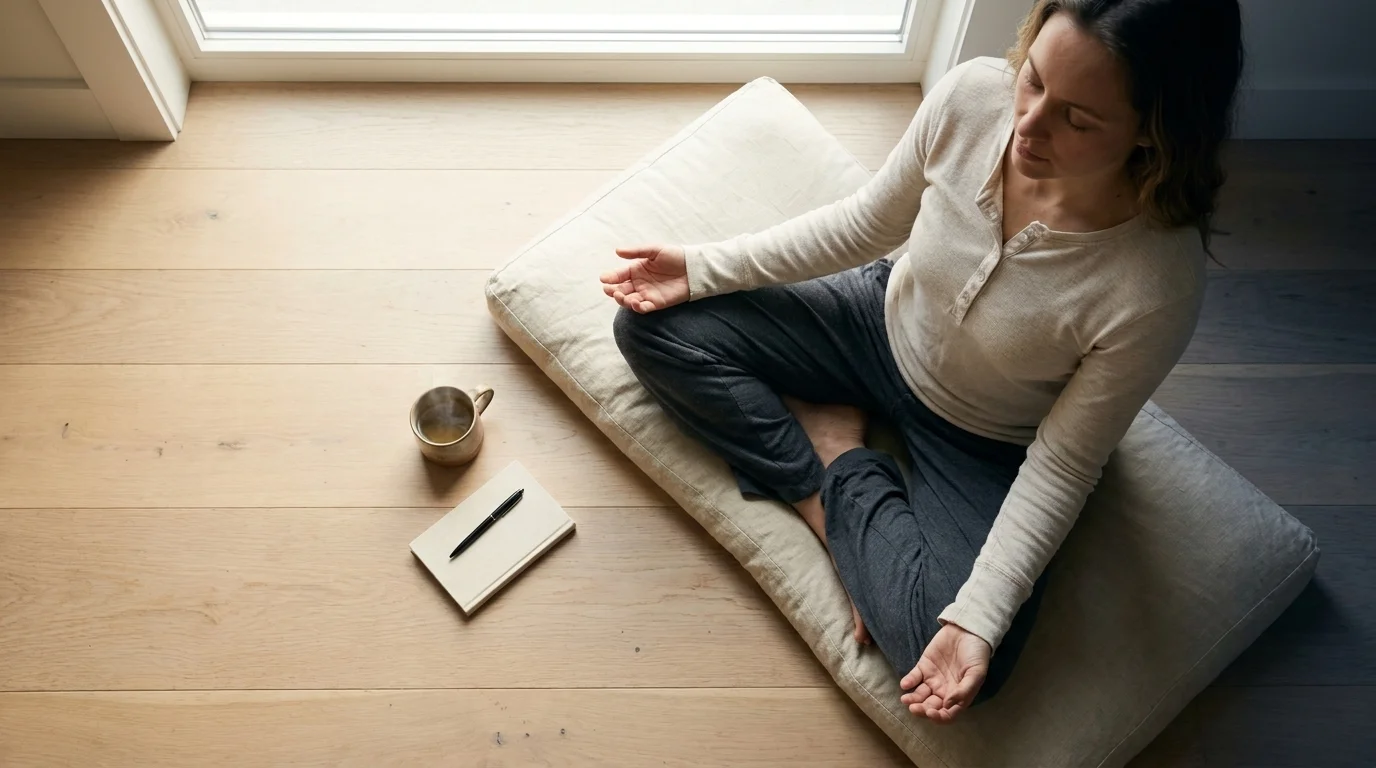
This is the single highest-evidence breathwork practice that has emerged in the last few years, and almost no general-wellness blog covers it accurately. In a 2023 Stanford randomized controlled trial published in Cell Reports Medicine (Huberman & Spiegel labs), participants who did 5 minutes per day of cyclic sighing for 28 days showed a daily mood improvement of +1.91 PANAS points, compared to +1.22 for an equivalent dose of mindfulness meditation. They also showed a reduction in resting respiratory rate that the meditation group did not. The Stanford Medicine summary is a good plain-language overview if you want to look at the source yourself.
The protocol:
- Inhale through the nose to a comfortable fullness.
- Take a second short inhale on top — to fully expand the lungs. (This is the unique step. The double inhale matters.)
- Exhale slowly and fully through the mouth — the longest part of the cycle, twice as long as the first inhale or longer. A soft sound is fine.
- Repeat for 5 minutes.
- Do it daily for at least 28 days before evaluating.
The mechanism, in a sentence: the second inhale fully recruits the alveoli, and the long exhale shifts the autonomic balance toward parasympathetic dominance through vagal pathways. Recent neuroimaging and HRV research has consolidated this as a real and measurable effect, not a speculative one.
I have started prescribing this to my clients as their "between hard sessions" recovery practice. It produces a faster downshift than meditation, which is useful when you have ten minutes between work and dinner and your nervous system is still in alert mode.
Related Article: Pacific Island Paradigm: Infusing Indigenous Wisdom into Holistic Healing Practices
What kind of tired are you?
Most "how to de-stress" articles list ten generic techniques without telling you which one to use. Different stressor types respond to different practices. A coach's matrix:
| Stressor type | Signature symptom | 5-minute reset | Evening ritual |
|---|---|---|---|
| Decision fatigue | "I can't choose what to eat" | A walk outside, no decisions | Prep tomorrow's clothes/lunch the night before |
| Rumination | "The same thought keeps cycling" | Cyclic sighing + 5-4-3-2-1 grounding | Write the loop on paper, then close the book |
| Physical tension | "My shoulders are up around my ears" | 4-7-8 breathing + a doorway pec stretch | Warm shower or bath; mobility work for 10 minutes |
| Overstimulation | "Everything feels too loud and too bright" | Cool water on the wrists; eyes closed; quiet 3 minutes | Dim lights at 9 p.m.; no music or podcasts after dinner |
The matrix is not a contest. Most stressful days end up being two or three of these at once, and the practice is to figure out which one is dominant in this hour and start there.
The 7pm Threshold: a cortisol-aware evening wind-down
This is the single piece of "evening relaxation" advice I would actually defend, and it is grounded in physiology rather than aesthetics. Cortisol — the alertness hormone — needs to drop two to three hours before bed for melatonin to rise normally and for sleep to consolidate. A 2024 Oxford Sleep review confirmed the inverse relationship and reported that bright light or screen exposure in the wind-down window suppresses melatonin and re-elevates cortisol. The two-hour wind-down isn't a soft suggestion; it is the physiological window the rest of your sleep depends on.
A cortisol-aware evening timeline, working backward from a 10 p.m. lights-out:
- 9:00 p.m. (T-60). Phone goes on a charger in another room. Last screen of the night. Dim the overhead lights; switch to lamps or warm bulbs.
- 9:00-9:20 p.m. Warm shower or bath. The brief rise in core body temperature, followed by the post-shower drop, is itself a sleep-onset signal — your body reads the cooling phase as "evening."
- 9:20-9:40 p.m. A short mobility flow or gentle stretching. Five to ten minutes is enough. The 12-Minute Desk Reset from my desk-exercises article fits cleanly here.
- 9:40-9:55 p.m. Tea (decaf, ideally something with chamomile or lavender) and a short journaling pass — three lines on the day, three on tomorrow's priorities. Lavender on a pillow or a wrist works well now.
- 9:55-10:00 p.m. Five minutes of cyclic sighing. Then bed.
If your bedtime is 11 p.m. instead of 10, push every step back an hour. If you have a partner with a different schedule, the dimming-the-lights and putting-the-phone-away pieces are still the load-bearing structural moves. Everything else is preference.
Related Article: Embracing Cultural Diversity in Health and Wellness: Insights and Practices from Around the World
Lavender, briefly, with the actual evidence
The aromatherapy section in most wellness articles treats lavender as ambient mood-setting. That is selling it short. A systematic review and meta-analysis of 11 randomized trials covering 972 participants found that lavender inhalation reduced anxiety with a Hedges' ĝ effect size of −0.72 (p<0.001) — a moderate-to-large clinical effect. Ten of the eleven trials reported significant decreases in anxiety. This is not "vibes." It is one of the better-evidenced single-intervention findings in the entire stress-management literature.
Three protocols I would consider:
- Diffuser at the desk: 4 drops in a small ultrasonic diffuser, run for 30 minutes during a focused work block. Non-distracting, mild effect.
- Bath: 5 drops of lavender essential oil in 1 cup of Epsom salts, dispersed in a warm bath. Soak for 15-20 minutes. Pairs cleanly with the wind-down timeline above.
- Roll-on at pulse points: A 1-2% lavender dilution applied to wrists and neck, ten minutes before bed. The effect is subtler than a diffuser or bath but easier to deploy on a busy night.
A practical caveat: essential oils interact with some medications (notably blood thinners and some psychiatric medications) and can be skin-irritating undiluted. If you are pregnant, breastfeeding, or on prescription medication, run any new aromatherapy protocol past your clinician.
Forest bathing without the forest
The Japanese practice of shinrin-yoku — translated as "forest bathing" — is one of the better-studied nature-based relaxation interventions. A 2024 Frontiers in Psychology study measured cortisol drop from 5.2 µg/dL to 2.77 µg/dL after a two-day forest immersion, with parallel increases in natural-killer-cell activity and parasympathetic dominance.
Most U.S. readers do not have a forest within ten minutes. The applied version that produces a meaningful slice of the same physiology, without the forest:
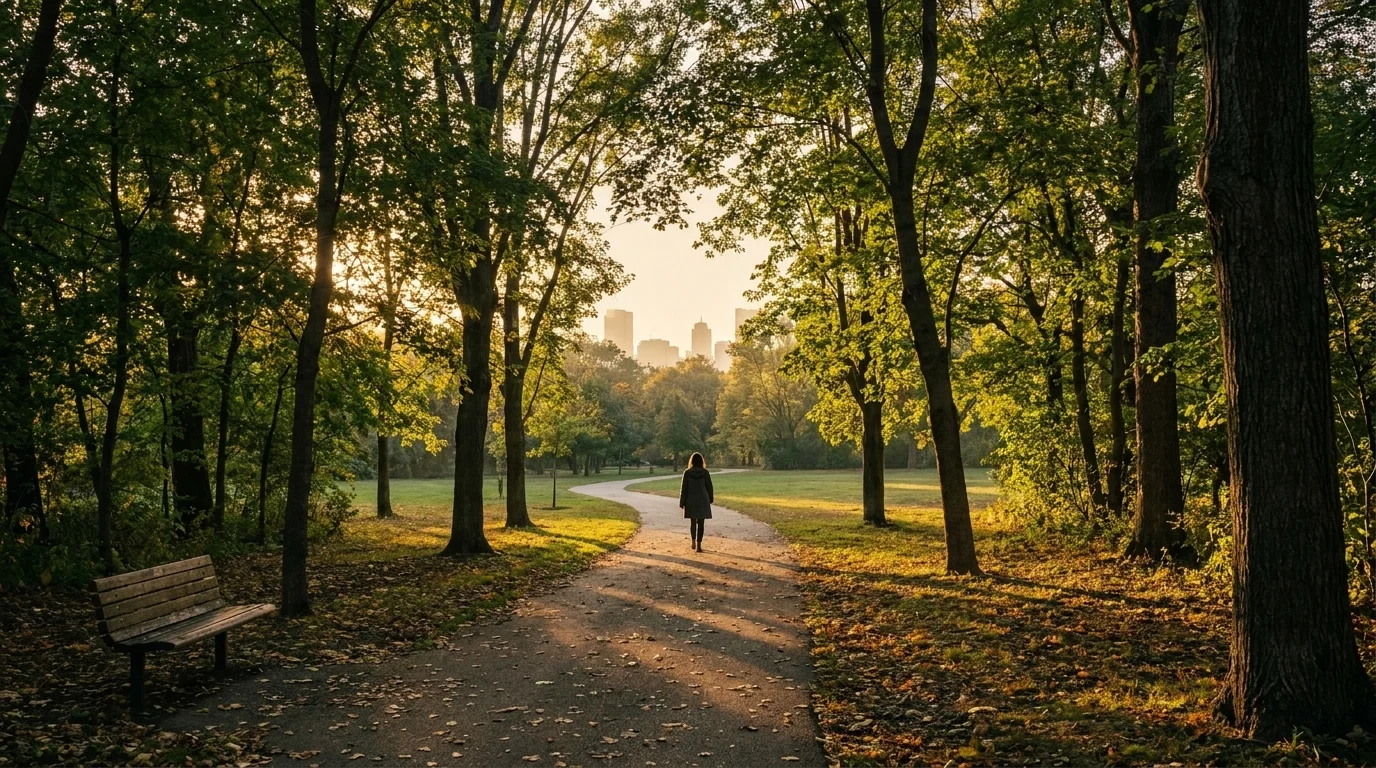
- Twenty minutes outdoors, in any green or natural space — a city park, a riverbank, a lake, a backyard with trees.
- Phone in your pocket, not in your hand. The intervention requires unstructured attention.
- Walk slowly, or sit. Pace doesn't matter. Notice three things visually that take longer than a glance to take in (the texture of bark, the structure of a tree's branches, the sky behind buildings).
- Aim for daily. Twenty minutes a day in a green space outperforms a long weekend hike for sustained nervous-system effects, partly because the dose-response in the cortisol literature suggests frequency matters more than length per session.
This works in winter. This works in cities. This works in the small park behind your office building. The practice is the unstructured attention, not the specific landscape.
Related Article: Physical Fitness Traditions from Around the World
Why you cannot out-app your phone
This is the section the wellness internet keeps soft-pedaling. A 2025 randomized controlled trial summarized in NPR and published in PMC tested a one-week social-media detox in young adults. The results: a 16.1% reduction in anxiety, a 24.8% reduction in depression, and a 14.5% reduction in insomnia. Effect sizes the researchers described as "in the same ballpark as cognitive behavioral therapy and larger than the typical effect of antidepressants." Ninety-one percent of participants improved on at least one major mental-health outcome. Average screen time halved (to about 2.5 hours per day), and participants slept about 20 minutes more per night.
I am not telling you to throw your phone in a lake. I am telling you that a meditation app on a phone you check 87 times a day is doing meaningfully less work than the structural change of putting the phone down for sustained windows. A workable, sub-disruptive version of the protocol:
Day 1: Notifications off for everything that isn't a person texting you specifically. Email badges off. Slack badges off. App-store-promotional notifications off.
Day 2: Move social media apps off the home screen. Search-to-open is a meaningful friction increase.
Day 3-4: Turn on a phone bedtime mode (most modern OSes have one) that grays the screen and silences notifications from 9 p.m. to 9 a.m.
Day 5-7: One screen-free meal each day. Ideally dinner. Pick the meal you eat with another person if you eat with one.
You will be uncomfortable for the first 48 to 72 hours. That is a withdrawal pattern, and the discomfort itself is a useful diagnostic — if a one-week reduction in social media is producing actual distress, the relationship probably warrants more attention than this article can offer.
A short note on the body
This is the part where my actual professional lane shows up. Chronic stress is not just a cognitive problem. It expresses physically — neck and shoulder tension, hip flexor shortening, jaw clenching, shallow chest-breathing, lower-back rigidity. The relaxation rituals above work better when the body has somewhere to put the tension that has accumulated.
The minimum useful dose: ten minutes of mobility work at the end of the day. Five minutes of foam rolling for the upper back and glutes if you have a roller, and the doorway pec stretch and seated hip flexor opener from my desk-exercise article are good fallbacks if you don't. A short walk also counts. The point is letting the body discharge what the workday loaded into it before you ask the nervous system to downshift into sleep.
Yoga, particularly slow-paced or restorative styles, is one of the more efficient versions of this for people who like a structured practice. My own training is in the Krishnamacharya tradition, which is pragmatic about the relationship between breath, movement, and nervous-system regulation. A twenty-minute restorative sequence at the end of a hard week is a meaningful intervention.
When relaxation isn't enough
This is the honest line I want to draw. The practices in this article work for most people most of the time. They are not a treatment for clinical conditions, and they should not be used as a substitute for one.
If you are experiencing persistent anxiety that does not respond to behavioral changes, panic attacks, intrusive thoughts, sleep that does not improve with a wind-down routine, persistent low mood, anhedonia (loss of pleasure in things you used to enjoy), or any sense that the floor is lower than it has been — please bring that to a clinician. Therapy is a meaningful intervention. Cognitive behavioral therapy for insomnia (CBT-I) has stronger long-term evidence than any sleep medication. Pharmacological options exist for clinical anxiety and depression, and they work, often in combination with behavioral practices.
If you are in crisis or having thoughts of self-harm, in the United States, please call or text 988 to reach the Suicide and Crisis Lifeline. Outside the U.S., your local equivalent is one search away. Reaching for it counts.
A sober usable takeaway
Pick one ritual from this article and run it for a week. Most of my clients start with the 5-minute Stanford protocol, because it is the cheapest and the evidence is the strongest. Pair it with a 9 p.m. screen cutoff three nights this week. Reassess in seven days.
Nothing in training works in a week. Most of what works in nervous-system recovery does not work in a week either. Give the practice four weeks of consistent run before deciding whether it has changed how your evenings feel — and your sleep, and your default state at 4 p.m. on a Wednesday. A few weeks is the unit, not a few days.
Frequently Asked Questions
Both work primarily by activating the parasympathetic side of the autonomic nervous system through breath work and sustained attention. The 2023 JAMA Internal Medicine meta-analysis on app-based mindfulness reported about an 18% improvement in sleep efficiency versus controls. Slow-paced or restorative yoga adds a physical-discharge component (releasing accumulated tension in hip flexors, pec minor, and the upper back) that pure seated meditation does not. For most people, ten to twenty minutes a day of either, sustained for four weeks, produces a measurable shift.
The structural moves that matter most are light and screens. Dim overhead lights to lamps or warm bulbs in the two hours before bed. Move screens — phones, tablets, laptops — to a charger in another room from 9 p.m. onward. The 2024 Oxford Sleep review confirmed that bright light or screen exposure in the wind-down window suppresses melatonin and re-elevates cortisol. Soft textures, plants, and calming scents help, but light and screen control are the load-bearing changes.
Aromatherapy is the use of plant-derived essential oils for therapeutic effect, most often via inhalation. Lavender has the strongest evidence base: a systematic review and meta-analysis of 11 randomized trials with 972 participants found lavender inhalation reduced anxiety with a Hedges' ĝ effect size of -0.72 (p<0.001) — a moderate-to-large clinical effect. Diffusers, baths, or roll-ons at pulse points all work. Run essential oils past your clinician if you are pregnant, breastfeeding, or on prescription medication — interactions and skin sensitivity are real.
Acute stress (a tense moment) can be reset in 90 seconds with extended-exhale breathing — the longer exhale activates parasympathetic pathways through vagal mechanisms. Chronic stress reset takes longer: the 2023 Stanford cyclic-sighing trial measured meaningful mood improvement after 28 days of daily 5-minute practice. The frame I use with clients is that any single practice produces a same-day effect, and the cumulative practice changes baseline state at four to six weeks.
In one head-to-head study (Stanford, 2023, published in Cell Reports Medicine), 5 minutes per day of cyclic sighing produced larger daily mood gains than mindfulness meditation (+1.91 vs +1.22 PANAS points) and a larger reduction in resting respiratory rate. Both work; cyclic sighing wins on speed and mechanism (the second inhale fully recruits the alveoli; the long exhale shifts autonomic balance to parasympathetic dominance). The protocol: two short inhales through the nose, then a long exhale through the mouth, repeated for 5 minutes daily.
Yes — with effect sizes that are not subtle. A 2025 randomized controlled trial showed a one-week social-media detox cut anxiety by 16.1%, depression by 24.8%, and insomnia by 14.5% in young adults — effect sizes the researchers described as comparable to cognitive behavioral therapy and larger than typical antidepressant effects. Average screen time halved and participants slept about 20 minutes more per night. A workable, sub-disruptive version: notifications off, social apps off the home screen, phone in another room from 9 p.m. to 9 a.m., one screen-free meal a day.
Lavender has the strongest evidence base — a meta-analysis of 11 RCTs (972 participants) reported a Hedges' ĝ effect size of -0.72 for anxiety reduction via inhalation. Roman chamomile and bergamot are reasonable second-tier choices with smaller evidence bases. Skip the longer-list of 'calming' oils that do not have RCT support. Diffuser, bath, or roll-on at pulse points all work; the diffuser-and-bath versions tend to produce the most consistent effect.
A 60-to-90-minute wind-down beats a 5-minute one. Cortisol naturally drops 2-3 hours before bed, so the structure that aligns with physiology: screens off by 9 p.m., a warm shower or bath at 9-9:20, gentle mobility work for 5-10 minutes, herbal tea and a short journaling pass at 9:40, then 5 minutes of cyclic sighing at 9:55 before bed at 10. Adjust an hour for an 11 p.m. bedtime. The light and screen-control pieces are the load-bearing structural moves; the rest is preference.
Check Out These Related Articles
Aesthetic Harmony: Integrating Design Principles with Holistic Wellness Concepts
Navigating Holistic Wellness: Embracing a Well-Balanced Lifestyle for Beginners
Japanese Zen Embodied: The Art of Integrating Mindfulness into Everyday Life