Epistemology of Wellness: Reimagining Knowledge in Pursuit of Health


There is a particular kind of tiredness that comes from caring about your health and not knowing who to believe. You read that a supplement is essential and, two scrolls later, that it is useless. A video tells you your symptoms mean one thing; a comment underneath, with equal confidence, says the opposite. The problem is rarely that you do not care enough — it is that no one ever taught you how to evaluate health information. The volume of it has outpaced anyone's ability to sort by hand, and a fair amount of what reaches you is health misinformation — confidently delivered, emotionally pitched, and wrong.
I want to take that experience seriously rather than wave it away. The skill you actually need is not more willpower or a longer reading list. It is a small, repeatable way to evaluate health information before you act on it — and a clear sense of when the question in front of you is no longer something to settle on your own.
The stakes are not abstract. In suburban Cook County, public-health officials reported in May 2026 that more than 13,000 children are now unprotected against measles — roughly double the number a decade ago, a shift they tie directly to the spread of bad information about vaccines. When enough people can't tell a sourced claim from a persuasive one, the cost stops being personal and becomes communal.
How do you actually evaluate a health claim?
Run any health claim through five questions: who is saying it, what evidence backs it, how current it is, who benefits from your believing it, and whether it leans on red-flag language. If a claim can't survive those five, treat it as unproven — not as truth.
That capsule is the whole framework. Here is each piece, in the order I'd use them.
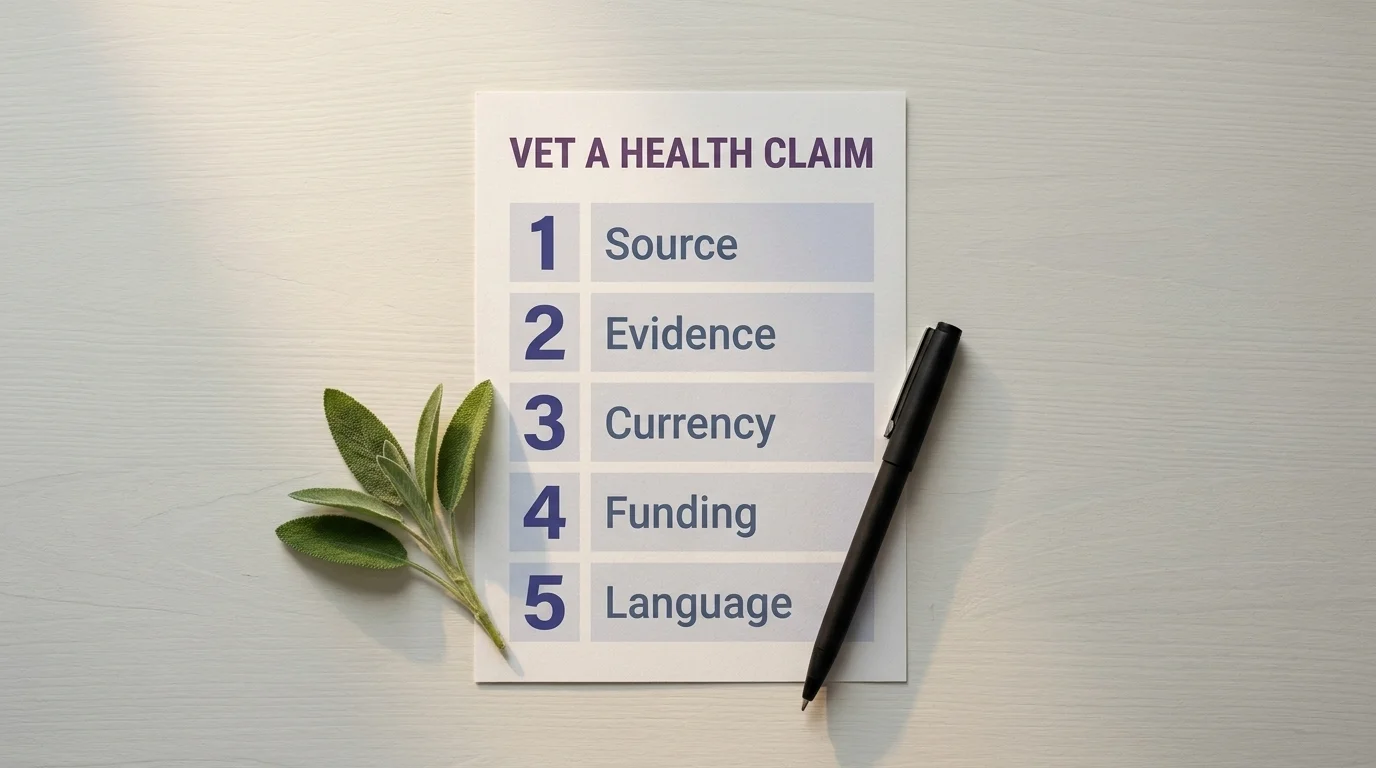
1. Source and authority. Who is actually behind the claim, and are they qualified to make it? A named clinician, a government health agency, or a peer-reviewed study carries more weight than an anonymous account or a brand selling the exact thing it is recommending. This is the pillar institutional guides put first — MedlinePlus, the U.S. National Library of Medicine's consumer health service, frames it as asking who runs and pays for the site and why it exists.
2. Evidence and citations. Does the claim point to anything — a study, a clinical guideline, a body of research — or does it simply assert? This is what evidence based medicine means in practice: a claim is only as strong as the evidence it can show you. "Studies show" with no study linked is not evidence; it is the costume of evidence. If you can follow a claim back to a real source, you can judge it. If you can't, you are being asked to trust on vibes.
3. Currency and recency. Health knowledge genuinely changes — what was sound advice five years ago can be revised as research accumulates. That is a feature of good science, not a flaw, but it means a date matters. Check when the page was written or last reviewed, and be wary of advice presented as timeless and beyond revision.
4. Funding and bias. Who profits if you believe this? A page that diagnoses a problem and then sells you the only cure has a conflict you should name out loud. Funding doesn't automatically make a claim false, but it tells you whose interests the framing serves.
5. Red-flag language. The way a claim is worded leaks information. "Miracle cure," "what doctors won't tell you," "one weird trick," and any pressure to act right now are tells. Good health information rarely needs to shout.
A note on the limits of all this, because it matters: running a claim through these five questions tells you how much to trust information. It does not replace a clinician for a decision about your own body or mind. If a claim concerns your specific treatment, medication, or symptoms, the right move is not to win the argument in your head — it's to take it to your doctor or a credentialed therapist who can see the whole picture.
The red flags — and the tactics behind them
It helps to know not just what bad information looks like but how it is built to persuade you. Public-health communicators have started naming the recurring tactics — Cook County's Department of Public Health lays several of them out plainly — and once you can name them, they lose a lot of their grip.
- Appeal to nature. "It's natural, so it's safe." Nature is full of things that will hurt you; "natural" is a marketing word, not a safety rating.
- False choices. Framing a complex decision as two stark options ("medicine OR your body's own healing") when the real answer is usually "both, in proportion, with a professional."
- Emotional pressure. Fear and urgency short-circuit careful thinking — which is exactly why misinformation reaches for them. If a claim's main argument is how it makes you feel, slow down.
- "Common sense" oversimplification. Reducing something genuinely complicated to a slogan that feels obviously true. The feeling of obviousness is not evidence.
I'll be blunt about the language I see most in wellness spaces: phrases promising to "raise your frequency" or "manifest your healing" are not describing anything measurable. They feel good and they explain nothing, and they are worth treating with the same skepticism you'd bring to a sales pitch.
Where bad health information actually reaches you now
Most evaluation guides still picture you reading a webpage. In 2026, that is not where the problem mostly lives. It lives in your feed — short videos, confident and well-produced, that arrive in the moments you are least braced for them.
The data here is sobering. A University of East Anglia analysis of 27 studies, reported in March 2026, found misinformation rates "as high as 56 per cent" in social-media posts about mental health and neurodivergence. TikTok was the worst platform in that analysis: 52% of ADHD videos and 41% of autism videos shared inaccurate information, compared with about 22% on YouTube and just under 15% on Facebook. As one of the study's authors put it, engaging videos "spread widely online, even when the information isn't always accurate."

I am especially careful with this because mental-health content is where I work, and it is the category the research flags as worst. A fifteen-second clip is good at feeling true. The five questions above still apply on social media — they just take more deliberate effort, because the format is engineered to keep you from pausing. Before you act on something a video told you about your own mind or body, find the same claim on a source that can show its work.
Why "it looks professional" stopped meaning "it's true"
The oldest shortcut for judging credibility — does it look polished and well-written? — has quietly broken. A January 2026 systematic review in BMC Public Health, synthesizing fifteen studies, concluded that generative AI "substantially increases the volume, speed, and perceived credibility of health disinformation production". In plain terms: false health content can now be produced quickly, in fluent, professional-sounding language, at scale.
This doesn't mean trust nothing. It means polish is no longer a credibility signal — it has been automated. The five questions matter more now, not less, because the surface cues we used to lean on have been cheapened. Authority, real citations, and funding transparency don't fake as easily as good grammar does.
Where to start instead
When you need to check something, it helps to have a few trustworthy front doors rather than the open ocean of search results:
- MedlinePlus — consumer-friendly, from the U.S. National Library of Medicine.
- PubMed — the underlying biomedical research, when you want to see the actual studies.
- The NIH and CDC — government health agencies for conditions, prevention, and public-health guidance.
None of these is perfect or complete, and reading them well still takes the five questions. But they are accountable, dated, and citation-backed in a way an anonymous feed is not.
As Dr. Kiran Joshi of the Cook County Department of Public Health put it, "both our individual and community health rely on our ability to tell the difference between what feels true and what is rooted in scientific evidence." That is the whole skill, and it is workable — you do not need a research degree, just five honest questions and the willingness to slow down before you act.
One last line, because the worst-hit category in all of this research is mental-health content. If what you are sorting through is information about your own distress, please don't let a confident stranger online be the deciding voice. Therapy is not a luxury, and it is one of the most evidence-backed forms of care there is. If you are in crisis, contact the 988 Suicide and Crisis Lifeline (call or text 988 in the US) or your local equivalent — that is not a question to evaluate alone.
Frequently Asked Questions
Check five things: the source's credentials, whether the claim cites real evidence, how current the page is, who funds it, and whether it uses red-flag language like "miracle cure." If a claim can't survive those five questions, treat it as unproven rather than true.
Often no. A 2026 University of East Anglia analysis found up to 56% of mental-health social-media posts contained misinformation, with TikTok the worst platform — 52% of ADHD videos shared inaccurate information. Verify against an accountable source before acting on what a video tells you.
A 2026 BMC Public Health review found generative AI increases the volume, speed, and perceived credibility of false health content. Polished, professional-looking writing is no longer a reliability signal, because fluent language can now be produced at scale.
Watch for "miracle cure" or "quick fix" claims, anonymous or uncredentialed authors, no citations, heavy product-selling, the "it's natural so it's safe" appeal, and emotional pressure to act fast.
Start with accountable, dated, citation-backed sources: MedlinePlus and PubMed (from the U.S. National Library of Medicine), and government agencies like the NIH and CDC. They still require careful reading, but they show their work in a way an anonymous feed does not.