
The Visual Language of Wellness: Communicating Health Messages Through Colors


We reach for color before we reach for words. A green juice, a blue clinic wall, a soft pink wellness app — long before a reader processes the sentence, they have already felt the hue. So when people ask me about the colors that represent health and wellness, I take the question seriously, because color is doing real communicative work. What I want to be honest about is where that work is grounded in evidence and where it is grounded in something gentler and less certain: culture, habit, and association.
What color represents health and wellness?
Green is the color most associated with health and wellness — it reads as vitality, balance, and renewal across most Western contexts. Blue runs a close second, signaling calm and trust; white suggests cleanliness and clarity; and earth tones suggest groundedness. None of these is a law of the nervous system. They are shared conventions, and conventions are worth knowing precisely because they shape how a message lands before anyone has thought about it.
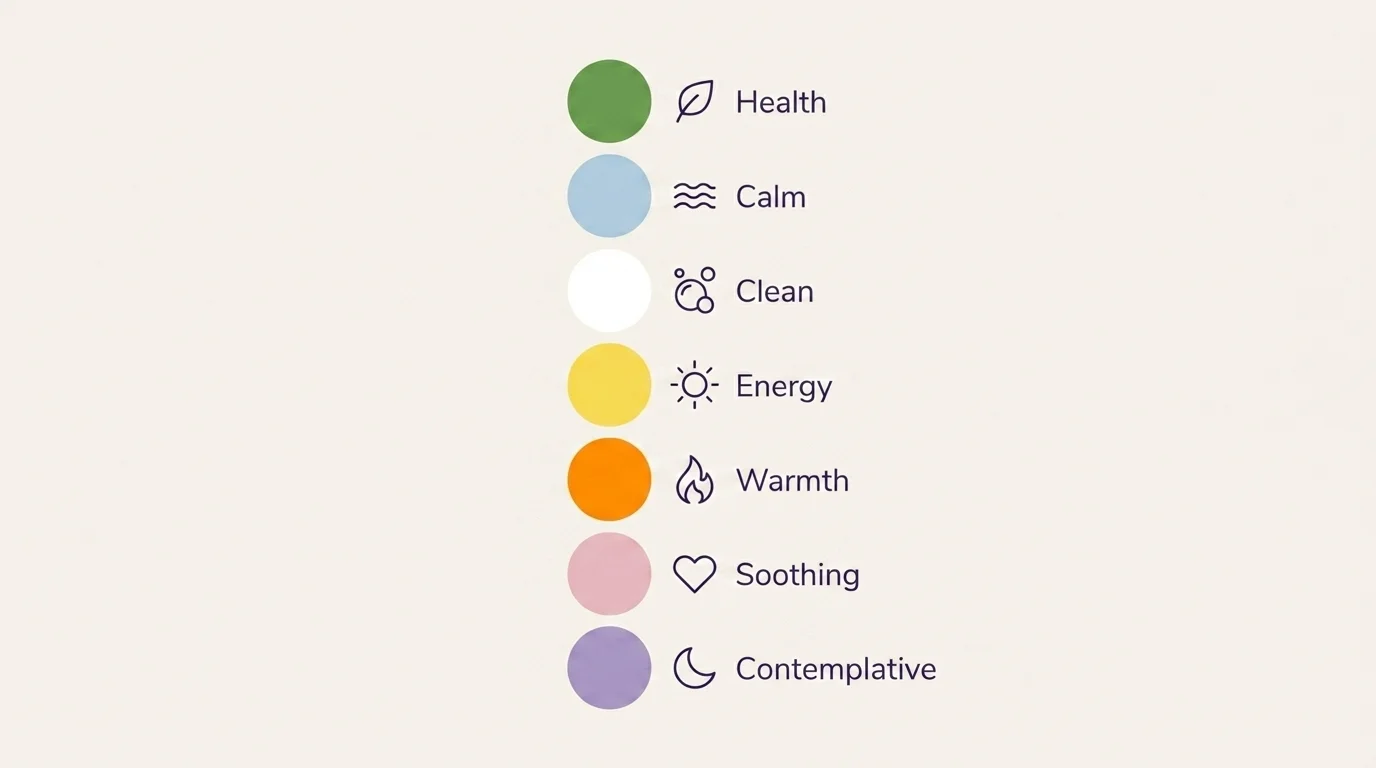
Here is the color vocabulary most readers in the U.S. and Europe carry, with the caveat that it is a vocabulary, not a fact about your physiology:
- Green — health, growth, balance, renewal. The default "wellness" color and the one the AI and search results lead with.
- Blue — calm, trust, recovery. The reason it dominates clinical and healthcare design (more on that below).
- White — cleanliness, clarity, a fresh start. Worth flagging because its meaning flips hard across cultures.
- Yellow / orange — energy, optimism, warmth. Useful when you want a message to feel approachable rather than clinical.
- Pink / lavender — softness, self-soothing, gentleness. Often used for self-care content, fairly recently and largely by convention.
- Purple — in mainstream design, a sense of the contemplative; in chromotherapy and chakra traditions, it carries specific spiritual meanings. I'd keep those two things separate, and I'll come back to why.
What the evidence actually shows — and what it doesn't
I work in a field that is careful about the difference between a finding and a feeling, so I want to be careful here too.
There is real, recent evidence that color affects how health messages are received. A 2025 content analysis of 1,824 public-health posts on the Chinese platform Xiaohongshu found that "the use of warm colors in visuals" positively predicts audience engagement — while overly complex visuals reduce it. That is a specific, measured effect about engagement, not a claim that yellow heals you. Blue's association with trust shows up in practice too: roughly 60% of healthcare brands build their interfaces around blue, and blue-dominated healthcare interfaces are reported to see about 20% higher user retention. Again — that is a behavioral pattern in how people respond to design, not a physiological cure.
And then there is the other category. Claims that purple opens a spiritual channel, or that a specific hue rebalances an energy center, belong to chromotherapy and chakra traditions. Those traditions are meaningful to a lot of people, and I am not here to mock them. But they are cultural and spiritual frameworks, not findings from controlled research, and a piece that blurs the two does its reader a quiet disservice. So: green and blue have documented associations with calm and recovery in mainstream color psychology. Purple's "spiritual" reading is cultural. Both can matter to how you feel. Only one of them has a study behind it.
Color isn't universal: meaning across cultures
The biggest blind spot I see in color-and-wellness writing is the assumption that these meanings are global. They are not, and assuming they are can quietly break a health message. A 2025 Frontiers in Digital Health scoping review on visual public-health communication lists "cultural and contextual differences" among the challenges that "have created public health information gaps". In plainer terms: the wrong color can mean the wrong thing to the person you most need to reach.
A few reversals worth knowing:
- White signals purity and cleanliness across much of the West, but it is the color of death and mourning across China, India, and Japan — so a "clean, calming, all-white" wellness layout can read very differently.
- Green means health and nature in the Americas and Europe, but carries sacred religious meaning in many Muslim cultures.
- Red reads as danger or alarm in the West and as luck and celebration in China.
- Orange can feel life-affirming in parts of Asia while functioning as a hazard and warning color in the United States.
None of this means you can't use color. It means a color choice is a guess about your audience, and it pays to know whose conventions you're borrowing.

Make the color message readable for everyone
This is the part almost no one writing about "wellness colors" mentions, and it's the part with the firmest ground under it.
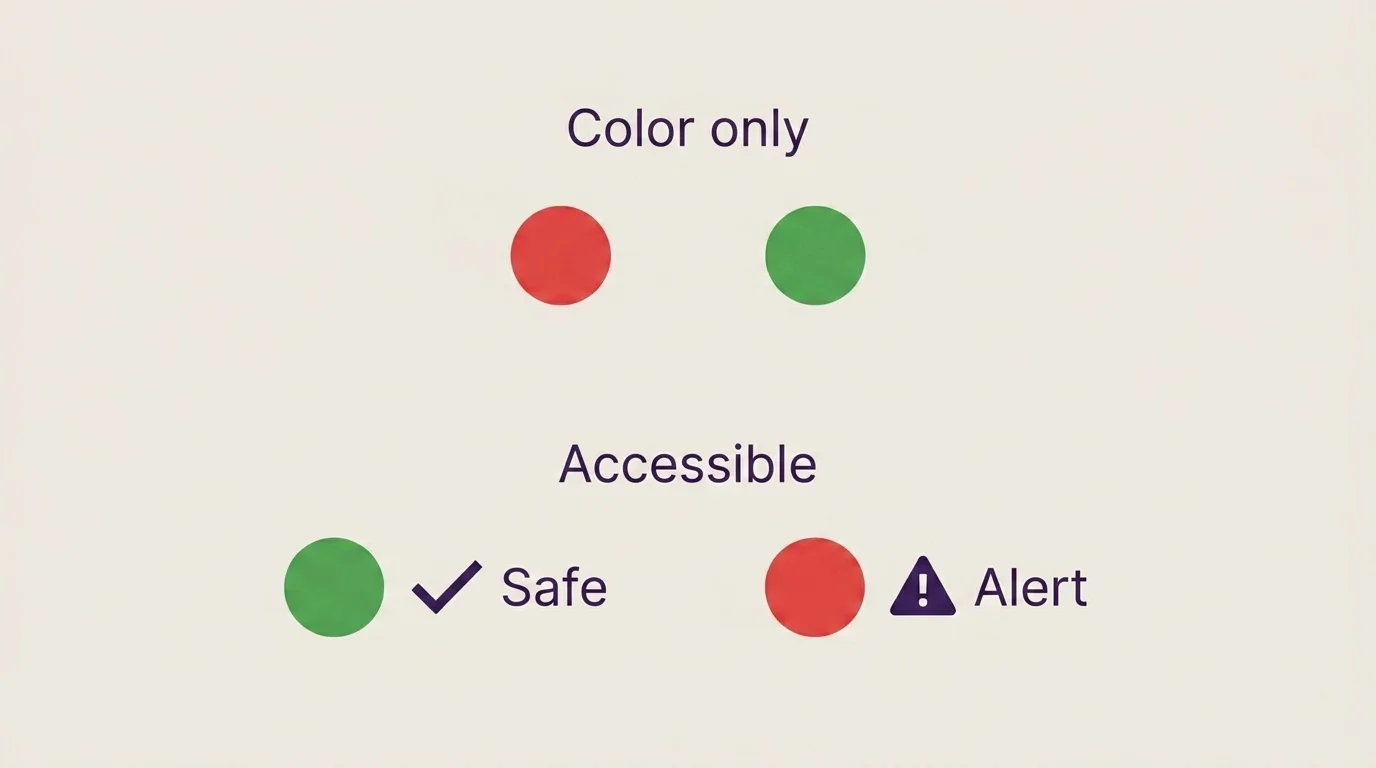
Color cannot be the only carrier of meaning. Federal accessibility guidance is explicit that color "should not be the only indicator," and that a hue meant to signal urgency — shades of red for alarm — should be reserved for that purpose so the signal isn't diluted. The reason is straightforward: about 4.5% of people have color vision deficiency, including roughly 1 in 8 men, and red-green is the most common form. A red "danger" / green "safe" cue is invisible to a meaningful share of the people you're trying to protect unless you back it with text, an icon, or a pattern.
Two more practical thresholds, for anyone designing health materials:
- Contrast. WCAG recommends a 4.5:1 contrast ratio for normal text (3:1 for large text), with 7:1 as the higher AAA standard. This is the difference between readable and merely decorative.
- It's the most common failure there is. Insufficient color contrast is the single most common web accessibility failure, affecting 83.6% of sites in WebAIM's 2024 analysis. So the most frequent way a color message fails isn't symbolic — it's mechanical.
A closing note
Color is a genuine language, and like any language it is partly shared and partly local. Green will probably keep meaning health for most of the readers you reach. Blue will keep calming clinic walls. But the colors that represent health and wellness do so by convention, not by magic — and the most caring thing a communicator can do is hold the vocabulary loosely enough to notice when it isn't landing, and pair it with words and contrast so that it reaches everyone, including the one in eight men who can't tell your red from your green.
Frequently Asked Questions
Blue most often symbolizes healthcare — it signals trust, calm, and reliability, which is why roughly 60% of healthcare brands and apps build around it. Green runs a close second for "health" specifically.
Yes. White signals purity in the West but mourning across China, India, and Japan; green means nature and health in the West but is sacred in many Muslim cultures; orange reads as life-affirming in parts of Asia but as a hazard color in the US.
No. Accessibility guidance is explicit that color must never be the only signal — about 4.5% of people (roughly 1 in 8 men) have color vision deficiency, so red and green cues need a backup like text, an icon, or a pattern.
Green and blue are most associated with healing in mainstream color psychology — green for renewal and balance, blue for calm and recovery — while purple carries the spiritual and chromotherapy associations, a separate and less evidence-backed tradition.