Amazonian Wisdom Unveiled: Exploring Unique Healing Traditions from the Rainforest


Most people who land on a wellness article about "Amazonian healing" today are really asking one of two questions. They have read something about ayahuasca — eye-uh-WAH-skuh, from the Quechua for "vine of the soul" — and they want to know whether the science is real and whether it is safe. Or they have heard that the Amazon is a pharmacy and they want to know which plants in that pharmacy are worth paying attention to. This piece tries to answer both honestly, in plain language, with the studies named.
A note on framing before we start: the Amazon is home to hundreds of indigenous nations, each with its own healing traditions. When I write "Amazonian plant medicine," I mean the broader field of ethnobotany — the study of how human cultures use plants — as practiced by communities including the Shipibo-Konibo, Asháninka, Yawanawa, Huni Kuin, and the Brazilian syncretic churches Santo Daime and União do Vegetal (UDV). I am a registered dietitian, not a psychiatrist or an indigenous practitioner. Everything below about clinical effects is attributed to the study that found it, and everything about ceremony comes secondhand from the lineages that own it.
What ayahuasca actually is
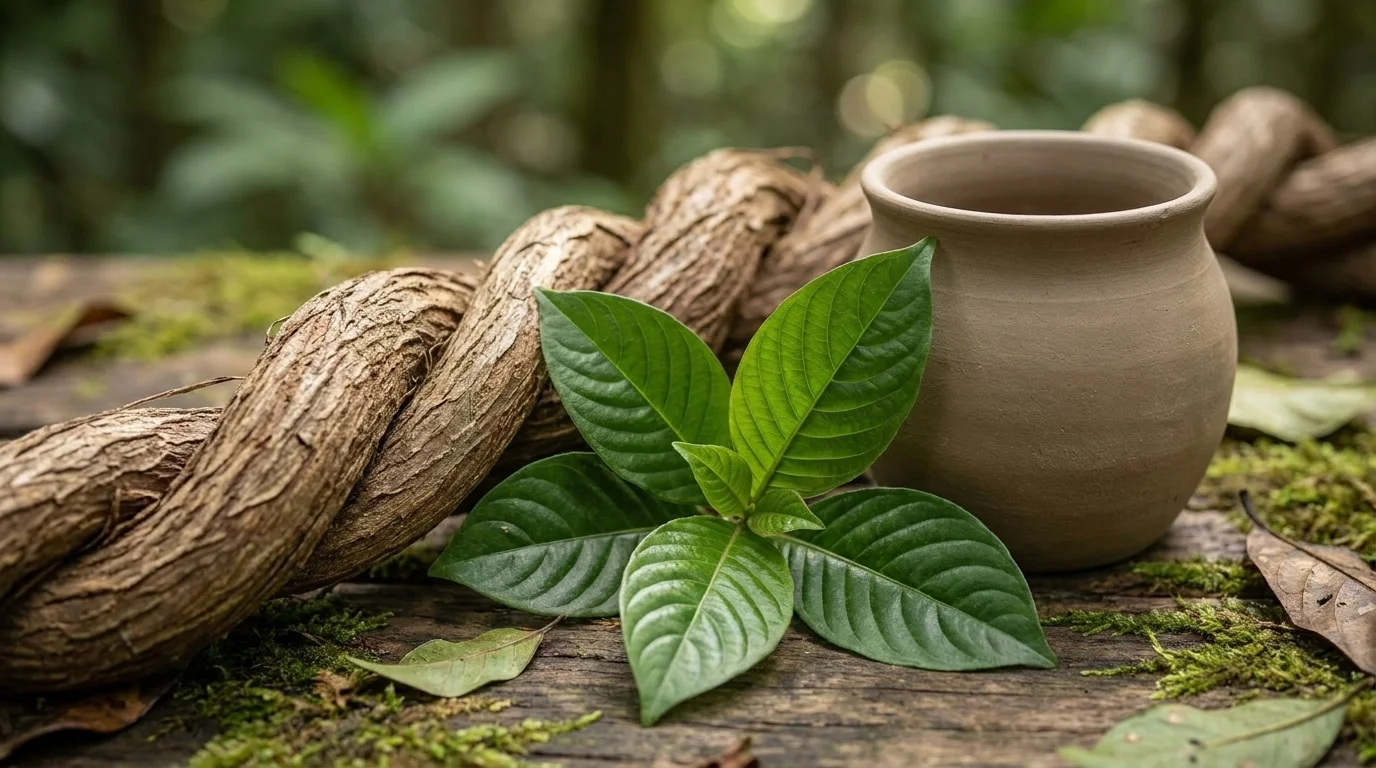
Ayahuasca is a brewed decoction of two Amazonian plants: Banisteriopsis caapi (the vine) and Psychotria viridis (a shrub, sometimes called chacruna). The vine contains harmine and harmaline, which are reversible monoamine oxidase inhibitors. The leaf contains N,N-dimethyltryptamine (DMT), a serotonin-2A agonist that, taken orally on its own, would be broken down before it crossed into the bloodstream. The vine prevents that breakdown. That is the entire pharmacological trick. Without one half, the other does nothing.
In ceremony, the brew is typically taken in the evening under the guidance of a vegetalista or ayahuasquero. The 2025 longitudinal study described below used a dose of 50 mL of brew followed by a 25 mL booster two hours later, with a 5:1 Banisteriopsis caapi to Psychotria viridis ratio (Therapeutic Potential of Ayahuasca, PMC, 2025). Effects last roughly four to six hours and are typically accompanied by nausea, vomiting (referred to within the traditions as la purga), and intense visual and emotional experience.
What 2025 clinical research actually shows
For most of the last decade, the ayahuasca-and-depression literature was built on small Brazilian trials — useful but easy to dismiss as preliminary. That changed in 2025.
A 280-participant longitudinal study with 180-day follow-up published in 2025 was the first ayahuasca depression-and-anxiety trial at this scale (PMC, 2025). Sample composition was 40.4% major depression, 25.2% generalized anxiety, and 22% treatment-resistant depression. MADRS depression scores fell from a baseline of 43.04 to 24.56 at Day 180, with the largest changes occurring within the first two weeks. Effect sizes ranged from Cohen's d 0.81 to 2.20 — large to very large by conventional benchmarks, and sustained over six months. The design was observational, not a randomized controlled trial, so causal language has to be tempered, but the scale and follow-up duration are a meaningful step up from prior literature.
On PTSD: a 2024 systematic review of veterans attending therapeutic ayahuasca retreats reported 71.4% with clinically meaningful PTSD symptom reductions sustained at three-month follow-up (PubMed, 2024). A head-to-head randomized trial of single-dose ayahuasca versus esketamine for PTSD is currently enrolling, with primary completion scheduled for June 2026 (ClinicalTrials.gov NCT07317206) — the first major comparator-controlled trial in this indication.
Regulatory tone has shifted in parallel. In April 2026, the FDA announced it would prioritize development and review of serotonin-2A agonists for treatment-resistant depression, PTSD, and substance use disorders (CNN, April 2026). Ayahuasca itself does not have an approval pathway — the priority track is currently focused on psilocybin and methylone — but the regulatory posture toward this drug class has changed.
What none of this means: it does not mean ayahuasca is approved. It does not mean it is safe for everyone. It does not mean retreat marketing is calibrated to the evidence. It means a small but growing body of data suggests real and sustained effects on depression and PTSD symptoms in screened populations under supervised conditions. That is the honest summary.
Related Article: Embracing Cultural Diversity in Health and Wellness: Insights and Practices from Around the World
Is ayahuasca legal? Is it safe?
Legality in the United States. DMT is a Schedule I controlled substance under federal law, which makes ayahuasca federally illegal to possess, distribute, or import. Two religious organizations — the União do Vegetal (UDV) and the Santo Daime church — operate under federal religious-use exemptions granted after U.S. Supreme Court and lower-court rulings. State-level decriminalization of natural psychedelics has progressed in cities including Oakland, Denver, and Seattle, but state decrim does not override federal law.
SSRI co-administration — the contested question. Practitioner and retreat guidance almost universally requires participants to taper SSRIs four to six weeks before ceremony, on the theory that combining serotonin reuptake inhibition with an MAOI and a serotonin-2A agonist could trigger serotonin syndrome. The 2025 280-patient study is more nuanced. Most participants were concurrently on SSRIs or benzodiazepines at the time of dosing, and the published report does not describe serotonin syndrome events (PMC, 2025). This is one observational dataset, not a license to ignore the concern — but it suggests the blanket "you must taper" guidance circulating in retreat marketing oversimplifies what the evidence actually shows. Anyone on a serotonergic medication considering plant medicine needs a conversation with a clinician familiar with psychedelic pharmacology, not advice from a retreat website.
The honest safety side. A 2023 peer-reviewed case report describes a psychotic episode in a vulnerable individual after repeated ayahuasca intake (PMC, 2023). Ayahuasca is contraindicated in people with personal or family history of schizophrenia and psychotic spectrum disorders, in late pregnancy, and in people with serious cardiovascular conditions because MAOIs interact with tyramine-containing foods and with many medications.
The takeaway is the same one I write at the end of every piece on a substance that does something pharmacologically real: this is a conversation for your physician, not a substance to source from the internet.
Beyond ayahuasca: a short field guide to Amazonian plant medicine
Ayahuasca dominates the search traffic and the headlines, but it is one entry in a much larger pharmacopeia. A few of the more widely studied plants:
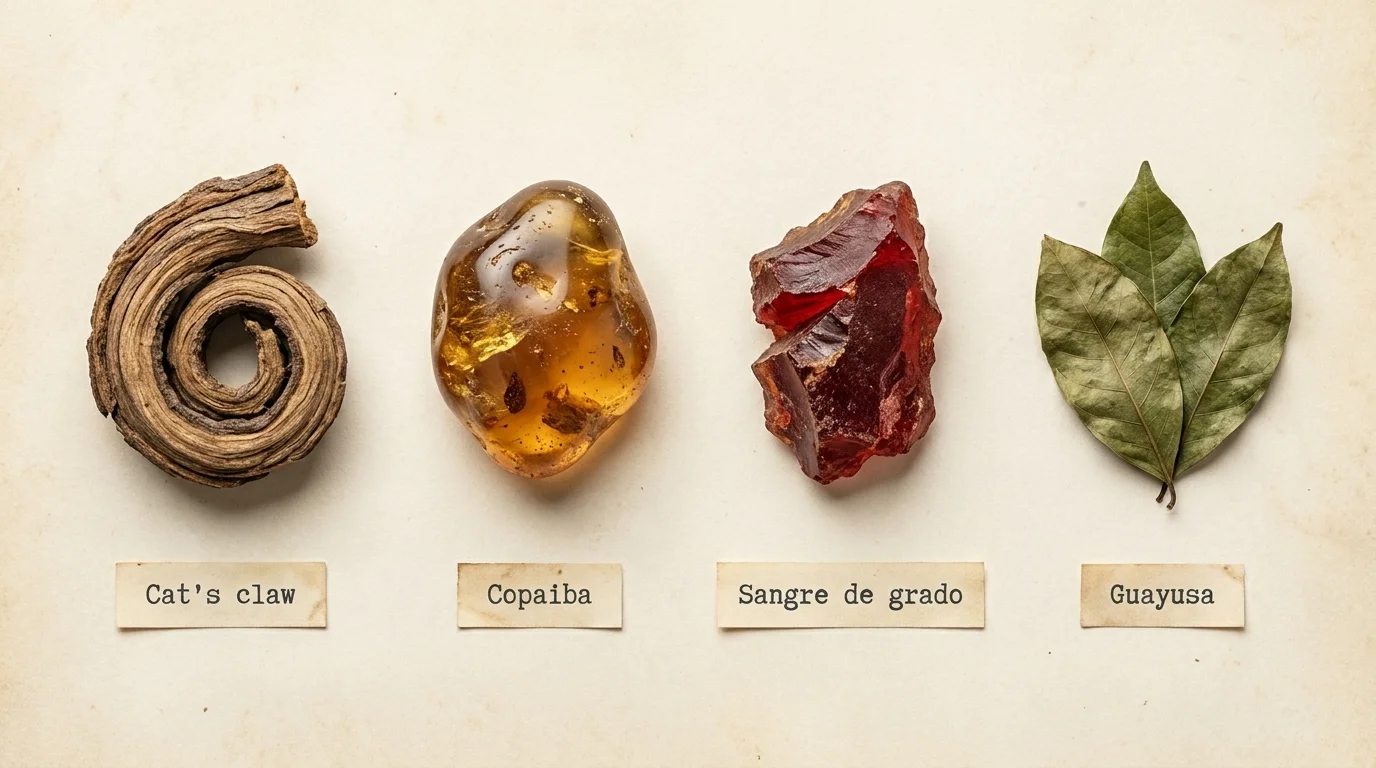
Cat's claw (Uncaria tomentosa, uña de gato). Anti-inflammatory and immunomodulatory effects have been studied most in rheumatoid arthritis and osteoarthritis. WebMD's monograph on the plant notes "very little research" supporting most of the claims made for it commercially, and the trials that do exist tend to be small. Cat's claw has documented interactions with several medications (including some blood thinners and immunosuppressants); dose, preparation (bark vs. inner-bark vs. extract), and active fraction (pentacyclic vs. tetracyclic alkaloid chemotype) all matter, and product labels usually do not disclose them.
Copaiba (Copaifera spp.). The oleoresin tapped from copaiba trees is used traditionally for skin and respiratory conditions. Modern interest centers on its sesquiterpene content; clinical evidence in humans is mostly small studies.
Sangre de grado (Croton lechleri, "dragon's blood"). A red latex used topically for wound healing and orally for gastrointestinal complaints. A standardized extract (crofelemer, originally Fulyzaq, now Mytesi, FDA-approved December 2012) is indicated for non-infectious diarrhea in HIV/AIDS patients on antiretroviral therapy — one of the few Amazonian botanicals to clear a U.S. regulatory pathway.
Guayusa (Ilex guayusa). A caffeine-containing holly leaf consumed as a morning tea by Kichwa communities. Caffeine content is comparable to coffee; antioxidant studies are mostly in vitro and translate poorly to clinical claims.
Chuchuhuasi (Maytenus krukovii). Bark used traditionally for joint pain and as a tonic. Clinical evidence in humans is thin; most published work is preclinical.
A standing caution on all of the above: a plant that has been used safely for centuries within a specific cultural preparation is not the same as a capsule extract sold online. Dose, the food matrix it is consumed in, and the cultural protocol around use all change what happens in the body.
Related Article: Physical Fitness Traditions from Around the World
Lineages and ceremony: why "Amazonian shaman" is the wrong frame
There is no single Amazonian healing tradition. The Shipibo-Konibo of the Ucayali region in Peru are best known internationally for their ayahuasca work and the distinctive geometric kené designs associated with the songs (icaros) used in ceremony. The Asháninka, also in the Peruvian Amazon, have a separate ceremonial structure and plant pharmacopeia. The Yawanawa and Huni Kuin of the Brazilian Amazon have developed their own contemporary ceremonial traditions, often in dialogue with the urban-syncretic churches Santo Daime and União do Vegetal, both of which incorporate ayahuasca (referred to as daime or vegetal) into structured liturgical settings.
These are different traditions, with different protocols, different cosmologies, and different rules about who can administer the medicine. Lumping them under "Amazonian shamanism" or "indigenous spirituality" is the wellness-industry equivalent of describing every Christian tradition as "going to church."
Biopiracy and the ethics of sourcing rainforest plants
This is the section the rest of the internet skips, and it is the one that should change the most about how a Western consumer engages with rainforest botanicals.
In the early 2000s, French researchers documented an antimalarial molecule (simalikalactone E) extracted from Quassia amara, a plant used in Amazonian traditional medicine. The work proceeded to a patent application without benefit-sharing agreements with the source communities. The case became one of the textbook examples of biopiracy — extraction of traditional knowledge or biological material from indigenous communities without consent, attribution, or compensation (ScienceDirect).
The 2014 Nagoya Protocol on Access and Benefit-Sharing, an international agreement under the Convention on Biological Diversity, requires that researchers and companies negotiate access and benefit-sharing agreements with the communities from which genetic resources and associated traditional knowledge originate (Sunstein Law). Enforcement varies widely by country, the United States is not a party, and illegal collection persists.
What this means for a reader trying to source rainforest botanicals responsibly: prefer products from fair-trade-certified suppliers, look for explicit benefit-sharing language and indigenous co-op partnerships in the supplier's documentation, and treat the absence of any sourcing transparency as a meaningful red flag.
Conservation: where the money should go
The reflexive "support rainforest conservation" line in most wellness articles is well-meaning and useless. Specific organizations working on Amazon protection and indigenous land rights include the Rainforest Foundation US (supports indigenous land titling and territorial defense), the Amazon Conservation Association (protected-area work in Peru and Bolivia), and the ICCA Registry (international platform for indigenous and community-conserved areas). Donations and advocacy directed at organizations that center indigenous land rights are doing more for both the ecosystem and the source communities of these medicines than buying a bottle of cat's claw extract from a brand without sourcing disclosure.
A sober takeaway
Ayahuasca research has moved past its preliminary phase. The 2025 280-patient longitudinal study, the active PTSD comparator trial, and the FDA's shifted regulatory posture all suggest a substance class that warrants serious clinical attention. None of that translates into "you should try this." Ayahuasca is federally illegal in the U.S. outside narrow religious exemptions, it carries real contraindications, and most of what is sold under the "Amazonian healing" banner in the wellness market is closer to lifestyle marketing than to either the clinical evidence or the indigenous traditions it borrows from.
If the underlying interest is depression or PTSD that has not responded to first-line treatment, the conversation is with a psychiatrist familiar with the emerging psychedelic literature — not with a retreat website. If the underlying interest is plant medicine more broadly, the most defensible move is to learn the specific plant, the specific preparation, the specific dose, and the specific sourcing chain. That is the same advice I would give about any supplement: name the study, name the dose, name the population, and bring the question to your own clinician.
Frequently Asked Questions
Ayahuasca is pronounced eye-uh-WAH-skuh. The name comes from Quechua and means roughly 'vine of the soul.'
Ayahuasca is a brewed decoction of two Amazonian plants: Banisteriopsis caapi (the vine), which contains the MAO-inhibiting alkaloids harmine and harmaline, and Psychotria viridis (the leaf, sometimes called chacruna), which contains the serotonin-2A agonist DMT. Neither plant produces ayahuasca's effects on its own — the vine prevents the breakdown of DMT in the gut so that it can reach the bloodstream.
DMT is a Schedule I controlled substance, which makes ayahuasca federally illegal. The União do Vegetal (UDV) and Santo Daime churches operate under federal religious-use exemptions. As of April 2026, the FDA is fast-tracking review of serotonin-2A agonists for depression, PTSD, and substance use disorders, but ayahuasca itself has no approval pathway yet.
Conventional retreat guidance requires tapering SSRIs four to six weeks before ceremony to avoid serotonin syndrome. The 2025 280-patient longitudinal study, however, included participants on concurrent SSRIs and benzodiazepines without reported serotonin syndrome — so the evidence is more nuanced than the blanket-ban guidance suggests. Anyone on a serotonergic medication needs a conversation with a clinician familiar with psychedelic pharmacology before considering ayahuasca.
The 280-participant longitudinal study with 180-day follow-up reported MADRS depression scores falling from a baseline of 43.04 to 24.56 at six months, with effect sizes between Cohen's d 0.81 and 2.20 — large to very large by conventional benchmarks. The design was observational, not a randomized controlled trial, so causal language has to be tempered, but the scale and follow-up duration are a meaningful step beyond prior small Brazilian trials.
Biopiracy is the extraction of traditional knowledge or biological material from indigenous communities without consent or benefit-sharing — the Quassia amara antimalarial patent case is the textbook example. The 2014 Nagoya Protocol on Access and Benefit-Sharing requires researchers and companies to negotiate agreements with source communities, but enforcement varies by country, the U.S. is not a party, and illegal collection persists.
They are distinct healing traditions with different protocols, cosmologies, and rules about who can administer the medicine. The Shipibo-Konibo of the Peruvian Ucayali region are internationally best known for ayahuasca work and the geometric kené designs associated with their icaros (medicine songs). The Asháninka have a separate ceremonial structure and pharmacopeia. The Yawanawa and Huni Kuin of the Brazilian Amazon have developed their own contemporary traditions. Santo Daime and União do Vegetal are urban-syncretic churches that incorporate ayahuasca into structured liturgical settings. Lumping them under 'Amazonian shamanism' flattens real differences.
Prefer products from fair-trade-certified suppliers, look for explicit benefit-sharing language and indigenous co-op partnerships in the supplier's documentation, and treat the absence of any sourcing transparency as a meaningful red flag. Donations to organizations supporting indigenous land titling (such as the Rainforest Foundation US) often do more for both ecosystem and source communities than the supplement purchases themselves.
Check Out These Related Articles

Aesthetic Harmony: Integrating Design Principles with Holistic Wellness Concepts

Navigating Holistic Wellness: Embracing a Well-Balanced Lifestyle for Beginners
Japanese Zen Embodied: The Art of Integrating Mindfulness into Everyday Life