
Digitizing Wellness: Navigating the Future of Health and Wellness in the Digital Age


A reader landed on this article almost certainly searching one of two very different things. They either wanted to know how to spend less time on their phone, or they wanted to know which app, ring, or smartwatch actually does something useful for their health. Those are different topics, they have different SERPs, and most of what is published under the "digital wellness" label conflates them.
This guide covers the second one. Digital wellness here means using technology — apps, wearables, telehealth, FDA-cleared prescription digital therapeutics — to support physical and mental health. Managing screen time is a real and important topic, but Google increasingly files that under "digital wellbeing," and it is not what follows.
The market for the products in this guide is large and growing. Consumer wearables alone were around $86 to $96 billion in 2025 and are projected to roughly double to $181.7 billion by 2035. The U.S. digital mental health market is projected to climb from $8.97 billion in 2026 to $47.13 billion by 2035. Most of that money is consumer spending, not insurance — though as of January 2025, the line between "consumer wellness app" and "covered medical treatment" has finally started to move.
A note on framing: I am a registered dietitian, not a software engineer or a regulator. Where this guide names FDA-cleared products, the clearance pathway and date are cited; where it names consumer apps, the category is honest about what those apps do and don't claim.
What digital wellness actually means in 2026
The most useful working definition: digital wellness is the use of consumer or prescribed technology to support measurable health outcomes — sleep, activity, mood, blood pressure, glucose, cycle, mental-health symptoms — outside of conventional in-person care, often in coordination with it.
That definition pulls four product categories into one frame:
- Consumer wellness and mental health apps — Calm, Headspace, MyFitnessPal, Noom, BetterHelp, Talkspace. Mostly unregulated as medical devices; reasonable for general wellness use; not a substitute for clinical care for serious conditions.
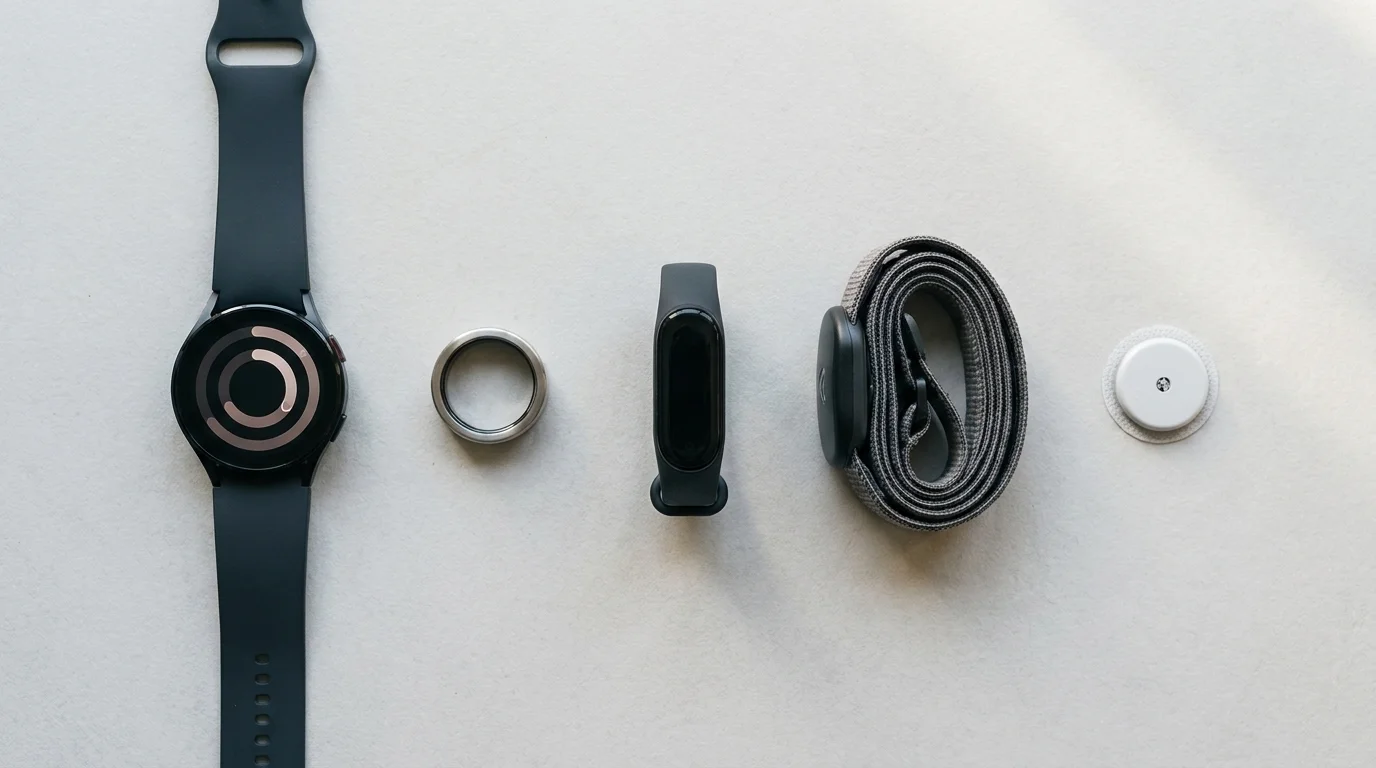
- Wearables and sensors — Apple Watch, Oura Ring, Whoop, Fitbit, Garmin, continuous glucose monitors. A growing subset has FDA clearance for specific medical features (AFib detection, hypertension screening, oxygen saturation).
- Telehealth services — virtual consultations across primary care, mental health (BetterHelp, Talkspace), and specialty care. HIPAA-covered.
- Prescription digital therapeutics (PDTs) — FDA-cleared apps that are prescribed by clinicians and, as of January 2025, can be covered by Medicare.
What "digital wellness" does not mean in this guide: managing screen time, parental controls, digital detoxes, or general anxiety about phones. Those belong under "digital wellbeing" and have their own (different) SERP and authorities.
Prescription digital therapeutics: the FDA-cleared category
This is the category most consumer wellness coverage skips, and it is the one with the strongest regulatory backing. A prescription digital therapeutic (PDT) is a software-based treatment that has cleared the FDA through the same regulatory pathway used for traditional medical devices — most through the 510(k) clearance route. As of May 2025, 12 to 13 PDTs were on the U.S. market, with 61.5% cleared via 510(k).
The clearances most consumers will encounter:
- EndeavorRx — a video-game-based PDT for pediatric ADHD attention symptoms, FDA-cleared in 2020. The original poster child for the category.
- Somryst — a smartphone-based cognitive behavioral therapy program for chronic insomnia (CBT-I), cleared as a PDT.
- Rejoyn — cleared in April 2024 as the first FDA-cleared PDT for major depressive disorder. Six weeks of smartphone-based cognitive emotional training paired with brief therapy lessons, intended as an adjunct to standard care.
- DaylightRx — cleared in September 2024 as the first FDA-cleared PDT for generalized anxiety disorder.
The insurance shift that matters. On January 1, 2025, Medicare began covering FDA-cleared digital therapeutics for depression and anxiety — the first time a major U.S. payer reimbursed prescription mental health apps as a covered benefit. Cigna followed in late 2025. This is what crosses the line from "interesting category" to "the kind of thing your clinician may actually be able to prescribe and your insurance may actually pay for."
Where the FDA's 2026 guidance comes in. A common point of consumer confusion is whether a wellness app is FDA-regulated. The FDA's 2026 updated guidance on general wellness devices clarifies the line: products that promote general well-being without making specific medical claims fall outside FDA device regulation. PDTs and apps that make specific disease-treatment claims do not. If a product talks about "supporting calm" or "general fitness," it is in the general-wellness lane. If it talks about treating insomnia, depression, or anxiety, it had better have a clearance number — and the ones above do.
Related Article: AI-Powered Personalized Fitness: Revolutionizing Workout Regimens Through Data-Driven Insights
Best wellness wearables in 2026
The wearable category has finally moved past "step counter that vibrates." Several devices now have FDA clearance for specific medical features, and that is the lens worth using to pick one.
| Device | Strongest feature | FDA-cleared features | Best for |
|---|---|---|---|
| Apple Watch Series 11 | Cardiovascular early detection | AFib detection, ECG, hypertension notifications (added Sep 2025) | All-purpose, especially cardiovascular risk |
| Oura Ring (Gen 4) | Sleep and recovery depth | None specific to medical conditions; cycle tracking is consumer-grade | Sleep, recovery, cycle awareness |
| Whoop 5.0 | Training load and recovery | None specific to medical conditions | Athletes, training periodization |
| Fitbit Charge | Activity + sleep basics | ECG/AFib detection on select models | Mainstream activity tracking |
| Garmin (Forerunner / Venu) | Endurance training metrics | ECG on Venu models | Endurance athletes |
The most consequential addition in this category in the last year is the Apple Watch Series 11's FDA-cleared hypertension notifications, launched in September 2025. This is the first consumer wearable to passively screen for high blood pressure — a meaningful step from "fitness tracker" toward "early-detection device." That same market report notes Apple now holds over 28% share of the wearable category, with the smart-ring segment (led by Oura) growing 21% per year despite still representing under 1% of total wearable volume. Oura shipped 2.31 million units in 2025 and is projected to reach 3.23 million by 2028.
A standing caution about FDA clearance language on these devices: clearance for a specific feature (AFib detection on an Apple Watch) is not clearance for the whole product. "FDA-cleared smartwatch" in marketing usually means "this smartwatch has one cleared feature." The rest of what it tracks is consumer wellness data, useful but not diagnostic.
Best wellness and mental health apps in 2026
Unlike PDTs, the apps below are not FDA-cleared. They are general wellness or consumer mental-health products. That does not mean they don't work — many have real research behind specific modules — but the regulatory baseline is "general wellness," not "treats depression."
- Calm, Headspace — guided meditation, sleep stories, breathwork. Strong evidence for short-term stress and sleep-onset improvements in regular users; not a substitute for therapy.
- BetterHelp, Talkspace — telehealth therapy platforms connecting users with licensed therapists by chat, video, or phone. HIPAA-covered, in-network with some insurers, generally cheaper than traditional therapy.
- Noom, MyFitnessPal — nutrition and behavior-change apps. Noom adds a behavioral-psychology module on top of food tracking; MyFitnessPal is the dominant food log. Useful if behavior tracking helps you; not a weight-loss treatment.
- Wysa, Woebot — AI-driven chatbot mental-health support. More on these in the AI coaching section below.
The 2026 number worth knowing about this category: 61% of mental-health-app developers now embed AI therapy tools and 58% integrate wearable data. The shift across the entire category is from passive logging to active, contextual prompting — the app pings you when it spots a pattern, instead of waiting for you to open it. Whether that is helpful or invasive depends on the person.
Related Article: Democratizing Wellness Tech: Ensuring Equal Opportunities for Digital Health Adoption
AI health coaching: what "active support" means in practice
"AI health coaching" is the cluster that has changed most quickly in the last 18 months. The 2026 shift is from passive tracking to pattern recognition and proactive prompting: the app or wearable notices that your resting heart rate has crept up over five nights, that your sleep latency tracks with screen time, that your mood ratings cluster around specific days of your cycle — and surfaces that pattern with a suggested action.
Concrete products consumers will encounter:
- Whoop Coach — built into the Whoop band, an AI-driven coach trained on the company's recovery and strain data. Answers natural-language questions about training load and recovery and surfaces patterns across longer time horizons.
- Oura advisor — Oura's AI feature layered on top of sleep and readiness scores; framed as a coach for sleep and stress.
- Wysa, Woebot — AI-driven conversational mental-health support. Wysa has cleared CE marking in Europe as a medical device for some indications; Woebot Health discontinued its consumer Woebot app in mid-2025 and pivoted to clinician-facing tools.
- Embedded coaches in nutrition apps — Noom, MyFitnessPal Premium, and others have added AI conversation layers on top of their existing tracking.
A reality check on what AI coaching is and isn't: an AI coach is a recommendation engine on top of consumer-grade sensor data. It is not a clinician. It does not have your medical record. Its training data is the population average plus whatever it has seen from you, which is a much narrower base than a clinician's pattern recognition across hundreds of patients with your condition. For general wellness coaching — sleep timing, training load, hydration nudges — that base is enough. For mental health, the developer's documentation should explicitly state what the product is designed to treat (and most consumer apps explicitly say "not a substitute for professional care").
A pick-by-goal matrix
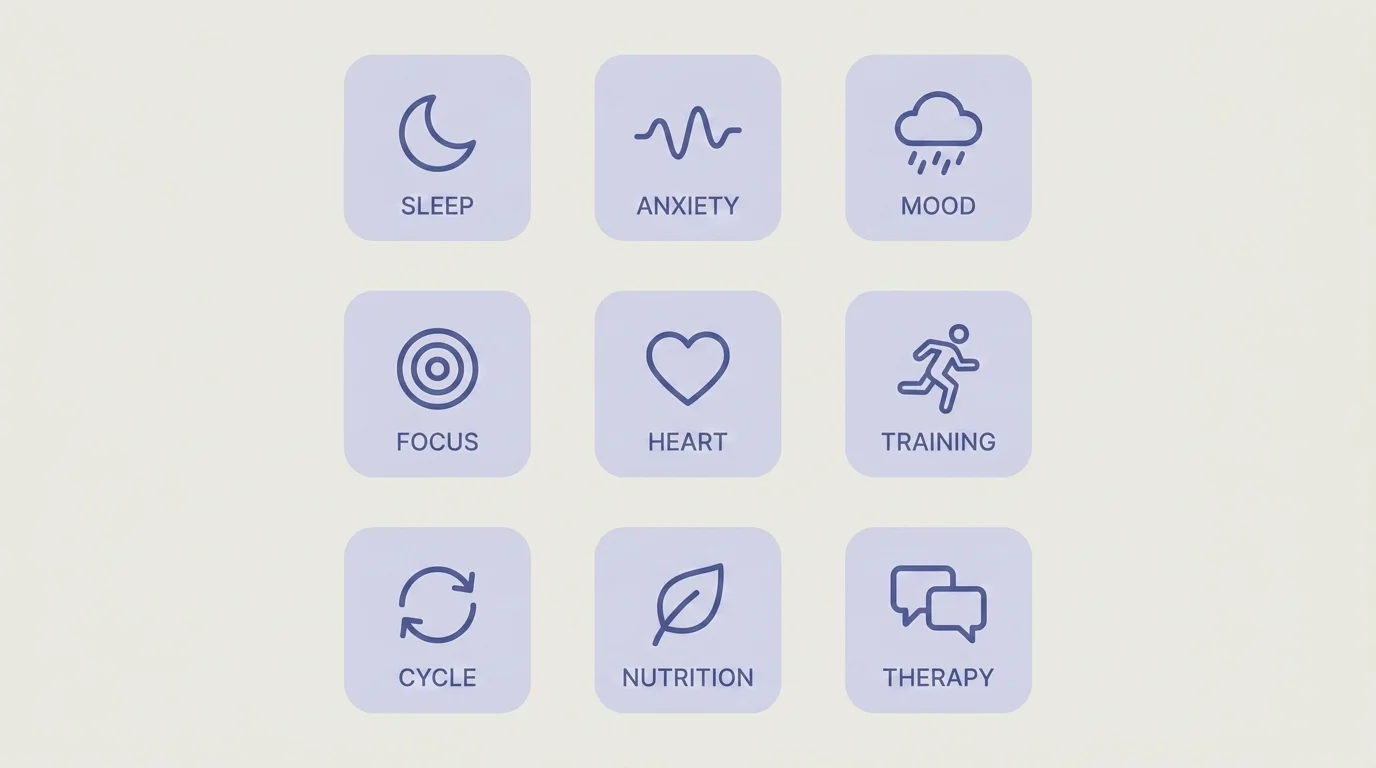
The single most useful framing question is: what specific health goal are you trying to support? The category-to-tool mapping below covers the most common entry points.
| Goal | First-pass consumer pick | If it warrants a prescription product |
|---|---|---|
| Sleep onset / quality | Oura Ring + Calm or Headspace | Somryst (FDA-cleared CBT-I) via a clinician |
| Anxiety symptoms | Calm, Headspace, Wysa | DaylightRx (FDA-cleared for GAD) via a clinician |
| Depressive symptoms | BetterHelp / Talkspace + Calm or Headspace | Rejoyn (FDA-cleared for MDD) as adjunct to standard care |
| ADHD attention support | (consumer apps are limited) | EndeavorRx for pediatric attention symptoms |
| Cardiovascular risk awareness | Apple Watch Series 11 (hypertension + AFib + ECG) | A cardiology referral if notifications flag anything |
| Training load / recovery | Whoop or Garmin | (consumer category) |
| Cycle tracking | Oura Ring or a dedicated cycle app | (consumer category) |
| Nutrition tracking | MyFitnessPal (logging), Noom (behavior change) | A registered dietitian for medical nutrition therapy |
| Therapy access | BetterHelp / Talkspace (telehealth) | Local in-person care for severe or complex conditions |
The pattern across the table: consumer apps for general support, FDA-cleared PDTs (via a clinician) when the issue is a diagnosable condition the consumer category cannot treat, and human care for anything serious or complex. None of these categories replaces the others.
Telehealth: where it has settled
Telehealth volumes spiked during the pandemic and have settled into a steady share of routine care since. The current pattern: telehealth dominates mental-health visits (where the consultation rarely needs a physical exam), holds significant share in primary-care follow-ups and prescription refills, and is most often a video visit through a patient portal or a dedicated platform like Teladoc, Amwell, or insurer-direct virtual care.
What telehealth is genuinely useful for: medication management for stable chronic conditions, mental health appointments (where the platform shift removed a major access barrier), routine follow-ups, urgent-care triage. What it is not a substitute for: physical exams, procedures, or any visit where the clinician needs to see, palpate, or measure something a webcam cannot capture.
Coverage is broad: most commercial insurance and Medicare cover telehealth visits at parity with in-person visits for most indications, though some state and modality-specific exceptions remain. Check your specific plan.
Privacy: where HIPAA does and does not apply
This is the section most consumer wellness coverage hand-waves at, and it is the one with the highest practical consequence.
HIPAA covers health information held by "covered entities" and their business associates — your doctor's practice, your hospital, your insurance company, your pharmacy, telehealth services delivered by a licensed provider, and the data flowing between them. PDTs prescribed through a clinician are inside the HIPAA perimeter. Telehealth platforms are inside.
HIPAA does not cover most consumer wellness apps. Calm, Headspace, MyFitnessPal, Noom, Whoop, Oura, Apple Health, Fitbit's consumer data — none of these are HIPAA-covered. They operate under the developer's own privacy policy, which is governed by the FTC's general consumer-privacy authority, state laws (California's CCPA is the toughest), and the EU's GDPR for users in Europe.
What that means in practice: the wellness app on your phone can legally share, sell, or use your data for purposes laid out in its privacy policy, which most users never read. Some categories — mental health and reproductive-health apps in particular — have repeatedly been found sharing data with advertisers and third parties in ways users did not expect. The right move is not to avoid all wellness apps; it is to read the privacy policy on the ones that handle data you would prefer to keep private (cycle, mental health, sexual health, fertility) and prefer products with explicit no-sale policies or end-to-end-encrypted storage.
Three questions to ask before signing up for any wellness app or service handling sensitive data:
- Is this product covered by HIPAA? If yes, federal protections apply. If no, you are relying on the company's own privacy policy.
- Does the company sell or share my data with third parties? Look in the privacy policy specifically for "third-party advertising," "marketing partners," and "data brokers."
- What happens to my data if I delete my account? Many companies retain de-identified data; some keep the full record. Knowing this in advance is easier than asking after the fact.
What this changes for you, if anything
If you are already using one of the consumer wellness apps or wearables in this guide and it is working for you, none of this is a reason to change. The category is real, most of the products are reasonable, and "track this and notice patterns" is a defensible wellness intervention.
If you have a diagnosable mental-health condition that has not responded to first-line treatment — depression, anxiety, insomnia, ADHD — the most important update from the last 18 months is that prescription digital therapeutics are now real, FDA-cleared, and at least partially covered by Medicare. That is a conversation worth having with your clinician, not because PDTs replace therapy or medication, but because they are a low-friction adjunct that the regulatory and reimbursement systems have started to take seriously.
If you are wearable-shopping and the goal is cardiovascular early detection, the Apple Watch Series 11 is the only consumer device with an FDA-cleared hypertension feature right now, and that is the most clinically meaningful new wearable feature of 2025. If the goal is sleep depth, recovery, or cycle awareness, Oura is the deeper sensor. If the goal is training load, Whoop is the more focused tool. Pick by goal.
The closing rule is the same one I write in every nutrition piece, adapted: name the product, name what it has been cleared or studied to do, name the dose or duration that was studied, and bring the question to your own clinician before you treat any of these tools as healthcare.
Frequently Asked Questions
Digital wellness is the use of consumer or prescribed technology — apps, wearables, telehealth, and FDA-cleared prescription digital therapeutics — to support physical and mental health outcomes. It is distinct from 'digital wellbeing,' which refers to managing screen time and device use.
Digital wellness uses technology to support health (apps, wearables, telehealth, prescription digital therapeutics). Digital wellbeing is about managing your relationship with technology itself — screen time, parental controls, digital detoxes. Google increasingly separates the two in search.
Yes — 12 to 13 prescription digital therapeutics (PDTs) were FDA-cleared as of May 2025, including Rejoyn (depression, cleared April 2024), DaylightRx (generalized anxiety, cleared September 2024), EndeavorRx (pediatric ADHD attention), and Somryst (chronic insomnia / CBT-I). Most cleared via the 510(k) pathway.
Medicare began covering FDA-cleared digital therapeutics for depression and anxiety on January 1, 2025, and Cigna followed in late 2025 — the first time a major U.S. payer reimbursed prescription mental-health apps. Most consumer wellness apps (Calm, Headspace, MyFitnessPal, Noom) are not covered and remain out-of-pocket.
Pick by goal, not by brand prestige. Apple Watch Series 11 added FDA-cleared hypertension notifications in September 2025 and is the strongest pick for cardiovascular early detection (AFib, ECG, hypertension). Oura Ring has the deepest sleep and recovery sensor. Whoop is the strongest pick for training load and athletic recovery. Garmin leads on endurance metrics. Fitbit Charge covers mainstream activity tracking. None of them are diagnostic devices — the cleared features are.
Generally no. HIPAA covers health information held by covered entities (doctors, hospitals, insurers, pharmacies) and their business associates. Prescription digital therapeutics and telehealth platforms are inside the HIPAA perimeter. Most consumer wellness apps — Calm, Headspace, MyFitnessPal, Whoop, Oura, Apple Health, Fitbit — are not, and operate under their own privacy policies governed by the FTC, state law (California's CCPA is strictest), and GDPR for European users. Read the privacy policy for any app handling sensitive data.
An AI health coach is a recommendation engine that uses sensor data and natural-language interaction to surface patterns and suggest actions — Whoop Coach for training load, Oura's advisor for sleep and stress, Wysa or Woebot for mental-health support. For general wellness coaching (sleep timing, training, hydration), the underlying data is enough. For mental-health conditions, AI coaches are not a substitute for clinical care, and the developer's documentation should state what the product is designed for.
Check Out These Related Articles

Revolutionizing Patient Care: The Impact of Data Analytics in Health and Wellness

The Technological Future of Holistic Healing: Innovations Reshaping Well-Being Practices
Revolutionizing Fitness Regimens with Smart Gym Equipment