
Ethics vs Morals


Picture a nurse who believes a frightened patient deserves the truth, working under a policy that tells her to wait for the attending physician. That gap — between what she believes is right and what the rules permit — is the whole of the ethics vs morals question, and it is not a word game. Morals are the principles you carry inside you. Ethics are the rules a group, a profession, or a society writes down.
This page does the definitional work: what each word means, how they differ at a glance, real examples across everyday life, the workplace, and healthcare, and how both relate to your values and the law. It also does one thing the dictionaries skip. It names what the collision costs you. When your personal morals and your professional ethics point in opposite directions, the result has a documented name — moral distress — and a documented price. By the end you will be able to spot that tension and know what to do with it.
What is the difference between ethics and morals?
Morals are your personal principles about right and wrong; ethics are the external rules a group, profession, or society sets for conduct. That is the entire distinction, and every other line on this page is a footnote to it.
What are morals?
Morals are the internal principles you hold about right and wrong, shaped by upbringing, culture, and belief. They live in you, not in a rulebook. According to Oxford College, which ranks first for this query, "morals are based on each person's own principles." That is why two reasonable people can look at the same situation and reach opposite conclusions in good faith. Your morals are yours. They can also change as you do; the conviction you held at twenty is not always the one you hold at forty.
What is ethics?
Ethics are the external rules a group sets for how its members should behave — a profession's code, an institution's policy, a society's shared standards. The same source frames the core difference cleanly: ethics "concerns rules from an external source." Where morals answer what do I believe is right, ethics answer what are the members of this group required to do. A doctor, a lawyer, an accountant, and a journalist each operate under a written code they did not personally author and cannot personally opt out of.
Morals vs ethics at a glance
The fastest way to hold the two apart is a side-by-side. Note the reversible phrasing — morals vs ethics, moral vs ethical — describes the same split from either direction.
| Source | Flexibility | Application | Example | |
|---|---|---|---|---|
| Morals | Internal — upbringing, culture, personal belief | Personal; can shift as you grow | Guide your own conduct | You return the extra change a cashier hands you because keeping it feels wrong |
| Ethics | External — a profession, institution, or society | Codified; slower to change | Govern a group or role | A lawyer must defend a client zealously, because the profession's code requires it |
The hidden cost when ethics and morals collide (moral distress)
The definition pages leave out one thing: morals and ethics do not always agree. A personal conviction can collide with an external duty. That collision has a cost — and a name.
Clinicians call it moral distress. The University of Rochester Medical Center describes it as what "arises when individuals find themselves caught between what they believe is ethically and morally the right thing to do and external pressures applied by their employers or societal expectations to the contrary" — the specific bind of someone who "knows the ethical action to take, however feels powerless to do so." The AMA Journal of Ethics traces the move from a narrow clinical definition to one meant to span professions. By February 2026 the concept had migrated into general wellbeing writing about anyone whose values and reality clash.
The effects are not abstract. Unresolved moral and ethical conflict correlates with burnout, anxiety, and depressive symptoms. It also tracks with physical signs like sleep disturbance and fatigue, according to URMC and Medical News Today. I am not going to hand you a percentage. The honest research here is qualitative, and inventing a number is exactly what this page exists to argue against.

Three moves help you hold that tension, none requiring that you resolve the philosophy first. Name it: the label moral distress, rather than "I'm just stressed," turns a vague weight into something specific. Separate the roles: your professional duty is real, but it is not your personal conviction. Then realign what you can control — the daily choices where ethics, morals, and values align. That is the ordinary work of ethical wellness. Some collisions are, as one government ethics toolkit puts it, a true dilemma with no clear answer. Naming the cost is still the first thing that makes it manageable.
Ethics vs morals examples: personal, workplace, and healthcare
Definitions are easy to nod along to and hard to apply. Here is the internal-versus-external split in three settings, so you can see which one is doing the work in a given moment.
In everyday personal life
A friend asks whether you like the apartment they just signed a lease on, and you don't. Honesty is a moral principle; so is kindness. No external code governs the moment — there is no committee reviewing your answer — so what you say is pure morals, your own principles negotiating with each other in real time. That is the tell for a moral question: the standard lives inside you, and reasonable people land in different places.
In the workplace
Now add an external code and the calculus changes. A criminal defense lawyer may privately believe a client is guilty and still be required to mount a vigorous defense — MasterClass uses exactly this case to show a professional ethical duty overriding personal moral discomfort. The lawyer's morals did not vanish. They were outranked, in that role, by an external standard the profession imposes precisely so that the system does not depend on any one lawyer's private judgment. As one ethics resource puts it bluntly, personal ethics are not a substitute for professional ones.
In healthcare
Medicine is where the two collide most sharply, which is why the vocabulary for the collision came from there. A clinician operates under a formal ethical code — confidentiality, consent, scope of practice — that can run against personal moral judgment in a specific case; LanguageTool illustrates this with the professional medical code a practitioner is bound to follow even when their private conviction pulls elsewhere. This is the exact setting where moral distress was first documented, and it is why the concept is now being exported to the rest of us.
Ethics vs morals vs values: how the three connect
People run values into this conversation and lose the thread, so keep the layers separate. Values are your core priorities — the things you care about most, like honesty, security, or fairness. Morals are the personal right-and-wrong principles that flow from those values. Ethics are the external conduct rules of a group or role you operate within.
The cleanest way to picture it is nesting. Values sit deepest, morals grow out of them, and ethics is the outer layer you meet the world through. Your values tell you what matters. Your morals translate that into what is right for me to do. The ethics of your job or community set what the group requires. Living "in alignment" is just the state where those three point the same direction. The friction between the layers — when the outer rule contradicts the inner principle — is the same crack where the distress from the last section shows up. The three-way distinction is not academic tidiness. It is a diagnostic for where, exactly, a conflict is coming from.
Morals vs law: when legal isn't the same as right
Law is a fourth layer, and it is the one people most often mistake for the others. Law is codified and enforceable — break it and the state can act. Ethics are professional or social standards that frequently exceed what the law requires. Morals are personal convictions that can diverge from both. The three overlap heavily, which is why they blur. But they are not identical, and none guarantees the others.
The gap is easiest to see from one direction: something can be perfectly legal and still leave people worse off. A company can do exactly what the law permits — exploit a loophole, sell a product it never had to prove works — and break no rule at all, while plenty of people would call the result wrong. "Legal" is a floor, not a ceiling. It tells you what you can be punished for, not what you ought to do, and treating the two as the same is how "it's allowed" quietly becomes "it's fine." Ethics and morals are the layers that ask the second question the law never gets around to.
Where "ethics" and "morals" come from
The words themselves carry the distinction. According to Britannica, ethics descends from the Greek ēthos, meaning "character," while morals comes from the Latin mores, meaning "custom" — one rooted in who a person is, the other in what a community practices. Britannica also offers the loosest useful summary of the overlap: both terms have to do with distinguishing "good and bad" or "right and wrong." That shared job is why the two are used interchangeably in ordinary speech, and the etymology is why, when precision matters, they are not quite the same word.
Ethics vs morals: the bottom line
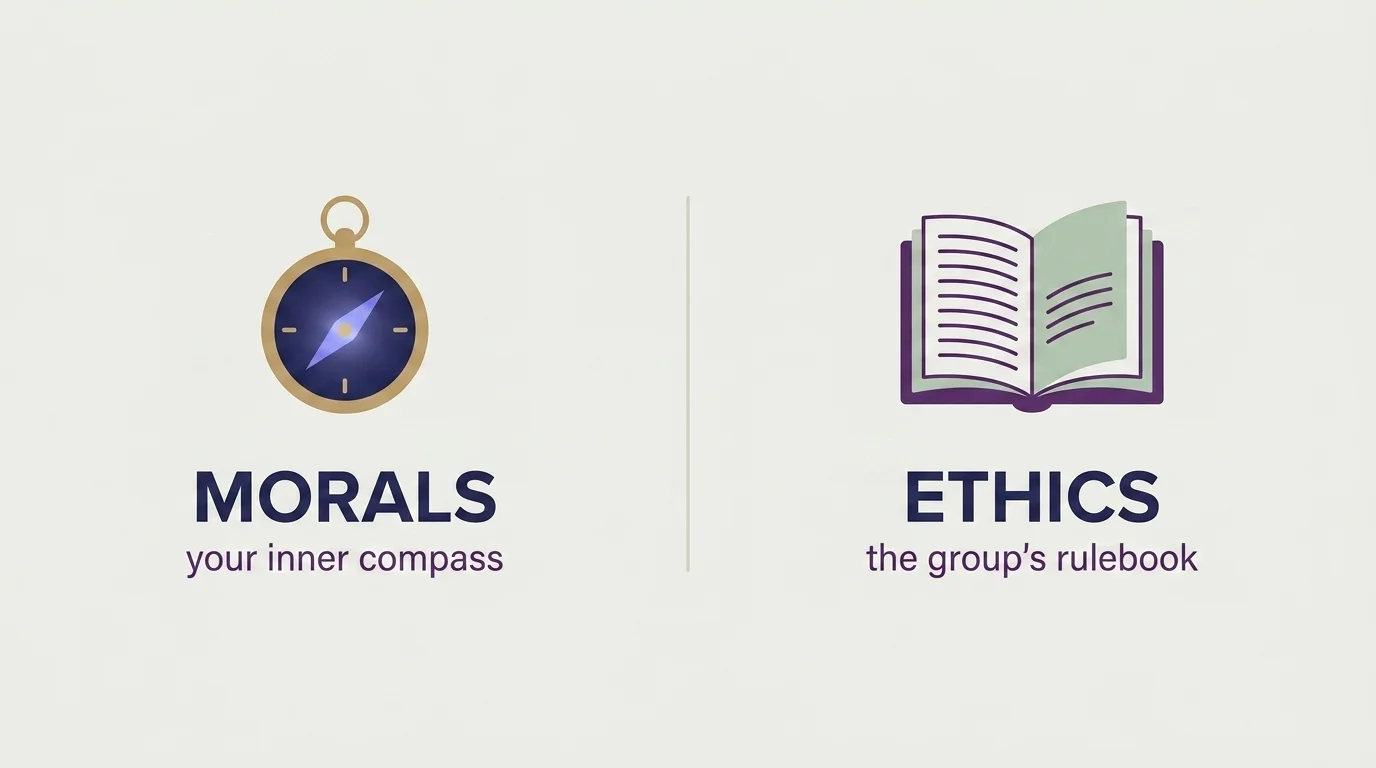
Strip it down and the ethics vs morals distinction is one axis: morals are the inner compass you were raised with and refine over a lifetime; ethics are the outer rulebook a profession or society hands you; and your values sit beneath both, deciding what the compass points toward in the first place. Knowing the difference is genuinely useful for a crossword answer or an exam. It becomes useful for your actual life the moment the two pull apart. That friction is not just confusing — it is a measurable weight, and it has a name. Notice the next decision where an external rule clashes with your own conviction. Name the tension instead of absorbing it. That small act of precision is where ethical wellness starts.
Frequently Asked Questions
Yes. Morals are your personal principles; ethics are the external rules of a group or profession. Someone can follow a strict personal moral code yet breach a professional ethical duty — and vice versa.
Kant grounded morality in duty and reason: an action is moral if it follows a universal rule (the categorical imperative) you could will everyone to follow — not because of its consequences.
Treat others as you would want to be treated. It's a near-universal moral principle that also underpins many formal ethical codes.
The gap can cause "moral distress" — the documented stress of knowing what you believe is right but being unable to act on it. Naming it, and separating your personal role from your professional one, helps ease it.