Perks of Laughter Yoga: Cultivating Happiness for Enhanced Mental Health


A client asked me last spring whether laughter yoga was a real practice or "exercise YouTube wearing a costume." I had been carrying a 200-hour yoga certification from a Krishnamacharya-lineage studio in Chennai for about three years at that point, and I had watched two laughter yoga sessions in person while I was there. The honest answer is that it is a real, defined practice, with a 30-year institutional history, a growing peer-reviewed evidence base, a clear standardized session structure, and a list of people who should not do it. Almost none of that shows up in the breezy wellness coverage of the topic. So let me try to walk through it the way I would walk a client through any other practice — what it actually is, what the cue looks like from the outside and feels like from the inside, what the timeline is, and what it can and cannot do.
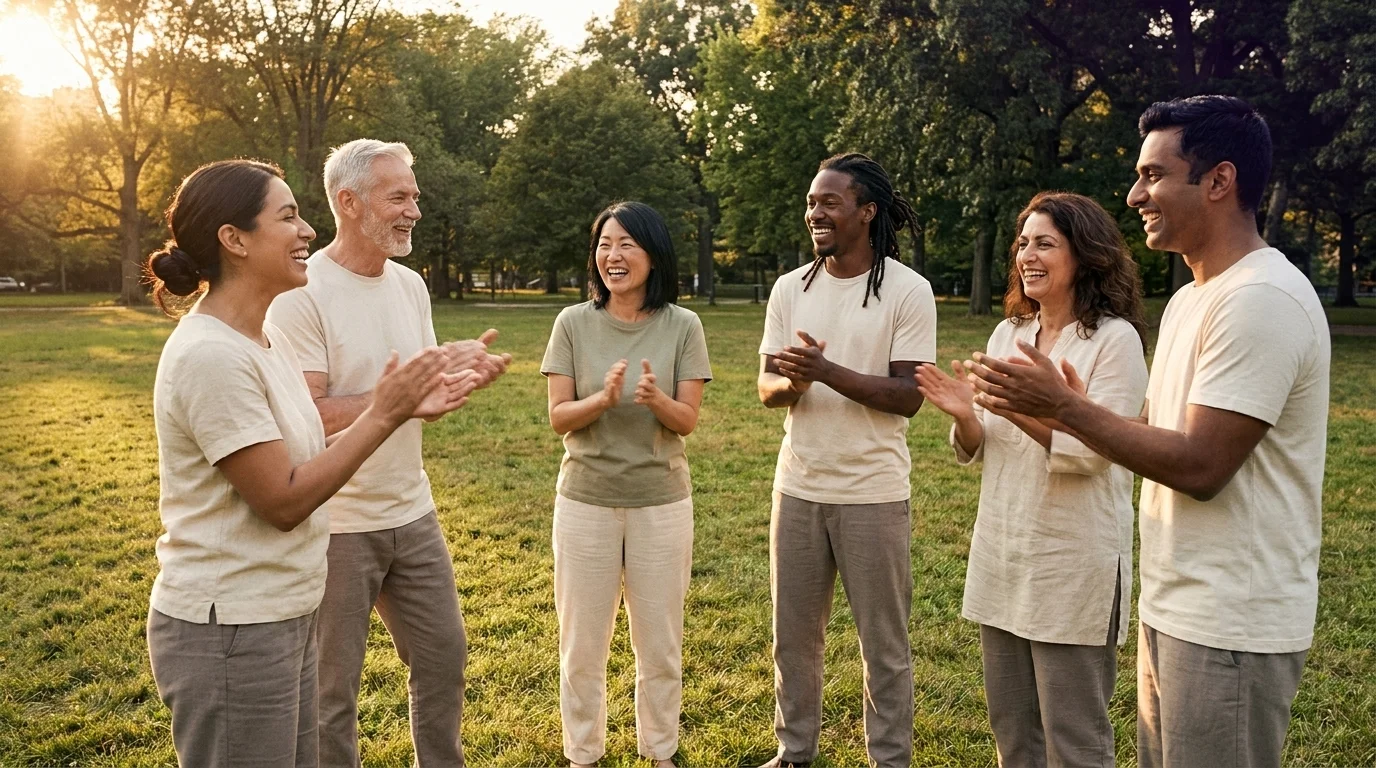
What is laughter yoga?
Laughter yoga (in Sanskrit, hasya yoga) is a structured group practice that combines voluntary simulated laughter exercises with yogic breathing techniques (pranayama). The premise — and the part that surprises people most — is that the body cannot reliably distinguish simulated laughter from spontaneous laughter at the physiological level. You start by deliberately producing laughter sounds in a group, and within a few minutes the laughter almost always becomes genuine. The yogic breathing component provides the structural backbone: deep diaphragmatic breaths between exercises that recruit the parasympathetic nervous system and prevent the simulated-laughter cycle from becoming hyperventilation.
The practice is distinct from comedy, from improv, and from laughter therapy — it is its own modality with a specific session structure, and the 2019 ScienceDirect meta-analysis of laughter-inducing therapies found that simulated laughter is actually more effective than spontaneous (humor-driven) laughter for improving depression. That is counterintuitive, and it is one of the more replicated findings in the field.
Where it came from
The practice was founded in 1995 in Mumbai by Dr. Madan Kataria, a family physician, and his wife Madhuri, a yoga teacher, with a five-person park club. Per Wikipedia's documentation of the practice, the Kataria network now operates in more than 120 countries through thousands of in-person and virtual clubs. The lineage matters because it gives the practice an institutional anchor that most wellness modalities lack — a founder still living, a documented protocol, a certification pathway, and a recognizable session format that is reproducible across continents.
Recent press coverage has tracked the practice's mainstream uptake. A December 2025 Euronews feature profiled Dr. Santosh Sahi leading sessions in Delhi's Lodhi Gardens and cited Dr. Michael Miller's cardiovascular research at the University of Pennsylvania on the endothelial and nitric-oxide effects of sustained laughter — the closest the field has come to a clean mechanism for the cardiovascular benefits the small trials keep reporting.
How a session actually runs (and the standardized dose)
A laughter yoga session follows a four-step structure, in the protocol described by the Kataria network and replicated across most active clubs:
- Clapping warm-up — coordinated rhythmic clapping while saying "ho-ho, ha-ha-ha" to oxygenate and synchronize the group.
- Yogic breathing (pranayama) — deep diaphragmatic breaths between segments to reset the nervous system.
- Laughter exercises — a sequence of named simulated-laughter drills (described in the next section), each lasting 30 to 60 seconds.
- Closing chant — the canonical "We are very good, very good. Yay!" with arms raised, repeated three times, followed by a brief seated grounding.
A typical session runs 30 to 45 minutes. The standardized clinical dose now converges across recent trials at eight sessions of 40 to 45 minutes each, over four weeks — that is the protocol most-replicated in the 2024 PMC11520822 systematic review of laughter yoga in nursing populations, and a 2026 dose-response meta-analysis on laughter therapy puts the optimal cumulative dose at 400 to 600 minutes. As a coach, the honest framing is the one you would give any other practice: six to eight weeks of consistent attendance is the timeline at which measurable effects show up. Nothing in training works in a week. Laughter yoga is not an exception.
Eight named exercises you can try at home
Below are eight canonical exercises from the Kataria network. The cue is what to do; the external marker is what a person watching would see; the internal sense is what it should feel like. You can practice solo to learn the mechanics, but the practice is group-designed and lands harder with at least one other person.
- Greeting laugh — turn to face another person, make eye contact, and laugh while shaking hands in the style of meeting a stranger. The cue is the eye contact; without it, the laughter stays self-conscious.
- Hearty laugh — head tilts back, arms raised overhead, laughter from the belly. External marker: shoulders drop visibly on the exhale.
- Milkshake laugh — pretend to pour a glass of milk between two cups, then drink it while laughing. Sounds absurd; the absurdity is the point — it is the cue that gets people out of self-consciousness.
- Mobile-phone laugh — hold an imaginary phone to your ear, listen for a beat, and burst into laughter as if hearing the funniest thing of your week.
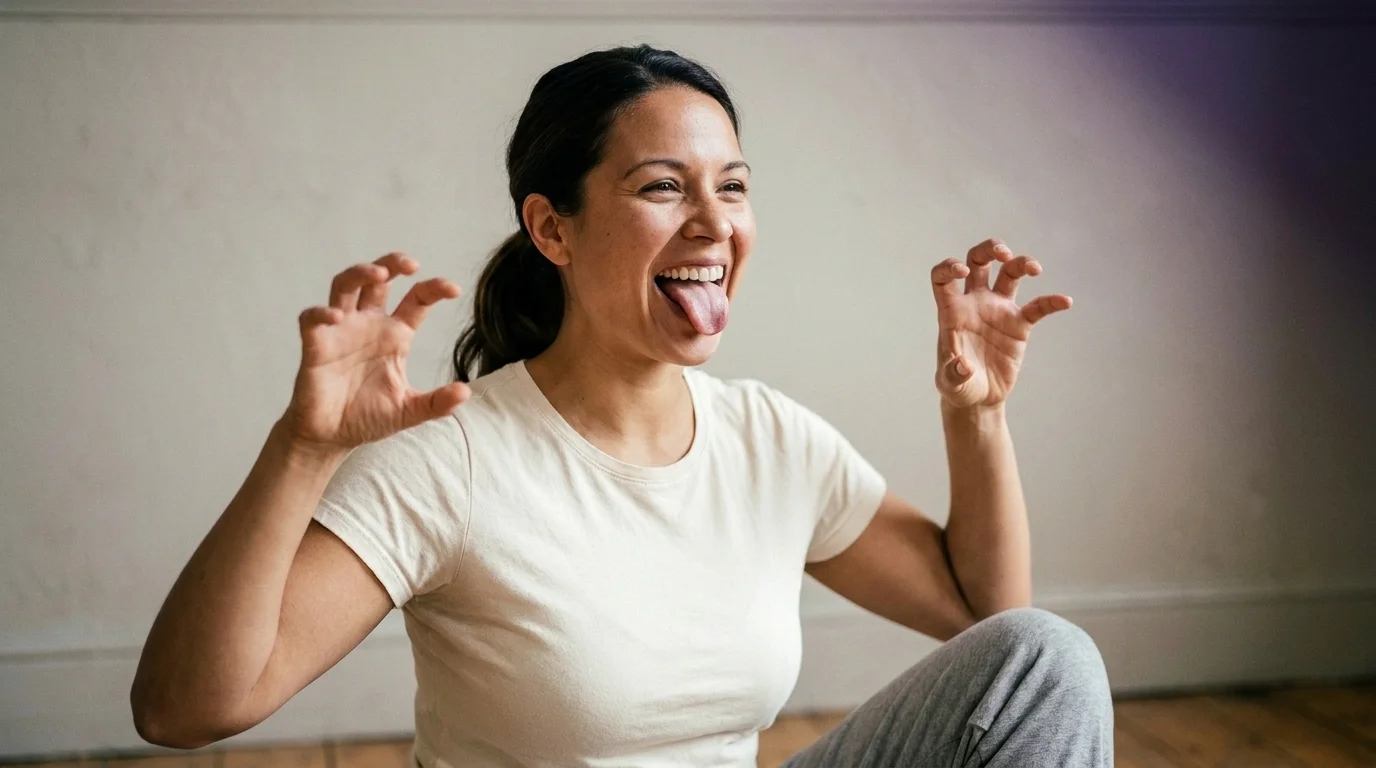
- Lion laugh — open the mouth wide, stick the tongue out, hands stretched into claws, laugh loudly. Borrowed directly from simhasana (the lion pose in classical yoga); the facial-muscle engagement is the active ingredient.
- Gradient laugh — start with a smile, then a chuckle, then a giggle, then a full laugh, then back down. Used to warm a cold group or to land a session.
- Silent laugh — full open-mouth laughter posture with no sound, eye contact maintained. The sneaky-difficult one; it generates the most genuine laughter once people stop being able to hold the silence.
- One-meter laugh — extend one arm out like drawing a bow, pulse it back three times saying "Aae, aae, aae" then release into a sustained "ha-ha-ha". The most distinctively Kataria-network exercise and the closest the practice gets to choreography.
Two practical notes from the coach side. First, the breathing between exercises is not decorative — it is what prevents the cycle from tipping into hyperventilation, particularly for new participants. Second, eye contact is the single most underrated variable in whether a group session lands. Closed eyes or downcast gaze produces self-conscious solo laughter; sustained eye contact produces real group laughter, every time.
Evidence by condition: what the meta-analyses actually show
This is the section the original version of this article was missing entirely. Here is what the controlled-trial literature actually supports.
Stress and cortisol. The 2024 PMC11520822 systematic review of 10 studies in nurses and nursing students found measurable reductions in perceived stress (Cohen PSS-10 dropped from a mean of about 22 to about 16 in one trial) and in salivary cortisol (0.91 ± 0.74 ng/ml at baseline to 0.61 ± 0.05 post-intervention — roughly a 33% drop) across the eight-session protocol described above.
Burnout. The same review documented a burnout-score drop from 85.25% to 54.59% post-intervention in one nursing cohort. Burnout is the outcome with the largest absolute effect size in this literature, which is worth noting because nursing and caregiving populations are where the practice is being most actively researched.
Depression and anxiety. The 2018 Bressington systematic review (PubMed 30030938) covering six studies reported a medium-to-large short-term effect on depression, with the explicit caveat that the underlying evidence quality was low — sample sizes were small and blinding is structurally difficult for this kind of group practice. Take both findings seriously.
Happiness and life-satisfaction (older adults). A 2025 Iran RCT (PMC12448539) with 220 retirees aged 60 to 90 ran the standardized eight-session protocol and reported happiness scores rising from 63.18 to 69.86 and hope/life-expectancy scores rising from 65.86 to 69.42 — both significant at p<0.001 versus an unchanged control group. n=220 is a real sample for this category.
Cardiovascular. Dr. Michael Miller at the University of Pennsylvania has been the most-cited research voice on the cardiovascular mechanism, documenting endothelial improvements and nitric-oxide release from sustained laughter (Euronews 2025 coverage). A clinical trial on hypertension specifically (NCT07148869) is among several active registered laughter-yoga trials as of 2025.
Safety profile in elderly populations. A 2020 meta-analysis cited in the Wikipedia entry found no adverse effects reported in older adults across studies covering blood pressure, cortisol, sleep, life satisfaction, loneliness, death anxiety, depression, mood, and happiness outcomes.
The honest summary: the effect sizes are real, the dose-response is becoming clear, and the practice is in roughly the same evidence position as most other group-based mind-body practices — better than nothing, comparable to other low-cost stress interventions, and not a replacement for first-line clinical care.
For seniors
The strongest evidence for laughter yoga specifically — versus laughter therapy or other interventions — is in older adults. The 2025 Iran RCT cited above (n=220, ages 60-90, eight 45-minute sessions over four weeks) is the largest single trial in the consumer-facing literature, and the 2020 meta-analysis covering this population found no adverse effects. For senior centers, retirement communities, or adult-day programs, this is one of the cleanest evidence bases supporting a regular structured offering. The contraindications below apply.
Laughter yoga vs. laughter therapy vs. laughter meditation
These three terms get conflated, and the distinctions matter for both the search and the practice.
Laughter yoga is the specific 1995 Kataria protocol — group practice, simulated-laughter exercises, integrated yogic breathing, four-step session structure.
Laughter therapy is the broader clinical umbrella term covering any therapeutic intervention that uses laughter — clown therapy in hospital pediatric wards, humor-based group therapy, and laughter yoga itself when administered in a clinical context. The 2024 systematic review in nurses, the 2025 RCT in older adults, and the 2026 dose-response meta-analysis all fall under this umbrella.
Laughter meditation is the smallest of the three categories — a quieter, often solo practice of sitting with the body's laughter impulse without the structured group exercises. It is the one with the weakest evidence base and the smallest research footprint, and search interest has declined in recent years.
The three are not interchangeable. If a practitioner offers "laughter therapy" the question to ask is which protocol — Kataria-style laughter yoga, humor-based group work, or something else they have devised.
Who should approach laughter yoga with caution
This is the section the Kataria network publishes explicitly and most consumer wellness coverage skips. Laughter yoga is mostly safe and well-tolerated, with a list of populations who should consult a clinician before participating. The full list, as documented by Kataria-affiliated programs:
- Cardiovascular: uncontrolled high blood pressure, recent heart attack, severe heart disease (the same sustained vocal effort that produces the nitric-oxide benefit can spike BP transiently)
- Surgical and post-surgical: within three months of any major surgery
- Hernias of any kind, and advanced piles (hemorrhoids), because of the intra-abdominal pressure generated by sustained laughter
- Respiratory: persistent cough, severe asthma (acute, not well-controlled)
- Neurological: epilepsy or seizure disorders
- Pregnancy: the first and third trimesters specifically (second trimester is generally fine if you are otherwise healthy and your provider clears it)
- Postpartum: first eight weeks
- Urinary incontinence that has not been clinically addressed
- Severe back pain that is acute or unstable
- Major psychiatric conditions managed without clinical support — group emotional release can be destabilising without a therapeutic frame in place
None of these are absolute prohibitions; all of them are conversations to have with your clinician first. A good club leader will ask about them at intake.
Related Article: The Evolution of Fitness: Modern Workout Trends for Maximum Impact
How to try it
Three reasonable entry points, in increasing levels of formality:
- YouTube starter — search "Laughter Yoga University" or "Madan Kataria" for short guided sessions. Useful for getting the cadence in your body before you walk into a room.
- Free or low-cost virtual clubs — the Kataria network maintains a public directory at laughteryoga.org; many clubs run weekly free Zoom sessions, particularly in evening hours across multiple time zones.
- In-person clubs — the same directory lists local clubs in most major cities and a meaningful number of smaller towns. Most clubs are donation-based or modestly priced; commercial workshops and certification programs run higher.
If you want to lead sessions yourself, certification through the Kataria network or one of its affiliated trainers is a multi-day intensive in the low four figures of pricing, with continuing-education and supervision standards comparable to other adjacent-wellness certifications.
A closing note
Laughter yoga is real. It is anchored in a documented 30-year tradition, supported by a small but growing evidence base, taught through a recognisable session protocol, and structurally safe for most people. It is also not magic, and it does not replace therapy or medication for diagnosed mental-health conditions. If you are managing depression, anxiety, or another condition with a clinician, this practice is an adjunct — a low-cost, evidence-supported addition to the existing care plan, with the contraindications above noted. If you are in crisis, please contact the 988 Suicide and Crisis Lifeline in the US or your local equivalent. The bowls and the breath and the laughter are useful. They are not a substitute for the people trained to help you, and they were never meant to be.
Frequently Asked Questions
Laughter yoga (hasya yoga) is a structured group practice founded by Dr. Madan Kataria in Mumbai in 1995 that combines voluntary simulated laughter exercises with yogic breathing. The premise is that the body cannot reliably distinguish simulated from spontaneous laughter at the physiological level — a 2019 ScienceDirect meta-analysis found simulated laughter is actually more effective than spontaneous (humor-driven) laughter for improving depression. A 2024 systematic review of 10 studies documented measurable reductions in stress, salivary cortisol, and burnout following the standard eight-session protocol.
A laughter yoga session interleaves yogic breathing (pranayama) between each simulated-laughter exercise — deep diaphragmatic breaths that recruit the parasympathetic nervous system, oxygenate the blood, and prevent the laughter cycle from tipping into hyperventilation. The pranayama is the structural backbone, not decoration; without it, sustained simulated laughter can produce dizziness in new participants.
The 2024 PMC systematic review documented salivary cortisol dropping from 0.91 to 0.61 ng/ml (about 33%) and burnout-score reductions from 85.25% to 54.59% in nursing-cohort trials. Dr. Michael Miller at the University of Pennsylvania has documented endothelial improvements and nitric-oxide release from sustained laughter — the closest the field has come to a clean cardiovascular mechanism. A 2020 meta-analysis in older adults reported benefits across blood pressure, cortisol, sleep, life satisfaction, loneliness, and mood with no adverse effects.
Most clinical trials use 8 sessions of about 45 minutes over 4 weeks (around 400–600 total minutes), which is when measurable drops in stress, cortisol and depressive symptoms tend to appear. The 2026 ScienceDirect dose-response meta-analysis converges on the same 400–600 minute cumulative dose as the optimal sweet spot for the depression/anxiety effects.
The laughter starts as simulated and almost always becomes genuine within a few minutes of group practice. A 2019 ScienceDirect meta-analysis found simulated laughter is actually more effective than spontaneous, humor-driven laughter for easing depression — a counterintuitive but replicated result. The 2018 Bressington systematic review reported medium-to-large short-term effects on depression, with the caveat that underlying study quality is variable.
People with hernias, advanced piles, persistent cough, severe asthma, epilepsy, heart disease, uncontrolled high blood pressure, urinary incontinence, major psychiatric conditions managed without clinical support, or severe back pain should consult a clinician first. Same goes for those within three months of major surgery, women in the first or third trimester of pregnancy, and the first eight weeks postpartum. None are absolute prohibitions; all are conversations to have with your provider.
Yes — and the strongest single trial in the consumer-facing literature is in this population. A 2025 randomized trial (PMC12448539) of 220 retirees aged 60 to 90 ran eight 45-minute sessions over four weeks and found happiness scores rising from 63.18 to 69.86 and hope/life-expectancy scores from 65.86 to 69.42, both significant at p<0.001 versus an unchanged control. A 2020 meta-analysis covering older adults reported no adverse effects across studies.
Laughter therapy is the broader clinical umbrella covering any therapeutic intervention that uses laughter — clown therapy in pediatric wards, humor-based group therapy, and laughter yoga itself when administered in a clinical context. Laughter yoga is the specific 1995 Kataria protocol — group practice, simulated-laughter exercises, integrated yogic breathing, four-step session structure. The two are not interchangeable.