Essentials of Physical Activity: Finding Your Fitness Path


Most people don't need a better reason to exercise. They need someone to tell them exactly what to do on day one, in plain numbers, without a thirty-day-transformation pitch attached. So this is a beginner workout plan built the way I'd hand it to a client walking into the gym for the first time: three days a week, real sets and reps, a cue for each movement and the marker a coach watches for, and an honest answer about when you'll actually feel different. Nothing here works in a week. All of it works if you keep showing up.
How should a beginner start working out?
Start with three full-body sessions a week, doing two to three sets of 8–12 reps per exercise at a weight that's challenging but controlled, and treat consistency as the goal for the first month. That's it. Everything below is detail on top of that sentence. The most common beginner mistake isn't picking the wrong exercise — it's doing too much, too hard, too soon, getting sore and discouraged, and quitting in week two. Pick a load you could stop two or three reps short of failure, and leave the gym wanting to come back.
What's new: the 2026 ACSM guidelines
In March 2026 the American College of Sports Medicine published its first major update to resistance-training guidelines in 17 years, synthesizing 137 systematic reviews covering more than 30,000 participants (ACSM; ScienceDaily). For a beginner, the headline is freeing: consistency and frequency beat program complexity. The practical floor is to train every major muscle group at least twice a week — and any resistance training beats none.
Two more findings clear away common excuses. First, you don't need a gym: bands, bodyweight, dumbbells, and machines all produce a meaningful muscle-building stimulus (Medical News Today). Second, training to failure and elaborate periodization are optional, not required, for general health and fitness. As Stuart M. Phillips, PhD, FACSM, who co-led the work, put it: "The best resistance training program is the one you'll actually stick with. Training all major muscle groups at least twice a week matters far more than chasing the idea of a 'perfect' or complex training plan" (ACSM).
Your week-1 beginner workout plan
Here's the routine. Do it three non-consecutive days a week (say Monday/Wednesday/Friday). For each lift, two to three sets of 8–12 reps at roughly RPE 6–7 — meaning you stop with two or three good reps still in the tank, which for most people lands near 60–70% of a one-rep max (DailyBurn, citing ACSM). Rest 60–120 seconds between sets. Three full-body days like this hits every major muscle group well above the ACSM twice-a-week floor.
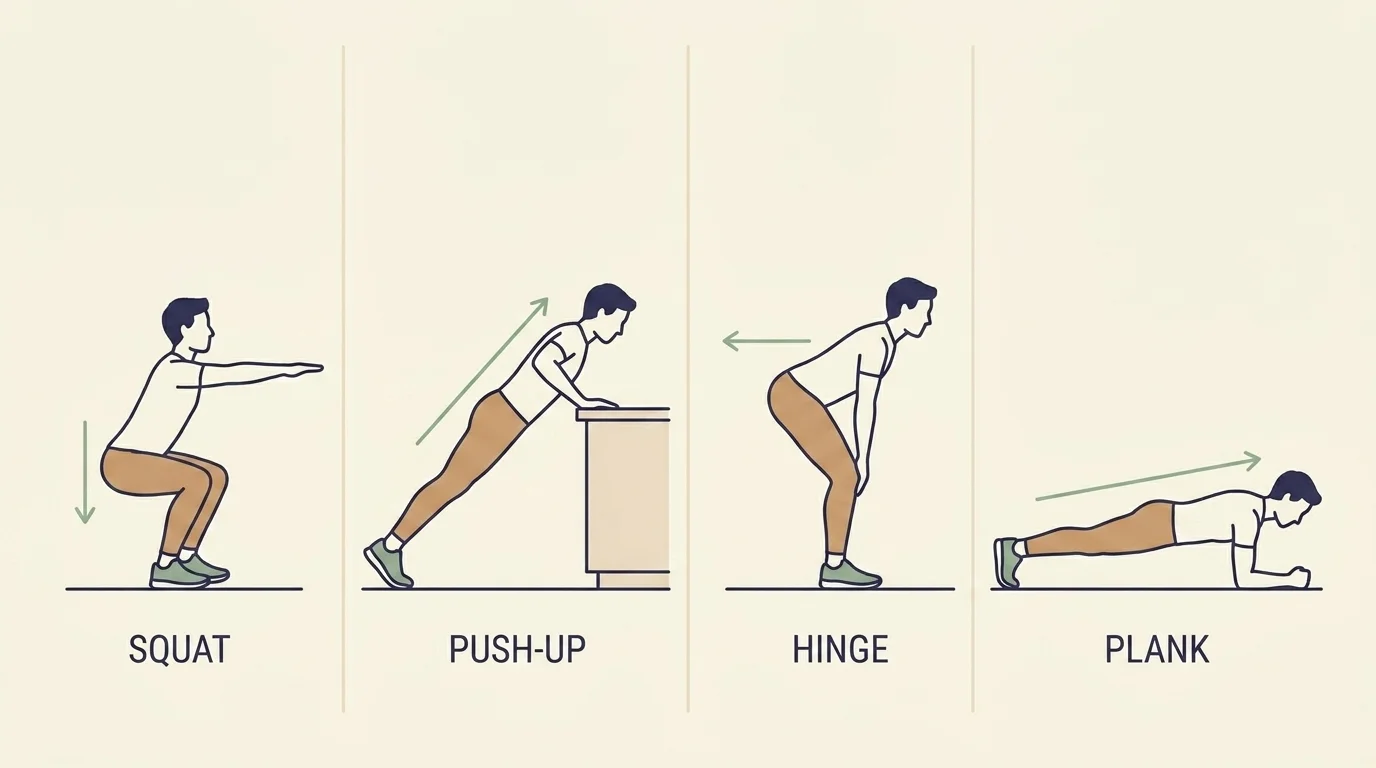
| Movement | Sets × reps | Load / effort | Cue (what to think) | External marker (what a coach sees) |
|---|---|---|---|---|
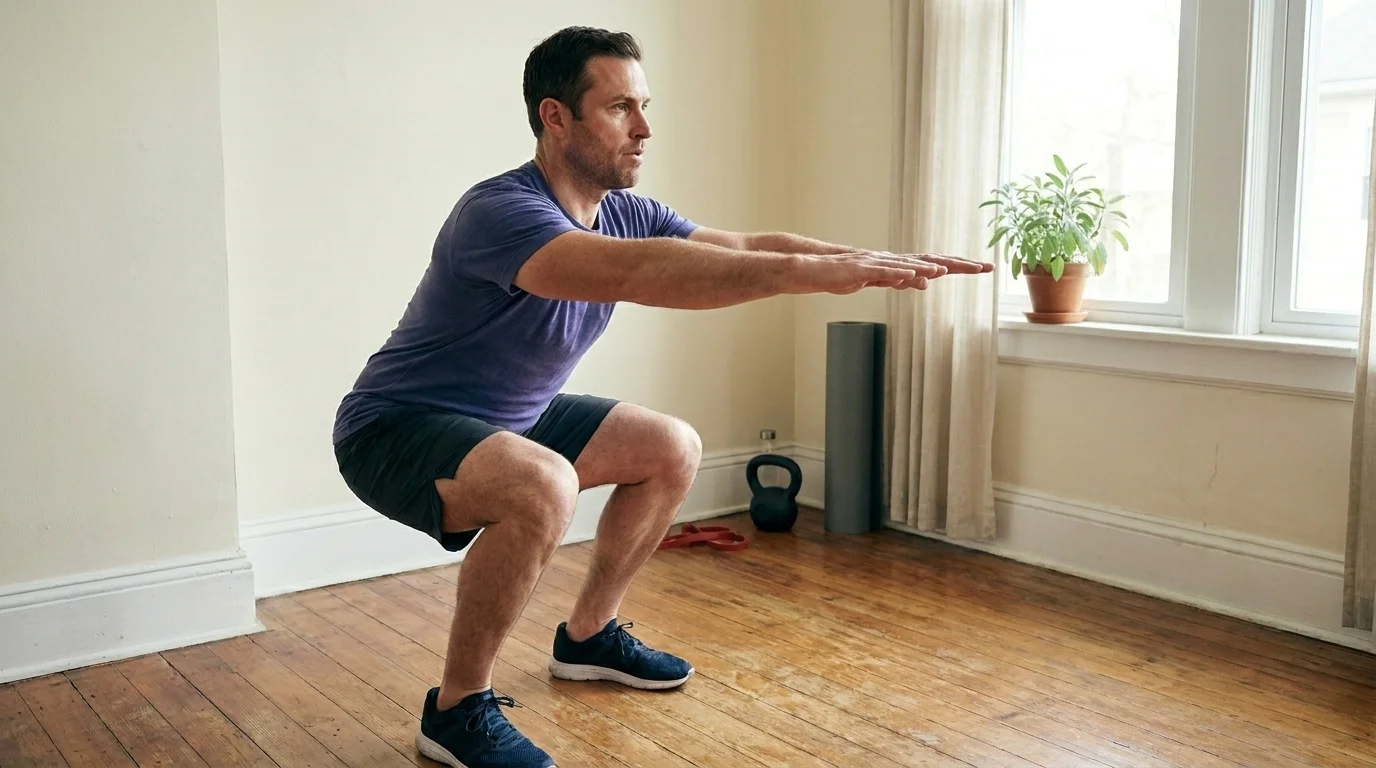
| Goblet or bodyweight squat | 2–3 × 8–12 | RPE 6–7 | "Sit down between your hips; spread the floor with your feet" | Heels stay planted, knees track over the second toe |
| Push-up (hands on a counter if needed) | 2–3 × 6–12 | RPE 6–7 | "Ribs down, whole body one straight line" | Hips don't sag, elbows tuck to about 45° |
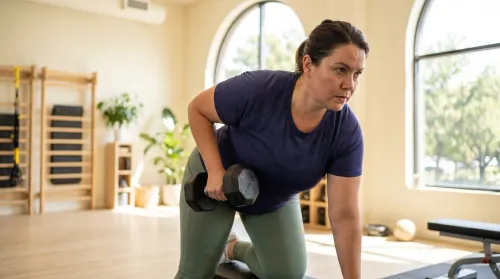
| Hip hinge (dumbbell RDL or glute bridge) | 2–3 × 8–12 | RPE 6–7 | "Push your hips back, feel the hamstrings load" | Flat back, weight stays close to the legs |
| Row (band or dumbbell) | 2–3 × 10–12 | RPE 6–7 | "Lead with the elbow, squeeze the shoulder blade" | Shoulder doesn't shrug up toward the ear |
| Plank | 2–3 × 20–40 sec | hard but steady | "Squeeze glutes, brace like you're about to be poked" | Hips level — no sag, no pike |
No equipment? The 2026 guidelines confirm you don't need a gym. Run the same five patterns with bodyweight only: bodyweight squat, incline push-up off a counter, glute bridge, a band or towel row (loop a towel around a sturdy post), and plank. Same sets, same reps, same cues.
Progression: add roughly 2–5% load per week, or one or two reps, whenever all your sets feel like a clean RPE 6 (DailyBurn). Early on, beginners gain nearly as much from one hard set as from three, so don't let set count be the thing that stops you from training.
The three jobs: strength, cardio, and mobility
A complete program does three jobs, and "types of exercise" really comes down to these. Strength (the routine above) builds muscle and bone and protects you from injury — it's the foundation, so train it first when you're fresh. Cardio builds your aerobic base; for most beginners, two or three easy 30–45-minute sessions a week — a brisk walk, easy bike, or "zone 2" effort where you can still hold a conversation — does more for recovery and health than punishing intervals. Mobility is where people waste the most time, because they confuse it with flexibility.
Flexibility is the passive range a joint can be moved through; mobility is the range you can actively control. If you can pull your knee to your chest lying down but can't sit comfortably at the bottom of a squat, the answer isn't more passive stretching — it's training your hips to produce force in that range with controlled tempo squats and split squats. Functional movements — squats (sitting and standing), hinges (picking things up), pushes, pulls, and carries — are simply the patterns your day already demands, loaded a little.
Set goals you can measure
"Get in shape" isn't a goal; it's a wish. Make it specific and, more important, make it externally measurable — track the number, not your mood about the number. Good beginner targets: add 10 push-ups to your best clean set within eight weeks; squat your current working weight for three solid sets of 12 before adding load; or, for cardio, walk-run a continuous 20 minutes within six weeks before chasing a 5K. (Note that "run a 5K in six weeks" from a standing start is aggressive for most true beginners — build the continuous-time base first, then the distance.) The metrics worth logging are reps at a fixed load, your RPE on those sets, and time-to-distance on cardio — concrete markers that don't lie to you the way the bathroom scale does.
Recovery, rest, and staying with it
Rest days are where the adaptation actually happens — the training is the stimulus, sleep and recovery are when your body builds. On a three-day full-body plan, your off days are doing real work, so don't apologize for them; light walking and good sleep beat an extra hard session you didn't need. A little muscle soreness in the first couple of weeks is normal; sharp joint pain is not.
For the consistency problem underneath all of this: pick activities you don't dread, schedule sessions like appointments rather than leaving them to motivation, train with a friend or a class if accountability helps, and let small wins — an extra rep, a heavier kettlebell, an easier flight of stairs — be the fuel. The plan you'll repeat for a year beats the perfect plan you'll abandon in March.
When will I actually see results?
Here's the honest timeline, because the fitness industry lies about this constantly. Your first gains are neural — your nervous system getting better at recruiting muscle — and they show up in 2–4 weeks as lifts that simply feel easier. Visible changes in muscle and definition typically take about 6–8 weeks of consistent work. Over a longer arc, a dedicated beginner can add roughly 27% to a major lift across 20 weeks, and put on about a pound of muscle a month (women) or one to two pounds a month (men) in the first year (TODAY; Fitbod). If nothing feels different on day 10, that's not failure — that's the schedule. Keep going.
The honest close
A beginner workout plan isn't complicated, and anyone selling you a secret movement or a three-week miracle is selling you something. Three full-body days, the five patterns above, real numbers, and the patience to let 6–8 weeks do their work — that's the whole game, and it's backed by the most current guidelines we have. One caveat that matters: if you're carrying an injury or you feel pain (not normal soreness) in a joint, see a clinician or physical therapist before you load that movement. Train smart, show up, and let the timeline be the timeline.
Frequently Asked Questions
Train three days a week with full-body sessions of two to three sets of 8–12 reps, start light, and prioritize consistency over intensity. Per the 2026 ACSM guidelines, training each major muscle group at least twice weekly matters most.
Three full-body days a week is the most-recommended beginner schedule. The 2026 ACSM guidelines set the practical floor at hitting every major muscle group at least twice a week.
Strength climbs in the first 2–4 weeks through neural adaptation, visible muscle and definition changes show around 6–8 weeks, and a dedicated beginner can add roughly 27% to a major lift within 20 weeks.
No. The 2026 ACSM guidelines confirm that bands, bodyweight, dumbbells, and machines all deliver a meaningful muscle-building stimulus, so a no-equipment home routine works well to start.
Three jobs: strength training (full-body, the foundation), cardio (easy 'zone 2' sessions for aerobic base and recovery), and mobility — the actively controlled range you can use, which beginners build with loaded tempo work, not just passive stretching.