
Grapes Nutrition


Patients ask me about grapes more than almost any other fruit. The question is nearly always the same: are they a smart snack, or basically candy? It is a fair thing to wonder — a single cup carries about 23 grams of sugar. But the full grapes nutrition picture is more reassuring than that one number suggests. It is worth walking through carefully rather than settling for a headline.
This guide gives you the complete, USDA-grounded breakdown — calories, carbs, sugar, and vitamins, in both per-cup and per-100-gram terms. You also get the benefits that actually have studies behind them and a green-versus-red-versus-black comparison. And here is the part most pages skip: exactly how much sugar is in grapes. It also covers how many of them count as a sensible portion. The search results split into bare data panels on one side and "top 16 benefits" listicles on the other. My goal here is to put the hard table and a dietitian's plain verdict in the same place. That includes a plain answer on the sugar question.
Grapes Nutrition Facts: Per 1 Cup and Per 100 g
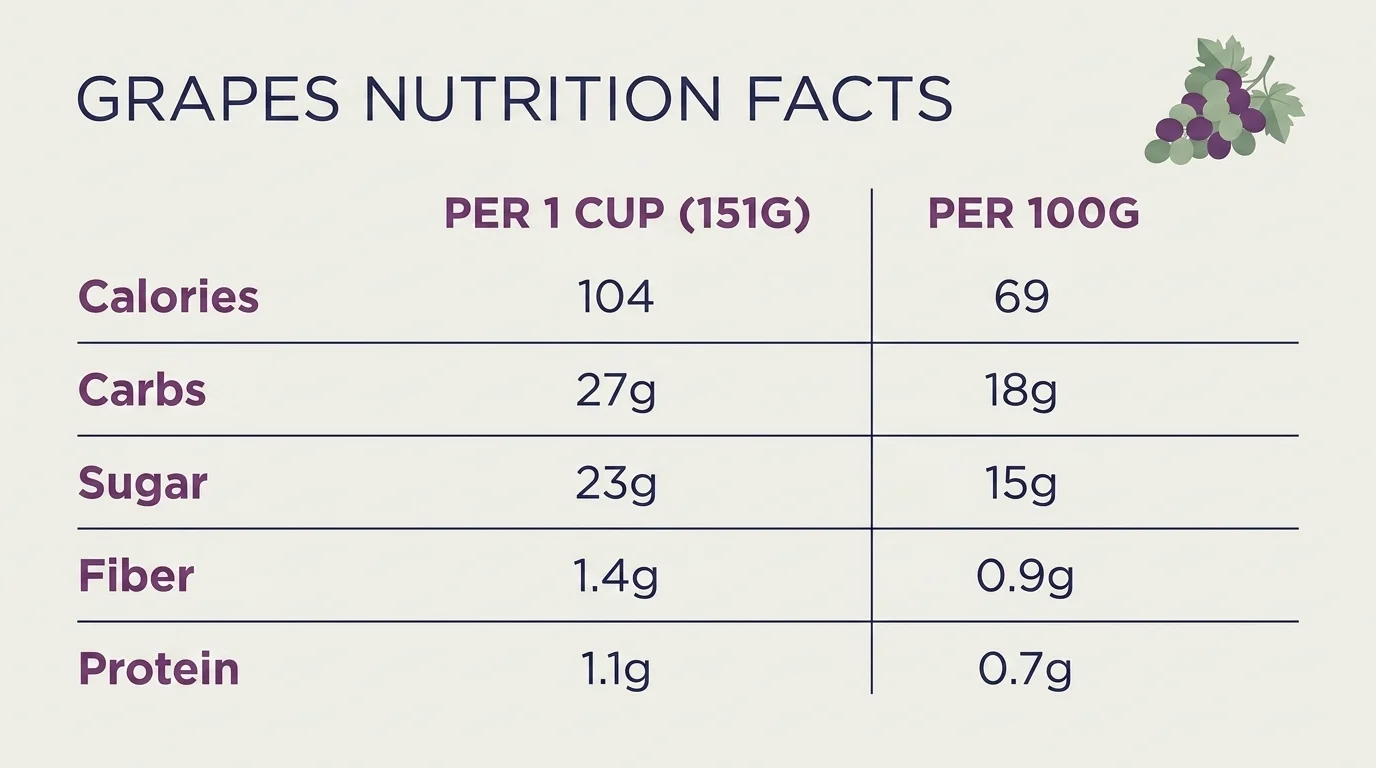
One cup of grapes (151 g) has about 104 calories and 27 g of carbohydrate. It also carries 23 g of natural sugar, 1.4 g of fiber, and 1.1 g of protein.
Here is where a lot of pages get sloppy. Some report per 100 grams, others per ¾ cup or a 92-gram "small handful," so the numbers stop being comparable. So this table anchors everything to one cup (151 g) — the serving the USDA and most nutrition labels use. It also adds a per-100-gram column for anyone reading a European label or doing their own math. The figures come from the USDA's SNAP-Ed produce data and the USDA-derived values compiled by Healthline.
| Nutrient | Per 1 cup (151 g) | Per 100 g |
|---|---|---|
| Calories | 104 | 69 |
| Total carbohydrate | ~27 g | ~18 g |
| Total sugar | ~23 g | ~15 g |
| Fiber | ~1.4 g | ~0.9 g |
| Protein | ~1.1 g | ~0.7 g |
| Fat | ~0.2 g | ~0.1 g |
Grapes are not a protein or fiber powerhouse, and I would not pretend otherwise. Where they earn their keep is in the micronutrients that ride along with the sugar. One cup covers roughly 18% of the Daily Value for vitamin K (about 22 µg) and 21% for copper. It also gives you around 5% for vitamin C (4.8 mg) and about 288 mg of potassium. Vitamin K and copper are the standouts. Most people do not think of grapes as a vitamin K food. But a cup gets you close to a fifth of the day's target. If you want more context on how fruit fits a balanced plate, our nutritional wellness section covers the wider pattern.
Are Grapes Too High in Sugar?
Grapes have about 23 g of natural sugar per cup, but a low glycemic index (43–53) means roughly 15 grapes equal one 15 g carbohydrate serving — portion-controlled, they fit most diets.
This is the question that actually drives people to search, and it is under-served enough that a Reddit thread calling grapes "fairly high in sugar" ranks near the top of Google. So let me be specific, because "grapes are sugary" and "grapes spike your blood sugar" are two different claims, and only the first is straightforwardly true.
Yes, the sugar is real: about 23 grams in a cup. But that sugar arrives inside a food matrix — water, fiber, skin, and polyphenols — not stripped and concentrated the way it is in candy or juice. That matters for your glycemic response. Measured glycemic index values for grapes land in the low range, roughly 43–53 for green grapes and up to 59 for red, with a low glycemic load because a normal portion is not that many grams of carbohydrate. In plain terms, the measured GI data puts grapes well below table sugar's postprandial punch.
Here is the portion rule I give patients, and it is the single most useful number on this page: about 15 grapes is one 15-gram carbohydrate serving. That is a small handful. If you are counting carbs, 15 grapes is a clean, easy exchange — no scale required. Twenty grapes is closer to a 20-gram serving, still reasonable for most people.
Does that include people managing diabetes? Generally yes, in portion — the low GI and low glycemic load are exactly why dietitians who counsel diabetic clients rarely tell them to avoid grapes outright, and pairing the fruit with a little protein or fat blunts the rise further. But this is the one spot where I will not hand you a blanket answer: if you take blood-sugar medication or manage diabetes, work the exact portion into your plan with your own dietitian or doctor, who knows your numbers and your medications. That conversation beats any rule of thumb from an article.
Grapes Calories: How Many in a Cup, a Handful, and 20 Grapes
One cup of grapes is about 104 calories, and 100 grams is about 69 calories. A small handful of roughly 15 grapes is about 52 calories.
The arithmetic is friendly here. A cup weighs 151 grams and runs about 104 calories. So half a cup — the 15-grape carb serving from the last section — is around 52 calories. Twenty grapes, a portion a lot of people reach for without thinking, lands near 100 calories. Green and red grapes are close enough on calories that the color you buy makes no meaningful difference to the total.
What I like about grapes is that they are what I would call a high-volume snack. You get a satisfying number of them for not many calories. There is enough water and fiber to feel like you ate something. That is a genuinely useful property if you are managing appetite. And it is a more honest way to describe grapes than reaching for a marketing label. They are a good snack. I do not need to call them anything grander than that.
What Are the Health Benefits of Grapes?
Grapes do have benefits with real research behind them. But the quality of that research varies a lot from claim to claim. So I am going to label each one, so you know how much weight it carries.
Heart Health and Cholesterol
The most interesting recent evidence is a small UCLA pilot. Participants ate 46 grams a day of whole-grape powder — about two servings of table grapes' worth. On that dose, total cholesterol dropped about 6.1%, with a downward trend in LDL. They also showed a more diverse gut microbiome, including more of a beneficial bacterium called Akkermansia. You can read the pilot data here and the follow-up mechanism paper here. As Dr. Zhaoping Li, chief of clinical nutrition at UCLA Health, put it: "It also gives us nutrients that feed our gut bacteria, making the microbiome a much better community of good bacteria."
That is a promising finding. It is also a small, short study using grape powder rather than the grapes in your fruit bowl, so read it as an encouraging early signal, not a prescription. Grapes can support cholesterol care; they do not replace it.
Antioxidants: Resveratrol and Quercetin
Grapes carry polyphenols — resveratrol and quercetin chief among them — concentrated mostly in the skin. A 2024 umbrella review in Springer's Food Production, Processing and Nutrition associated grape intake with reduced risk of cardiovascular disease, type 2 diabetes, and certain cancers. I want to be careful with the word "associated," though: an umbrella review pools observational studies, which show that people who eat more grapes tend to be healthier — not that the grapes caused it. It is real, reassuring evidence that grapes belong in a healthy dietary pattern. It is not proof that grapes, by themselves, prevent disease.
Skin and Sun Protection
This one gets oversold, so here is the actual study. A 2021 human trial in the Journal of the American Academy of Dermatology had participants eat about 2.25 cups of grapes a day for 14 days, after which their sunburn threshold rose and UV-induced DNA-damage markers fell. Dr. Craig Elmets, the principal investigator at the University of Alabama at Birmingham, described it this way: "We saw a significant photoprotective effect with grape consumption and we were able to identify molecular pathways by which that benefit occurs — through repair of DNA damage and downregulation of proinflammatory pathways." Headlines called grapes "edible sunscreen." They are not. This was a small, two-week study of a modest effect, and nothing in it suggests you should eat grapes instead of wearing SPF. Enjoy the bonus; keep the sunscreen.
Bone and Everyday Nutrition
The quieter benefit is the one in the nutrition table. That cup of grapes brings about 18% of the Daily Value for vitamin K and 21% for copper — both of which contribute to normal bone health — plus potassium for everyday function. No single serving of fruit is going to build your skeleton, but grapes are a pleasant, low-effort way to chip away at nutrients many people fall short on.
Green vs. Red vs. Black Grapes: A Nutrition Comparison
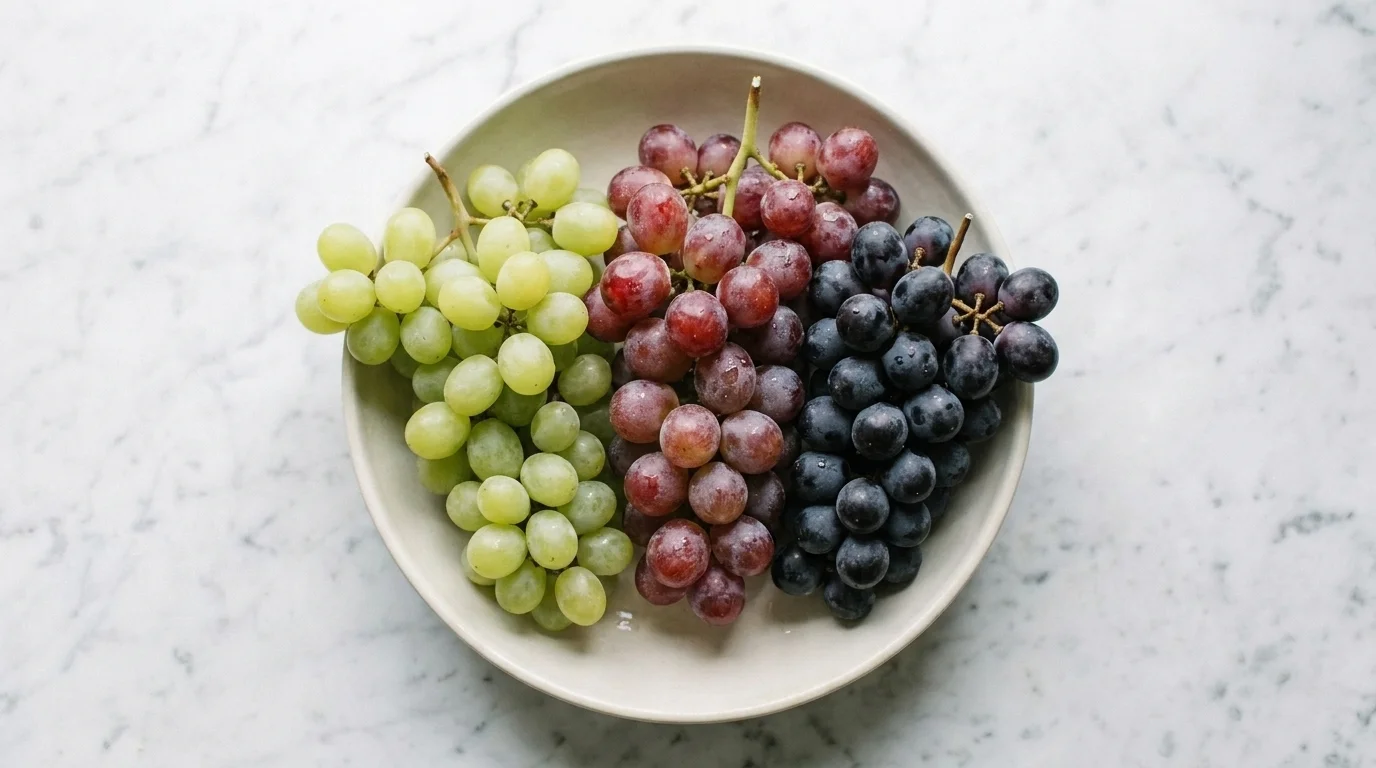
Green, red, and black grapes are near-identical on calories and macronutrients; the real difference is in the skin, where darker varieties carry more resveratrol and anthocyanins.
If you have ever stood in the produce aisle wondering whether the black grapes are "healthier," here is the short version: nutritionally they are almost the same, and the differences that exist are in the pigments, not the calorie count.
| Variety | Calories (per cup) | Sugar (per cup) | Standout compound |
|---|---|---|---|
| Green | ~104 | ~23 g | Near-identical macros; lightest skin, fewest pigment antioxidants |
| Red | ~104 | ~23 g | More resveratrol; slightly higher GI (up to ~59) |
| Black | ~104 | ~23 g | Highest anthocyanins (the dark-purple pigments) |
The reason color tracks antioxidant content is straightforward: the resveratrol and anthocyanins live in the skin, and darker skins simply have more of those pigment compounds. So red and black grapes carry a bit more of the polyphenols that get all the attention, while green grapes hold their own on calories, fiber, and vitamins. All three fit the same 15-grape carb serving and the same calorie range, so the honest advice is to buy whichever you will actually eat.
The Bottom Line on Grapes
The full grapes nutrition story is a good one, and it does not need embellishment. A cup is about 104 calories and 23 grams of natural sugar, but with a glycemic index of 43–53 and a simple portion rule — roughly 15 grapes per carbohydrate serving — they fit almost any way of eating, including, in portion, most diabetes-friendly plans. Eat them for the antioxidants, the heart and skin research, and the vitamin K and copper that come along for the ride.
One honest caveat before you stock up: grape skins do contain small amounts of melatonin, but the strongest human sleep evidence points to kiwifruit and tart cherries, not grapes. A bowl of grapes is a fine light evening snack; just do not count on it as a sleep aid. For more USDA-grounded guides to everyday snacks — and if a chronic condition is in the picture, alongside a conversation with your own clinician — browse the rest of our nutritional-wellness section, and portion your grapes with the 15-grape rule.
Frequently Asked Questions
Grape skins contain small amounts of melatonin, but the strongest human sleep trials are for kiwifruit and tart cherries, not grapes. A bowl of grapes is a fine light evening snack if you enjoy it — just don't count on it as a proven sleep aid.
Yes. About 20 grapes is roughly 100 calories and close to a 20-gram carbohydrate serving, a reasonable daily portion for most people. If you're counting carbs, that's an easy exchange to plan around a normal snack.
Usually yes, in portion. Grapes have a low glycemic index (43–53) and low glycemic load, so about 15 grapes — one 15-gram carbohydrate serving — fit most diabetes-friendly plans, especially paired with protein. Count the carbs and confirm your portion with your own dietitian or doctor.
A small UCLA pilot found that about two servings a day of grapes lowered total cholesterol by roughly 6.1%, with a downward LDL trend linked to gut-microbiome changes. It's an encouraging early signal from a small study — grapes support cholesterol care, they don't replace it.
All are nutritious and near-identical on calories and macros. Red and black grapes carry more resveratrol and anthocyanins in their darker skins, while green grapes are essentially the same on calories, sugar, and vitamins. Buy whichever variety you'll actually eat.
Check Out These Related Articles

Nourishing Your Body: The Essentials of Holistic Nutrition
Vegan vs. Paleo Diets: Unraveling Nutritional Philosophies for Optimal Health

The Skinny on Fat-Free Foods: Healthy Choice or Hidden Harm?