Embracing Cultural Diversity in Health and Wellness: Insights and Practices from Around the World


Most people searching for "traditional healing practices" today are doing one of two things: trying to understand what their grandmother actually does when she lights sage or measures out herbs, or trying to figure out whether the Ayurveda, acupuncture, or Reiki session they are about to book is grounded in something or just expensive lifestyle marketing. This piece is a plainspoken field guide to the major traditional healing systems still in active use around the world, with a section at the end on how to engage with them respectfully and where they currently sit in the U.S. healthcare system.
The headline number to start with: the World Health Organization estimates that around 80% of the world's population uses traditional medicine for some part of their primary health care, and 170+ WHO member states now formally recognize traditional medicine practitioners or products under the WHO Global Traditional Medicine Strategy 2025–2034. This is not a fringe topic. It is, by user count, the most common form of healthcare on Earth.
A note on framing: I am a registered dietitian, not an ethnographer. Where this piece describes specific ceremonies or lineages, the information is drawn from the named tradition's own institutions, peer-reviewed ethnobotanical literature, or WHO documentation. Where claims about clinical effects are made, the study or strategy is named.
What changed in 2025–2026
For most of the last decade, "traditional medicine" sat in a regulatory gray zone in high-income countries — tolerated for personal use, ignored by insurers, and largely invisible in national health policy. Three things have shifted that picture in the last 18 months.
The WHO Global Traditional Medicine Strategy 2025–2034 was published in May 2025, replacing the 2014–2023 strategy. It sets out four objectives: strengthen the evidence base, ensure safety and regulation, integrate traditional, complementary and integrative medicine (TCIM) into national health systems, and optimize its cross-sectoral value (WHO). This is the policy frame other governments now write against.
California became the first U.S. state to fund traditional Native healing under Medicaid. In October 2024, the federal Centers for Medicare and Medicaid Services approved Medi-Cal coverage of traditional health care practices delivered by Indian Health Care Providers, specifically within the Drug Medi-Cal Organized Delivery System for substance-use disorder treatment, through December 31, 2026 (California Governor's Office, October 2024). This is the first time a U.S. state has paid for a sweat lodge, a talking circle, or a ceremonial intervention out of Medicaid funds. The Dec 2026 sunset is real — what happens after that depends on outcomes and renewal.
The TCIM market itself is growing fast. Industry analysis projects growth from $213.81 billion in 2025 to $359.37 billion in 2032 — a 7.7% compound annual growth rate (PMC, 2025 policy analysis). Most of that is consumer spending on supplements, mind-body services, and traditional practitioners outside conventional insurance coverage, which is exactly why the regulatory questions matter.
What none of this tells you: it does not tell you whether any specific tradition's practices work for a specific condition, what the right dose is, or who to see. It tells you that the policy and reimbursement environment is moving — slowly, unevenly, and with real follow-through in places like California.
A field guide to traditional healing systems
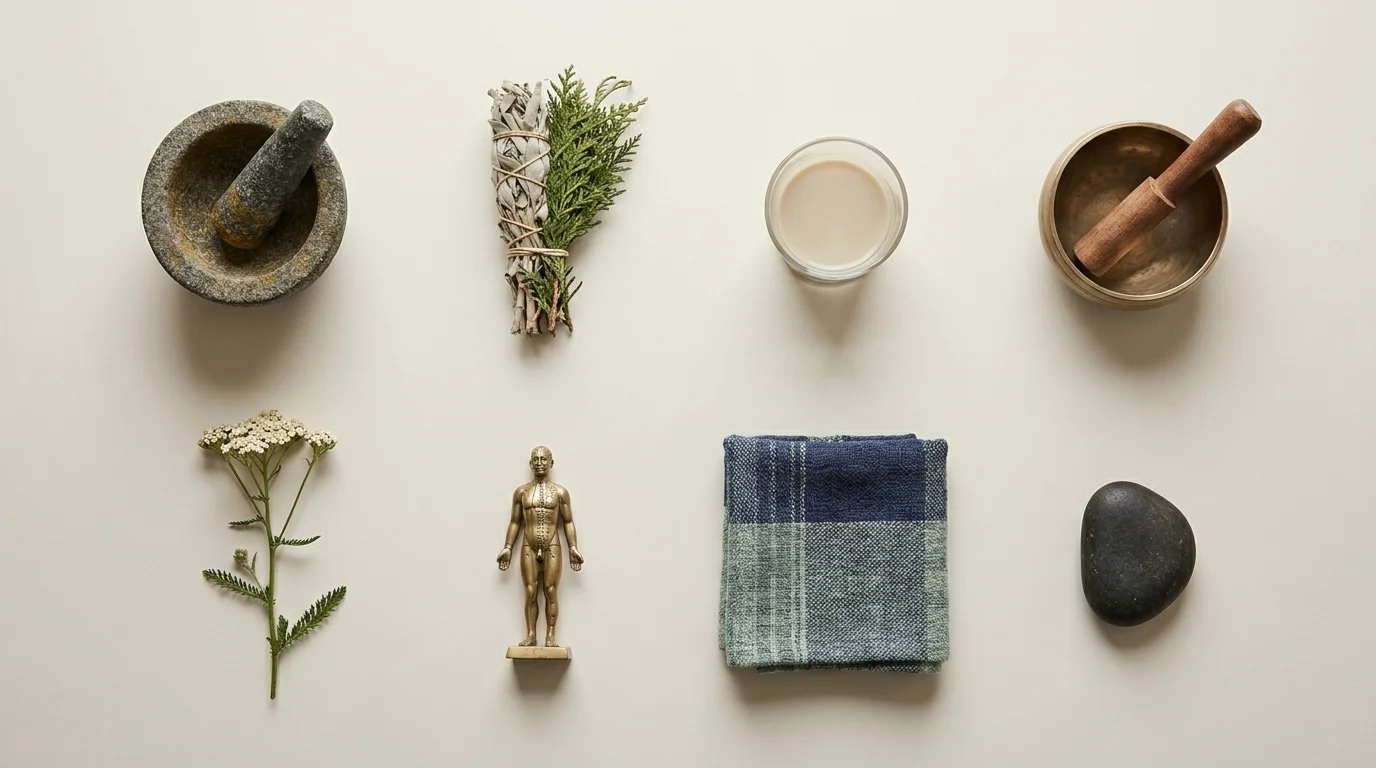
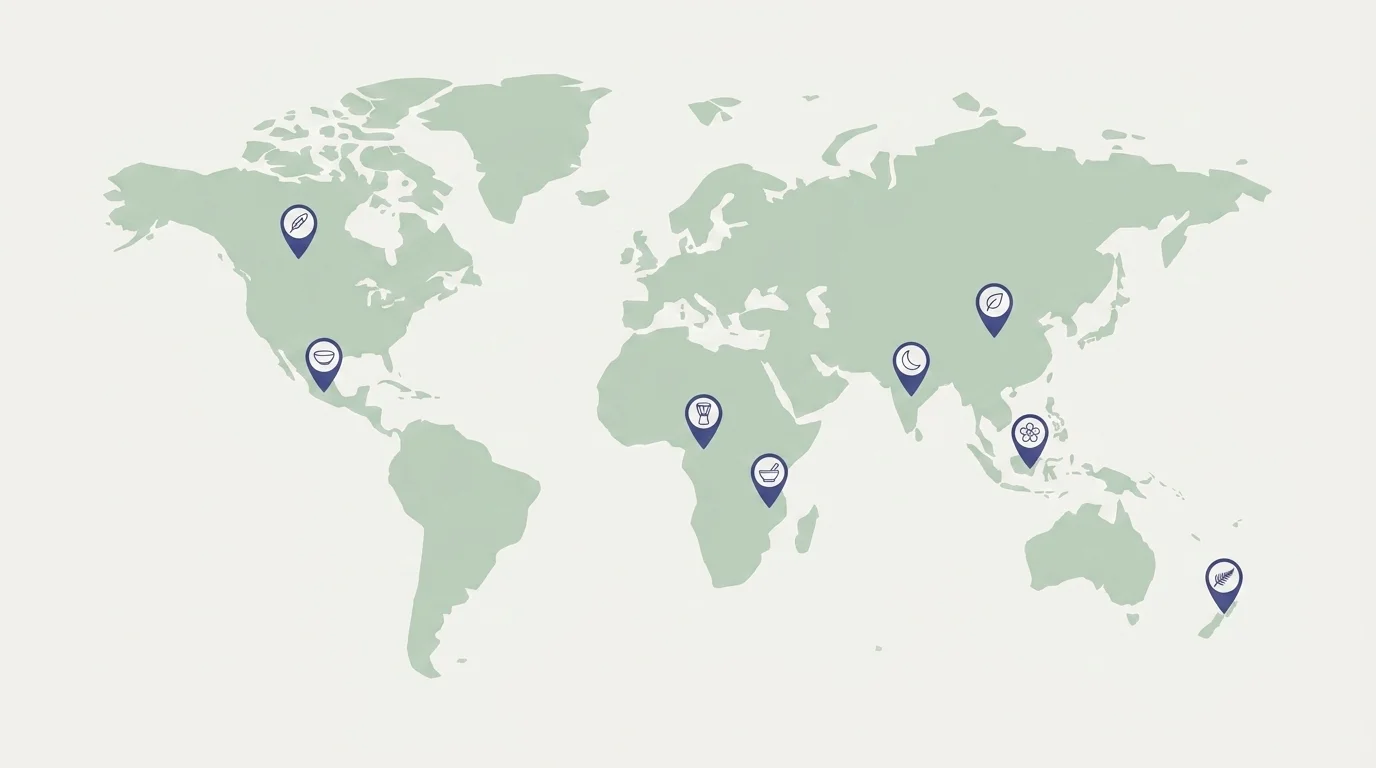
The eight systems below are not exhaustive. They are a deliberate cross-section: the systems with the largest global user bases (Ayurveda, TCM), the systems where U.S. readers are most likely to encounter a practitioner (TCM, Reiki, curanderismo, Indigenous North American practices), and the systems most often missing from English-language wellness coverage (African Traditional Medicine, Unani, Rongoā Māori, Balinese Balian).
Related Article: Pacific Island Paradigm: Infusing Indigenous Wisdom into Holistic Healing Practices
Ayurveda (India and South Asia)
Ayurveda is one of the world's oldest documented medical systems, with classical texts dating to the first millennium BCE. Its diagnostic frame organizes individuals into three primary doshas — vata, pitta, and kapha — and treatment aims to restore the balance between them through diet, herbs, oil treatments (abhyanga), structured detoxification (panchakarma), and lifestyle adjustment.
Modern ethnobotanical work in India keeps documenting the active materia medica. A 2025 study from Madhya Pradesh's Dindori district recorded tribal healers using 81 plants from 45 botanical families for conditions including digestive complaints, respiratory illness, anemia, and liver disease. Some of those plants — turmeric, ashwagandha, holy basil — have moved into the Western supplement market with varying evidence behind their commercial claims. Many others have meaningful local clinical evidence and no Western marketing footprint.
For a Western reader: Ayurvedic diet and lifestyle guidance is reasonably low-risk and culturally rich. Ayurvedic herbal formulations, particularly imported products, have repeatedly been found to contain heavy-metal contamination in U.S. testing — that is the safety issue to know about.
Traditional Chinese Medicine (TCM)
TCM is a comprehensive system organized around qi (vital energy), the balance of yin and yang, and the five elements. In practice, it combines acupuncture, herbal medicine, tui na massage, dietary therapy, and movement disciplines like qigong and tai chi.
Of the named modalities, acupuncture has the most developed Western clinical literature — used as an adjunct treatment for chronic pain, chemotherapy-induced nausea, and tension headaches, and integrated into many U.S. academic medical centers. TCM herbal medicine has a much thinner Western evidence base, partly because classical TCM prescribes individualized multi-herb formulas that are not easy to study in standard randomized-controlled-trial designs.
TCM has parallel sister systems in Japan (Kampo), Korea (Korean Medicine), and Vietnam. Kampo is unusually well-integrated into Japan's mainstream medical system: 148 Kampo formulas have been covered by Japan's National Health Insurance since 1967, and because Japan issues a single medical license, all licensed physicians can prescribe both Kampo and conventional medicine. A 2008 nationwide survey reported 83.5% of Japanese physicians use Kampo in clinical practice.
Related Article: Physical Fitness Traditions from Around the World
Curanderismo (Mexico and Latin America)
Curanderismo is the traditional healing system practiced across Mexico and Latin American diaspora communities, drawing on a blend of Indigenous Mesoamerican, Spanish, and African elements. A curandero or curandera combines herbal medicine (often using plants like ruda, romero, and gordolobo), spiritual practices including limpieza (cleansing) ceremonies, and frequently a strong community and family role.
Specializations vary: a yerbero focuses on herbal preparations; a huesero on bodywork and bone-setting; a partera on midwifery; a sobador on therapeutic massage. The system is alive in the U.S. — particularly in California, Texas, and the Southwest — and increasingly studied as part of culturally concordant care for Latino patients.
Indigenous healing practices (North America)
There is no single "Indigenous North American" system — there are hundreds of distinct nations with distinct practices. Common across many traditions: the use of medicinal plants (sage, sweetgrass, cedar, tobacco), structured ceremonies like the sweat lodge and the talking circle, and a relational framing of health that includes spiritual, emotional, mental, and physical dimensions together. The First Nations Health Authority's "First Nations Perspective on Wellness" is one widely shared contemporary articulation of this framework.
The California Medi-Cal expansion noted above is the most concrete recognition of these practices in U.S. health policy to date. Outside that specific program, most Indigenous traditional care in the U.S. happens through Indian Health Service facilities, tribal-run clinics, and community providers, and is not covered by commercial insurance.
African Traditional Medicine
The WHO recognizes African traditional medicine as one of the most widely practiced healing systems in the world by user count. It is a heterogenous field — a Sangoma (diviner-healer) in South Africa works within a very different cosmological frame than a Yoruba babalawo in Nigeria, who works differently again than an Ethiopian herbalist. Common threads include extensive herbal pharmacopeias, divination practices, and ritual cleansing or protection (sometimes called muti in southern Africa, though the term has acquired multiple meanings).
WHO regional offices have been working since the 1970s to formalize collaboration between conventional and traditional providers in sub-Saharan Africa, partly because in many rural communities the traditional healer is the first and sometimes only provider available. Modern phytochemistry has identified active compounds in many African medicinal plants — Artemisia annua (the source of artemisinin antimalarials) is the most famous example.
Rongoā Māori (Aotearoa New Zealand)
Rongoā Māori is the traditional healing system of the Māori people, organized around three main components: rongoā rākau (plant-based medicine), mirimiri (massage and bodywork), and karakia (prayer and incantation). The New Zealand Accident Compensation Corporation now contracts with registered Rongoā Māori providers for certain services — a level of state integration that puts it ahead of most traditional systems in the English-speaking world.
Related Article: Global Nutrition Habits and Philosophies: A Cross-Cultural Analysis
Unani / Tibb (Islamic and South Asian medicine)
The Unani system descends from Greco-Arabic medicine — Hippocrates, Galen, and Ibn Sina (Avicenna) — and is widely practiced across South Asia, particularly in India, Pakistan, and Bangladesh. India formally recognizes Unani as one of its AYUSH systems (Ayurveda, Yoga, Unani, Siddha, Homeopathy) with state-funded medical colleges and hospitals. Its diagnostic frame uses the four humors (blood, phlegm, yellow bile, black bile) and treatment combines herbal-mineral compound formulations (ma'jun), dietary regimens, and regimental therapy (ilaj-bil-tadbeer). Related Islamic medical traditions include Tibb-e-Nabawi, the prophetic medicine described in hadith literature.
Balinese Balian (Indonesia)
A Balian is a Balinese traditional healer, working within a Hindu-Balinese cosmology that distinguishes sekala (the seen, material world) from niskala (the unseen, spiritual world). Different categories of Balian specialize in different work — Balian usada read classical lontar (palm-leaf) medical texts and prescribe herbal remedies, Balian tetakson work as intermediaries with the unseen world, Balian katakson mediate communication with ancestors. The system is deeply woven into Balinese daily life and is notable for its detailed written medical-text tradition.
Related Article: Breaking the Stigma: Cultural Influences on Seeking Alternative Therapies for Holistic Healing
Cultural beliefs about health: where the frame really comes from
What every system on the list above shares — and what diverges sharply from the dominant Western biomedical frame — is that illness is not located only in the individual body. In Ayurveda, illness reflects an imbalance among doshas, diet, season, and life-stage. In TCM, it reflects a disrupted flow of qi between organ systems and external forces. In curanderismo and many Indigenous frameworks, illness can reflect a disturbance in relationships — between people, between people and the land, between the seen and unseen worlds.
This matters in practical terms. When a patient who holds one of these frames is asked by a Western clinician "what brought this on?", the answer may not be a virus or a stress event. It may be a fight with a family member, a broken obligation, or a place that needed to be visited. None of that is irrational. It is a different model of where causation lives, and effective care needs to be able to hold both.
It is also why most published research on culturally concordant care — care delivered by, or in collaboration with, providers who share the patient's cultural frame — finds better outcomes on adherence and patient satisfaction than care that does not.
Cultural perspectives on mental health
Mental health is the area where Western and many traditional frames diverge most sharply, and where cultural humility matters most.
Several patterns recur across non-Western traditions: depression and anxiety are often framed in relational, spiritual, or somatic terms rather than as discrete psychiatric diagnoses; community and family support structures carry significant therapeutic weight; and stigma around naming a "mental illness" can be intense, even when the underlying distress is widely recognized through other vocabulary (susto in Latin American traditions, dhat syndrome in South Asia, ataque de nervios across Hispanic communities).
For clinicians and for readers thinking about their own care: a patient who declines to use the word "depression" is not necessarily in denial. They may be using a more accurate map for what they are experiencing, drawn from a tradition that did not invent the DSM-5. The work is to figure out what care reaches the actual problem, not to overwrite the patient's frame.
Related Article: Supercharge Your Productivity with Healthy Habits
Cultural humility vs. cultural competence
A short framing note that the wellness industry has not fully absorbed: clinician literature has largely moved from "cultural competence" (the idea that a provider can become competent in another culture's frame through training) to "cultural humility" (the idea that the provider's job is to keep learning, acknowledge what they don't know, and follow the patient's lead). Cultural competence presumes a finite curriculum; cultural humility presumes a relationship.
If you are evaluating a practitioner — traditional, conventional, or integrative — this is one of the things to listen for. A provider who treats their understanding of your background as a closed book is in a different posture than one who treats it as an open conversation.
Engaging respectfully and finding a culturally aligned practitioner
A few practical guidelines for readers thinking about engaging with a traditional system either as a patient or as a curious newcomer.
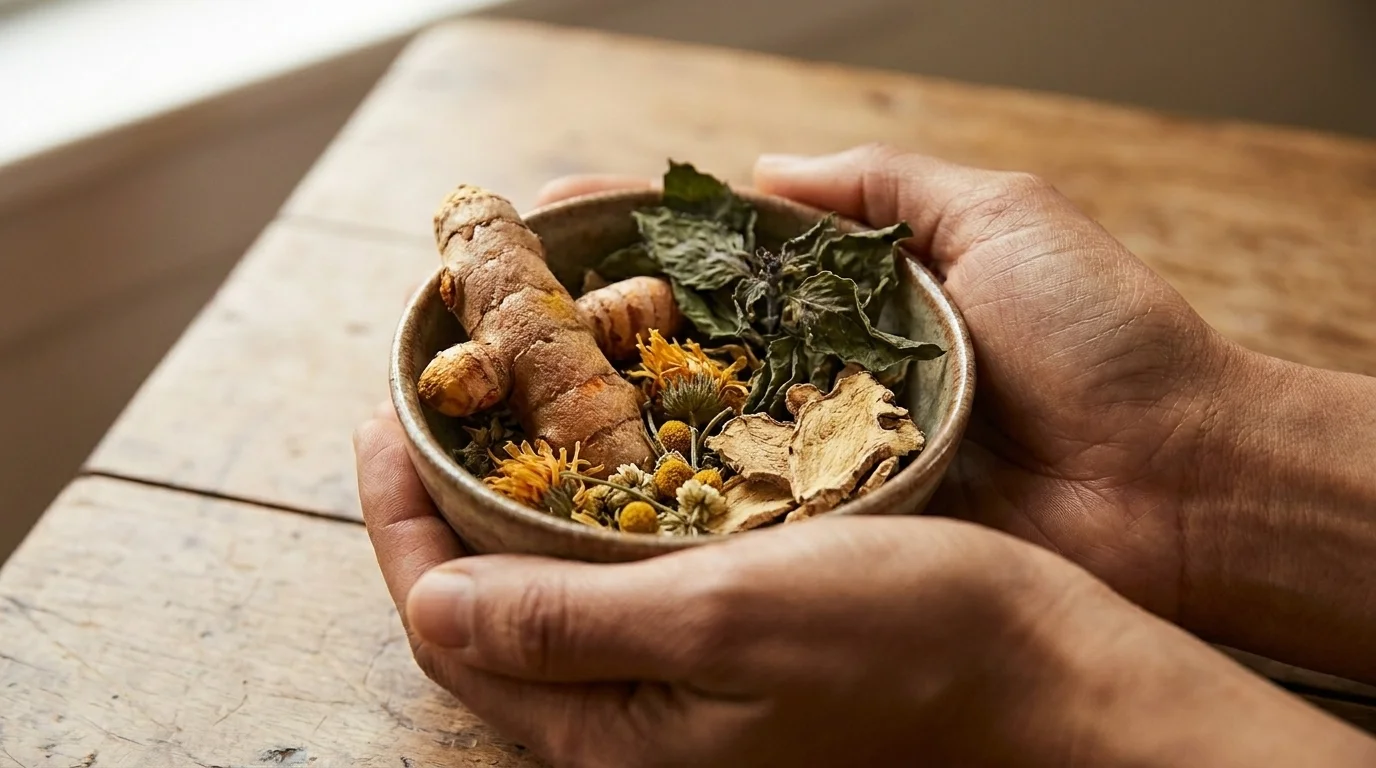
On herbs and supplements. Many traditional formulations are pharmacologically active — that is part of why they have lasted. Pharmacological activity also means drug interactions. St. John's wort interacts with SSRIs (serotonin-syndrome risk), hormonal contraceptives (CYP3A4 induction can reduce contraceptive efficacy), and HIV protease inhibitors. Turmeric (curcumin) at supplement-level doses can affect anticoagulants like warfarin (culinary amounts are not the concern). Ayurvedic preparations have repeatedly tested positive for heavy-metal contamination in U.S. testing programs — Saper et al. in JAMA (2004) found 14 of 70 Ayurvedic products purchased in Boston contained lead, mercury, or arsenic, and the 2008 follow-up found a similar 20% contamination rate among U.S.- and India-manufactured products sold online. The same care you would apply to a prescription medication — name the dose, name the source, tell your other providers — applies here.
On combining traditional and conventional care. This is increasingly the default rather than the exception, particularly in oncology, chronic pain, and palliative care. The principle most integrative-medicine programs use: traditional and complementary approaches augment conventional care, they do not replace it for conditions with established conventional treatment. Delaying chemotherapy to try an herbal protocol is the classic harm scenario. Adding acupuncture during chemotherapy to manage nausea is the classic benefit scenario.
On finding a practitioner. Look for: training and credentialing within the tradition's own framework (an Ayurvedic doctor trained at an accredited Indian institution; an acupuncturist with NCCAOM certification in the U.S.; an Indigenous practitioner working under their own community's recognition rather than self-identifying); willingness to coordinate with your other providers; clear answers about what they can and cannot do; and a posture that matches the cultural-humility framing above.
On respect. If you are engaging with a tradition you did not grow up in, the most important thing is to slow down. Many of these systems are bound to specific communities that have been historically extracted from rather than collaborated with. Buying a generic "shamanic journey package" online from a U.S. wellness brand is not the same thing as participating in a ceremony hosted by the community that owns that tradition. Knowing the difference is part of engaging respectfully.
Related Article: Boost Your Mental Resilience with These Mindfulness Practices
What this changes for you, if anything
If you are interested in a specific tradition, start by reading what that tradition's own institutions say about itself, not what the Western wellness market says about it. Most of the systems above have national-level professional bodies that publish in English. The WHO's traditional medicine pages link to many of them.
If you are a Western consumer of supplements that originate in a traditional system, treat them with the same diligence you would treat any pharmacologically active product: name the dose, name the source, tell your doctor.
If you are skeptical of the whole field: the WHO's 80% figure is real, the California Medi-Cal expansion is real, and the policy direction is toward greater integration, not less. The interesting question is not whether traditional medicine deserves a place at the table. It already has one. The interesting question is what good integration looks like — and that question is best answered by listening to the traditions themselves and to the patients whose care they reach.
Frequently Asked Questions
The World Health Organization estimates that around 80% of the world's population uses traditional medicine for some part of their primary health care, with prevalence ranging from 65% to 85% depending on region. Over 170 WHO member states formally recognize traditional medicine practitioners or products.
It is the World Health Organization's 10-year plan to strengthen the evidence base, ensure safety and regulation, integrate traditional and complementary medicine into national health systems, and optimize its cross-sectoral value. It was published in May 2025 and replaces the 2014–2023 strategy.
As of October 2024, California became the first U.S. state to fund traditional Native healing under Medi-Cal, covering practices delivered by Indian Health Care Providers for substance-use treatment in participating counties through December 31, 2026. Most traditional care outside that specific program remains uncovered by commercial insurance.
The largest by user count include Ayurveda (India and South Asia), Traditional Chinese Medicine and its sister systems (Kampo in Japan, Korean Medicine, Vietnamese), curanderismo (Mexico and Latin America), Indigenous North American healing practices, African Traditional Medicine, Rongoā Māori (Aotearoa New Zealand), Unani (Islamic and South Asian medicine), and Balinese Balian (Indonesia).
Many traditional systems locate illness in relationships, environment, or spiritual disturbance rather than only in the individual body. This shapes which symptoms get reported, what treatments feel appropriate, and whether and when someone seeks conventional care. Culturally concordant care — care delivered by, or in collaboration with, providers who share the patient's frame — is consistently associated with better adherence and patient satisfaction.
Many non-Western traditions frame depression and anxiety in relational, spiritual, or somatic terms rather than as discrete psychiatric diagnoses. Community and family structures often carry significant therapeutic weight, and stigma around naming a 'mental illness' can be intense even when the underlying distress is widely recognized through other vocabulary, such as susto in Latin American traditions or ataque de nervios across Hispanic communities.
Cultural competence is the idea that a provider can become competent in another culture's frame through training; cultural humility is the idea that the provider's job is to keep learning, acknowledge what they don't know, and follow the patient's lead. Clinician literature has largely moved toward the cultural-humility framing because culture is not a finite curriculum.
Look for credentialing within the tradition's own framework (such as an NCCAOM-certified acupuncturist, an Ayurvedic doctor trained at an accredited Indian institution, or an Indigenous practitioner recognized by their own community), willingness to coordinate with your other providers, clear answers about what they can and cannot do, and a posture of cultural humility rather than presumed expertise.
Check Out These Related Articles

Aesthetic Harmony: Integrating Design Principles with Holistic Wellness Concepts
Navigating Holistic Wellness: Embracing a Well-Balanced Lifestyle for Beginners
Japanese Zen Embodied: The Art of Integrating Mindfulness into Everyday Life