
Mindfulness Techniques for Stress Relief and Mental Wellness


A specific room, a specific question
A friend who teaches mindfulness techniques in a community clinic in Honolulu opens her sessions with the same sentence in English and Japanese: please don't try to clear your mind. The instruction is meant as a corrective to what she calls the "airport-bookstore" version of mindfulness — the one her clients arrive having read about, in which a practitioner is meant to achieve a placid, thought-free state and feel guilty when their mind drifts, which it always does. Her actual instruction is the opposite: notice the mind moving, name what is moving, return. That is the practice.
I am writing this guide as a medical anthropologist, not as a clinical psychologist or a meditation teacher. What I can offer is a careful version of "what mindfulness actually is, where it comes from, what the recent research supports, and what gets lost when it is translated into a 45-minute app subscription." I will name the lineage where I can. I will name the studies where I cite them. And I will be careful about the line between secular technique and contemplative tradition, because the two are routinely conflated in wellness media in ways that do nobody — neither the practitioner nor the source community — any favors.
A note on the moment we are in. The American Psychological Association's Stress in America 2025 report, based on a Harris Poll of 3,199 U.S. adults, found that 89% of respondents say their mental health is itself a major stressor, 62% cite societal division as a major stressor, and 54% report feeling isolated. Among adults aged 18 to 34, 65% report AI-related stress, up from 52% one year prior. The 2026 version of "I am stressed" is no longer mainly about email volume. It is about disconnection, about a fractured public sphere, about an uncertain technological future. Mindfulness is not a treatment for any of those things. It is a practice that helps a nervous system stay legible to itself while those things are happening.
Where mindfulness comes from
This is the part of the article that competitors uniformly skip, and I think skipping it produces a worse practice. The contemporary clinical use of "mindfulness" — the version that has the meta-analytic evidence base and that is taught in hospitals and clinics — is most directly traceable to a specific person and a specific institution. In 1979, Jon Kabat-Zinn founded what he called the Stress Reduction Clinic at the University of Massachusetts Medical School, and developed the eight-week curriculum now known as Mindfulness-Based Stress Reduction (MBSR). His protocol drew on multiple sources — most prominently the Vipassanā meditation tradition of Theravada Buddhism, but also Zen, Hatha yoga, and an explicit goal of secularizing the practice for a hospital context.
That last detail matters. MBSR is a deliberate translation. It removes the cosmological framework, the lineage transmission, the temple context, and the specific teacher-student relationships that, in the source traditions, are part of what the practice does. In place of those, it adds a clinical container, a structured curriculum, and a research apparatus. This is neither a cynical move nor a pure one. It is a translation, and like any translation, it is partial — some things travel and some do not.
Why I am insisting on this: when contemporary wellness media writes about "mindfulness," it tends to do one of two things. It either claims the practice as "ancient wisdom from the East" — collapsing dozens of distinct traditions across thousands of miles into a single marketing phrase — or it strips the practice from any source at all and presents it as a freestanding technique invented by clinical psychology in the 1980s. Neither is accurate. The accurate version is more interesting: a contemplative practice with specific lineages — Theravada, Mahayana, and other traditions, each with its own languages and teachers — was carefully translated into a secular clinical protocol by named researchers, and the resulting protocol has accumulated evidence. The lineage and the science are both part of the story.
When I refer to "mindfulness" through the rest of this article, I mean the secular MBSR-style clinical practice, not its source traditions. If you want to engage the source traditions, that is a different invitation and asks for a teacher.
Related Article: Pacific Island Paradigm: Infusing Indigenous Wisdom into Holistic Healing Practices
A 5-minute protocol you can run while reading this
Before we go any further, here is a five-minute practice you can run with your eyes open at your desk. It is constructed from techniques the research supports for stress reduction in a single session.
- Sit, with your feet flat on the floor and your back relatively straight (30 seconds). You do not need to cross-leg or close your eyes. Soften your gaze.
- Box breathe — inhale 4, hold 4, exhale 4, hold 4 — for 4 cycles (about 90 seconds). Count silently. If 4 seconds feels long, drop to 3.
- Body scan, top to toe (90 seconds). Crown of head, face, neck, shoulders, chest and back, belly, hips, legs, feet. Just notice. Not "fix" or "release" — notice.
- 5-4-3-2-1 grounding, one round (60 seconds). Five things you can see, four you can feel, three you can hear, two you can smell, one you can taste.
- One slow exhale to close (30 seconds). Longer exhale than inhale. Pause. Move on with your day.
A 2024 multi-site randomized trial in Nature Human Behaviour tested standalone, self-administered mindfulness exercises across 37 sites with 2,239 participants. The body scan component produced a stress-reduction effect of d = −0.56 — a moderate-to-large effect for a single self-administered session, comparable in magnitude to many therapist-led interventions. You do not need an app, an instructor, or an eight-week course to get a measurable benefit. You need five minutes and the willingness to actually do the practice instead of reading about it.
A 2026 systematic review and meta-analysis in Healthcare pooled 30 RCTs with more than 24,000 participants and reported a Hedges' g of −0.45 for mindfulness on anxiety, depression, and stress. The effect is real. It is not heroic. It compounds with practice.
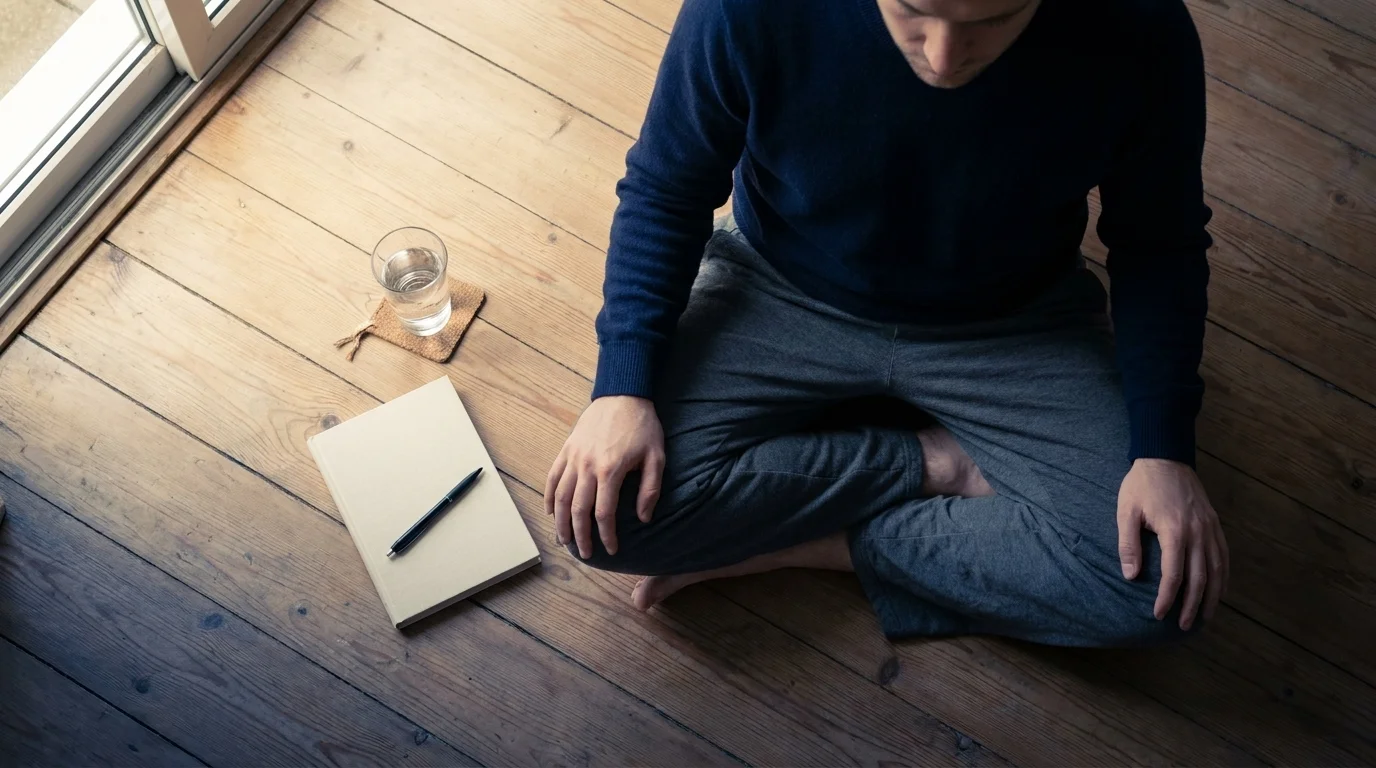
How to do box breathing and 4-7-8 breathing
Both of these breath patterns work through the same mechanism — extending or pausing the exhale to bias your autonomic nervous system toward the parasympathetic ("rest") side. A 2024 scoping review of 15 studies on the 4-7-8 method documented stress reduction, parasympathetic activation, and improved heart-rate variability via vagal pathways. A 2025 Medical Sciences review reaches similar conclusions for slow-paced breathing more broadly.
Box breathing (4-4-4-4):
- Inhale through the nose for 4 seconds.
- Hold for 4 seconds.
- Exhale through the mouth for 4 seconds.
- Hold (empty) for 4 seconds.
- Repeat for 4-8 cycles.
4-7-8 breathing:
- Exhale fully through the mouth, with a soft sound.
- Close the mouth. Inhale through the nose for 4 seconds.
- Hold for 7 seconds.
- Exhale through the mouth for 8 seconds, soft sound.
- Repeat for 4 cycles.
If you have a respiratory or cardiovascular condition, run these past your clinician before adopting them as a frequent practice. The breath holds are short, but they are not zero.
Related Article: Embracing Cultural Diversity in Health and Wellness: Insights and Practices from Around the World
Mindfulness for anxiety
The 2026 Healthcare meta-analysis above includes anxiety as one of the outcomes where mindfulness produces a moderate effect (g around -0.45). The version of mindfulness that works best for anxiety is rarely the long-form silent retreat. It tends to be brief, structured, and combined with cognitive practices that give the anxious thought somewhere to go.
A useful clinical distinction: acute panic and chronic worry call for different practices.
For acute panic — the kind where the chest tightens and the breath feels caught — the most reliably useful interventions are:
- The 5-4-3-2-1 grounding sequence above. Sensory grounding pulls cognitive resources back from the panic loop and re-engages the prefrontal cortex.
- 4-7-8 breathing for four cycles. The extended exhale is a fast parasympathetic signal.
- A cool object (cold water on the wrists, an ice cube briefly in the mouth, hands on something cold) as a sensory anchor that the autonomic nervous system reliably reads.
For chronic worry — the kind that keeps you awake at 2 a.m. running plans for a meeting four days away — a longer body scan and the RAIN protocol described in the next section are usually more useful than a quick grounding.
If you have a diagnosed anxiety disorder, OCD, or panic disorder, please bring these practices to a therapist for integration into your treatment rather than using them as a substitute for it. Mindfulness is increasingly used as an adjunct to cognitive behavioral therapy for anxiety; the research that exists is largely on those combinations, not on mindfulness as standalone treatment for clinical anxiety.
Mindfulness for overthinking and rumination
Rumination is the technical term for the loop where a thought keeps cycling without resolution — usually a self-critical or threat-focused thought. The 2024 study published in Affective Science on momentary mindfulness practices found that even brief, in-the-moment practices reduce rumination and negative affect in daily life. A meta-analysis of Mindfulness-Based Cognitive Therapy finds sustained reduction of rumination across follow-up periods.
The mechanism worth knowing about — and that nearly every mindfulness explainer omits — is the default mode network, or DMN. The DMN is the network of brain regions that becomes active when you are not focused on an external task: when you are remembering, planning, or thinking about yourself. It is the brain region most associated with self-referential rumination. Mindfulness practice quiets DMN activity. That is the neuroscience under the lived experience of "the loop slowed down."
The single most useful protocol for rumination I know of is RAIN, developed by the meditation teacher Tara Brach and now taught in clinical anxiety contexts by the Anxiety and Depression Association of America. The four steps:
- Recognize. Name what is happening. "Anxiety is here." "I am ruminating." Specific is better than vague.
- Allow. Stop trying to push the thought away. Allow it to be present without endorsing it. The phrase that helps in clinic is "this is here right now," in present tense.
- Investigate. Where is this in your body? What does it feel like? What is it actually about? This step can also include "what does this part of me need?" — not to fix, just to ask.
- Nurture. Offer yourself something small and warm — a phrase ("may I be okay"), a hand on your own chest, an exhale. Not toxic positivity. A small gesture of care.
RAIN is a five-to-ten-minute practice. It works best on the difficult thoughts that have already arrived; it is less useful as a daily prevention measure. Pair it with the shorter daily breath and body-scan practices for the prevention work.
Related Article: Physical Fitness Traditions from Around the World
When mindfulness is not the right tool
This is the section every honest mindfulness guide owes the reader, and almost no top-ranked SERP article includes. A 2025 PLOS One study examining mindfulness-based program outcomes found that childhood trauma and subclinical PTSD predicted worse outcomes and higher attrition. The result is consistent with what trauma-trained clinicians have been saying for years: long, silent meditation can intensify dissociation and re-traumatization in people with unprocessed trauma histories, particularly when the practice removes the external orientation cues that ordinarily keep a nervous system grounded.
Specific situations where I would not recommend self-administered mindfulness as a first-line practice without a trauma-trained clinician involved:
- Active PTSD or recent acute trauma
- A history of dissociation or depersonalization
- Active psychosis or recent psychotic episodes
- Severe substance withdrawal (medical supervision territory, not meditation)
- Severe untreated depression with suicidal ideation
- Unprocessed childhood trauma where strong emotion arises during practice and feels unmanageable
Trauma-informed alternatives that the clinical literature increasingly supports for these populations: somatic experiencing, EMDR with a trained therapist, gentle grounded movement (walking, certain forms of yoga taught by trauma-informed teachers), and resourcing-first practices that build present-moment safety before opening to inner experience.
I am not telling anyone in these situations to avoid mindfulness forever. I am saying that, in these situations, mindfulness should sit inside a clinical relationship rather than be self-administered from a blog. There is no shame in this. The framing that "everyone should meditate" has done some real damage, and I think the next decade of mindfulness writing has to be more honest about it.
A note on apps
The U.S. meditation app market reached approximately $1.11 billion in 2025 — about 43% of the global market — and is forecast to roughly triple by 2033. Carnegie Mellon research released in August 2025 confirms that brief, app-delivered mindfulness produces measurable health benefits, but separate cross-sectional surveys find that user engagement with these apps is shallow — most users churn within weeks.
I have a more anthropological worry about the app-delivered version of mindfulness, and I want to name it. A practice that, in its source traditions, is profoundly relational — embedded in lineages, teachers, monastic communities, and daily ritual life — has been packaged in many of these apps as a fully solitary experience: you and your phone, in your bedroom, paying a subscription. The clinical efficacy data is real. The wellness-market commodification — what the Global Wellness Summit in 2025 called the start of a consumer pushback toward "softcare" — is also real. Both can be true at once.
If you find an app useful, use it. The evidence supports it. If you find that the app is replacing something more relational in your life — a teacher, a sangha, a community of practice, even a shared sit with a friend — that is worth noticing. The clinical practice and the contemplative tradition both work better when they are not entirely solo.
A beginner ladder
If you are starting from zero, here is what I would tell you to do.
Day 1. Sit for two minutes. Box breathe (4-4-4-4) for four cycles. That is the whole practice. The point of day one is to find out you can do two minutes.
Week 1. Two minutes of box breathing daily, plus one body scan of about five minutes once or twice during the week. Use a recorded body scan if helpful; the Greater Good in Action version from UC Berkeley is freely available and well-paced.
Week 2-4. Five minutes daily, mostly body scan or breath-focused practice. Add the RAIN protocol when a difficult thought lingers — not as a daily ritual, but as a tool you reach for.
Month 2 onward. Ten minutes daily becomes the working dose. By this point, the practice tends to integrate into the day rather than feel like a discrete exercise. Some people add one longer weekly sit (twenty to thirty minutes). Some do not. Both are fine.
The tempting thing — and the thing the wellness marketing pushes — is to start at the destination: thirty-minute sits, eight-week courses, retreats. The clinical literature does not support that as a starting point. It supports a small, daily, sustained practice.
A close, in the form of a question
If a wellness blog tells you to "embrace mindfulness," I would gently push back on the verb. The practices in this article are tools — old ones in some cases, secular ones in others — and they work the way tools work, when you pick them up and use them with some specificity. They do not require you to embrace anything. They require five minutes a day for a few weeks, and they require you to be honest about whether the practice is making something easier or harder.
The question I would leave with: who is the practice for, and who benefits when it travels? If mindfulness in your life produces a calmer nervous system, a more legible inner experience, and a slightly easier time staying present with the people and the world around you, the translation has done what a translation can. If it has been routed primarily through a subscription app, a corporate wellness program, or a fifteen-minute ice booth marketed as "mindfulness training," it is worth noticing what has been kept and what has been stripped. Both versions are real. They are not the same thing.
Frequently Asked Questions
Box breathing — inhale 4 seconds, hold 4 seconds, exhale 4 seconds, hold 4 seconds — for four to eight cycles. The mechanism is straightforward: the extended exhale and pause activate the parasympathetic branch of the autonomic nervous system through vagal pathways, reliably slowing heart rate and lowering subjective stress within a couple of minutes. It can be run anywhere, with eyes open or closed, and requires no app or instructor.
Measurable stress reduction can occur within a single self-administered session. A 2024 multi-site randomized controlled trial in Nature Human Behaviour (n=2,239) found that standalone mindfulness exercises produced statistically significant stress reduction; the body scan component delivered an effect size of d = -0.56 — a moderate-to-large effect for a single session. The most durable benefits, per the broader meta-analytic literature, come from 8-week MBSR-style programs.
Jon Kabat-Zinn, the founder of MBSR, describes mindfulness as 'paying attention in a particular way: on purpose, in the present moment, and non-judgmentally.' Meditation is the formal practice that trains it. Put another way: mindfulness is a quality of attention you can bring to anything (eating, walking, a conversation); meditation is the structured sit (or walk, or scan) that builds that quality over time.
Yes — the recent literature is strongest on this point. A 2024 study in Affective Science found that even brief, in-the-moment mindfulness practices reduce rumination and negative affect in daily life. Meta-analyses of Mindfulness-Based Cognitive Therapy (MBCT) report sustained reduction of rumination across follow-up periods. The neural mechanism is a quieting of the default mode network — the brain region most associated with self-referential overthinking. The RAIN protocol (Recognize, Allow, Investigate, Nurture) is particularly useful when a difficult thought has already arrived.
Usually yes, with meaningful exceptions. A 2025 PLOS One study found that childhood trauma and subclinical PTSD predict worse outcomes and higher attrition in mindfulness-based programs. People with active PTSD, dissociation, unprocessed trauma, active psychosis, severe substance withdrawal, or severe depression with suicidal ideation should work with a trauma-trained clinician rather than self-administering long mindfulness practices from a blog or app. Trauma-informed alternatives include somatic experiencing, EMDR with a trained therapist, and resourcing-first practices that build present-moment safety before opening to inner experience.
Two minutes of box breathing daily for the first week, then add a 5-minute body scan once or twice in week two. Greater Good in Action at UC Berkeley offers a free, well-paced body scan recording. Move to about ten minutes a day by month two. Starting at thirty-minute sits or eight-week intensives is what wellness marketing pushes, but the clinical literature supports a small, daily, sustained practice as the actual on-ramp.
Check Out These Related Articles

Aesthetic Harmony: Integrating Design Principles with Holistic Wellness Concepts
Navigating Holistic Wellness: Embracing a Well-Balanced Lifestyle for Beginners
Japanese Zen Embodied: The Art of Integrating Mindfulness into Everyday Life