Embracing Mindful Walking: Transform Your Stroll into a Meditative Practice


Here's a problem a lot of people bring me: they've tried sitting meditation, bailed by day three, and concluded they're "bad at mindfulness." Meanwhile their daily walk is just thirty minutes of mentally re-litigating an email. Mindful walking — also called walking meditation, and the SERPs and your brain treat them as the same thing — solves both at once. It's a moving meditation: you walk while paying deliberate attention to your steps, your breath, and what's around you, instead of letting your mind run the same anxious loops. And the interesting part, which I'll back with data below, is that the combination of moving and paying attention appears to do more for your mood than either walking or meditating alone. It's also having a moment — "walking yoga" and mindful-movement are among 2026's fastest-growing fitness trends — but the practice itself is old and simple. Let me give you the actual mechanics, the evidence, and a 10-minute version you'll actually do.
What is mindful walking (a.k.a. walking meditation)?
Mindful walking, in the plain words of Michigan State University Extension, "simply means walking while being aware of each step and of our breath." That's the whole definition. It is not a faster walk, a longer walk, or a walk with better scenery. It's the same walk you already take, done with your attention deliberately parked on the present instead of wherever it usually wanders. The skill being trained is the returning — noticing your mind has drifted and bringing it back to your feet. That return is the rep.
Why it works better than walking or meditating alone
I'm allergic to "this one practice changes everything," so let me show you what the evidence actually supports — which is more than I expected. Research comparing single bouts of walking and meditation found that the combination of movement plus mindful awareness produced the strongest mood effect — better than either on its own. That's the case for mindful walking being more than the sum of its parts.
On the harder outcomes: a 2025 systematic review pooling 10 controlled studies concluded that "Buddhist Walking Meditation, Walking Meditation, and Mindful Walking are safe and potentially beneficial interventions for promoting physical and mental health," with reported improvements spanning stress, anxiety, and depression, balance and proprioception, and cardiometabolic markers like blood pressure in specific groups. And you don't have to wait weeks to feel something: a 2024 study of university students found that a single guided mindful walk raised state mindfulness by roughly 19% and lowered state anxiety by about 35% — its authors concluded that "completion of a guided mindful walk can reduce anxiety and stress, while increasing mindfulness." MSU Extension's own summary adds reduced blood pressure and heart rate, better sleep, and improved mood to the list. Promising, well-tolerated, and fast-acting — that's an honest read of the evidence.
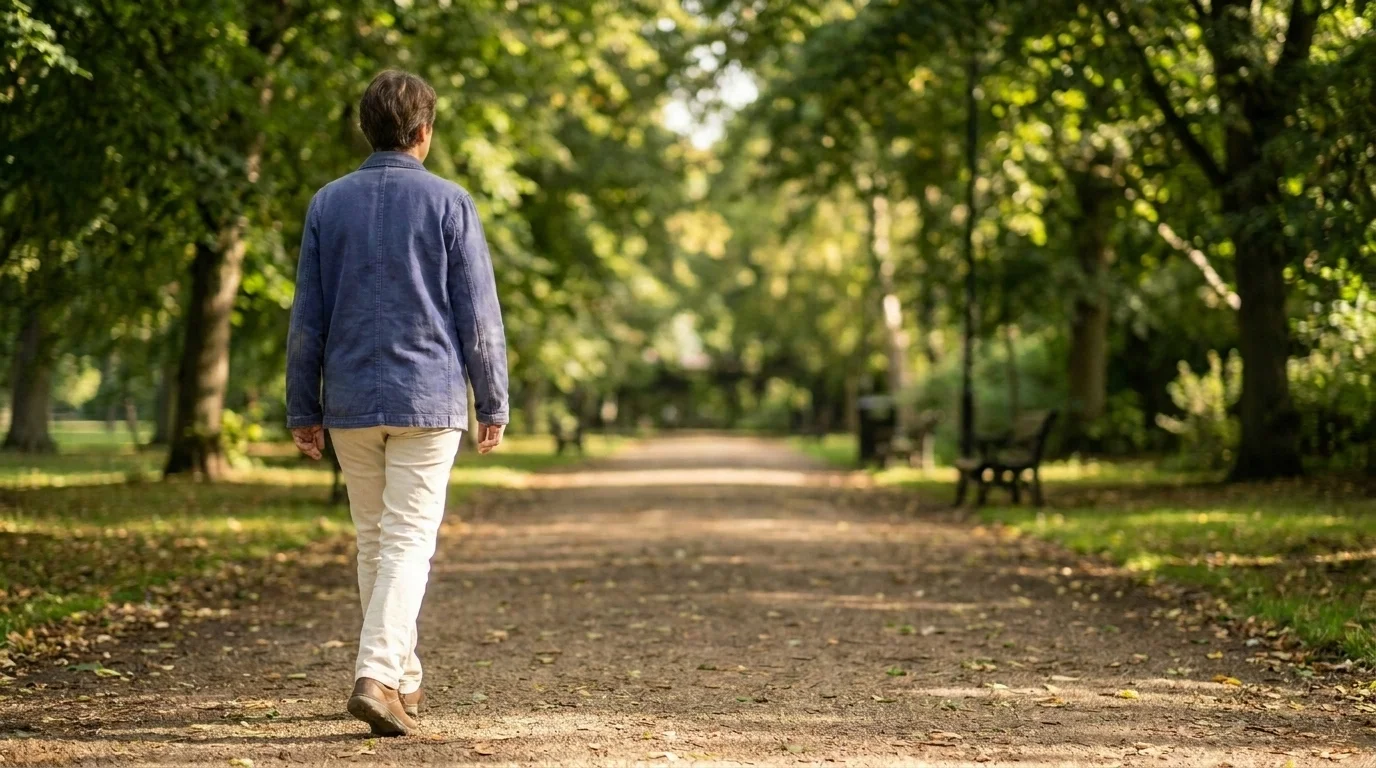
How to do it: the four moves
Here's the practice as a coach would cue it — the thing to think about (the cue) and, where it helps, what it should feel like (the marker):
- Anchor. Before you start, stand still for a few breaths and pick your anchor: usually the sensation of your feet on the ground. Cue: feel the contact, not the idea of the contact.
- Slow down. Walk noticeably slower than your commute pace — slow enough that you can actually feel the mechanics. Marker: you can sense the heel-to-toe roll of each foot, weight shifting from one side to the other, the brief moment of single-leg balance. If you can't feel that, you're still walking too fast.
- Engage your senses. Open your attention to one sense at a time — the sounds around you, the temperature of the air, the colors and textures you pass. You're not narrating; you're noticing. This is also where the "five senses" version lives if you want a structured prompt.
- Redirect. Your mind will wander — to the email, the to-do list, dinner. That's not failure; that's the exercise. The moment you notice, gently bring attention back to your feet. A walk where you wander a hundred times and return a hundred times is a successful walk.
Two honest notes from the coaching chair: if you have a pain or injury that walking aggravates, sort that with a clinician first — mindful or not, you shouldn't be loading a movement that hurts. And don't expect a switch to flip. Like any skill, the calm comes from reps, not from one perfect session.
Your 10-minute walking meditation
You don't need an app or an hour. Here's a self-contained routine you can run on any quiet stretch:
- Minute 1 — Settle. Stand still. Three slow breaths. Set a simple intention: "for these ten minutes, my attention lives in my feet."
- Minutes 2–5 — Slow walk, foot anchor. Walk at half your normal pace. Put all your attention on the heel-to-toe contact of each step. When you drift, return.
- Minutes 6–8 — Open the senses. Keep the slow pace, but widen attention to what you hear, then what you feel (air, sun, breeze), then what you see.
- Minutes 9–10 — Close. Slow further, then stand still for three breaths. Notice how your body and head feel compared to ten minutes ago.
That's it. Ten minutes, no equipment, repeatable daily.
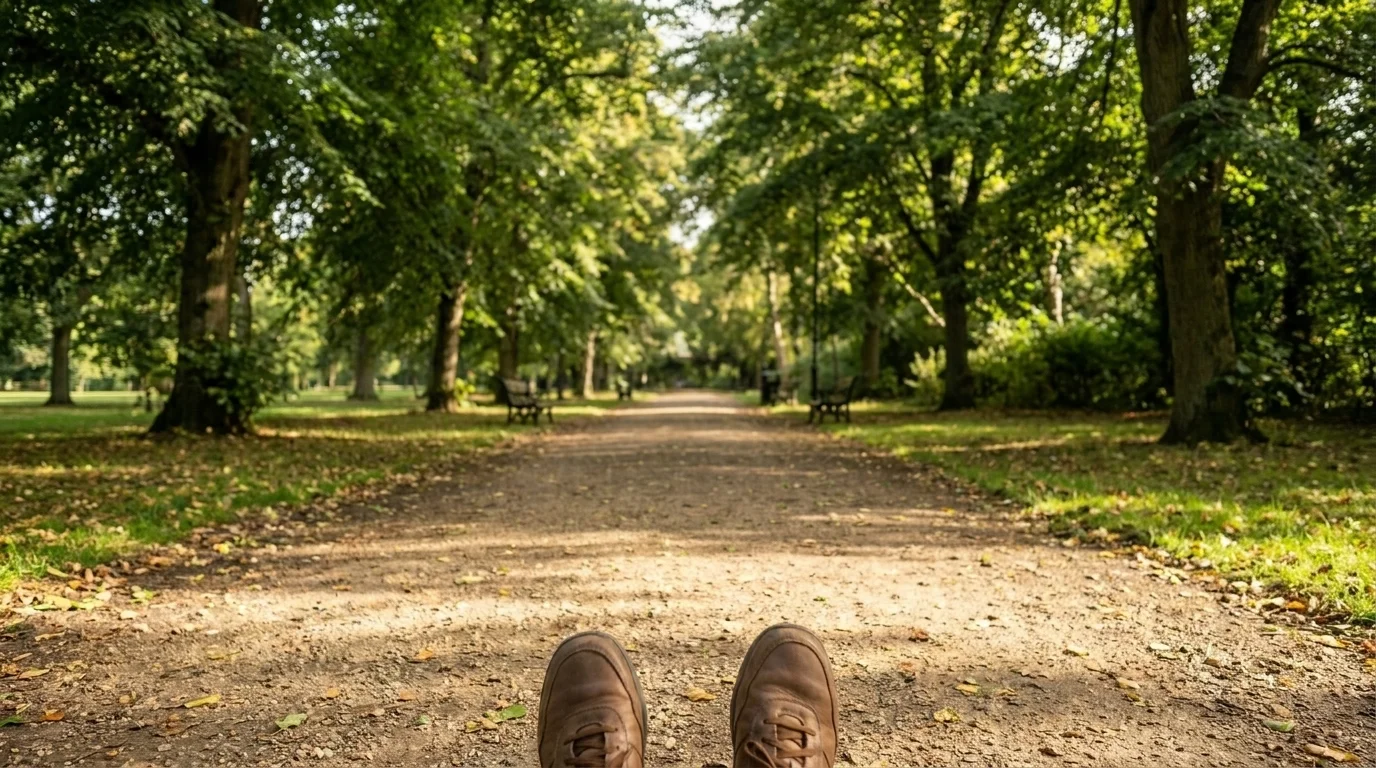
Where and how long to practice
Anywhere you can walk slowly without managing traffic works — a park or quiet street is ideal, but a backyard, an office hallway, or even a parking lot will do; the point is attention, not scenery. On duration, start at ten minutes. A 2025 study found that about ten minutes a day, five or more days a week, improved anxiety in previously sedentary adults, and the student research above shows even a single longer walk moves the needle. Ten minutes most days is a genuinely useful dose — extend it when it starts to feel like something you look forward to rather than something you're scheduling.
A reasonable timeline, since I always give one: expect a single session to take a bit of the edge off, and expect the steadier benefits — the calmer baseline, the easier return to focus — to show up over a few weeks of near-daily practice. It's training, not a trick. Walk slow, feel your feet, come back when you wander. Do that most days, and the rest follows.
Frequently Asked Questions
Mindful walking, also called walking meditation, simply means walking while paying deliberate attention to each step, your breath, and your surroundings instead of letting your mind wander. The skill being trained is gently returning your attention every time it drifts.
Use four moves: anchor your attention in the feeling of your feet, walk slower than your usual pace so you can feel the heel-to-toe roll, open your attention to your senses one at a time, and gently redirect back to your feet whenever your mind wanders.
Spend about a minute settling and breathing, walk at half-speed for several minutes anchoring on the sensation of each step, then widen your attention to what you hear, feel, and see, gently returning when your mind wanders, and close by standing still for a few breaths.
A 2025 systematic review found walking meditation safe and potentially beneficial for stress, anxiety, depression, balance, and blood pressure, and a 2024 study found a single guided mindful walk raised mindfulness about 19% and lowered anxiety about 35%.
Start with 10 minutes. A 2025 study found roughly 10 minutes a day, five-plus days a week improved anxiety in sedentary adults, and even a single longer guided walk helps. Extend the time once it feels like something you look forward to.
Anywhere you can walk slowly without managing traffic — a park or quiet street is ideal, but a backyard, an office hallway, or even a parking lot works. The practice is about attention, not scenery.