Nature Travel


Most travel writing treats nature travel as a scenery upgrade. It offers a prettier backdrop for the same trip you would have taken anyway. The research points somewhere more useful, and a little stranger. In five countries, doctors have begun writing prescriptions for time outdoors. Researchers, meanwhile, have started measuring nature the way a pharmacist measures a dose. That reframe is what this guide is about. Nature travel is not only where you go. It is a wellbeing practice you can plan for — and, as the science now supports, one you can dose. Think of it as a nature prescription you take on the road.
What follows is not a booking pitch. It is an editorial guide to five questions. What nature travel actually is, and what the evidence says about why it helps your mind and body. How much nature you need to feel the effect, and where to go to get it. And how to travel in a way that leaves the place better than you found it.
What Is Nature Travel?
Nature travel means visiting relatively wild or protected natural places — forests, mountains, coastlines, national parks. You go primarily to experience and benefit from the natural world itself. The trip is not about a city, a resort, or a purely cultural agenda. The destination is the nature. Everything else is logistics.
That sounds obvious until you notice what it changes. If the point of the trip is the forest and not the hotel, then the trip has a measurable purpose. And you can plan toward a purpose. This is where nature travel stops being a vacation category and starts behaving like a practice. It is something you do on purpose, in a certain amount, for a reason. Hold that idea; the "how much" question in a few sections is where it pays off.
Nature travel vs. ecotourism vs. sustainable tourism
People use these three interchangeably, and they should not. Nature travel describes why you go — to be in nature. Ecotourism and sustainable tourism describe how responsibly you go once you are there. The Global Ecotourism Network, via Sustainable Travel International, defines ecotourism as "responsible travel to natural areas that conserves the environment, sustains the well-being of the local people, and creates knowledge and understanding through interpretation and education." You can travel to nature carelessly, and you can travel responsibly to a city. The words are not synonyms, and the difference matters when you plan. For more of peppino's wellness and travel coverage, ecotourism gets its own treatment further down.
One shift worth naming: for 2026, the emerging trend pairs wellness with wildlife. Travelers are trading the spa for direct encounters with wild animals and wild places. The belief is that contact with the living world does something a massage table cannot. National Geographic has reported the shift. Whether it is a genuine movement or a marketing line is the next section's job.
Why Nature Travel Is Good for You: The Science
Here is the part no tour operator's homepage will tell you, because it does not sell a tour. There is real evidence that time in nature changes the body. It is worth being precise about what the studies measured, not romantic about what they might mean.
Start with stress. Spending 20 to 30 minutes in a natural setting produced the greatest drop in salivary cortisol — the stress hormone. Nature exposure lowered cortisol by roughly 21 percent. Salivary amylase, another stress marker, fell about 28 percent, Harvard Health reported. That is not a claim that nature cures anything. It is a claim that a measurable stress response goes down, measurably, in about the time it takes to drink a coffee.
The mental-health literature has moved past the question of whether. A 2025 systematic review and meta-analysis pulled together 78 studies covering 4,987 participants. It examined how the dose of nature exposure affects adults living with mental illness. When a field has enough trials to argue about how much rather than whether, it has grown up. That is where nature exposure now sits: a real effect that researchers are still sizing.
Forest bathing and nature therapy
Two named practices sit inside this evidence base. Shinrin-yoku is the Japanese term usually translated as "forest bathing" — unhurried, sensory time among trees, developed and studied in Japan long before it became a wellness export. Nature therapy is the broader clinical umbrella for using structured time outdoors as an intervention. It is worth keeping the names straight, because "forest bathing" as sold in a brochure and shinrin-yoku as practiced are not always the same thing — the first can be an add-on, the second a discipline. The evidence attaches to the doing, not the branding.
The neuroscientist Karina Del Punta, founder of neuroXnature, describes the felt version of what the instruments pick up. Standing before something vast, she told National Geographic, "we are hit with a sense of awe that cracks us open, shifting our brain activity, expanding awareness, and strengthening our bond with the living world." A cortisol reading and a moment of awe are two ways of pointing at the same event.
A word of honesty, since this is health writing and not advertising: none of this replaces medical care. Nature exposure is a complement to treatment, not a substitute for it, and if you are managing a real health condition, the person to talk to is your clinician, not a trailhead.
How Much Nature Do You Actually Need?
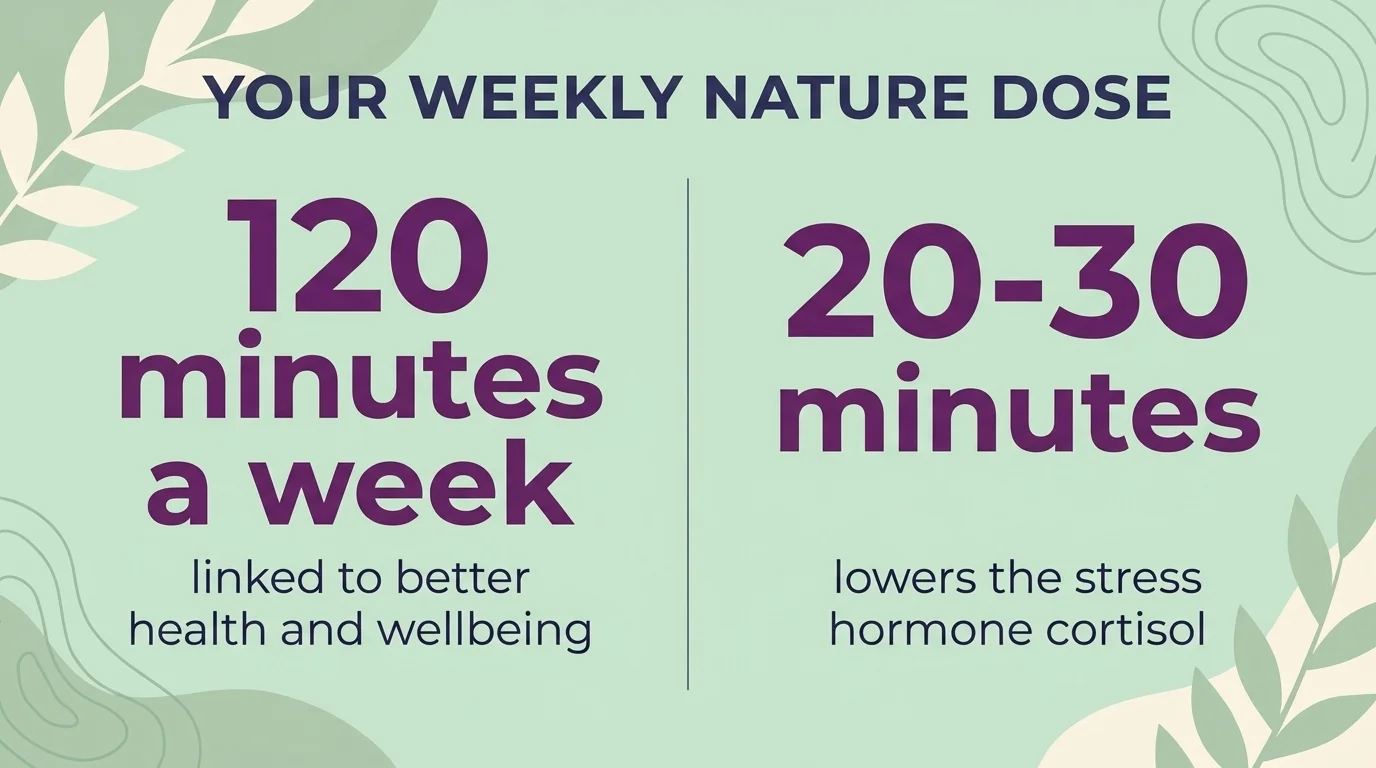
At least 120 minutes a week in nature tracks with better health and wellbeing. And 20 to 30 minutes measurably lowers the stress hormone cortisol.
The 120-minute figure comes from a study of nearly 20,000 people in England, published in Scientific Reports. People who spent at least two hours a week in nature more often reported good health and high wellbeing. That is an odds ratio of roughly 1.6, compared with people who got no weekly nature contact at all. Above that two-hour threshold, the benefit kept climbing and peaked somewhere around 200 to 300 minutes a week.
Now the detail that turns a statistic into a travel plan. It did not matter whether those 120 minutes came in one long visit or several short ones. Which means, in practice, that a single Saturday in a national park counts. So do six twenty-minute walks in a city park. That is the bridge from the lab to the itinerary. You can bank your nature dose across a trip, and you can top it up close to home between trips.
This is also why the "nature prescription" language is not a metaphor anymore. Canada's PaRx program launched in 2020. It has enrolled more than 13,000 healthcare professionals who can literally write nature onto a prescription pad. By 2025, Scotland, Canada, New Zealand, the United States and the United Kingdom had recognized nature as a clinical intervention. When a doctor can prescribe a forest, "how much" stops being a lifestyle question and becomes a dosing one.
Where to Go: Best Nature Travel Destinations
The rest of this guide is about turning that dose into a trip. I will frame each place by the kind of nature it offers, not by what it costs to book. The prices belong on the operators' sites, and the operators, frankly, explain nothing else. As backdrop, nature and wildlife tourism should hold close to a 59 percent share of the ecotourism market in 2026. Most people who travel for nature are trying to do exactly what this guide describes, per Fortune Business Insights.
Best US national parks for nature immersion
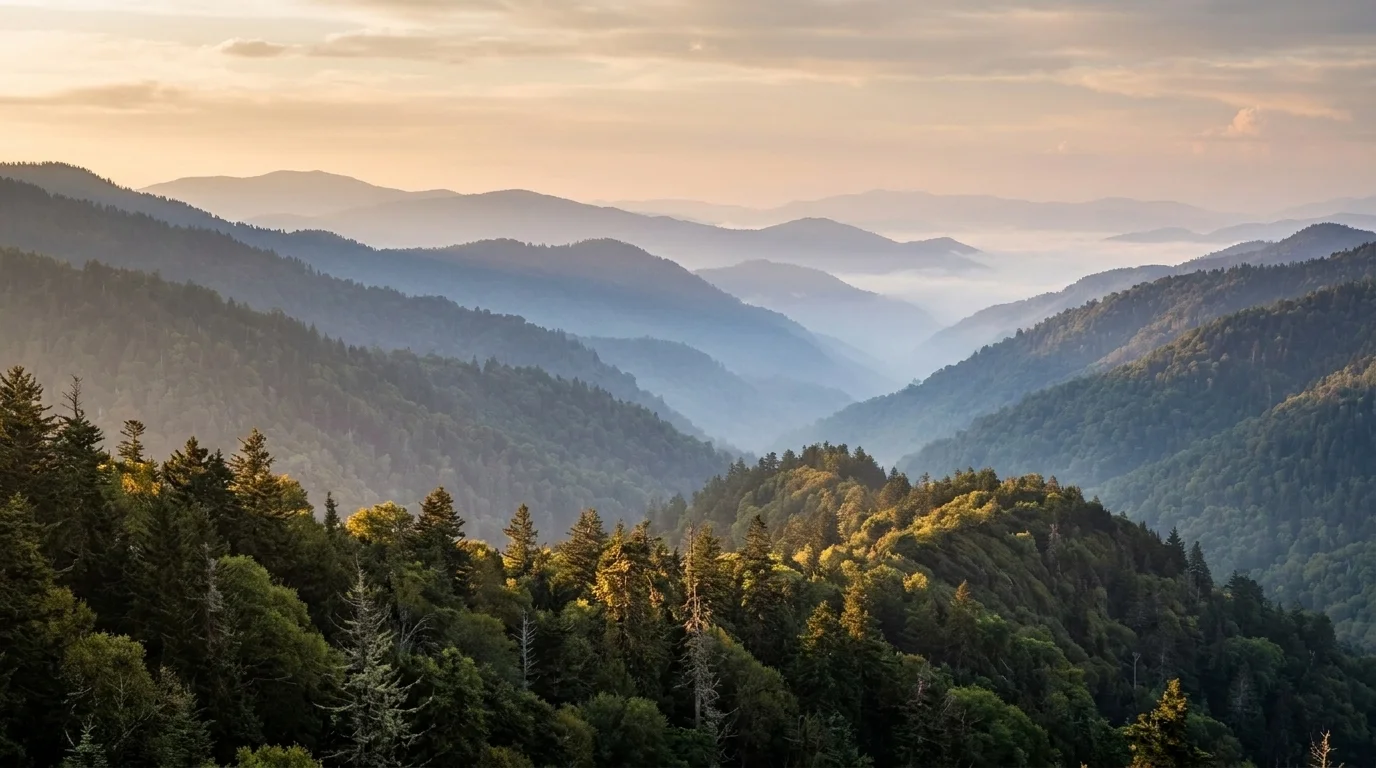
National parks are projected to account for roughly 34 percent of ecotourism product demand, by the same market data, and for once the crowd is right. If you want an easy, high-return nature dose within the United States, four parks earn the shortlist. The Great Smoky Mountains wrap layered, deeply immersive forest in the soft, near-constant mist that gives the range its name — a low-effort dose that asks for a walk, not a hard climb. Yellowstone is the reset for people who need scale: geothermal basins, wide valleys, animals living their own lives at a respectful distance. Yosemite trades on granite and silence, the kind of vertical landscape that produces Del Punta's "awe" without any prompting. Zion narrows the experience down to canyon walls and river light, and rewards a slow walk over a checklist.
Global nature icons
Look outward and Costa Rica is the name that keeps recurring, and for good reason. It has become a byword for doing nature travel and ecotourism at the same time. It offers cloud forests, two coastlines, and an eco-lodge culture. That culture treats accommodation as part of the ecosystem, not a break from it. Eco-lodges should make up around 41 percent of ecotourism accommodation demand, again per Fortune Business Insights. The wellbeing offer there is variety and vividness: you can hit your nature dose in a rainforest at dawn and a coastline by dusk.
Microadventures: nature travel close to home
The most quietly useful destination is the one you can reach on a Saturday. Microadventures — short, local, regional nature trips — are a named 2026 travel trend. They are the practical face of the research. The 120-minute dose does not care whether it arrives in one visit or several. So a regional forest, a nearby coast, or a state park you have driven past for years all count. Not every restorative trip has to be far-flung or expensive. For more destination guides, browse peppino's wellness and travel section.
How to Travel Sustainably and Regeneratively
Getting the dose is the personal half. The other half is what your visit does to the place, and here the language is shifting for 2026: from sustainable to regenerative. Sustainable travel aimed to minimize harm — leave no trace. Regenerative travel, as Fortune Business Insights frames the 2026 trends, aims to leave the destination measurably better: restored habitat, funded conservation, stronger local livelihoods. It is a higher bar, and a more honest one.
Four principles do most of the work. Slow travel — longer stays in fewer places — cuts the carbon of constant transit and lets a place register as more than a photo stop. Indigenous-led experiences matter beyond the itinerary: when the people who have stewarded a landscape for generations lead the visit, the knowledge is accurate and the money reaches the community that carries it, rather than a distant revenue line. Eco-lodges tie your stay to the ecosystem it sits in. And tech-enabled conservation — the tracking, monitoring, and habitat work that increasingly funds itself through tourism — turns a booking into a small contribution.
None of this requires a vow of purity. It requires asking, before you book, one question an anthropologist learns to ask of any exchange: who benefits from this, and who is left out of it? The regenerative version of nature travel is simply the one where the honest answer includes the people who live there. As context, not a sales figure: the ecotourism market was valued at about USD 295.83 billion in 2025 and is projected at USD 337.19 billion in 2026, growing at a 16.26 percent compound rate — enough money moving that where it lands is a real question.
How to Plan a Nature Trip for Wellbeing
Put the science to work as a short checklist. Aim for at least 120 minutes of genuine nature contact spread across the trip — the dose the research links to better wellbeing — and, if you can, front-load a 20-to-30-minute immersion on arrival to reset your cortisol before the itinerary swallows you. Match the intensity to what you actually need: a canyon or coastline for stress relief, a vast landscape for the awe reset, a rugged park for active immersion. Build in low-stimulation, unplugged time on purpose; the phone is the thing most likely to cancel the dose. And favor eco-lodges and regenerative operators, so the trip that helps you also helps the place.
One limit, stated plainly. Remote and wild travel carries real risk that a wellness framing can paper over: check conditions and closures before you go, keep a respectful distance from wildlife — it is wild, not a backdrop — and prepare properly for remote areas where help is far away. And treat all of this as a complement to your health, not a replacement for care. A nature prescription is a good idea; it is not a reason to skip the doctor.
The mindset is the whole reframe in one line: plan the dose, don't just book the view.
Nature Travel Is a Practice, Not a Postcard
Strip away the brochures and nature travel turns out to be simpler and more demanding than a destination list. Define it — the nature is the point. Understand the evidence — a measurable drop in stress, a real if still-sized effect on wellbeing. Hit your dose — 120 minutes a week, banked however you like. Choose a place that fits the goal, and travel so the place gains something too. The useful question at the end is not "where should I go," but "who benefits from how I go" — and if the answer includes both you and the forest, you have planned it well. For deeper dives — forest bathing, ecotourism, nature therapy — peppino's wellness and travel guides are the next stop.
Frequently Asked Questions
The difference between nature travel and ecotourism is what each word describes. Nature travel describes why you travel — to experience and benefit from wild or protected natural places. Ecotourism describes how responsibly you travel once you are there: conserving the environment, supporting local people, and learning from the place. You can do one without the other, though the best trips do both.
The best places to travel for nature in the US are its national parks. For accessible, high-impact nature immersion, four stand out: the Great Smoky Mountains for dense, misty forest, Yellowstone for wide geothermal landscapes, Yosemite for granite and silence, and Zion for canyon walls and river light. Each delivers a strong nature dose without a complicated itinerary.
A nature prescription is a formal recommendation from a healthcare provider to spend time in natural settings as a health intervention. It has moved from metaphor to practice: Canada's PaRx program has enrolled more than 13,000 clinicians who can prescribe time outdoors, and countries including Scotland, New Zealand, the US and the UK now recognize nature exposure as a clinical tool.
No — you do not need to travel far to get nature's health benefits. The research on roughly 20,000 people found that the 120-minutes-a-week threshold linked to better wellbeing worked whether it came in one long visit or several short ones. That means local microadventures — a nearby forest, coast, or state park — count just as much as a far-flung trip.
Any season works for the health benefits of a nature trip — the stress and wellbeing effects do not depend on the calendar. If you want the destination itself at its calmest and least crowded, plan around off-peak windows and the local climate. Note that nature-travel planning demand itself tends to peak from November through February, as people book winter and new-year getaways.