
AI-Powered Personalized Fitness: Revolutionizing Workout Regimens Through Data-Driven Insights


At a small barbell gym I trained at in Honolulu, the head coach used to spend the first ten minutes of every new client's session asking questions. About sleep. About what they ate yesterday. About what hurt this morning, in what direction, when. He had been coaching for twenty years and could see things in a person's gait that no chest-strap heart-rate monitor would ever catch. The relationship — between him, the practice, and the body in front of him — was the product.
What an AI personal trainer does is something different. It is not the same practice ported into an app. It is a translation, and like all serious translations, it gains some things and loses others. The thing it gains is scale: a fraction of the cost, sessions adapted in real time to data that no human coach has the bandwidth to track, and a delivery model that meets people in their kitchens at 6 a.m. on a Tuesday. The thing it loses is the part that lives in the relationship — the part that catches a knee tracking inward on the third rep because the coach is across the room watching. I want to walk through both halves of that translation carefully, because the marketing around this category has been very confident about the first half and very quiet about the second.
A few numbers to anchor what we are actually talking about. The AI fitness market is projected to reach $46.1 billion by 2034, and as of 2026, roughly 70% of new fitness apps integrate machine learning of some kind. A 2024 Sports Medicine study found that AI-guided training improved strength gains by 11 to 17% versus static programs in recreational lifters over a twelve-week intervention. That is a real effect, and it is the headline the industry leads with. The same body of research includes a British Journal of Sports Medicine meta-analysis showing that supervised, relationship-based training outperforms tech-only programs by up to 40% in long-term adherence. Both findings are true. Holding them at the same time is the work.
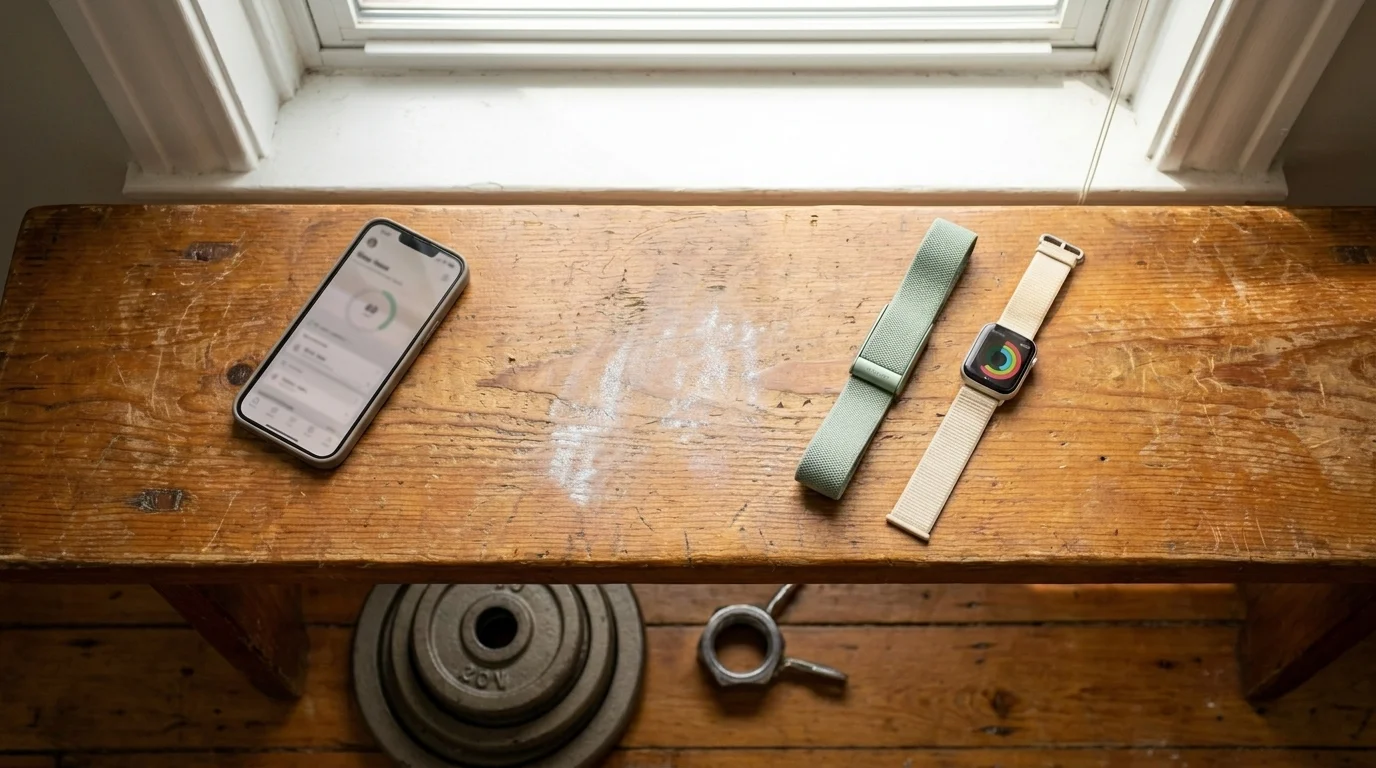
The five signals behind a real AI personal trainer
If you stripped the marketing language away from a tier-1 AI fitness coach in 2026, what you would find underneath is a fusion of five inputs that the algorithm uses to decide what your next session should look like. Understanding the five signals is the difference between buying an app that personalizes and buying an app that tells you it personalizes.
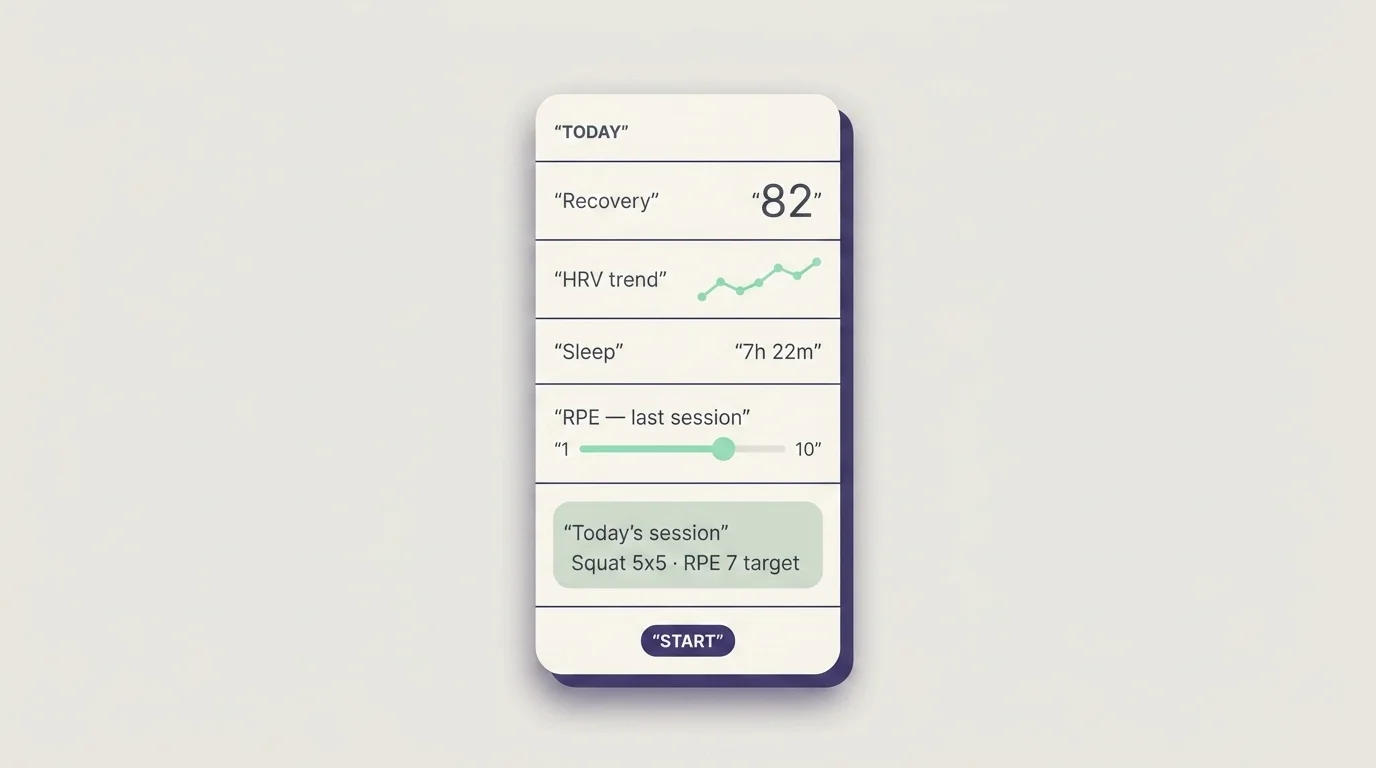
The first is heart rate variability trend. Not your HRV today — your HRV trend over the last 7 to 14 days against your personal baseline. A meaningful drop in trend HRV (the parasympathetic-recovery signal) is one of the cleanest indicators that your nervous system is under load, and tier-1 apps will deload the next session — typically by trimming working-set volume to 60–70% of planned — without you having to ask.
The second is sleep architecture. Total sleep time matters, but so does deep-sleep and REM proportion, sleep latency, and night-to-night consistency. Apps that pull from Oura, Whoop, or Apple Watch typically use a composite "sleep score" rather than a single number, and the better ones adjust intensity targets rather than just adding a warning.
The third is rate of perceived exertion (RPE) — the subjective effort number you log after each set, on a 1–10 scale. RPE is the most under-used signal in consumer apps and the most rigorously studied in strength-coaching literature. An algorithm that takes your last-set RPE seriously can adjust the next set's load in real time — Arvo, for example, adapts in under 500 milliseconds per set based on RPE input.
The fourth is velocity and load history — what weight you lifted, how fast, across what set-and-rep schemes, over weeks. This is the input strength-specific apps (Fitbod, FitnessAI) use to drive progressive overload without you having to plan it. Velocity-based training, when supported by an attached barbell sensor, gives the algorithm a window into bar speed that historically only an experienced coach could read.
The fifth is recovery score, which is a composite — most platforms compute it from HRV, resting heart rate, sleep, and recent training load fused together — that effectively answers the question "is today a day to push, hold, or recover?" Whoop popularized the framing; SensAI, Future, and Apple Fitness+ now compute their own versions.
A practical note. Multi-signal biometric adaptation has replaced single-metric programs at the tier-1 level. Apps that look only at one input — usually heart rate — are doing a much weaker version of this work, regardless of what the marketing says.
Adaptation tiers: where the actual differences live
The biggest source of confusion between AI fitness apps in 2026 is not which signals they use. It is when they act on the signals. There are three tiers.
Block-level adaptation is the oldest. The app generates a 4-, 6-, or 8-week program for you, and unless you manually report a problem, it runs to the end of the block before recalculating. Legacy apps still operate here. The cost is responsiveness; the benefit is that the program is internally coherent.
Workout-level adaptation is the current consumer baseline. Fitbod is the canonical example. Before each session, the app evaluates recent volume, recovery, and progress, and chooses the workout accordingly. By the time you start lifting, the plan is fixed.
Set-level adaptation is the leading edge — the under-500-millisecond, per-set adjustment Arvo introduced and that a handful of tier-1 apps now match. If you report RPE 9 on a set that was planned as RPE 7, the next set drops. The trade-off is that the program has to be designed to absorb this kind of micro-adjustment without losing its overall shape; not every training goal benefits from it.
A new category emerged in 2026: voice-first coaching, in which apps like Ray talk you through reps in real time, count automatically, and adjust mid-set on verbal feedback. Voice-guided AI trainers average 3.2 workouts per week vs 1.8 for video-based apps — the largest single behavioural shift the category has produced. Whether that is the AI or the social-presence simulation of being talked to is, anthropologically, an interesting open question.
Related Article: Democratizing Wellness Tech: Ensuring Equal Opportunities for Digital Health Adoption
AI fitness apps in 2026: a working shortlist
There are perhaps eight apps an informed shopper should know about in this space. The table below is a synthesis of the named coverage in the industry sources cited above. Prices and capabilities shift; check the current state when you buy.
| App | Price (USD/mo) | Best for | Biometric integration | Adaptation tier |
|---|---|---|---|---|
| Future | $149–$199 | People who want human-coach pairing with AI infrastructure | HRV, sleep, Apple Watch | Workout-level + coach review |
| Fitbod | $12.99 | Algorithmic strength programming, gym lifters | Apple Watch activity sync | Workout-level |
| FitnessAI | $9.99 | Strength-only, minimalist UI | Apple Watch | Workout-level |
| Freeletics | Free / $11.99 | Bodyweight programming, beginners | Limited | Workout-level |
| SensAI | $14.99 | Multi-signal recovery-aware coaching | HRV, sleep, recovery score | Workout-level |
| Ray | $19.99 | Voice-first, real-time talking coach | Apple Watch | Set-level (voice) |
| Whoop Coach | Whoop subscription | People already wearing Whoop, recovery-led training | HRV, sleep, recovery score (native) | Workout-level |
| Apple Fitness+ | $9.99 (or Apple One) | Apple ecosystem users, varied disciplines | Apple Watch native | Workout-level |
Best-for categorization matters more than price ranking. A $9.99 algorithmic-strength app will out-train a $199 human-AI hybrid for a recreational lifter who only needs progressive overload; the inverse is true for someone who needs accountability and live form review.
What an AI coach cannot do (and why it matters)
Every honest discussion of an AI fitness coach has to include this section, and most discussions still don't. There are four areas where the algorithmic version does substantially worse than a credentialed human, and they are worth naming individually.
Pain diagnosis. An AI cannot tell whether your knee hurts because your VMO is firing late, because your shoes are wrong for your gait, because the previous workout exposed an old meniscal injury, or because you slept on it weird. A coach with their hands on you can run a few quick assessments and route you toward physical therapy if needed. An app will tell you to deload.
Olympic lifts and other technically complex movements. The snatch and the clean-and-jerk have a learning curve that requires sub-second video review and live verbal cueing from someone who has coached the movement a thousand times. Computer-vision form-check in current consumer apps is real but limited; it catches gross asymmetries, not the kind of subtle hip-knee timing errors that injure people in these lifts.
Post-injury rehabilitation. Rehab programming is genuinely individualized — it depends on the surgery, the surgeon's protocol, the patient's pain tolerance, and the trajectory of the specific injury — in ways that no current consumer AI is licensed or designed to handle. A physical therapist is the correct provider here.
Read-the-room situational coaching. The grief week. The bad-flu return-to-training. The first session after a deployment. The pregnant client whose energy has shifted. A human coach reads the whole person and adjusts accordingly; an algorithm reads the metrics. Sometimes those are the same thing. Often they are not.
This is also where the 40% adherence gap the BJSM meta-analysis reports likely lives. The AI may produce a better-programmed session than a generic template, but the human coach produces a relationship — and relationship is one of the most replicated predictors of long-term adherence in behaviour-change research.
Related Article: The Fusion of Wellness Tech and Fashion: Wearable Innovations Revolutionizing Health and Style
What your biometric data actually does (and where it goes)
This is the section that almost no editorial coverage of AI fitness apps includes, and it should. When you wear a Whoop, an Oura, or an Apple Watch and connect it to an AI coaching app, you are generating one of the most detailed continuous biometric records of yourself that has ever existed at consumer scale. HRV. Sleep stages. Resting heart rate trends. Menstrual cycle data, in some platforms. Geolocation of every workout, often.
A few questions worth asking before you connect a wearable to a coaching app:
- Where does the data live? On-device only, on the vendor's servers, or both? Most apps store on their servers — that is how the model trains.
- Who owns it? Read the terms. Some vendors retain rights to use anonymized biometric data for product improvement and research; some sell aggregated data sets to third parties.
- Can you export and delete it? Under GDPR (Europe) and California's CCPA, you have legal rights to both. Practical exercisability varies a great deal across apps.
- What happens if the vendor is acquired or shuts down? This has happened repeatedly in the wearables space. Your data goes with the corporate transaction. Read the privacy policy for the transfer clause.
None of this is a reason not to use these tools. It is a reason to use them with the same considered consent you would bring to handing your medical records to a clinic you had not vetted.
A question rather than a slogan
What gets translated when 1:1 coaching becomes an algorithm is most of the visible product — the programming, the data tracking, the progressive overload, the recovery adjustment. What gets lost is mostly the part you cannot bill for: the relationship that knew you before this Tuesday and will know you after. For most people, most of the time, an AI personal trainer is a measurable upgrade over a generic template and is meaningfully cheaper than a human. For some training goals, and for some life seasons, the relational coach is still the better tool, and the right question is when to use which.
The honest answer in 2026 is that both are real options, that the AI version has caught up enough to be a genuine first-line choice for general fitness, and that the marketing on either side will tend to overclaim. Choose the tool that matches what you are actually trying to do, and check the data it is collecting on you before you commit it your sleep, your heart, and your body for the next two years of Tuesdays.
Frequently Asked Questions
For consistent, structured training between $10-30/month, yes — a 2024 Sports Medicine study found AI-guided programs improved strength gains by 11-17% over static templates. The trade-off is roughly 40% worse long-term adherence than supervised, relationship-based coaching (per a British Journal of Sports Medicine meta-analysis), so AI works best when paired with self-accountability or used alongside an occasional human check-in.
SensAI, Future, Whoop Coach, and Apple Fitness+ actually adjust the next session based on HRV, sleep score, and recovery — most other apps only display the data without using it to change programming. Ask whether the app changes load and volume in response to your wearable, not just whether it 'syncs' with it.
Not for pain diagnosis, Olympic lifts, post-injury rehab, or read-the-room situational coaching — those still require a credentialed human. For general strength, hypertrophy, cardio, and bodyweight programming, AI now matches or beats generic templates and costs a fraction of a human trainer.
Freeletics offers a free bodyweight tier with weekly AI-generated plans. Apple Fitness+ is bundled with Apple One subscriptions. Most algorithmic-strength apps (Fitbod, FitnessAI) gate adaptation behind a paid tier after a short trial — you get a workout for free, but you don't get the algorithm adjusting it.
It fuses five signals — HRV trend, sleep architecture, RPE (your reported effort), velocity and load history, and a composite recovery score — and adjusts at one of three tiers: the training block (legacy apps), the workout (Fitbod, most current consumer apps), or the individual set (Arvo and other set-level apps, including voice-first coaches like Ray).
It is the use of machine learning to adapt training to your individual physiology and recent history — biometric data (HRV, sleep, heart rate), subjective feedback (RPE), and historical performance (load, velocity, volume) — to produce workouts that change in response to how you actually are today rather than what a generic template assumed about you.
By continuously updating an internal model of your training response and adjusting load, volume, intensity, and recovery in real time. Set-level systems can change the next set in under 500 milliseconds based on your reported effort; workout-level systems recalculate the day's session before you start; block-level systems hold a plan and revise it every few weeks.
Because the same workout produces different responses in different people, and in the same person on different days. Customization that responds to recovery, training history, and effort feedback drives both better outcomes (the 11-17% strength-gain difference cited in 2024 Sports Medicine work) and better adherence to a degree that matters more than the programming itself.
Check Out These Related Articles

Revolutionizing Patient Care: The Impact of Data Analytics in Health and Wellness

The Technological Future of Holistic Healing: Innovations Reshaping Well-Being Practices
Revolutionizing Fitness Regimens with Smart Gym Equipment