
Revolutionizing Recovery: The Next Generation of Post-Injury Rehabilitation


If you are recovering from a torn ACL, a stroke, or a back injury and you have been told that "AI is changing physical therapy," you are right to want to know what that actually means before you sign up for an app subscription or skip a clinic visit. I am a clinician-turned-journalist, and the honest version of this story is that AI in physical therapy is doing real work, that the strongest evidence sits in a few specific use cases, and that the technology is best understood as filling specific gaps in conventional rehab rather than replacing your therapist. This guide walks through the rehab technology that has actually changed since 2024 — AI apps, VR, exoskeletons, wearables, and the hybrid care model that quietly became the 2026 default — and where each one fits.
Three things to read carefully before the modality tour. First, the Frontiers in Digital Health 2026 review is the new authoritative academic citation on AI in rehabilitation — it covers clinical effectiveness, safety, and equity across modalities, and it supersedes the 2024-and-earlier reviews most consumer articles still link to. Second, the rehab landscape changed materially in late 2025 (Sword Health acquired Kaia Health for $285M, the FDA expanded the Atalante X exoskeleton indications to spinal cord injury, and Ekso Bionics' EksoNR became the first robotic exoskeleton cleared specifically for MS rehabilitation). Third, the consumer-facing story is no longer "telehealth versus the clinic" — it is hybrid care, in-clinic sessions paired with AI-driven remote follow-up, and that shift matters for how you read every product claim below.
Why Conventional PT Falls Short (and What That Has To Do With AI)
The reason AI rehab tools have grown so fast in recent years is not that the underlying science is shocking — it is that conventional outpatient PT has measurable gaps that AI is genuinely good at filling. According to XRHealth's 2024 review of the clinical literature, patients in conventional outpatient rehab attend an average of just 7.4 visits, only 35% complete the home-exercise programs their therapist prescribes, 53% cite time barriers as the reason, and 73% disagree with the treatment cost. Those are the four numbers worth tattooing onto every claim about "AI revolutionizing recovery" — each subsequent technology you will read about below earns its keep by closing one of those gaps.
It is also worth saying, before the technology tour, what AI in this space is not. It is not a replacement for hands-on assessment, it is not a substitute for clinical judgment when something on your scan or in your gait does not match the textbook, and it is not — anywhere yet, despite the marketing — a system that can diagnose and treat an injury independently. The February 2025 PMC study on physical therapist readiness found PTs strongly interested in AI adoption but consistently citing organizational and training gaps as the bottleneck. Translated: this is technology that augments a clinician's work, not a self-service rehab vending machine.
AI-Driven Personalization: The Apps
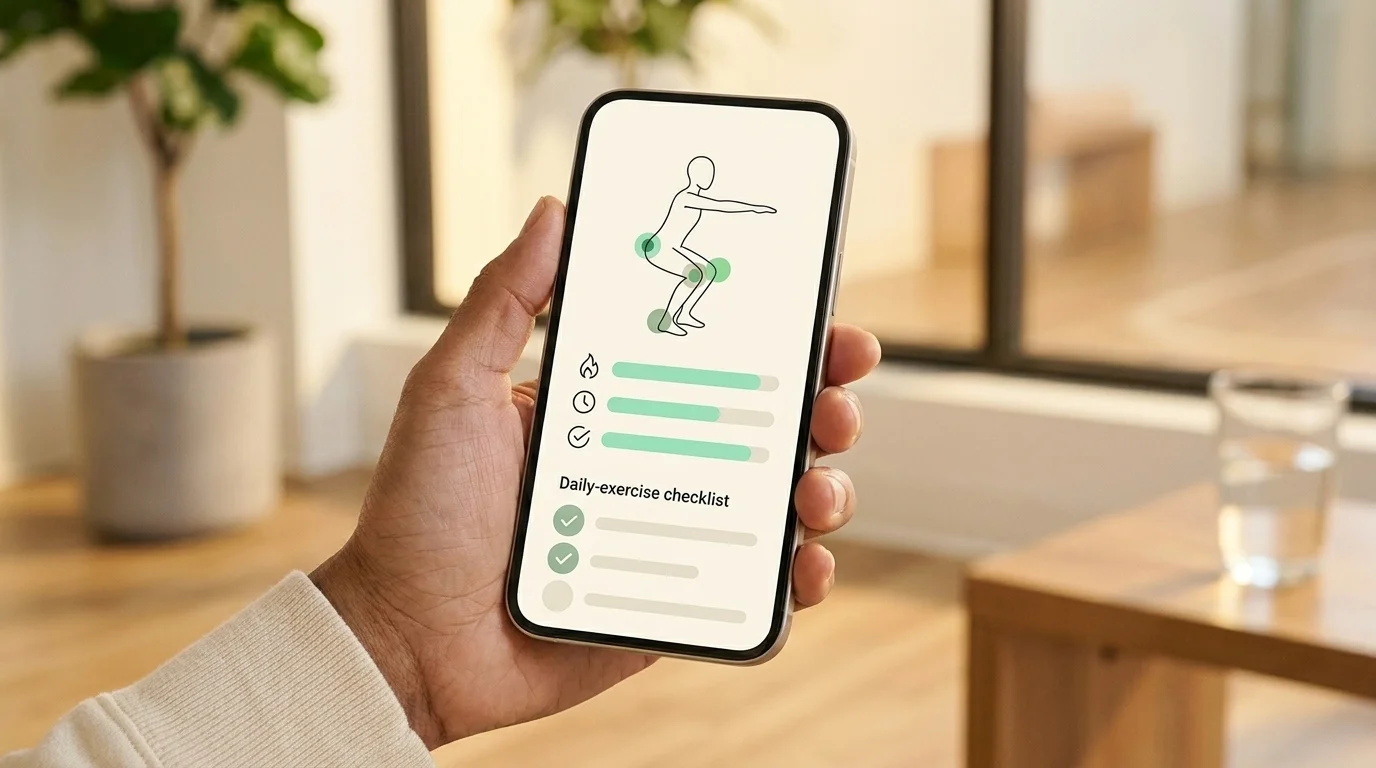
The most consumer-visible piece of rehab AI right now is the digital MSK (musculoskeletal) app, delivered usually as a phone or sensor-based program that combines computer-vision movement analysis with adaptive exercise prescription. The names worth knowing in 2026: Sword Health (which acquired Kaia Health for $285M in October 2025 — the two products our older competitor pages still profile as separate are now one company, per Fierce Healthcare's October 2025 reporting), Hinge Health, Omada, RecoveryOne, Vori Health, and Physitrack. According to Grand View Research's US AI in PT market analysis, peer-reviewed outcomes for these platforms are comparable to in-person physical therapy with a net decrease in spending — a sentence worth bounding carefully, because "comparable" does not mean "better" and does mean "for the conditions actually studied."
The mechanism that makes these apps work is a tighter feedback loop than conventional rehab can manage. The SprintPT 2025 review of the literature reports 35% better patient outcomes and 40% treatment-time reduction for AI-integrated therapy practices, with computer vision systems now interpreting movement data with 95% accuracy. On the clinician-facing side, tools like Flok, Physio-IAssist, and Kassandra AI (Kinvent 2026 trends summary) handle ambient documentation and movement-pattern analysis, which is more boring than the consumer headlines and more useful to working PTs.
The honest framing on these apps: they are the right tool for patients with stable, well-characterized MSK conditions (low back pain, neck pain, shoulder, knee OA, post-surgical knee or hip rehab once acute phase is over) who need higher-frequency engagement than their PT budget allows. They are the wrong tool as the primary care path for an acute injury that has not been clinically evaluated, for complex post-surgical recovery, or for neurological conditions where assessment subtlety matters. None of that is hidden in the product literature, but it is rarely on the marketing page.
Related Article: Microbiome Insights: Revolutionary Findings on Gut Health and Its Impact on Mental Well-Being
VR for Rehab: The Movement-Dose Multiplier
Virtual reality in rehab is the modality with the cleanest mechanism-of-action story. The reason VR works in upper-limb rehabilitation is dose — game-based VR sessions deliver 200 to 300 functional movements per one-hour session, versus 23 to 32 functional movements in a conventional therapy session of the same length, according to PMC11668540 (December 2024). That is roughly an order-of-magnitude difference in the only variable that genuinely drives motor recovery: the number of correctly executed reps the affected limb performs. Once you understand that, everything else about VR rehab makes sense.
The adherence piece is the other half of the case. XRHealth's 2024 data reports gamified VR programs reaching 78% home-exercise adherence, with the Nintendo Wii Fit knee-osteoarthritis clinical cohort showing 83% retention — both well above the 35% baseline adherence for conventional home exercise. The 60-to-90% "users rated AI-powered treatment helpful" figure from the same source is exactly what it sounds like: useful directional signal, not a controlled effect size.
What VR rehab is genuinely good for: post-stroke upper-limb recovery (where dose is the binding constraint), balance training for older adults, and chronic-pain desensitization protocols. What it is not yet good enough for: standalone lower-extremity strength work, conditions where the clinical question is "is this rehabbing correctly or am I about to re-injure," and any setting where hands-on assessment is part of the dose. As with the AI apps: best as a force multiplier on a real treatment plan, not a substitute for one.
Wearable Sensors: The Data Layer Underneath Everything Else
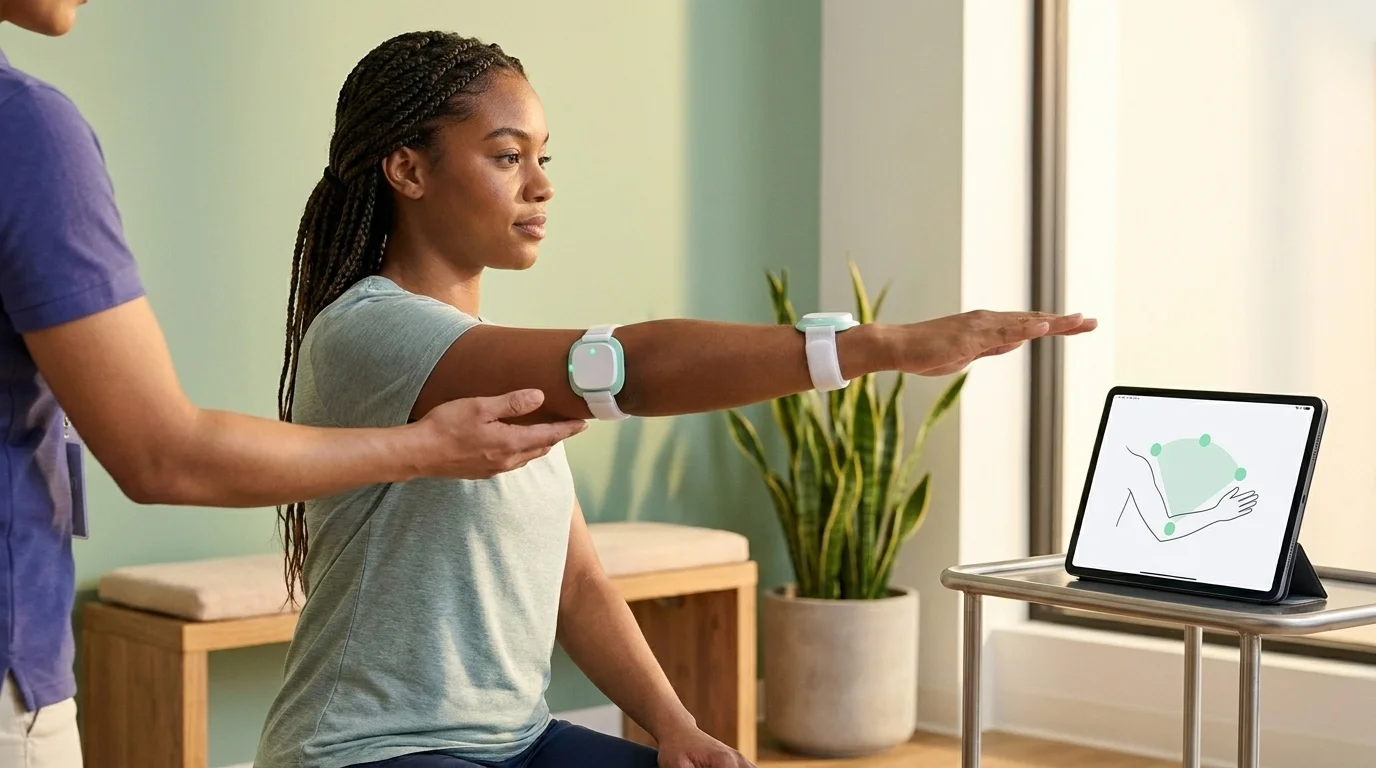
Wearable rehab technology is the least visible and arguably most consequential layer of all of this — the data fabric that lets every other modality on this list actually personalize. Wrist and chest sensors, IMU-based motion trackers (Sword Health's product is a leading example of consumer-facing IMU rehab hardware), and consumer smartwatches now feed continuous movement-frequency, sleep, and activity-load data into the underlying AI models. The result is that the rehab plan adjusts to what you actually did this week, not what you reported in the next clinic visit.
The clinical research base on wearables in rehab is real but narrower than the consumer marketing implies. The strongest evidence sits in: post-operative ambulation tracking (knee and hip replacement specifically), sedentary-behavior reduction for cardiac rehab, and adherence monitoring for home-exercise programs. The weakest evidence sits in: any wrist-worn device claiming clinical-grade ECG, sleep-stage, or "stress" measurement — the underlying sensors are largely the same as the consumer-fitness market, and the clinical claims should be read with the same skepticism you would apply to a supplement that "supports" something.
For someone in rehab right now, the practical version of this is: if your PT recommends a specific wearable as part of your program, the data feedback loop is meaningful; if you bought one yourself and are watching the numbers go up, you are getting motivation, not medicine. Both are fine. Knowing which you are getting is the point.
Robotics in Rehabilitation
Robotic rehab covers two distinct product categories worth separating: assistive exoskeletons that help a patient walk (covered in the next section), and task-trainer robots that guide repetitive limb movements in clinic. The task-trainer category has the longer clinical track record. Bionik Labs' upper-extremity systems and Hocoma's Armeo Spring product line are the workhorses; per PMC11668540's review, pediatric exoskeleton studies using the Hocoma Armeo Spring showed motor gains that persisted up to 6 months post-intervention, which is the durable outcome marker that matters most for pediatric and stroke rehab populations. Cyberdyne's HAL system, originally developed in Japan, falls in the same product category and has a meaningful European deployment footprint.
For ML-driven assessment, the same PMC review reports random-forest models achieving 95.4% accuracy on spasticity assessment — meaningfully above the inter-rater reliability that clinicians historically achieve on the same task. The point is not that the ML model is "better than a clinician," because it is not assessing the same downstream clinical decisions; the point is that for the specific narrow task of quantifying spasticity, the AI gives you a more reproducible number than a human exam does. That number then feeds the personalized exercise plan the AI app generates. You can see the system working as a system.
Exoskeletons in 2026
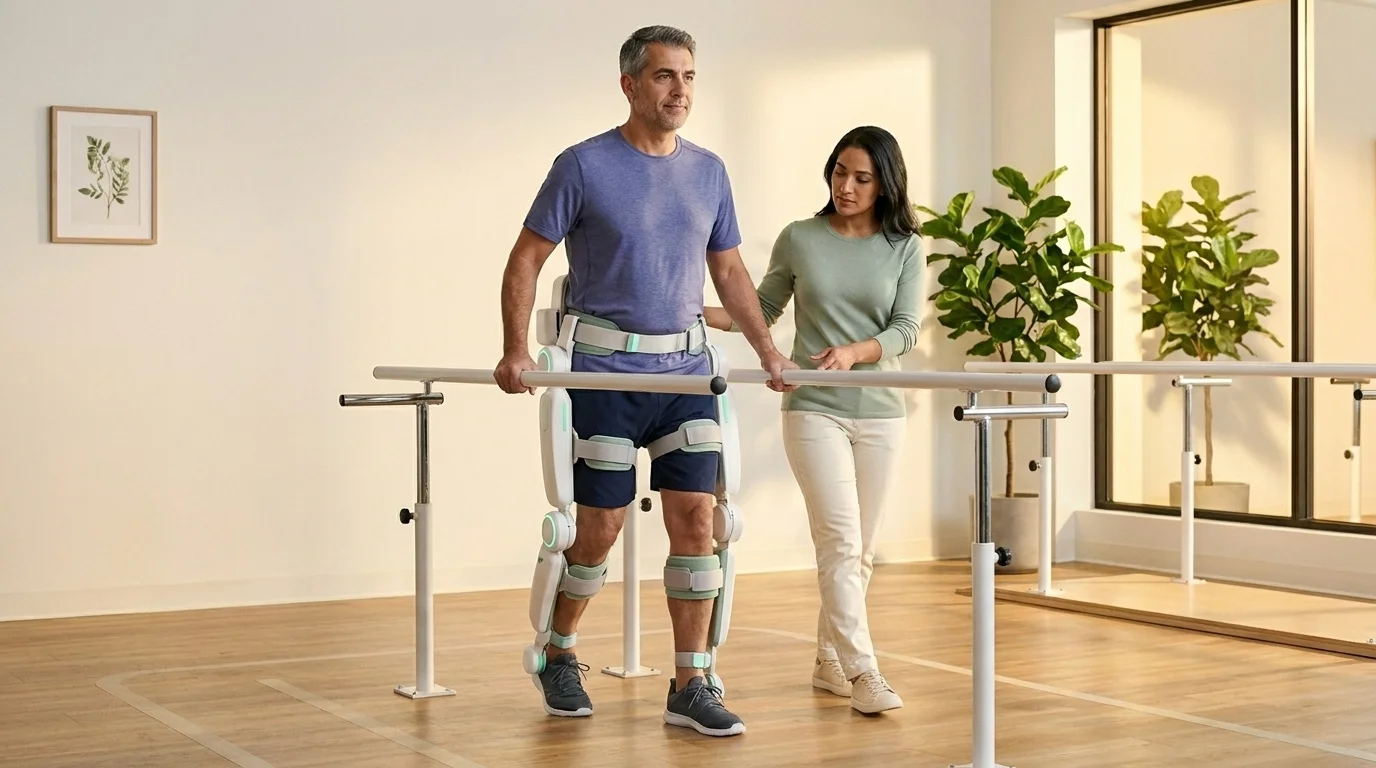
The exoskeleton story changed materially in 2025, which is why it deserves its own section rather than a paragraph inside robotics. Two FDA developments are worth knowing about specifically.
First, the Wandercraft Atalante X, a hands-free self-balancing exoskeleton that lets users walk without crutches or a walker, had its FDA indications expanded in 2025 to cover both multiple sclerosis and spinal cord injury at the C4–L5 levels (per MassDevice and MS News Today's November 2025 coverage). It is the first hands-free, self-balancing exoskeleton approved for both populations.
Second, Ekso Bionics' EksoNR received FDA 510(k) clearance for multiple sclerosis rehabilitation, making it the first robotic exoskeleton specifically cleared for MS rehab use, per NeurologyLive. For an MS patient looking at gait-rehabilitation options, the EksoNR clearance moves the device from "available in some advanced rehab centers" toward broader insurance-coverage conversations — though, as with any new clearance, the reimbursement story is downstream of the regulatory one.
The honest framing here: exoskeleton rehab is real, it is no longer experimental for the populations it is cleared for, and it is also still primarily a clinic-based modality (not a consumer device). If a center near you offers Atalante X or EksoNR sessions, it is worth asking your neurologist or physiatrist whether your specific case fits the cleared indication.
Related Article: The Alchemy of Essential Oils: Unveiling the Science Behind Aromatherapy’s Therapeutic Effects
Tele-Rehab and the Hybrid-Care Reality
Telerehabilitation is the modality that gets covered the most badly in older articles, and it is worth correcting the framing. Search interest in "telerehabilitation" is down roughly 46% year-over-year, but that is post-pandemic normalization, not topic death. The 2026 reality, per Kinvent's 2026 trends review and the PhysicalTherapy Substack 2026 predictions, is the hybrid-care model — in-clinic sessions for hands-on assessment and progression decisions, paired with AI-driven remote follow-up between visits. The headline modality is no longer "video calls with your PT"; it is the AI-app-plus-clinic combination that the digital MSK companies are now built around.
For most outpatient MSK conditions, this is the model the evidence actually supports — and it is, for the average patient, the most accessible mix of clinical oversight and adherence support that has ever existed. The mistake to avoid is treating telerehab as a replacement for in-clinic visits when your case actually needs hands-on assessment, which is most acute injuries and most complex post-surgical recoveries.
What's Changed in 2025–2026
If you read a rehab-technology article older than spring 2025, here is the short list of what is now out of date:
- Sword Health acquired Kaia Health for $285M in October 2025 (Fierce Healthcare, Galen Growth analysis). The companies are now one platform; Sword inherits Kaia's German DiGA reimbursement approvals and a much larger combined movement-data training set.
- The Wandercraft Atalante X exoskeleton's FDA indications expanded in 2025 to cover MS and spinal cord injury C4–L5. First hands-free self-balancing exoskeleton approved for both populations.
- EksoNR received FDA 510(k) clearance for MS rehabilitation — first robotic exoskeleton specifically cleared for MS rehab.
- The hybrid care model became the consensus 2026 framing across the major industry analyses; telehealth as a standalone modality has been quietly retired in favor of in-clinic-plus-remote-AI.
- Frontiers in Digital Health published a 2026 comprehensive AI-rehab review that has now superseded the older PMC academic anchors most consumer articles still cite.
Related Article: The Science of Sleep: Optimizing Your Rest for Health and Vitality
Which Technology Fits Which Injury
This is the table I most wish existed two years ago when patients started asking about all of this. Use it as a directional guide, not a treatment plan — the right answer for your specific case sits with your PT or physiatrist.
| Injury / condition | Best-fit primary technology | Best-fit support technology | Typical access channel | Strength of evidence (2026) |
|---|---|---|---|---|
| Low back pain (chronic, stable) | AI MSK app (Sword/Kaia, Hinge, Vori) | Wearable activity tracker | Employer-sponsored benefit; subscription | Strong |
| Knee OA | AI MSK app + gamified exercise (Wii Fit) | Wearable activity tracker | Employer benefit; subscription | Strong |
| Post-knee/hip replacement (subacute) | AI MSK app + telerehab + in-clinic visits | Wearable ambulation tracker | Hybrid clinic + remote | Strong |
| ACL post-op (return-to-sport) | In-clinic PT + AI app for adherence | Wearable load-monitoring sensor | Sports medicine clinic + AI app | Moderate |
| Post-stroke upper-limb | Robotic task trainer (Bionik, Armeo Spring) + VR | Wearable IMU sensors | Inpatient/outpatient rehab + research centers | Strong (dose-driven) |
| Post-stroke lower-limb / gait | Robotic gait trainer; Atalante X for select cases | In-clinic PT | Specialized rehab hospitals | Moderate-Strong |
| Multiple sclerosis (rehab) | EksoNR or Atalante X exoskeleton | AI-driven MSK app | MS center / specialized rehab | Newly approved, growing |
| Spinal cord injury (C4–L5) | Atalante X exoskeleton | Task-specific robotic trainers | Specialized rehab center | Newly approved |
| General sports rehab / prevention | Wearable load monitor + AI app | In-clinic PT for assessments | Direct-to-consumer + clinic | Moderate |
| Chronic neck pain | AI MSK app | Wearable activity tracker | Subscription / employer benefit | Strong |
A note on "strength of evidence" in that last column: it reflects the depth of peer-reviewed clinical literature for the specific use case as of 2026, not the marketing claims for any specific product. A product's existence in a row above is not an endorsement of any one vendor.
Cost, Access, and Will AI Replace Therapists
The cost data on digital MSK is meaningfully better than it was even two years ago. XRHealth's clinical literature review puts the savings on AI virtual physical therapy at $313 to $519 per patient versus traditional in-person care — driven by fewer provider visits, less imaging, and reduced ER use rather than by any single price difference. Coverage is the variable to investigate: Sword Health, Hinge Health, Omada, RecoveryOne, and Vori Health are most commonly offered as employer-sponsored benefits rather than billed through standard medical insurance. If you have not asked your HR benefits team whether your employer offers a digital MSK benefit, that is the first phone call to make before paying out of pocket for any app subscription.
On the "will AI replace physical therapists" question — which the search data says is now growing roughly 57% year-over-year as a query — the honest answer is no, not in the near term, with the caveat that the work PTs do is shifting. The February 2025 PMC study on PT readiness is direct: most PTs are interested in AI adoption but cite training and organizational gaps as the limiter. The work that AI does well in this space — adherence tracking, dose monitoring, ambient documentation, standardized exercise progression — is the work that conventional PT was already doing badly. The work that PTs do well — hands-on assessment, clinical judgment on complex cases, motivation and trust-building — is the work AI is least equipped to take over. The honest near-term forecast is more PT time per patient on the hard parts, less PT time on the parts a sensor and an algorithm can do better.
Still Experimental — What to Watch
Three rehab technologies show up in older articles (including the version of this article from 2024) that I have deliberately not centered in this update: bioprinting (using 3D-printed tissues for regeneration), neural interface technology (brain-computer interfaces for restoring movement), and prolotherapy (regenerative injections). All three are real research areas, all three have some clinical activity, and none of them are yet at the point where a patient choosing rehab options in 2026 needs to factor them into a decision. Bioprinting remains a research-stage modality with no broadly available clinical applications. Neural interface technology has produced striking proof-of-concept results in spinal cord injury and stroke research, but search interest is down roughly 18% quarter-over-quarter (a tell that the consumer-facing buzz is normalizing) and the clinical availability remains tightly bounded to a small number of academic centers. Prolotherapy has the longest clinical history of the three but mixed evidence on durable outcomes — worth a separate evidence-quality conversation, not a survey line in a guide like this. Watch the space; do not bet your rehab plan on it.
A Plainspoken Note on Choosing the Right Tool
If you are reading this because you are trying to choose between an AI app subscription, a clinic visit, a wearable, or — for the right condition — an exoskeleton-equipped rehab center, the four questions worth answering before any of those choices are: What specifically is the diagnosis or working clinical question that needs to be answered? Who is the clinician owning that question and signing off on a plan? What does the strongest evidence for your specific condition actually say about each modality? And what does coverage or out-of-pocket cost look like for the realistic length of recovery?
Behavior change and movement dose are what these technologies are actually doing, and both work best on top of a real clinical plan rather than instead of one. The credential of the app or the exoskeleton matters; the clinical judgment of the human in your corner matters more. If those two are aligned, the technology genuinely helps. If they are not, no app subscription will fix the gap.
The right tool is the one that closes the right gap, on the right plan, with the right clinician. Anything else is marketing.
Frequently Asked Questions
No — current evidence shows AI augments physical therapists rather than replacing them. A February 2025 PMC study found most PTs are interested in AI adoption but cite organizational and training gaps as the limiter. AI tools like Sword Health, Hinge Health, and Physitrack handle monitoring, exercise guidance, and adherence tracking; clinicians still own diagnosis, hands-on assessment, and treatment-plan decisions for complex cases.
AI virtual physical therapy saves an average of $313 to $519 per patient versus traditional in-person visits, per XRHealth's 2024 review of the clinical literature. Savings come from fewer provider visits, less imaging, and reduced ER use. Many programs (Hinge Health, Sword Health, Omada, Vori Health, RecoveryOne) are covered as employer-sponsored benefits rather than billed through standard medical insurance — check with your HR benefits team before paying out of pocket.
As of 2026, FDA-cleared rehabilitation exoskeletons include Wandercraft's Atalante X (cleared for multiple sclerosis and spinal cord injury C4–L5, with indications expanded in 2025), Ekso Bionics' EksoNR (first robotic exoskeleton cleared specifically for MS rehabilitation), and ReWalk (the original FDA-approved exoskeleton for lower-body paralysis from spinal cord injury). All three are primarily clinic-deployed devices, not consumer products.
Yes for upper-limb recovery and dose-driven motor rehabilitation. PMC11668540 (December 2024) reports VR sessions delivering 200 to 300 functional movements per hour versus 23 to 32 in conventional therapy — roughly an order-of-magnitude difference in the variable that drives motor recovery. Gamified VR programs report 78% adherence and 83% retention (Nintendo Wii Fit knee-osteoarthritis cohort), well above the 35% home-exercise baseline. Less established for lower-extremity strength work or any setting requiring hands-on assessment.
As of October 2025, Sword Health acquired Kaia Health for $285M — the two are now one company. Sword offers wireless motion-tracker hardware plus a digital therapist; Kaia's Motion Coach app uses your phone's camera for movement analysis. Hinge Health is the main competitor in the US digital MSK market and uses similar app-plus-sensor delivery. All three have peer-reviewed outcomes comparable to in-person physical therapy with a net decrease in spending.
Robotic task-trainer devices (Bionik Labs hand/wrist/arm trainers, Hocoma Armeo Spring) combined with VR upper-limb therapy show the strongest evidence for stroke motor recovery. Hocoma's pediatric Armeo Spring studies showed gains persisting up to 6 months post-intervention per PMC11668540. AI movement-analysis tools (Flok, Physio-IAssist, Kassandra AI) layer on top for objective progress tracking. The strongest outcomes come from dose-driven repetition, which is the mechanism VR and robotic task trainers are built around.
Coverage varies. Sword Health, Hinge Health, Omada, RecoveryOne, and Vori Health are most commonly offered as employer-sponsored digital MSK benefits rather than billed through standard medical insurance. Direct-to-consumer access usually runs as a monthly subscription. Ask your HR benefits team whether your employer has a digital MSK benefit before paying out of pocket, and check whether your standard insurance plan covers any digital therapy options before assuming you need a separate subscription.
Check Out These Related Articles

The Gut-Brain Connection: Unveiling the Impact of Gut Microbiota on Mental Health

Redefining Nutritional Science: The Role of Epigenetics in Personalized Dietary Recommendations

The Birth of Nutrition Science: From Superstition to Evidence-Based Diets