Energizing Exercises for a Busy Workday


The sitting tax is real, and it has numbers
Desk exercises are not optional for desk-bound workers; they are insurance against a measurable mortality cost. A 2024 JAMA Network Open cohort study followed 481,688 adults for an average of 12.85 years and found that people who predominantly sit at work have a 16% higher all-cause mortality risk and a 34% higher cardiovascular mortality risk than peers who do not. Same paper, same data set, gave the antidote with similar specificity: an extra 15 to 30 minutes of physical activity per day offsets the increased risk.
That is the actual research version of "sitting is bad." Most desk-exercise articles open with vague "sedentary lifestyle" prose and never put numbers on either the cost or the cure. The cost is meaningful. The cure is small enough to fit into your workday.
I am a CSCS — a certified strength and conditioning specialist — and I have spent nine years coaching general-population clients, most of them desk-bound knowledge workers. The exercises that actually move the needle for this population are not "do some yoga at your desk." They are specific movements that target the muscles that shorten from sitting (hip flexors, pec minor, upper traps, levator scapulae) and activate the muscles that go quiet (glutes, mid and lower traps, deep neck flexors, transverse abdominis). When competitors hand you a flat list of stretches, they are often just listing what feels good. When a strength coach prescribes desk exercises, every move is doing a specific job against a specific compensation pattern.
What follows is fifteen prescribed exercises, organized into three rotations, plus a named program — the 12-Minute Desk Reset — that pulls six of them into a routine you can run twice a day. Plus a hybrid-worker callout, because roughly 39% of the U.S. workforce is now hybrid or fully remote and the SERP almost universally pretends otherwise.
The 5 chair-bound exercises (do these between meetings)
These are the moves you can run without standing up, without changing clothes, and without anyone in a video meeting noticing. They specifically counter upper-cross syndrome — the chin-forward, shoulders-rounded, chest-tight pattern that eight hours of typing reliably produces.
1. Chin tucks (10 reps, 3-second hold) Sit tall, look straight ahead, and slide your chin straight back as if you were making a double chin. Not down. Not up. Straight back. Hold for three seconds, release. The cue: imagine you are pressing the back of your skull into a wall behind you. The external marker a coach watches for is that the back of your neck lengthens without your chin tipping up. Targets the deep neck flexors that go quiet when you stare at a screen — the antagonist to the forward-head pattern.
2. Scapular retractions (12 reps, 2-second hold) Sit tall, arms relaxed. Squeeze your shoulder blades down and back as if you were trying to tuck them into your back pockets. Hold two seconds, release. The cue: down-and-back, not up-and-back (most people shrug; that is not the move). The external marker: your collarbones widen and your sternum rises slightly.
3. Seated thoracic extension over the chair back (5 reps, 5-second hold) Lace your fingers behind your head, elbows wide. Lean back slightly into the top of your chair so the chair back hits between your shoulder blades, and let your upper back arch over it for five seconds. Breathe. Return. The cue: the bend happens in your upper back, not your lower back. The external marker: your gaze tilts up by maybe 15 degrees, and your sternum lifts. Counters the thoracic kyphosis that hours of slumping produces.
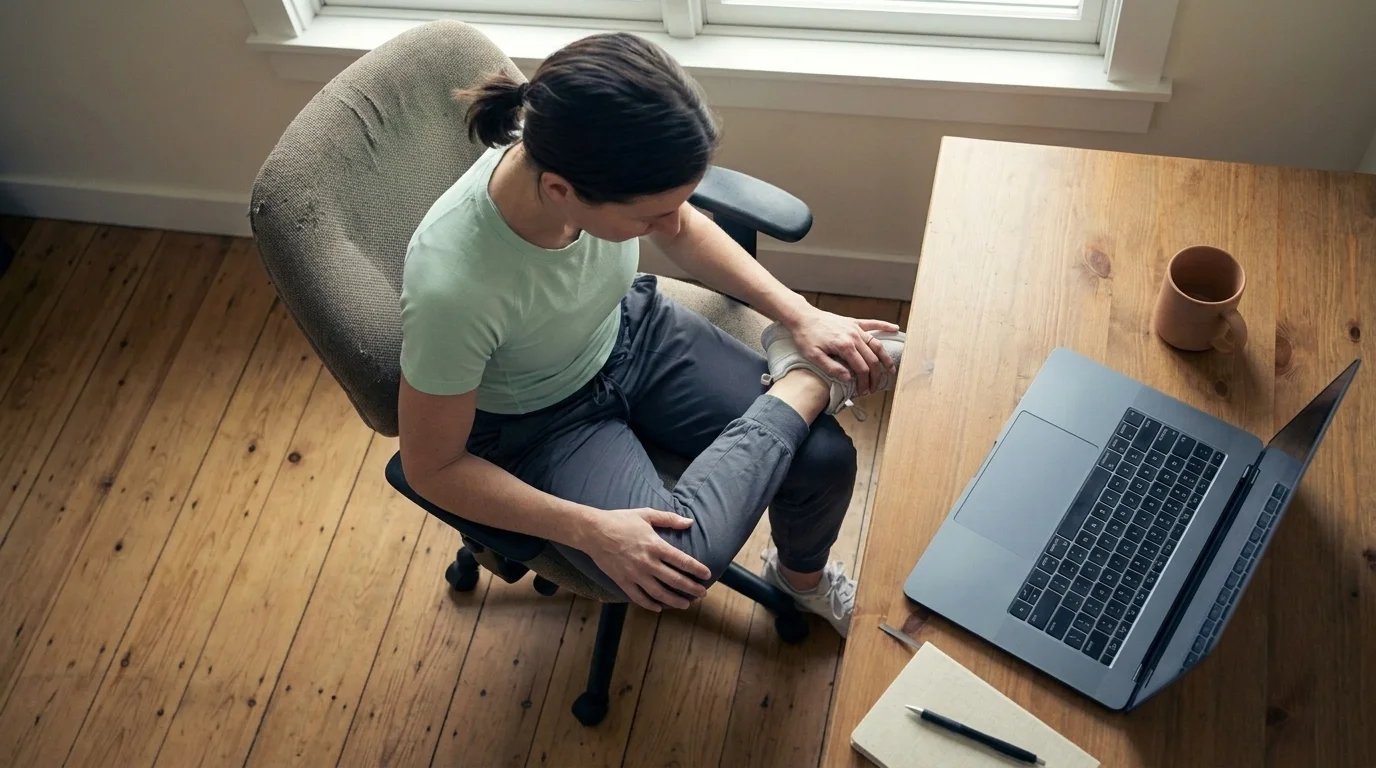
4. Seated figure-4 piriformis stretch (30 sec each side) Cross your right ankle on top of your left thigh, just above the knee. Sit tall, gently fold forward at the hips until you feel a stretch deep in the right glute. Hold thirty seconds. Switch sides. The cue: hinge at the hips, do not round the lower back. The external marker: your back stays roughly flat, your sternum stays open, and the stretch is felt in the gluteal region of the elevated leg, not in the lower back.
5. Seated hip flexor opener (45 sec each side) Scoot to the front edge of your chair. Drop your right leg back so your right knee is closer to the floor and your hips can extend slightly behind you. Squeeze the right glute and tuck your tailbone, then lean your torso slightly forward without rounding. Hold forty-five seconds. Switch. The cue: the stretch should be felt at the front of the right hip, not in the lower back. If it is in the lower back, your tailbone is not tucked. Counters psoas shortening — the single most predictable adaptation of a desk job.
Stand-and-stretch (5 moves, 2-minute break)
These are the moves to run when you stand up between calls. They take about two minutes total and address the lower-body and shoulder shortening that the chair-bound rotation cannot quite reach. Darius's note: my yoga training was at a Krishnamacharya-lineage studio in Chennai, and I will use the asana names where they are useful — yoga and strength training are not opposites and I will keep saying so.
6. Standing forward fold with bent knees (60 seconds) Feet hip-width, knees softly bent (more bent than you think). Hinge at the hips and let your upper body hang. Hands can rest on the floor, on shins, or on opposite elbows. The cue: the goal is not to touch the floor — it is to release the spinal erectors and hamstrings. Bent knees are a feature, not a compromise. The external marker: your head hangs heavy, your neck releases, and the stretch is felt along the back body, not in the hamstring belly.
7. Doorway pec stretch (30 sec each arm) Find a doorframe. Place your right forearm on the frame at shoulder height, elbow bent 90 degrees. Step your right foot forward and let your chest rotate gently to the left. Hold thirty seconds. Switch arms. The cue: the stretch should be felt at the front of the right shoulder and chest, not at the elbow. The external marker: your sternum opens, your shoulder blade slides down your back, and your spine stays neutral. Targets pec minor, the muscle that pulls your shoulders forward over a keyboard.
8. Standing hip circles (10 each direction, each leg) Stand on your left leg, lightly holding the desk for balance. Lift your right knee to roughly hip height. Trace ten slow circles outward, then ten inward. Switch legs. The cue: the movement happens at the hip, not the spine. The external marker: your standing leg stays vertical, your torso does not sway. Mobilizes the hip capsule, which is the actual reason your hips feel "tight" by 4 p.m.
9. Standing thoracic rotation (8 reps each side) Feet hip-width. Cross your arms over your chest, hands on opposite shoulders. Rotate your upper body to the right as far as comfortable, return to center, rotate to the left. Eight reps each direction. The cue: the rotation happens above the navel, not below it — your hips face forward throughout. The external marker: your knees stay pointing straight ahead while your shoulders move.
10. Calf raises with a 2-second hold (15 reps) Stand tall, lightly hold the desk if needed. Push through the balls of your feet and rise onto your toes. Hold two seconds at the top, lower with control. Fifteen reps. The cue: rise straight up, do not lean forward. The external marker: your weight stays even across the big and little toes, no roll-out. Counters the calf and ankle stiffness that prolonged sitting produces — and helps with venous return, which is part of the post-lunch slump story.
The 3-minute hourly reset
This is the dose I want you to actually defend. A 2026 study in BMC Public Health tested three-minute movement breaks every hour across an eight-hour workday — seven breaks per day total — in sedentary office workers. The metabolic results were striking for an intervention this small: fasting glucose dropped by about 0.31 mmol/L, postprandial glucose by 0.58 mmol/L, and insulin sensitivity (HOMA-IR) improved by about 20%. Numbers in that range are typically associated with more intensive lifestyle programs. The dose, in this case, was small and frequent.
The three-minute version that I prescribe to clients:
- 30 seconds: chin tucks (10 reps)
- 30 seconds: scapular retractions (12 reps)
- 30 seconds: standing hip circles (5 each direction, each leg)
- 60 seconds: standing forward fold with bent knees
- 30 seconds: calf raises with a 2-second hold (15 reps)
Run this on the hour. If you are in back-to-back meetings, run it during a single back-to-back transition. The point is not perfection. The point is the cumulative dose — about 21 minutes of movement spread across the day, which is exactly the lower end of the JAMA "extra 15-30 minutes" antidote dose.
The walking reset (lunch-break version)
This is the move I would not skip if you are going to do nothing else. Twenty minutes of walking, ideally outdoors, ideally without your phone. The mechanism is straightforward — sustained low-intensity locomotion is the activity our species is built around, and we did not evolve to spend the metabolic equivalent of nine hours in an aquarium.
Three small structural notes:
- Walk at a conversational pace, not a power-walk. This is not a workout. It is a metabolic-and-circulatory reset.
- Get outside if you can. The combination of natural light, longer eye-line, and lower-grade visual stimulation contributes to the cognitive part of the reset.
- Leave the phone in your pocket. Twenty minutes of unstructured attention is part of the intervention, not a productivity tax.
If you have a separate evening cardio practice, a midday twenty-minute walk does not replace it. It is additive. Your evening session will feel better because you have moved blood and lymph all day.
The 12-Minute Desk Reset
This is the named protocol I would give a new client on day one. It combines six of the moves above into a single sequence, run once or twice a day. Once is the floor; twice is the prescribed dose for someone who sits more than five hours a day.
| Move | Time | Notes |
|---|---|---|
| Standing forward fold (bent knees) | 60 sec | Release lower back and hamstrings |
| Doorway pec stretch | 30 sec/side | Open chest, counter pec minor |
| Seated hip flexor opener | 45 sec/side | Counter psoas shortening |
| Standing thoracic rotation | 8 reps/side | Mobilize the upper back |
| Chin tucks | 10 reps × 2 | Activate deep neck flexors |
| Scapular retractions + 5 calf raises | 12 + 15 | Activate posterior chain at the desk |
Run it slowly. The point is not to rush through. The whole sequence should take about twelve minutes if you actually hold the durations. Twice a day is roughly one hour a week of targeted counter-movement to the eight-hours-of-sitting compensation pattern. That is not a lot. It is enough to noticeably change how your body feels by week three.
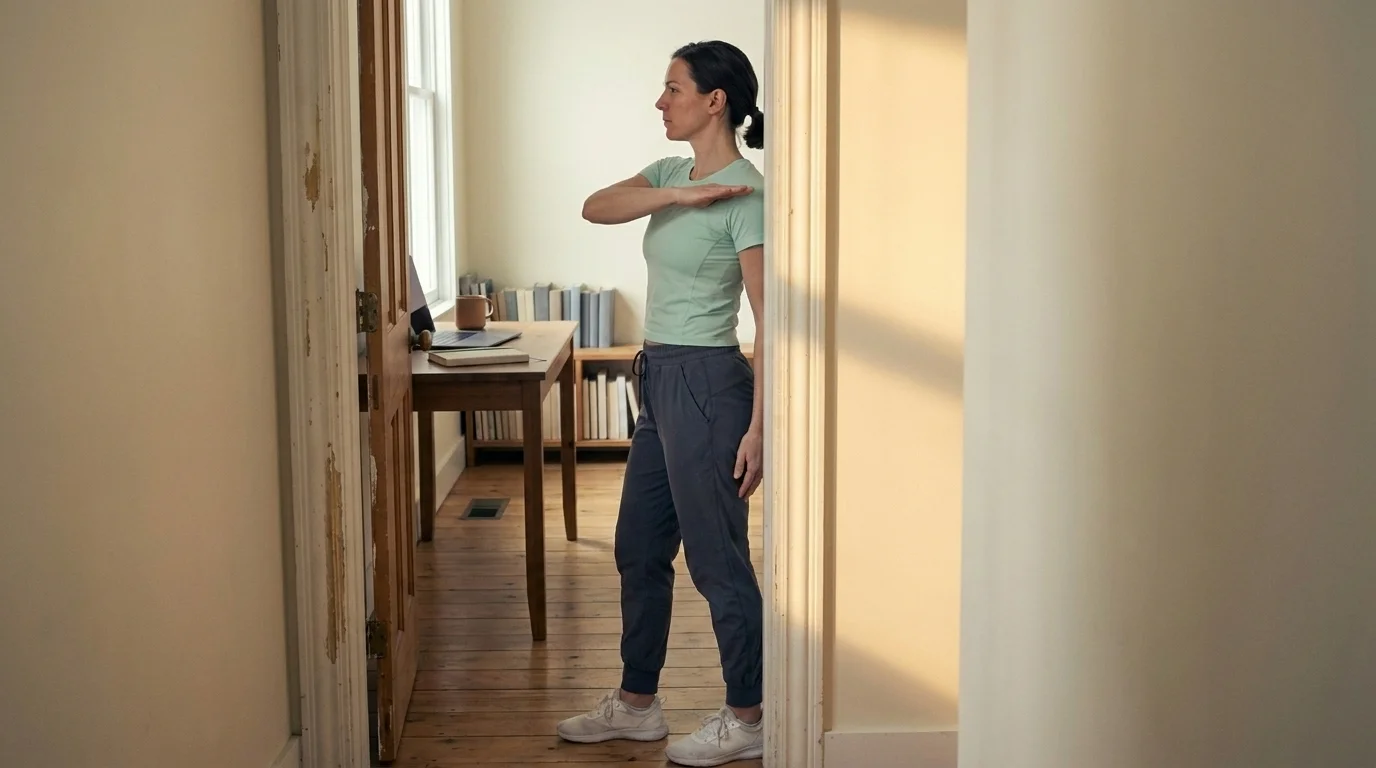
For hybrid and remote workers
About 39% of the U.S. workforce is now hybrid or fully remote, and the desk-exercise SERP almost universally writes for the in-office reader — the "take the stairs" and "walk to a coworker's desk" advice that does not apply to your spare bedroom. Working from home also correlates with about a 20% increase in sedentary time compared to in-office work, partly because the office at least forced incidental movement (commute, kitchen runs, cross-floor meetings).
A few specific adjustments for the home-office reader:
- Use your environment. Pace during phone calls. Take video calls standing for 15 minutes at a time. Walk to the kitchen for water — by the long route — during mental transitions between tasks.
- Build in a real lunch break, away from the desk. This is the easiest sedentary-time reduction available, and it is the one most home workers skip.
- Schedule the 3-minute hourly reset on a calendar repeat. The office has natural interruptions; the home office does not. The interruption has to be scheduled.
- Have a cleared floor area near the desk. Even three feet of space is enough for the standing rotation. The friction of moving the chair every time is what prevents the move from happening.
The home-office subset of the routine — anything in the chair-bound list, the doorway pec stretch, and the standing forward fold — covers most of what you need without leaving a 6×6 working area.
Why a strength coach's approach is different
Most desk-exercise content is written by general-practice physicians, journalists, or PTs — all credible voices, but with a different lens than mine. The strength-and-conditioning lens treats sitting as a programming problem, not a wellness one. Eight hours in a chair is, in coach terms, a sustained loaded position — your hip flexors are held short, your pec minor is held short, your deep cervical flexors are held long and inhibited, your glutes get effectively no recruitment. The fix is not "move more." It is targeted antagonist activation combined with stretching for the muscles that have shortened. That is why every exercise above has a specific muscular role rather than a generic "feels good" pitch.
This is the same reason my yoga training matters here. The Krishnamacharya tradition I trained in is heavy on intelligent counterposes — every shape has a complement that closes the loop. Desk work is the most predictable shape modern life puts you in. The complement is not random. It is engineered.
How you'll know it's working
I want to give you external markers, not vibes. By a coach's standard, here is what you should expect:
Week 1
- Less afternoon shoulder tension, especially around the upper traps.
- A noticeable cue when you have been sitting too long — your body now signals it instead of going numb.
- Slightly easier deep breaths after the 12-Minute Desk Reset.
Week 2
- Standing up from your chair without using your hands to push off. (This is the hip-flexor and glute change starting to register.)
- Reduced afternoon headache frequency, if cervical-tension headaches were a pattern.
- Your sitting posture self-corrects more often; you catch yourself slumping faster.
Week 4
- The forward-head pattern visible in photos starts to soften.
- Twenty-minute walks feel easier and you actually want them.
- Lower-back stiffness on long workdays is meaningfully reduced.
If you are not seeing any of these by week four with consistent practice (the 3-minute hourly reset most days plus the 12-Minute Desk Reset 1-2x/day), the volume is probably too low. Adding rather than restarting tends to be the right move.
A note on existing pain or injury
If you have a current diagnosed back, neck, or shoulder issue — disc involvement, radicular symptoms, recent surgery, ongoing physical therapy — please run any new movement protocol past your clinician or physical therapist before adopting it. The exercises in this article are well-tolerated by most adults but are not a personal recommendation for someone with a specific clinical picture. The coach's rule applies: see a clinician before loading the movement.
Related Article: The Evolution of Fitness: Modern Workout Trends for Maximum Impact
A sober usable takeaway
The CDC and WHO both recommend 150 minutes of moderate-intensity activity per week plus two days of muscle-strengthening, and both explicitly endorse splitting that volume into smaller chunks. The rotations above are how you get a meaningful slice of that volume into a workday without a gym. Pick one rotation. Run it for a week. Add the next one. Anchor the 3-minute hourly reset to a calendar repeat. Give the whole stack four to six weeks of consistent practice before you decide whether it has changed how your body feels at the end of a workday. Nothing in training works in a week, and nothing in countering eight hours of sitting works in three days either.
Frequently Asked Questions
Two doses, ideally. The first is a 3-minute hourly reset (chin tucks, scapular retractions, hip circles, forward fold, calf raises) — based on a 2026 BMC Public Health study showing 7 three-minute breaks across an 8-hour workday improved insulin sensitivity by about 20%. The second is the 12-Minute Desk Reset 1-2x per day, which combines six targeted moves into a fuller counter-movement protocol. Total active time: about 30-40 minutes a day, broken into small chunks.
Largely, yes. A 2024 JAMA Network Open cohort study of 481,688 adults found people who predominantly sit at work have a 16% higher all-cause mortality risk and a 34% higher cardiovascular mortality risk — but an extra 15 to 30 minutes of physical activity per day offsets that increased risk. The combined dose of the 3-minute hourly resets plus the 12-Minute Desk Reset puts you at the lower end of that 15-30 minute target without leaving your home office.
Three specific moves target the upper-cross-syndrome pattern that produces most desk-related neck and shoulder pain: chin tucks (which activate the deep neck flexors that go quiet during screen time), scapular retractions (which activate the mid-traps and rhomboids that lengthen and weaken from typing), and the doorway pec stretch (which lengthens the pec minor that pulls shoulders forward). Run them daily for two to three weeks before evaluating.
Yes — chin tucks, scapular retractions, seated thoracic extension, and the seated hip flexor opener are all camera-invisible from the chest up. The figure-4 piriformis stretch is also discreet. Save the standing rotations and forward fold for between meetings.
Most people notice less afternoon shoulder tension and an easier deep breath within the first week. By week two, standing up from your chair without using your hands to push off becomes more reliable — that's the hip flexor and glute change registering. By week four, the forward-head pattern visible in photos softens and lower-back stiffness on long workdays is meaningfully reduced. If you are not seeing any of these by week four with consistent practice, the volume is probably too low.
No, but they close the sitting-risk gap and make gym sessions more productive. The desk routine targets specific compensation patterns from prolonged sitting — antagonist activation and stretching for shortened muscles — that a gym session generally does not address. They also dramatically reduce the recovery debt your body is carrying when you arrive at the gym, so loaded movements feel cleaner. Both/and, not either/or.
If you have a diagnosed back, neck, or shoulder issue — disc involvement, radicular symptoms (pain or numbness shooting down a limb), recent surgery, or ongoing physical therapy — run any new movement protocol past your clinician or PT before adopting it. The exercises here are well-tolerated by most adults but are not a personal recommendation for a specific clinical picture. See a clinician before loading the movement.
The exercises are the same, but the structure has to change. Working from home correlates with about a 20% increase in sedentary time compared to in-office work, partly because the office forces incidental movement (commute, kitchen runs, cross-floor meetings) that a home office does not. Schedule the 3-minute hourly reset on a calendar repeat, take a real lunch break away from the desk, pace during phone calls, and keep a cleared floor area near the desk so the friction of starting the movement is low.