Uncovering Herbal Wisdom: Harnessing the Power of Traditional Remedies for Holistic Well-Being


The honest version of any serious article about traditional herbal remedies has to do two things at once: take the ~5,000-year lineage seriously as evidence, and refuse to treat that lineage as a free pass on the actual safety and efficacy questions modern medicine asks. The two postures look like they contradict each other. They do not. The convergent finding that medicinal plants used independently across geographically separated cultures tend to be used for the same purposes — formalized in a 2023 ScienceDirect large-scale cross-cultural ethnobotany analysis — is now treated by researchers as a leading indicator for pharmacological activity, not as folklore. Approximately 50 percent of medications worldwide are derived from natural products or their chemical derivatives, per the NCBI Bookshelf on traditional herbal medicines. About 25% of pharmaceutical drugs trace their first identified active compound to ethnobotanical research. The traditions paid attention to something real.
This guide takes that framing seriously. I am a registered dietitian, which means food-and-plant medicine sits squarely in my scope; clinical practice of any traditional system (TCM, Ayurveda, Unani) does not, and I will defer to credentialed practitioners on that side throughout. The interesting structure is the historical lineage, the four great living traditions, the modern-science bridge stories, the polyherbal-versus-single-compound question, and the at-risk-plant sustainability layer that does not appear in any of the top-ranked competitor articles on this topic.
If you are looking for the practical "how do I use ginger and turmeric in my kitchen" guide, that is the sibling article on herbal remedies for beginners. This one is about the systems and the lineage.
A Chronological History of Herbal Medicine
The earliest documented herbal medicine sits on a Sumerian clay tablet from approximately 3000 BC, listing some 250 medicinal plants — poppy, henbane, mandrake, and dozens of others recognizable to a modern pharmacognosist. The historical spine that follows, drawn from the NCBI PMC review of medicinal plants' historical usage (PMC3358962), is the cleanest single-source chronological backbone in the literature.
| Date | Source / civilization | Scope | Representative plants |
|---|---|---|---|
| ~3000 BC | Sumerian clay tablets (Mesopotamia) | 250 plants in earliest documented pharmacy | Poppy, henbane, mandrake |
| ~2500 BC | Pen T'Sao (attributed to Emperor Shen Nung, China) | 365 drugs catalogued, foundation of TCM materia medica | Ginseng, ephedra, cinnamon |
| ~1550 BC | Ebers Papyrus (Egypt) | 700 plant species, 800+ prescriptions | Aloe, senna, garlic, willow |
| ~400 BC | Hippocrates (Greece) | ~300 plants organized by physiological action | Wormwood, mint, fennel |
| 77 AD | Dioscorides, De Materia Medica (Greco-Roman) | 944 drugs, of which 657 were plant-derived | Mandrake, opium poppy, hellebore |
| 1025 AD | Avicenna (Ibn Sina), Canon of Medicine (Persia) | 1,000+ medicinal plants, foundational text of Unani/Islamic medicine | Rose, fennel, saffron |
| 1493–1541 | Paracelsus (Swiss) | Doctrine of signatures + early chemical extraction | Mercury, antimony, plant alkaloids |
| 1753 | Linnaeus, Species Plantarum | Binomial nomenclature standardizes plant identification | Every plant gets a Latin binomial |
| 1806 | Friedrich Sertürner (Germany) | First isolation of morphine from opium poppy | Papaver somniferum |
| 1820 | Pelletier & Caventou (France) | Quinine isolated from cinchona bark | Cinchona officinalis |
| 1972 / 2015 | Tu Youyou (China) | Artemisinin isolated from sweet wormwood; 2015 Nobel Prize | Artemisia annua |
A few honest reads on this timeline. The pre-1500 entries are dated to the texts that survive, which is almost certainly a lag indicator of much older oral and practical knowledge. The post-1800 entries are the bridge into modern pharmacology — the moment plant-derived active compounds began to be isolated, purified, and standardized. The 2015 Nobel Prize to Tu Youyou for artemisinin is, more than any other single event, the proof-of-concept for traditional-to-pharmaceutical translation: a 4th-century Chinese reference (Ge Hong's Handbook of Prescriptions for Emergencies) led to a 1972 isolation that led to today's first-line antimalarial treatment, saving millions of lives. The full story is documented in the Wikipedia entry on herbal medicine and in standard pharmacology references.
The Four Great Traditional Systems
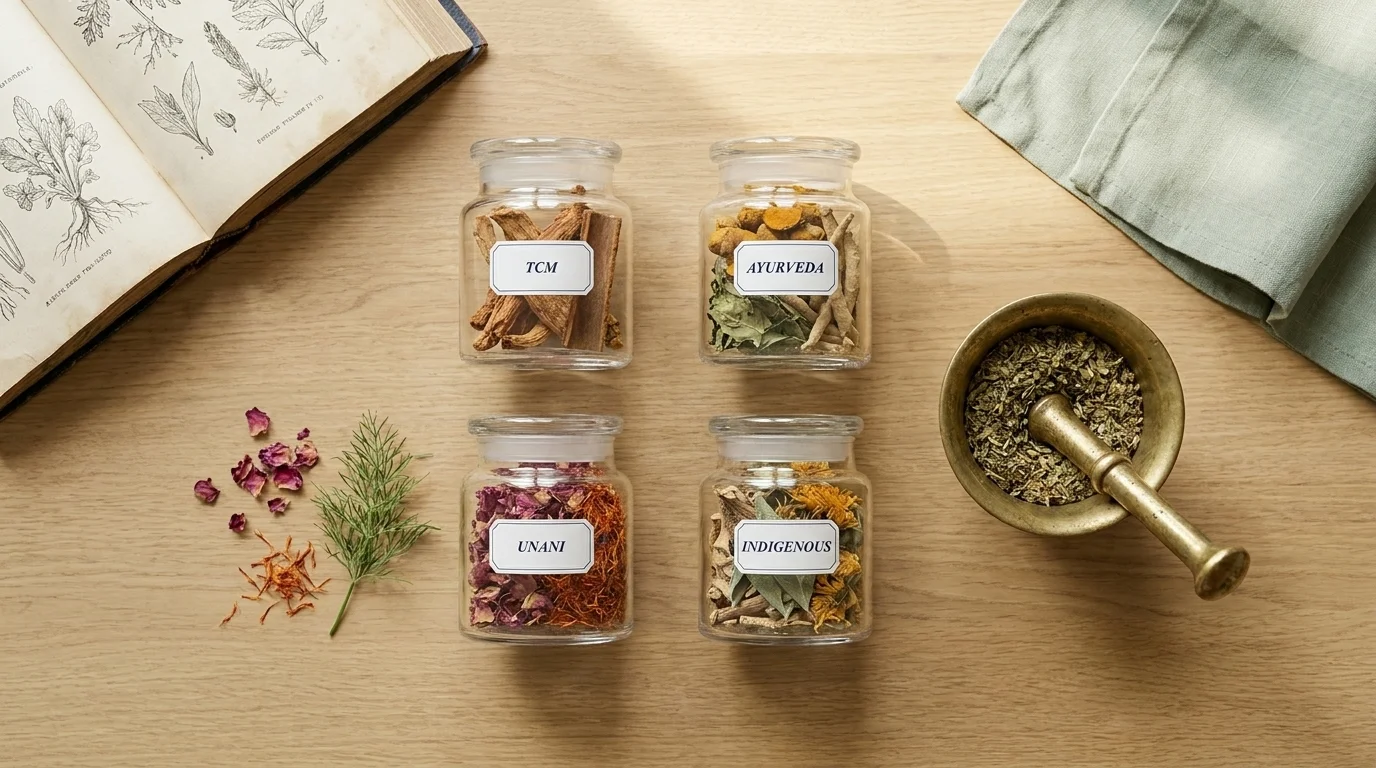
Four traditional healing systems remain in active practice in 2026 — each with internal logic, codified texts, named practitioners, and millions of users.
| System | Origin / age | Founding text(s) | Core philosophy | Representative herbs | Modern status |
|---|---|---|---|---|---|
| Traditional Chinese Medicine (TCM) | ~5,000 years | Pen T'Sao (~2500 BC); Huangdi Neijing (~200 BC) | Qi flow; five elements (wood/fire/earth/metal/water); Zang-fu organ systems; warming/cooling balance | Ginseng, astragalus, ginkgo, ephedra, sweet wormwood | State-supported in China; integrated alongside biomedicine in many hospitals |
| Ayurveda | ~5,000 years | Vedas; Charaka Samhita; Sushruta Samhita | Three doshas (vata, pitta, kapha); dosha-matched dietary and herbal regimens | Ashwagandha, turmeric, holy basil, triphala, neem | India's Ministry of AYUSH; widely practiced globally; growing supplement market |
| Greco-Arabic (Unani / Tibb) | ~1,000 years | Avicenna's Canon of Medicine (1025); Galen tradition | Four humors (blood, phlegm, yellow bile, black bile); inherited from Greek medicine; warming/cooling balance | Thyme, rose, fennel, saffron, frankincense | Active in South Asia, the Middle East, parts of Europe; recognized in Pakistan, India |
| Indigenous (Americas, Africa, Pacific) | Millennia | Oral traditions; ethnobotanical documentation | Place-based knowledge; doctrine of signatures; ceremony-integrated practice | Echinacea, willow bark, sage, calendula, kava | Maintained in many communities; subject to biopiracy concerns and conservation challenges |
A few honest notes on this table. TCM and Ayurveda are not interchangeable, despite both being ancient and Asian. They use different diagnostic frameworks, different therapeutic logics, and different herb-classification systems. Greco-Arabic medicine (Unani) is the system that connects the ancient Greek humoral tradition through Persian and Arab refinement (most consequentially Avicenna's Canon of Medicine, written ~1025 AD) to modern South Asian practice. It is largely missing from Western popular coverage of "traditional medicine" despite serving hundreds of millions of users today. Indigenous medicine traditions are not a single system but a family of place-based, oral-transmitted practices; the herbs listed are illustrative, not exhaustive, and the conservation pressures these traditions face are substantial.
The shared structural insight across all four systems: traditional herbal medicine almost universally treats herbs as having energetic properties (warming/cooling in TCM, dosha-modulating in Ayurveda, humoral-balancing in Unani) and prescribes them in polyherbal formulas matched to the practitioner's diagnosis. That is a meaningfully different stance from the modern supplement industry's "isolate one compound, scale it, sell it" model.
Related Article: The Healing Art of Sound Therapy: Harnessing Vibrational Frequencies for Holistic Wellness
Modern Science Validates Tradition (And Sometimes Doesn't)
The 2023 ScienceDirect cross-cultural ethnobotany analysis cited at the top of this guide is, to my reading, the strongest single piece of recent evidence that traditional use is more than folklore. Geographically separated cultures that had no plausible mechanism to share knowledge converged on the same plants for the same purposes — willow bark for pain (later isolated as salicylic acid, the basis of aspirin), foxglove for cardiac symptoms (later isolated as digoxin), sweet wormwood for fever (later isolated as artemisinin). The statistical convergence is itself an evidence signal that pharmacological action is present.
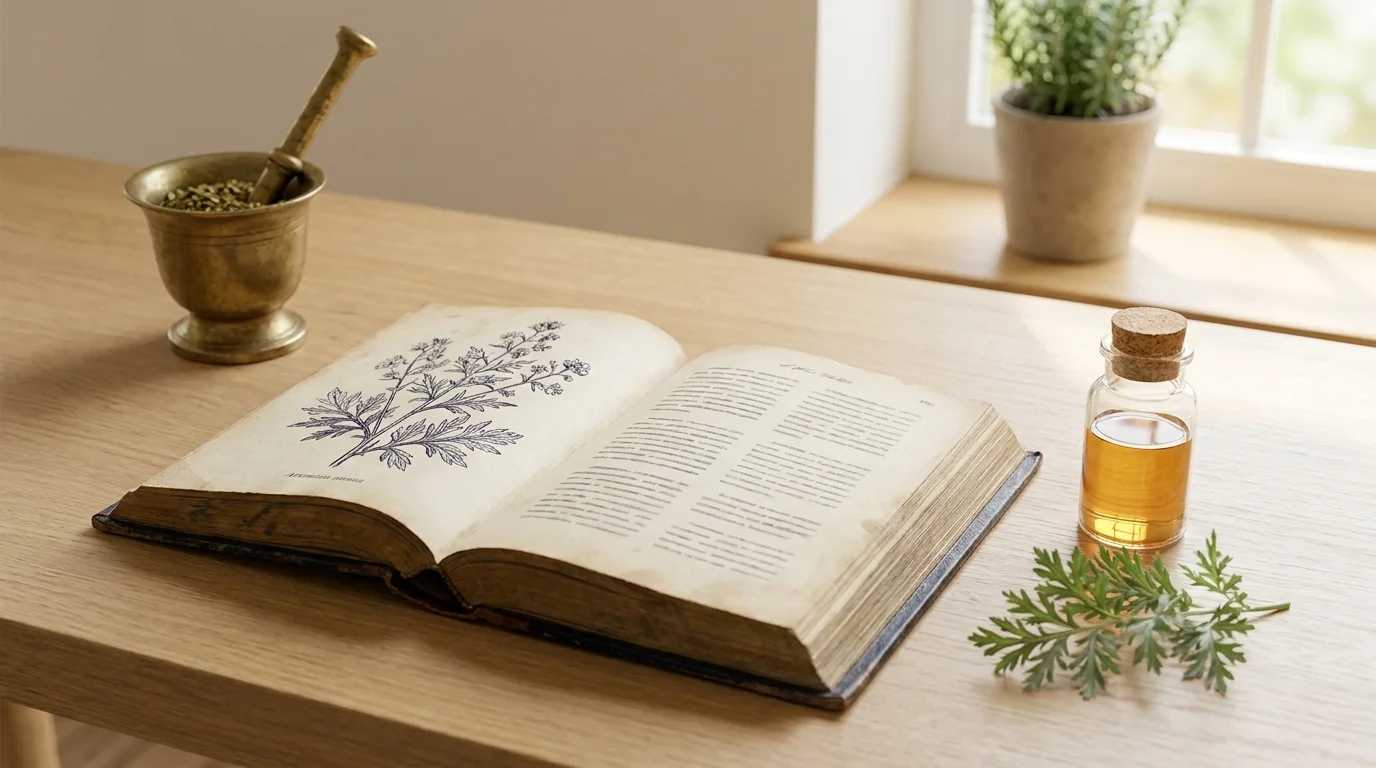
The canonical bridge story remains artemisinin. The Chinese herbalist Ge Hong, in the 4th century, recorded sweet wormwood (Artemisia annua) as a treatment for "intermittent fevers" in his Handbook of Prescriptions for Emergencies. Tu Youyou and her team isolated the active compound in 1972 during a Chinese Communist Party-led malaria research program. Artemisinin and its derivatives became the first-line antimalarial treatments globally, saving millions of lives. The 2015 Nobel Prize in Physiology or Medicine recognized this contribution — a direct line from a 4th-century traditional text to a 21st-century Nobel.
The honest framing on the modern-validation question is that traditional systems track the same therapeutic targets modern pharmacology does, but with three meaningful gaps. First, the dose-response relationships in traditional preparations are often imprecise by clinical standards, which is one reason commercial supplements often standardize to specific active-compound concentrations. Second, the safety profiles of many traditional herbs are well-established for the traditional preparation but less well-characterized for concentrated extracts. Third, the polyherbal formulas of TCM, Ayurveda, and Unani contain synergistic combinations that modern single-compound studies cannot easily replicate — which is both a strength of the traditional preparations and a complication for clinical-trial methodology.
The 2026 herbal medicine market is large and growing — global revenue projected at USD 326.46 billion by 2032 at roughly 7.4% CAGR per current industry reports — which means more pharmacological research on traditional herbs is happening now than ever before. The replication results so far validate some traditional uses cleanly (artemisinin, salicylates, curcumin for inflammation, ginger for nausea), partially support others, and have failed to support a meaningful minority. That mixed picture is what honest research looks like.
Polyherbal Formulas vs Single Compounds
The framing question worth holding throughout is whether you are using herbs the way the traditional systems use them or the way the modern supplement industry packages them. The two are not the same.
Traditional preparations are almost always polyherbal. Triphala, the Ayurvedic three-fruit formula (amla, bibhitaki, haritaki), is the canonical example. TCM formulas follow the jūn-chén-zuǒ-shǐ (君臣佐使) sovereign-minister-assistant-courier hierarchy, in which one herb is the primary therapeutic agent, others potentiate its action, others manage side effects, and others direct the formula to specific organ systems — typically 6 to 15 herbs in a finished prescription. Unani formulas like Joshanda (a 6+ herb cold-and-cough preparation) follow a similar combinatorial logic. The traditional position is that the synergy between the herbs is part of the therapeutic effect, and the formula is irreducible to any single component.
The modern supplement industry mostly does not work this way. Commercial supplements typically isolate one active compound (curcumin from turmeric, withanolides from ashwagandha, ginsenosides from ginseng), standardize the concentration, and sell it as a single-ingredient capsule. That approach has real advantages — reproducibility, dose precision, easier clinical-trial design — and a real cost: the synergistic effects that traditional formulas relied on are lost.
The practical implication for a 2026 consumer is that a "turmeric supplement" purchased in a US health-food store is not the same intervention as turmeric prepared in an Ayurvedic formulation under a credentialed Ayurvedic practitioner's supervision. Both have a place. They are not interchangeable, and the safety and efficacy data for one does not transfer cleanly to the other.
Related Article: The Power of Hydrotherapy: Transformative Benefits for Physical Rehabilitation & Relaxation
Adaptogens Across the Traditions
The Western wellness category of "adaptogens" was coined by Soviet researcher Nikolai Lazarev in 1947 and refined by Israel Brekhman and Igor Dardymov in 1969 to describe plants that increase non-specific resistance to stress. The category is modern; the herbs in it are not.
What modern adaptogen marketing calls a category, each traditional system already had a name for. In Ayurveda, rasayana herbs (literally "path of essence") are the rejuvenating tonics — ashwagandha, holy basil (tulsi), shatavari, gotu kola. In TCM, fu-zheng (扶正, "supporting the righteous") herbs strengthen the body's vital substances against pathogenic factors — ginseng, astragalus, schisandra, reishi. In European folk tradition, the nervines and tonic herbs (valerian, oat straw, lemon balm) served related roles.
The modern clinical evidence on the adaptogen category is mixed and improving. Ashwagandha has the strongest recent clinical-trial support among traditional rasayana herbs, particularly for stress and cortisol response. Ginseng has substantial but mixed data depending on species (Panax ginseng vs Panax quinquefolius) and preparation. Holy basil and astragalus have meaningful but less-replicated trial bases. The honest framing: each of these herbs has a legitimate place in the traditional system that named it, and the modern clinical replication is catching up unevenly.
Climate, CITES, and At-Risk Plants
This is the section that connects traditional herbal medicine to a meaningfully different 2026 conversation: the herbs themselves are increasingly under pressure from climate change, habitat loss, and over-harvesting. The connection is not abstract — it affects what you can ethically buy in a supplement aisle.
The 2025 NCBI PMC review on climate change and medicinal plants (PMC11830725) frames medicinal plant supply chains as first-order climate-vulnerable. Shifting species ranges, altered phenology (when plants flower and seed), and changing active-compound concentrations under climate stress are degrading the reliability of wildcrafted herbs. The EU-funded EthnoHERBS project (PMC11994333) explicitly couples traditional knowledge documentation with biodiversity conservation outcomes — positioning ethnobotanical practice as a conservation strategy, not just a research method.
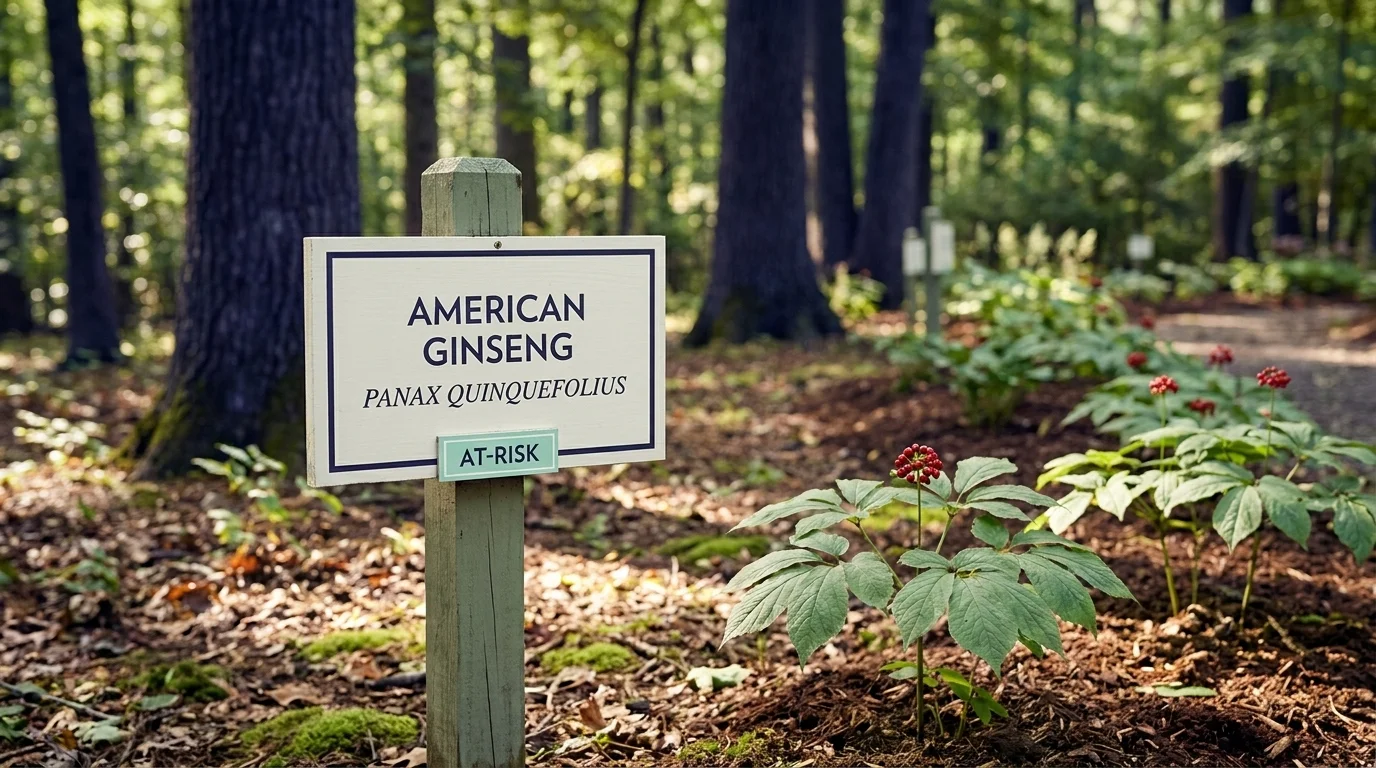
In North America specifically, the United Plant Savers At-Risk Tool is the canonical conservation registry for medicinal plants in commercial herbal trade. The list includes American ginseng (Panax quinquefolius), goldenseal (Hydrastis canadensis), black cohosh (Cimicifuga racemosa), bloodroot (Sanguinaria canadensis), echinacea, lady's slipper, and dozens of others. The IUCN coordinates internationally; species like American ginseng and goldenseal are listed under CITES Appendix II, meaning international trade in them is regulated.
The practical consumer implication: if you are buying a wildcrafted herb on the At-Risk list, look for certifications from United Plant Savers, ethical wildcrafting programs, or — preferably — sustainably cultivated alternatives. The same herb grown in cultivation rather than wild-harvested often has equivalent therapeutic value with vastly lower conservation cost. Cultivated American ginseng (Wisconsin-grown, for instance) is widely available and avoids the pressure on the wild populations that the species' international trade has imposed for decades.
The honest framing: ethical use of traditional herbal medicine in 2026 requires reading the label twice — once for the herb identification and once for the sourcing claim. Both matter.
Related Article: Unraveling the Power of Herbal Remedies: Integrating Nature's Healing Wisdom into Daily Life
Honest Boundaries — When Traditional Is Not Enough
The line every careful clinician walks with traditional medicine is to honor the lineage and use it for what it does well, without pretending it does what it does not do. A few practical boundaries worth holding explicitly.
Traditional use is not equivalent to clinical proof. Centuries of population exposure provide meaningful safety data and reasonable evidence for some therapeutic effects. They do not substitute for randomized clinical trials in the specific populations and conditions where modern medicine has them. Both layers of evidence belong in a serious conversation, neither alone.
Drug interactions are real and named. St. John's Wort, ginkgo, ginseng, and several other commonly used traditional herbs have documented interactions with prescription medications. If you are on any prescription drug, run any new traditional herbal preparation past your pharmacist before starting. The sibling article on herbal remedies for beginners has the named-mechanism interaction matrix.
Pregnancy, surgery, and chronic disease require clinical oversight. Several traditional herbs (ashwagandha, St. John's Wort, blue cohosh, ginkgo, garlic supplements, ginseng) carry specific avoidance recommendations in pregnancy or before surgery. Chronic disease — diabetes, cardiovascular conditions, kidney disease, active oncology — needs a clinician in the loop on every herbal addition.
Practitioner credentialing matters when working inside a tradition. A credentialed Ayurvedic practitioner (BAMS, Bachelor of Ayurvedic Medicine and Surgery, where available; otherwise NAMA-certified in the US) has training that a generic "wellness coach" does not. The same applies to TCM (Diplomate of Oriental Medicine via NCCAOM in the US) and to Unani practice in regions where it is regulated. The credential is not a guarantee of quality, but its absence is a meaningful signal.
A Plainspoken Note on Lineage and Evidence
If you take one idea from this guide, take this: traditional herbal medicine is a serious body of knowledge, and the 2026 research evidence is increasingly catching up with what the lineages have said. The artemisinin story is the cleanest example, and there are dozens of smaller versions of the same arc — willow bark to aspirin, foxglove to digoxin, sweet wormwood to malaria treatment, ephedra to ephedrine, opium poppy to morphine. The lineages knew. Modern pharmacology is still verifying details and isolating compounds.
What that does not give us is permission to use traditional preparations carelessly. The lineage is evidence for taking the herbs seriously. It is not evidence that any specific contemporary supplement product matches the traditional preparation, that any specific health claim is clinically validated for any specific condition, or that the herb is safe in combination with any specific modern medication. Those questions need their own answers.
The right way to engage with this material is to learn the systems, understand their internal logic, respect the credentialed practitioners who carry the traditions, and verify modern claims against modern evidence before acting on them. That is what a serious 21st-century relationship with traditional herbal medicine looks like — neither dismissive nor credulous.
Most of what these traditions teach us has held up. That is reason enough to take the rest of what they teach seriously. It is not a reason to skip the conversation with your clinician.
Frequently Asked Questions
The earliest documented herbal medicine appears on a Sumerian clay tablet (~3000 BC) listing 250 medicinal plants, followed by China's Pen T'Sao (~2500 BC, attributed to Emperor Shen Nung) with 365 drugs and Egypt's Ebers Papyrus (~1550 BC) describing 700 plant species and 800+ prescriptions. India's Ayurveda, codified in the Vedas, traces back roughly 5,000 years and is still actively practiced today. Persian Greco-Arabic medicine (Unani), codified in Avicenna's Canon of Medicine in 1025 AD, remains active across South Asia and the Middle East.
Both are ~5,000-year-old traditional systems but use distinct frameworks. TCM organizes the body around qi flow, the five elements (wood/fire/earth/metal/water), and Zang-fu organ systems, prescribing polyherbal formulas built on the jūn-chén-zuǒ-shǐ (sovereign-minister-assistant-courier) hierarchy. Ayurveda diagnoses through three doshas (vata, pitta, kapha) and matches herbs to constitutional type. TCM emphasizes warming/cooling energetic balance; Ayurveda emphasizes dosha modulation. Both traditions remain in active institutional practice in their countries of origin and globally.
Yes — extensively. The NCBI Bookshelf summary of WHO traditional/complementary medicine framing reports roughly 80% of people in rural developing regions rely on traditional medicine, more than half of China's population uses TCM regularly, and approximately 50% of modern pharmaceutical drugs are derived from natural plant compounds (about 25% first identified through ethnobotany). Artemisinin — extracted from sweet wormwood used in 4th-century Chinese medicine — is today's first-line antimalarial and won the 2015 Nobel Prize in Physiology or Medicine.
Several traditional herbs have substantial peer-reviewed support. Turmeric (curcumin for inflammation) has meta-analytic evidence comparable to NSAIDs for some arthritis presentations. Ginger has well-replicated trial data for nausea in pregnancy and chemotherapy. Ashwagandha has growing clinical-trial support for stress and cortisol response. St. John's wort has evidence for mild-to-moderate depression (with significant drug-interaction caveats). The strongest single direct-traditional-to-pharmaceutical translation remains artemisinin, derived from sweet wormwood per Ge Hong's 4th-century Chinese text.
Unani (also called Greco-Arabic or Tibb) is the traditional system that connects ancient Greek humoral theory (four humors: blood, phlegm, yellow bile, black bile) through Persian and Arab refinement — most consequentially Avicenna's Canon of Medicine, written ~1025 AD — to modern South Asian practice. It remains active in India, Pakistan, Bangladesh, and parts of the Middle East and Europe. Representative herbs include thyme, rose, fennel, saffron, and frankincense. Unani is widely missing from Western popular coverage of traditional medicine despite serving hundreds of millions of users globally.
It depends on the species. Several commercially traded medicinal plants are listed on the United Plant Savers At-Risk Tool — American ginseng (Panax quinquefolius, also CITES Appendix II), goldenseal (Hydrastis canadensis, also CITES Appendix II), black cohosh, bloodroot, lady's slipper. For these species, prefer sustainably cultivated alternatives or certified ethically wildcrafted sourcing. The 2025 PMC review on climate change and medicinal plants frames medicinal plant supply chains as first-order climate-vulnerable, which makes sourcing decisions more consequential than they were a decade ago.
Convergent ethnobotany is the finding that geographically separated cultures with no plausible mechanism of contact independently arrived at using the same plants for the same therapeutic purposes — willow bark for pain, foxglove for cardiac symptoms, sweet wormwood for fever. A 2023 ScienceDirect large-scale cross-cultural analysis formalized this convergence as a statistical evidence signal for pharmacological action. The implication is that traditional use across multiple independent cultures is itself a leading indicator that an herb has measurable biological effect — a reframing that has shifted academic respect for traditional medicine over the past few years.
Check Out These Related Articles

Transformative Potential of Psychedelic Therapy: Breakthroughs in Mental Health Treatment Paradigms

The Art of Healing: Exploring the Therapeutic Potential of Art Therapy

The Magic of Equine-Assisted Therapy: Harnessing Horse Power for Rehabilitation