
The Power of Hydrotherapy: Transformative Benefits for Physical Rehabilitation & Relaxation


A reader asked me last winter whether her chiropractor's recommendation to start "doing hydrotherapy" meant she needed to buy a sauna, sign up for a weekly aquatic class at the gym, or just start ending her showers cold. The honest answer is that all three are versions of hydrotherapy, that they do different things, that the temperatures and times matter more than the marketing suggests, and that her chiropractor probably had a specific protocol in mind that she did not ask about. This is the version of the explainer I would have wanted to hand her.
Hydrotherapy — sometimes called water therapy or, in the clinical-rehab subset, aquatic therapy — is the use of water (warm, cold, alternating, immersive, jetted, vapor) for pain relief, recovery, and rehabilitation. The tradition is old (Vincent Priessnitz and Sebastian Kneipp formalised it in 19th-century Europe; bathhouse practices long predate them), and the controlled-trial literature has expanded meaningfully in the last 18 months. Let me walk through what the evidence actually supports, what a useful at-home routine looks like, and who should not be doing any of it without checking with their doctor first.
What is hydrotherapy?
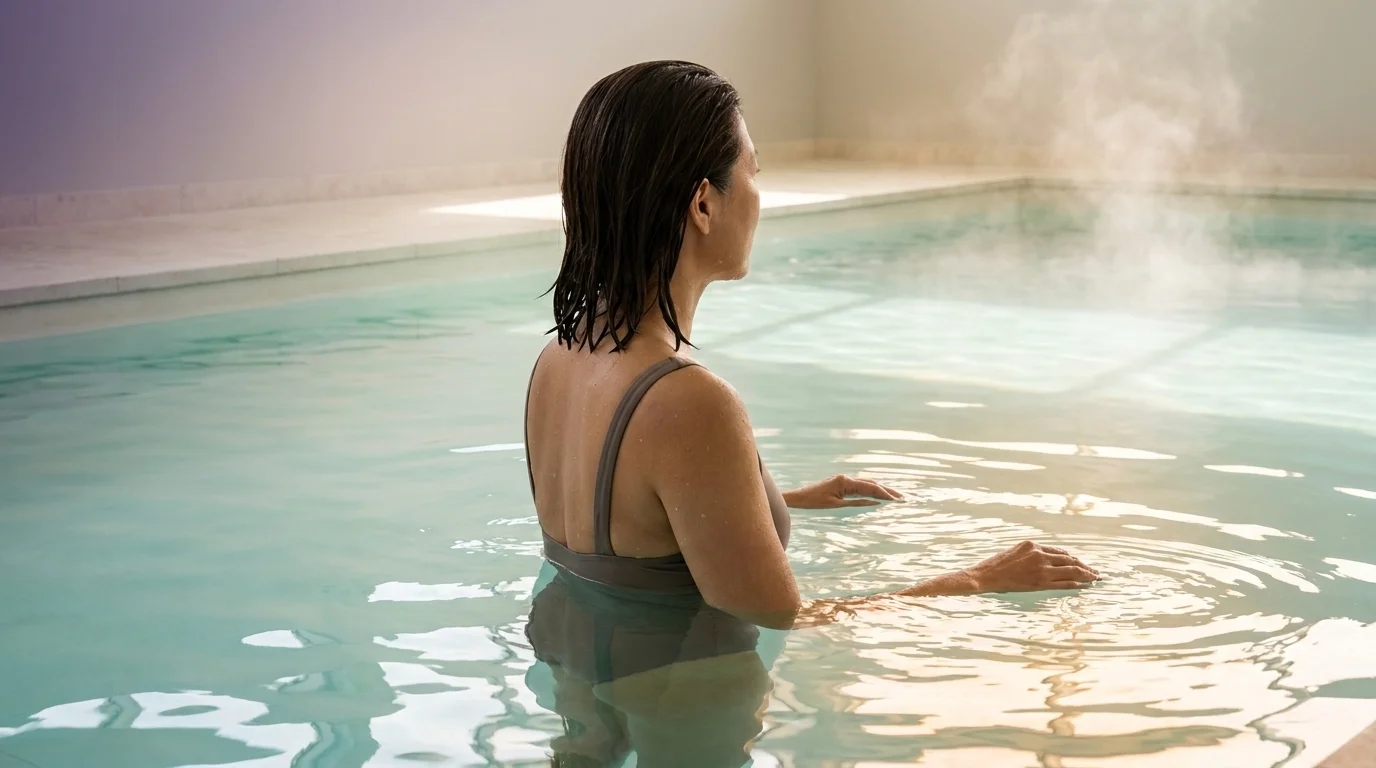
Hydrotherapy is the therapeutic use of water — applied at specific temperatures, pressures, or movement patterns — to influence circulation, pain perception, muscle relaxation, joint mobility, and inflammation. It includes everything from a clinical aquatic-therapy session in a hospital pool, to a hot tub at a wellness centre, to a contrast shower in your own bathroom, to a 10-minute cold plunge after exercise. The unifying mechanism is the body's response to water's physical properties: buoyancy, hydrostatic pressure, temperature, and viscosity.
The practice has well-established uses in physical rehabilitation, particularly for joint conditions, post-surgical recovery, neurological gait retraining, and athletic recovery — and growing peer-reviewed evidence in 2025 for conditions including Parkinson's, cerebral palsy, and chronic pulmonary disease. The wellness marketing has run somewhat ahead of the clinical evidence, but the core practice is real, useful, and inexpensive enough to be worth doing well rather than vaguely.
How hydrotherapy works: four mechanisms
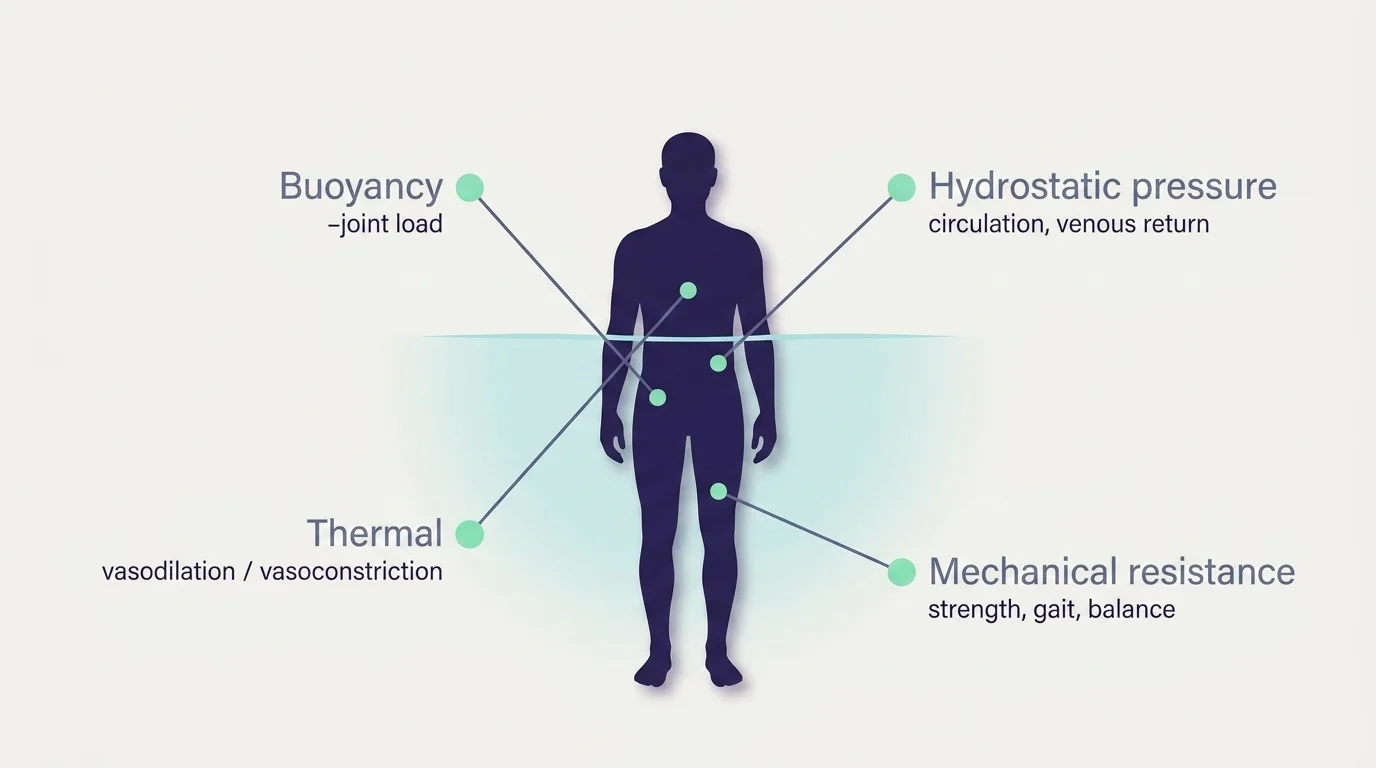
If you understand the four mechanisms by which water acts on the body, the rest of the practice becomes self-explanatory.
Buoyancy reduces the apparent weight of your body in water. According to HydroWorx's mechanism breakdown, chest-deep immersion can reduce joint loading by up to 90%, which is why aquatic exercise is recommended for arthritis, post-surgical rehab, and any condition where weight-bearing on land hurts.
Hydrostatic pressure — the pressure water exerts on a submerged body — acts as continuous, even compression. It improves venous and lymphatic return (the same physical principle as compression stockings), reduces swelling, and supports cardiovascular function during exercise.
Thermal effects are the lever most people think of first. Warm water (typically 92-100°F for therapeutic baths, hotter for spa settings) drives vasodilation, eases muscle tension, and modulates pain perception. Cold water (below 60°F for full immersion) drives vasoconstriction, reduces acute inflammation, and produces the sympathetic-nervous-system response that the cold-plunge community has spent the last five years discovering.
Mechanical / neurological effects — flowing water, jets, or simply walking through water provides resistance and proprioceptive input that helps with strength, balance, and gait retraining without the impact load of land exercise.
These four mechanisms are not interchangeable. A 10-minute warm whirlpool, a 10-minute cold plunge, and a 10-minute aquatic exercise session work through different combinations of them and are appropriate for different purposes.
Related Article: Transformative Potential of Psychedelic Therapy: Breakthroughs in Mental Health Treatment Paradigms
Types of hydrotherapy: a comparison
The honest version of "what kind of hydrotherapy should I do" depends on what you are trying to accomplish. The table below maps the most common modalities to typical settings, durations, and primary uses.
| Modality | Temperature | Typical duration | Best for | Notes / caution |
|---|---|---|---|---|
| Warm whirlpool / hot tub | 92-104°F | 10-20 min | Muscle relaxation, general stress, mild joint pain | Hotter end caps at 104°F; avoid in pregnancy, uncontrolled cardiovascular conditions |
| Sitz bath | 92-104°F (warm) or 50-60°F (cold) | 10-20 min | Postpartum healing, hemorrhoids, pelvic discomfort | Available as low-cost basin you can use on a toilet seat |
| Contrast bath / shower | Alternating 103-107°F warm and 55-60°F cold | 15-20 min total, 3+ cycles | Circulation, minor soft-tissue recovery, post-exercise | Avoid during first 72 hours of acute injury |
| Aquatic physical therapy (pool) | 88-94°F | 30-60 min, supervised | Rehab post-surgery, arthritis, Parkinson's, post-stroke | Requires PT supervision for clinical conditions |
| Cold-water immersion / ice bath | 41-50°F (5-10°C) | 10-15 min | Exercise recovery, neuromuscular markers | See dose section below; not for cardiovascular instability |
| Sauna (dry) | 150-195°F (air) | 10-20 min | Cardiovascular conditioning, mild detox sweating | Hydrate well before and after; avoid with uncontrolled blood pressure |
| Steam room | 110-120°F (air, high humidity) | 10-20 min | Respiratory comfort, muscle relaxation | Avoid in pregnancy, severe respiratory illness |
A note on the line that most affects what you do at home: the difference between a warm whirlpool and a contrast shower is not just temperature, it is the purpose. A whirlpool is for relaxation; a contrast shower is for circulation. If you want both, you do one then the other — not the same session at the same temperature.
What the 2025 evidence supports
Hydrotherapy is one of those categories where the evidence base has been growing quietly for years. The last 18 months have produced three systematic reviews and a major dose-response meta-analysis worth knowing about.
Neurological gait retraining: A 2025 systematic review in the Journal of Bodywork and Movement Therapies found that aquatic hydrotherapy was safe and more effective than conventional land-based physiotherapy for improving gait, balance, walking speed, postural stability, and quality of life in older adults with neurological impairments — Parkinson's disease, post-stroke, and similar conditions. The combination of buoyancy (reduced fall risk during practice) and resistance (proprioceptive input) is the leading mechanism explanation.
Pediatric cerebral palsy: A 2025 meta-analysis in PMC12151372 found hydrotherapy significantly outperformed conventional care on gross motor function in pediatric CP, with effects consistent across age groups and stronger for interventions lasting more than 10 weeks.
Pulmonary function: A 2025 systematic review in ScienceDirect documented improvements in pulmonary function as a solitary or adjuvant therapy across healthy adults, COPD patients, spinal cord injury, neuromuscular disorders, scoliosis, and various musculoskeletal disorders.
Osteoarthritis and joint pain: Medical News Today summarises the established finding that 8-week aquatic exercise programs produce statistically significant pain reduction in osteoarthritis. This is among the oldest and most-replicated findings in the field.
The honest caveat: effect sizes across these reviews are usually small-to-medium, and most studies are short-duration. Hydrotherapy is consistently beneficial as an adjunct to standard care; the evidence for it as a stand-alone replacement for medication or physical therapy in serious conditions is much weaker.
Related Article: Uncovering Herbal Wisdom: Harnessing the Power of Traditional Remedies for Holistic Well-Being
Hydrotherapy at home: the contrast-shower protocol
If you want a single, free, well-documented home routine, the contrast shower is it. The protocol synthesised across Healthline and Wildwood Lifestyle Center:
- Warm phase: ~103-107°F (39-42°C) for 3 minutes
- Cold phase: ~55-60°F (13-16°C) for 30-60 seconds
- Repeat: at least 3 full cycles
- Finish: always end on cold
- Frequency: once daily is generally safe for healthy adults
- Rest after: at least 20 minutes before vigorous activity
The mechanism is straightforward: the warm-cold alternation drives a vasodilation-vasoconstriction cycle that produces a pump-like circulatory flush. The "end on cold" rule matters because finishing on warm leaves you vasodilated and prone to lightheadedness on standing.
A few common questions. Sitz baths — warm or cold partial-immersion baths covering the hips and lower abdomen — are useful for postpartum healing, hemorrhoid relief, and minor pelvic discomfort; inexpensive basin attachments are widely available at drugstores and online. Foot baths at alternating temperatures replicate the contrast-shower mechanism on a smaller scale and are a reasonable option if a full contrast shower is too much, for the elderly, or for people who find sudden cold uncomfortable.
The "at home" version is genuinely the most accessible and cheapest part of hydrotherapy, and it covers most of what an ordinary person needs without buying a sauna, joining a club, or booking sessions.
Cold-water immersion: how cold, how long?
The cold-plunge category has exploded over the last five years, and the actual dose-response question — how cold, for how long, for what — was largely unanswered until recently. A 2025 network meta-analysis in Frontiers in Physiology examined cold-water immersion specifically for exercise-induced muscle damage and concluded that the most effective protocol was medium-duration, low-temperature CWI: 10-15 minutes at 5-10°C (41-50°F) for creatine kinase reduction and neuromuscular recovery markers.
Shorter immersions at colder temperatures (the "30 seconds at 38°F" approach popular on social media) produced smaller measurable physiological effects on the specific recovery markers studied. Longer immersions at warmer temperatures produced less benefit per minute spent. The 10-15-minute, 5-10°C window appears to be the actual sweet spot for the post-exercise recovery use case.
A few practical notes. Build up to this gradually — cold tolerance is genuinely trainable, and starting at 30-60 seconds in a 60°F shower is more sensible than going straight to a 10-minute 41°F plunge. The cardiovascular response to cold immersion is real, and if you have cardiovascular instability, hypertension, or arrhythmia history, this is exactly the kind of protocol to discuss with a clinician before starting. The recovery-marker effects do not translate cleanly to other claims floating around the wellness internet (immune boosting, weight loss, mental-health cures); the cleanest evidence is for exercise recovery.
Related Article: Unraveling the Power of Herbal Remedies: Integrating Nature's Healing Wisdom into Daily Life
Who shouldn't use hydrotherapy
This is the section most consumer wellness pages on hydrotherapy skip, and it is exactly the section a careful explainer must include. Hydrotherapy is generally safe; specific populations should consult a clinician before participating, particularly in modalities involving temperature extremes or full-body immersion.
Cardiovascular: uncontrolled high blood pressure, recent cardiovascular event, severe heart disease, history of arrhythmia — any of these warrant a doctor's clearance before hot tubs, saunas, contrast therapy, or cold plunges.
Pregnancy: avoid hot tubs and saunas (elevated core temperature is associated with neural tube defects in early pregnancy and other risks throughout); aquatic exercise in temperate water is generally safe and often recommended with provider clearance.
Skin and wound integrity: open wounds, recent surgical incisions, or active skin infections are general contraindications to shared-pool immersion.
Neurological: people with seizure disorders, multiple sclerosis (heat sensitivity is real and can transiently worsen symptoms), or peripheral neuropathy (impaired temperature sensation creates burn or frostbite risk) need clinician guidance on temperatures and durations.
Lymphedema and advanced kidney disease: fluid-shift dynamics in immersion can complicate these conditions; physician clearance is essential.
Acute injury (first 72 hours): contrast therapy specifically is contraindicated in the first ~72 hours of acute inflammation — let the initial inflammatory cascade do its work before introducing alternating thermal stress.
Meal and medication timing: wait at least 2 hours after a meal, alcohol, or sedating medication before any full-body hydrotherapy session — the combined cardiovascular load can cause lightheadedness or worse.
This list is not exhaustive. If you are managing any chronic condition or are on regular medication, the right move before adding a hydrotherapy practice is a brief conversation with your doctor about which modalities and temperature ranges are appropriate for you.
Hydrotherapy vs. colon hydrotherapy: a quick disambiguation
A note on a search term that gets conflated with this topic and shouldn't be. Colon hydrotherapy (colonics) — water-based irrigation of the large intestine — is a distinct procedure with its own (much more controversial) evidence base, its own safety profile, and its own practitioner credentialing. It is not what this article is about, and the mainstream gastroenterology consensus on colon hydrotherapy for general wellness is considerably less favourable than the evidence for water-based external hydrotherapy. If colon hydrotherapy is what you were researching, that is a different conversation and deserves its own careful look — not this one.
A practical closing
Hydrotherapy is one of the highest-leverage low-cost practices in the personal-wellness toolkit, and most of the wellness internet covers it badly. The clean version is this: pick the modality that fits the goal (warm whirlpool for relaxation; contrast shower for circulation; cold plunge for post-exercise recovery; aquatic therapy for rehab), use it at the temperatures and durations the evidence actually supports, and check with a clinician first if any of the contraindications above apply to you. Individual medical decisions, especially around cardiovascular conditions, pregnancy, and chronic illness, belong in a conversation with your own clinician — not in a wellness article.
The mechanism is old. The 2025 evidence is genuinely better than it was three years ago. The cost is mostly nothing if you have a working shower. That is a rare combination in wellness practices, and it is worth using carefully.
Frequently Asked Questions
Hydrotherapy is the therapeutic use of water at specific temperatures, pressures, or movement patterns to influence circulation, pain perception, muscle relaxation, and inflammation. It works through four physical mechanisms — buoyancy (which can reduce joint loading by up to 90% in chest-deep immersion), hydrostatic pressure (improving venous and lymphatic return), thermal effects (vasodilation in warmth, vasoconstriction in cold), and mechanical resistance from flowing water.
Pain relief, rehabilitation after injury or surgery, arthritis and fibromyalgia symptom management, athletic recovery, improved circulation, and relaxation. Specific 2025 systematic reviews also support gait recovery in Parkinson's disease (Journal of Bodywork and Movement Therapies), gross motor function in children with cerebral palsy (PMC12151372), and pulmonary function in healthy adults, COPD patients, and people with spinal cord injury or neuromuscular disorders.
Yes — contrast showers, sitz baths, and foot baths are safe at-home options for most healthy adults. A standard contrast shower alternates about 3 minutes of warm water (103–107°F / 39–42°C) with 30–60 seconds of cold (55–60°F / 13–16°C), repeated at least three times and always ending on cold. Once daily is generally safe for healthy adults, with at least 20 minutes of rest afterward.
A 2025 network meta-analysis in Frontiers in Physiology found 10–15 minutes at 5–10°C (41–50°F) was the most effective dose for muscle damage markers and neuromuscular recovery after exercise. Shorter immersions at colder temperatures produced smaller measurable effects on the specific recovery markers studied; longer immersions at warmer temperatures produced less benefit per minute. Build tolerance gradually before approaching this dose.
Effective for chronic and rehabilitative pain, less established for acute injury. Buoyancy reduces gravitational load on painful joints (up to 90% in chest-deep immersion), which is why aquatic exercise is recommended for arthritis, post-surgical rehab, and weight-sensitive conditions. 8-week aquatic exercise programs show statistically significant pain reduction in osteoarthritis. Contrast hydrotherapy is contraindicated in the first 72 hours of acute inflammation.
People with uncontrolled cardiovascular disease, high blood pressure, lymphedema, multiple sclerosis, seizure disorders, advanced kidney disease, neuropathy, or open wounds — and pregnant people, particularly for hot tubs and saunas — should consult a clinician first. Avoid contrast therapy in the first 72 hours after an acute injury, and wait at least 2 hours after meals, alcohol, or medication before any full-body hydrotherapy session.
Aquatic therapy (or aquatic physical therapy) is a clinical subset of hydrotherapy: it specifically describes pool-based therapeutic exercise supervised by a physical therapist, typically for rehab. Hydrotherapy is the broader umbrella covering whirlpools, sitz baths, contrast therapy, saunas, cold-water immersion, and at-home routines as well.
It is one of the more replicated recovery interventions in sports medicine. Cold-water immersion at 10–15 minutes / 5–10°C produces measurable reductions in creatine kinase and improves neuromuscular recovery markers per the 2025 Frontiers in Physiology meta-analysis. Contrast hydrotherapy aids circulation between training sessions. Aquatic-treadmill training offers a low-impact alternative for runners and athletes recovering from impact injuries.
Check Out These Related Articles
The Healing Art of Sound Therapy: Harnessing Vibrational Frequencies for Holistic Wellness

The Art of Healing: Exploring the Therapeutic Potential of Art Therapy

The Magic of Equine-Assisted Therapy: Harnessing Horse Power for Rehabilitation