The Ultimate Guide to Holistic Nutrition for Vibrant Health


What this guide is, and why I'm writing it now
In January 2026, the U.S. government released the 2025-2030 Dietary Guidelines for Americans, and the USDA's framing of the reset was unusually direct: eat real food. For the first time, federal nutrition policy explicitly names ultra-processed foods as a category to avoid, removes the prior 10%-of-calories ceiling on added sugar in favor of stricter per-meal limits, and raises daily protein guidance to roughly 1.2 to 1.6 grams per kilogram of body weight. Five years of policy movement compressed into one document. Holistic nutrition is the framing I want to bring to it.
This is the moment to be specific about what "holistic nutrition" actually is, because the term has been used to mean too many different things and most of them are not particularly evidence-based. I am a registered dietitian, and the version of holistic nutrition I find clinically useful — and that the current research actually supports — is roughly: a real-food, mostly plant-forward dietary pattern, paired with the lifestyle pieces (sleep, stress, mindful eating, daily movement) that nutrition policy alone cannot legislate. That is the working definition I'll use throughout this guide.
What follows is the version I would walk a patient through in clinic. Named studies. Specific portions. Citations. A 7-day plant-forward meal template you can copy. A skeptic's appendix on what to ignore in the holistic-nutrition marketing world. Where the evidence is mixed, I will say so. Where the evidence is strong, I will say that too.
What is holistic nutrition, evidence-first
The version of "holistic" the research actually supports is less mystical than the wellness internet implies. It is the recognition that what you eat operates as a system that interacts with sleep, stress, movement, social connection, and digestion — and that you cannot meaningfully address one without the others. The federally endorsed real-food framework is the central food piece. The mind and lifestyle pieces — mindful eating, stress regulation, daily movement, adequate sleep, and social meals where they're available — are the holistic surround.
Where it stops being holistic and starts being marketing: anything that frames food as morally clean or dirty, anything that promises a "detox" your liver and kidneys are not already doing, anything that names a single ingredient as a cure, and anything that uses the word "superfood" to do work that a citation should be doing. I am going to be careful about the line between the two throughout this article, because the gap is bigger than most consumer guides admit.
Related Article: Culinary Wellness: Redefining Nutrition with the Culinary Arts
Ultra-processed foods: the one move that matters most
If I could give you one piece of nutrition advice and nothing else, it would be this: meaningfully reduce ultra-processed food intake. The evidence has compounded over the last two years to the point where it is no longer a fringe position.
A 2025 three-paper Lancet series synthesized more than 100 prospective studies, meta-analyses, randomized controlled trials, and mechanistic studies on ultra-processed foods (UPFs). The collective conclusion: higher UPF intake increases risk of multiple diet-related chronic diseases across nearly every organ system. Specific 2025-2026 findings include associations with early signs of Parkinson's disease, increased early-onset colorectal cancer risk in younger women, and — this one matters — the loss of cardiovascular benefit from plant foods when those plant foods are themselves ultra-processed. "Plant-based junk food" is not the same thing as "plant-forward whole food."
The federal regulatory environment is moving in the same direction. In July 2025, HHS, FDA, and USDA jointly opened a Request for Information to establish a federally recognized definition of ultra-processed food. The 2025-2030 Dietary Guidelines name UPFs explicitly for the first time.
Two clarifications I want to make plainly because the discourse around UPFs is sloppy:
- "Ultra-processed" is not a synonym for "unhealthy snack." It is a category defined by industrial formulation and ingredients you would not have in a home kitchen — maltodextrin, hydrogenated oils, soy protein isolate, color and flavor additives, artificial sweeteners. Concrete examples: most cold breakfast cereals, packaged baked goods, sweetened yogurts, flavored crackers, soda, hot dogs, instant noodle cups, most "protein bars." A bag of frozen vegetables is processed; it is not ultra-processed. A bag of chips with eighteen ingredients usually is.
- Reducing UPF intake is not all-or-nothing. The clinical question is the dietary pattern across the week. A meaningful working threshold I use: aim for roughly two-thirds or more of weekly calories to come from minimally processed foods. That leaves real room for the cereal you grew up with on Saturdays. Perfection isn't the lever; the weekly average is.
The reason I am opening with this rather than with "add more kale" is the magnitude of the effect. The Lancet evidence puts UPFs ahead of any single nutrient (saturated fat, added sugar, sodium) as the leading dietary risk factor across populations. Adding nutrient-dense foods to a UPF-heavy pattern is far less impactful than displacing UPFs in the first place.
Nutrient-dense foods that actually have research
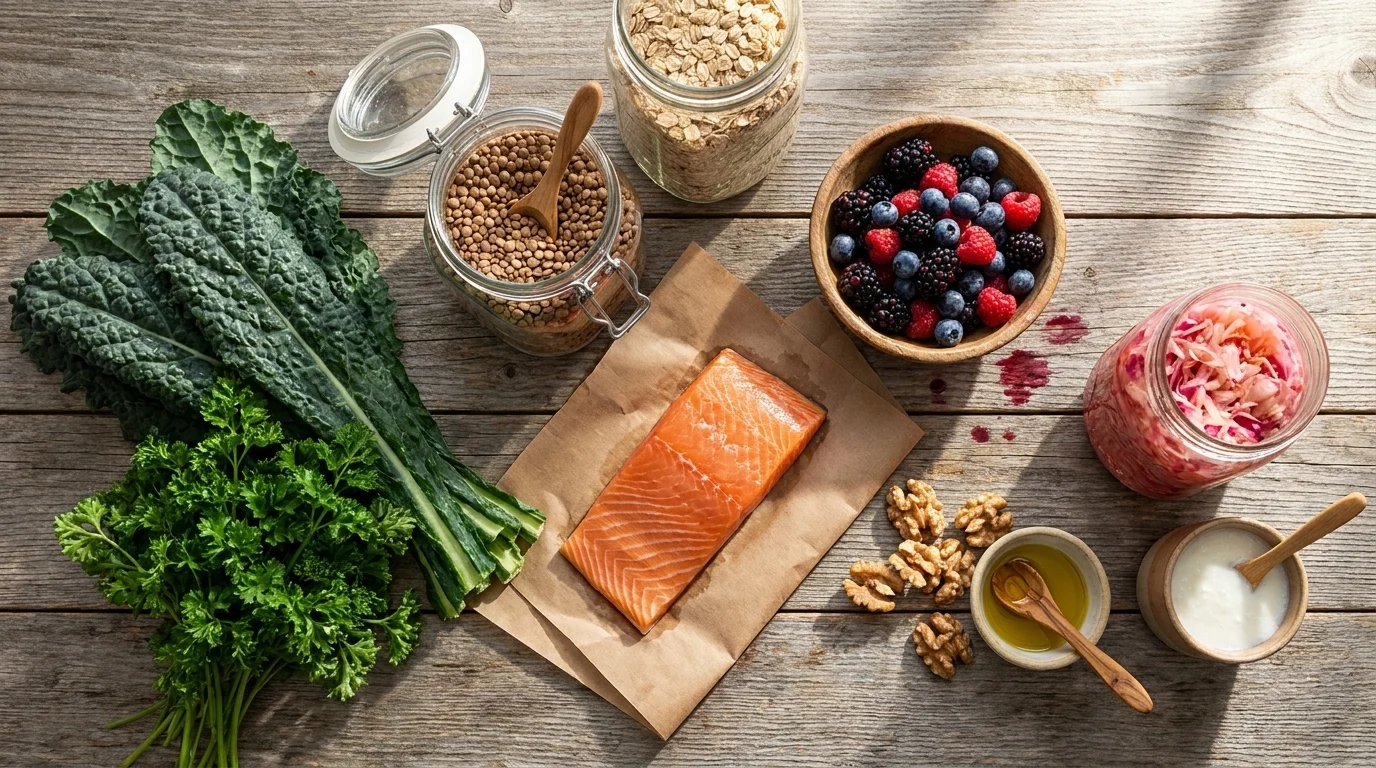
I am going to use the phrase "nutrient-dense" rather than "superfood," because the latter is marketing language and I am allergic to it. The list below is grouped by category, with portions worth knowing, anchored to studies you can verify yourself.
Fatty fish (salmon, sardines, mackerel, herring): two 4-ounce servings per week. AHA-aligned. Two servings supplies roughly 3 grams of EPA and DHA combined, in the lower-bound clinical range for the omega-3 work cited across the cardiovascular and mood literature. Canned wild salmon and sardines are cheaper and nutritionally close to fresh. Note: pregnancy and breastfeeding adjust upward for omega-3 intake but tighten on certain species due to mercury — a clinician conversation, not a blog one.
Leafy greens: about 1.5 cups raw or 0.75 cup cooked, daily. Spinach, kale, collards, arugula, romaine, mixed Asian greens. Daily is more important than the specific green. Folate, magnesium, potassium, fiber, and the polyphenol load arrive together.
Berries: about 1/2 to 1 cup daily, fresh or frozen. Frozen is fine — antioxidant content holds up well to freezing. Ignore the "açaí cures cancer" headlines; berries are nutrient-dense as a category, eat them often.
Extra-virgin olive oil: about 2 tablespoons daily, as primary cooking and finishing oil. PREDIMED (NEJM) found that a Mediterranean diet supplemented with EVOO reduced major cardiovascular events by about 30% versus a control diet. The polyphenol fraction in EVOO is part of the cardiovascular signal; refined olive oil loses most of it.
Tree nuts: about 1 ounce daily. PREDIMED's nuts arm produced a similar magnitude of cardiovascular benefit (~28% MACE reduction). Walnuts have the best omega-3 profile; almonds and pistachios have a stronger mineral and fiber profile. Variety beats volume.
Legumes (lentils, chickpeas, black beans, white beans): three or more servings per week. Cheap, fiber-dense, plant-protein source, and one of the easiest ways to bump weekly plant variety toward microbiome-relevant numbers.
Whole grains: most of your grain calories, most days. Oats, brown rice, quinoa, intact wheat berries, barley. The fiber and micronutrient gap between whole and refined grains is where most of the long-term health signal lives.
The repeated theme: foods, not nutrients. A "this nutrient was studied in a pill" finding is not the same as a "this food was studied in a meal" finding, and the two often give wildly different answers.
Related Article: Understanding Nutritional Psychology: Decoding the Relationship Between Food and Mood
Gut health: what the Stanford fermented-foods RCT actually showed
The gut microbiome has become one of the most over-claimed and under-explained areas in consumer nutrition. I want to give you the cleanest piece of evidence available and let it do most of the work.
A 17-week randomized controlled trial conducted by the Sonnenburg and Gardner labs at Stanford compared a high-fermented-foods diet against a high-fiber diet in healthy adults. The fermented-foods arm — yogurt with live cultures, kefir, fermented cottage cheese, kimchi, fermented vegetables, vegetable brine drinks, and kombucha — increased gut microbial diversity in a dose-responsive way (more servings, more diversity) and decreased 19 inflammatory proteins. The high-fiber arm did not lower those same inflammatory markers in the 10-week intervention window.
Two takeaways I want to make precise:
- Food-first beats supplements for most people. The study tested foods, not capsules. Most probiotic supplement research shows transient colonization at best — the bacteria pass through, do some work, and leave. That is not a flaw; it just means "gut health" is about the dietary pattern, not the morning shot.
- The dose-response means servings matter. The Stanford participants hit microbial-diversity gains by working up to about six small servings of fermented foods per day. That is more than most people are getting now. A practical step-up: one serving today, two next week, four by month two.
A practical fermented-food list with serving guidance:
- Yogurt with live cultures: 1 cup
- Kefir: 1 cup
- Fermented cottage cheese (where available): 1 cup
- Kimchi: 1/4 to 1/2 cup
- Sauerkraut (refrigerated, unpasteurized): 1/4 to 1/2 cup
- Vegetable brine drinks: a small glass
- Kombucha: 4 to 8 oz (mind the added sugar in many commercial brands)
A note on fiber: I am not down on fiber, despite the Stanford finding. Fiber is the substrate the microbiome ferments into short-chain fatty acids, which are the actual mechanism of much of the microbiome's benefit. The current target most US adults fall short on is 25 to 30 grams per day; most adults get under 16. Fiber and fermented foods are complements, not competitors.
The anti-inflammatory pattern and the acetate pathway
If there is one mechanism that links the cardiovascular, metabolic, and mental-health stories in nutrition, it is chronic low-grade inflammation. The Mediterranean dietary pattern is the most-studied anti-inflammatory eating pattern, and a recent synthesis in Frontiers in Nutrition reports that approximately 60% of the Mediterranean diet's anti-inflammatory effect is mediated through reduced gut dysbiosis and an acetate-related short-chain fatty acid pathway. The food → microbiome → inflammation chain is now mechanistically anchored, not just observational.
Translation for your kitchen: an "anti-inflammatory diet" is not a single food. It is a pattern. Foods that consistently show up in anti-inflammatory eating: fatty fish (omega-3 EPA/DHA), leafy greens, berries, extra-virgin olive oil, nuts and seeds, legumes, whole grains, herbs and spices like turmeric and ginger. The bigger lever, again, is reducing UPFs — they combine multiple pro-inflammatory drivers (refined carbohydrate, oxidized oils, low fiber, low micronutrient density, high salt) in one product.
For cardiovascular outcomes specifically, PREDIMED remains the gold-standard primary-prevention trial: about 30% reduction in major cardiovascular events with EVOO, about 28% with mixed nuts. A Mediterranean-pattern meta-analysis reports an odds ratio of 0.52 for major adverse cardiovascular events versus control, 0.62 for myocardial infarction, and 0.63 for stroke. These are real numbers, not vibes.
Related Article: Understanding the Basics of Nutrition for Beginners
A 7-day plant-forward meal template
I have included this because no top-ranking "holistic nutrition" article on the SERP currently does. Adapt portions to your size and activity level. The structure is roughly Mediterranean / plant-forward, hits 25-30 g fiber/day from a varied plant base, includes one fermented serving daily, and lands fish twice in the week.
| Day | Breakfast | Lunch | Dinner | Fermented serving |
|---|---|---|---|---|
| Mon | Greek yogurt + 1/2 cup berries + walnuts + chia | Lentil soup + green salad with EVOO + whole-grain bread | Roasted salmon + farro + sautéed kale | Greek yogurt at breakfast |
| Tue | Oats with sliced apple, almond butter, cinnamon | Quinoa salad with chickpeas, cucumber, herbs, lemon, EVOO | Stir-fry with tofu, broccoli, peppers, ginger, brown rice | Kimchi side at dinner |
| Wed | Eggs + sautéed spinach + whole-grain toast | White-bean and tuna salad on greens, EVOO, capers | Sheet-pan vegetables + chicken thighs + couscous | Kefir mid-afternoon |
| Thu | Smoothie: kefir, frozen berries, spinach, flax | Mediterranean grain bowl: brown rice, hummus, cucumber, olives, feta | Lentil curry with cauliflower and spinach + brown rice | Kefir at breakfast |
| Fri | Cottage cheese + cantaloupe + sunflower seeds | Big salad with chickpeas, eggs, avocado, mixed greens, EVOO | Grilled sardines or canned-salmon cakes + roasted root veg | Sauerkraut at dinner |
| Sat | Whole-grain pancakes + berries + Greek yogurt | Vegetable-and-bean chili + side salad | Pasta with white-bean and tomato sauce + side of dark greens | Yogurt at breakfast |
| Sun | Avocado toast on whole-grain + 2 eggs + arugula | Chicken-and-vegetable soup + whole-grain bread | Roasted whole chicken + Mediterranean salad + barley | Kombucha (small) with dinner |
The template runs about 1,800-2,200 calories depending on portions and is structured to hit roughly 1.2-1.6 g/kg protein for a 65-kg adult. Snacks (a piece of fruit, a small handful of nuts, a hard-boiled egg, hummus with vegetables) sit on top of meals as needed.
If you currently eat in a way that is far from this, do not try to install all seven days at once. Pick three meals a week to swap. Let those be your anchor for two weeks. Then add three more.
What the 2025-2030 DGA actually changed
A short reference sidebar, because the news matters and the 2025-2030 Dietary Guidelines are the most up-to-date federal anchor for "real food" framing.
- Headline message: "eat real food" — minimally processed, whole foods at the center of meals.
- Ultra-processed foods explicitly named to avoid for the first time in DGA history.
- Added sugar: capped at 10 g per meal (replacing the prior 10%-of-calories framework). No added sugar recommended for children under age 10 (previously age 2).
- Protein: 1.2 to 1.6 g per kg of body weight per day — a 50-100% increase over the prior 0.8 g/kg minimum.
- Saturated fat: 10% of calories cap unchanged. Worth noting, per Harvard's Frank Hu: on a 2,000-calorie diet, that ceiling is about 22 grams per day, and three full-fat dairy servings (whole milk, Greek yogurt, cheddar) total about 17 grams — a built-in tension worth knowing about.
- Plant foods: explicitly emphasized; the protein guidance is from "a mix of animal and plant sources."
This is the framework I am using throughout this article. Where I have departed from it, I have said so.
Mindful eating, briefly and with evidence
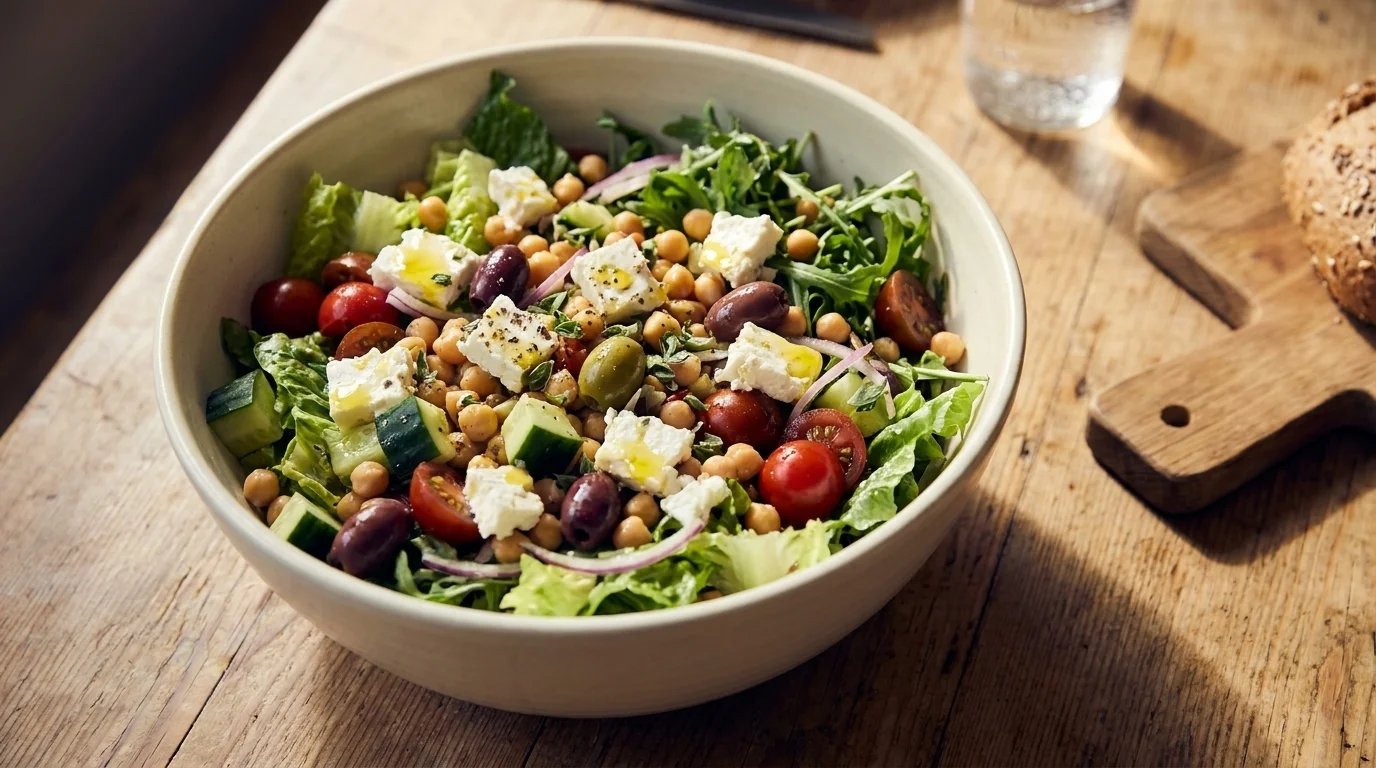
Mindful eating is the practice with the most modest evidence base in this guide, and I want to be honest about it rather than oversell. Several small RCTs and longer pilot studies report improvements in eating-related distress, binge-eating frequency, and some metabolic markers when participants adopted structured mindful-eating protocols. The signal is consistent but the effect sizes are modest, and the strongest results are in clinical populations with disordered eating, not the general public.
The version that holds up in practice is structured and short:
- Pause for ten seconds before the first bite. Notice the food in front of you. This gives your prefrontal cortex a window to actually engage.
- Run a one-to-ten hunger check before eating. Where are you? Aim to start meals around 3-4 and stop around 6-7.
- Make one meal a day screen-free. All-or-nothing rules collapse fast; one meal is sustainable.
Try those three for one week before deciding if mindful eating is for you. It is a real complement to the food-pattern guidance above. It is not a substitute for it.
Supplements: when food isn't enough
This is the section nearly every "holistic" article gets wrong by stacking ten supplements with vague "boost" claims. The version that actually fits an evidence-first guide is short.
Most people eating a real-food, plant-inclusive pattern do not need a multivitamin. A few common exceptions where evidence supports targeted supplementation, dose tied to clinician guidance and lab markers:
- Vitamin D — when serum 25-hydroxy levels are below ~30 ng/mL or when sunlight is limited (northern climates, winter, indoor work). Typical clinical dose: 1,000-2,000 IU/day, adjusted to labs.
- Vitamin B12 — for vegans, near-vegans, and many adults over 60 (declining absorption). Typical: 250-500 mcg/day or 1,000 mcg weekly under-the-tongue or sublingual.
- Omega-3 (EPA/DHA) — when fish intake is below two servings per week. Typical: 1,000-2,000 mg combined EPA/DHA per day, with a clinician check if you take blood thinners.
- Iron — for menstruating women with documented low ferritin. Dose and form (ferrous sulfate, ferrous bisglycinate) is a clinician conversation, not a self-prescription — too high a dose causes GI symptoms and oxidative load.
Adaptogens (ashwagandha, rhodiola, reishi), specialty herbal extracts, and "longevity stacks" sit in a different category. Some have small RCTs with positive findings; few have the RCT density to justify routine recommendation. If you are taking herbals, please tell the prescribing clinician for any other medication you are on — interaction risk is real (St. John's wort, kava, gingko, and several others have well-documented drug interactions).
A skeptic's appendix: what to ignore in holistic nutrition marketing
This is the part of the article I would have wanted to read before I trained as a dietitian, and it is the part the rest of the holistic-nutrition internet conspicuously skips.
- "Detox" programs and juice cleanses. Your liver and kidneys handle detoxification. Most cleanse-related symptoms are caloric restriction and low blood sugar, which is not a feature.
- Alkaline water for body pH. Your blood pH is tightly regulated within roughly 7.35-7.45 by the kidneys and lungs, regardless of what you drink. The mechanism does not work the way the marketing suggests.
- Celery juice as a daily ritual for healing. Celery juice has fluid and a small amount of micronutrients. It is not a cure for autoimmune disease, hormone imbalance, or chronic illness.
- Blanket gluten-free for everyone. If you have celiac disease (about 1% of adults) or a documented non-celiac gluten sensitivity, gluten-free is the intervention. For everyone else, gluten-free packaged products are usually higher in sugar and lower in fiber than the regular versions.
- "Superfood" claims naming a single ingredient as the cure. The pattern is what matters, not any single food.
- Megadose supplement protocols for healthy adults. More is not more. Fat-soluble vitamins (A, D, E, K) accumulate; some water-soluble vitamins have ceilings (B6 toxicity is real); minerals interact (zinc-copper, iron-zinc).
- "Personalized nutrition" plans based on a saliva or stool kit alone. The current consumer microbiome and genomics tests cannot reliably tell you what to eat. The technology is moving but the clinical case for these tests as standalone diet planners is not yet there.
I am not against any of these things being studied further. I am against being sold them as established when they are not.
A sober usable takeaway
If you remember three things from this article: meaningfully reduce ultra-processed food intake, build the rest of your eating around a plant-forward pattern (real food, daily fermented serving, two fish servings a week, 25-30 grams of fiber, EVOO as your main fat), and ignore the marketing layer that has accreted around "holistic nutrition." The dietary pattern most closely aligned with the current research is the one the federal government just decided to recommend out loud.
As always, individual nutrition decisions — especially around chronic disease, eating disorder history, pregnancy and postpartum, and any condition requiring lab markers — belong in a conversation with your own clinician. A 45-to-60-minute registered dietitian visit is, in many U.S. plans, covered without copay for chronic-disease management. It is one of the more useful uses of an hour I know.
Frequently Asked Questions
Not exactly, but the Mediterranean pattern is the most evidence-backed eating pattern that fits a holistic framework. Holistic nutrition adds the lifestyle pieces (mindful eating, sleep, stress, movement) alongside the food rules. PREDIMED — published in the New England Journal of Medicine — found a Mediterranean diet supplemented with extra-virgin olive oil reduced major cardiovascular events by about 30% versus a control diet, which is the strongest primary-prevention finding in the space.
At least 25-30 grams per day for most adults, from a mix of vegetables, fruits, legumes, nuts, seeds, and whole grains. Most U.S. adults get under 16 grams. Fiber is the substrate the gut microbiome ferments into short-chain fatty acids, which is the actual mechanism behind much of the microbiome's anti-inflammatory benefit.
For most people, food-first wins. The Stanford 17-week RCT (Sonnenburg/Gardner lab) showed dose-responsive gains in microbial diversity and a decrease in 19 inflammatory proteins from fermented foods (yogurt, kefir, kimchi, sauerkraut, kombucha) — a benefit not consistently shown for capsule probiotics. Probiotic supplements can have a role in specific clinical situations (e.g., antibiotic-associated diarrhea), but for general gut health, the dietary pattern matters more.
No. The 2025-2030 Dietary Guidelines and 2025 Lancet evidence support sharply reducing UPFs — especially sugary drinks and packaged snacks — not perfection. The clinical question is the dietary pattern across the week. Aim for roughly two-thirds or more of weekly calories to come from minimally processed foods. That leaves real room for the cereal you grew up with on Saturdays.
Usually no. Common exceptions include: vitamin D when sunlight is limited or labs are low (1,000-2,000 IU/day under clinician guidance), B12 for vegans and many adults over 60, omega-3 if you don't eat fish twice a week, and iron for menstruating women with documented low ferritin. Targeted, lab-anchored supplementation under clinician guidance generally outperforms a daily one-size-fits-all multivitamin.
For cardiovascular outcomes, yes. PREDIMED found a Mediterranean diet with extra-virgin olive oil reduced major cardiovascular events by about 30% versus a control diet. Coconut oil is high in saturated fat without comparable randomized-trial evidence supporting the cardiovascular benefits attributed to it. Use coconut oil if you like the flavor; do not use it because you have been told it is a health hack.
Reduce ultra-processed foods. The 2025 Lancet three-paper UPF series synthesized 100+ studies showing UPF intake is linked to increased risk across nearly every organ system. Cutting them back delivers more health upside than any superfood addition. The headline message of the 2025-2030 Dietary Guidelines — 'eat real food' — is built around exactly this finding.
No. Your liver and kidneys handle detoxification continuously, and there is no good evidence that juice cleanses or short-term elimination protocols accelerate or improve that process. Most cleanse-related symptoms are simply caloric restriction and low blood sugar. Evidence-based holistic nutrition focuses on consistent whole-foods patterns over time, not short cleanses.