
Debunking the Detox Myth: Separating Fact from Fiction


Do detoxes work? The cleanest answer in the published literature is older than you might expect. In 2009, a UK research charity called Sense About Science walked into fifteen mainstream supermarkets and pharmacies, bought one detox product from each, and asked the manufacturer of each to do two things: define what they meant by "toxin," and provide evidence that their product removed it. None could. No two companies even used the same definition of detoxification. The investigation, published as the Detox Dossier, is sixteen years old and still the cleanest single fact in the skeptical literature on detox products. The reason it has aged so well is that none of the underlying problems have changed.
This piece is an honest look at what "detox" actually means in the body, what the published evidence says about the marketed kind, and what to do instead. The short version, from the National Center for Complementary and Integrative Health's March 2025 guidance: there is "no compelling research to support the use of detox diets for weight management or eliminating toxins from the body." We will spend the rest of this article unpacking why. This is general nutrition information; it is not medical advice. If you are weighing a cleanse with a chronic condition or on a prescription medication, bring the conversation to your own clinician — some "detox" supplements interact with medications and a few have caused serious harm.
First: medical detox is real. Wellness detox is marketing.
Two completely different things share a name, and confusing them is the first reason this conversation gets muddled.
Medical detoxification is a supervised clinical service that helps people withdraw safely from alcohol or opioids. It is delivered by licensed providers, often in an inpatient setting, with medications managing the physiological withdrawal. This is real and life-saving.
Wellness "detox" is a marketing category for teas, juices, supplements, and short-restriction diets that promise to remove vague "toxins" and "reset" various organ systems. This is the thing the rest of this article is about. The two have nothing in common except the word.
What detoxification actually is, in the body
Your liver runs detoxification continuously in two biochemical phases. Phase I uses a family of enzymes called the cytochrome P450 (CYP450) system to oxidize fat-soluble compounds — medications, alcohol byproducts, environmental chemicals — into intermediates. Phase II takes those intermediates and conjugates them with glucuronic acid, sulfate, or glutathione to make them water-soluble. Once water-soluble, they can leave the body.
The compounds exit through one of four routes, which is the map most "detox" marketing quietly skips:
- Kidneys → urine. The largest elimination route for most water-soluble metabolites and drug byproducts.
- Liver → bile → stool. The route for many fat-soluble compounds and certain drug metabolites that get bound to bile and pass with feces.
- Lungs → exhaled air. How CO2 and some volatile compounds (including ethanol metabolites) leave.
- Skin → sweat. A minor route. Most chemicals cleared by sweat are present at low concentrations; this is not the main exit, contrary to most sauna-and-detox marketing.
The liver does not "store toxins" that you can release with a tea. It processes them in real time. The system either works or it is impaired — and a working system does not pause and require a cleanse.
Five myths worth retiring
This is the part of the conversation where, in my clinical years, I would write a one-page handout. Five claims keep showing up, and each one has a clear answer in the published literature.
Myth 1: "Your body needs help detoxing."
Bottom line: A healthy liver, kidneys, and lungs do this continuously. No commercial product has been shown to add capacity.
The most-cited systematic review in this space is Klein and Kiat's 2015 critical review in the Journal of Human Nutrition and Dietetics. Their conclusion, after looking at every available trial: "There is no compelling research to support the use of detox diets for weight management or toxin elimination." A 2017 secondary review on juicing specifically reached the same conclusion. In the decade since Klein and Kiat, no randomized controlled trial of a commercial detox diet has changed that picture.
There is a more specific version of this myth — that fat-soluble toxins build up in tissue and need to be flushed periodically. The real biochemistry: some compounds (certain pesticides, PCBs, dioxins) do sequester in adipose tissue, and they do get released slowly during sustained fat loss over months or years. Three days of cabbage soup does not change this. Sustained healthy weight loss does, modestly, and the body's standard elimination routes handle the released compounds at the slow rate they re-enter circulation.
Myth 2: "Detox teas remove toxins."
Bottom line: Most "detox" teas combine senna or similar stimulant laxatives with diuretic herbs. The weight loss is water and stool. The "toxin removal" is unfalsifiable because the marketers cannot name the toxin.
In March 2020, the Federal Trade Commission filed a complaint against Teami, LLC alleging that the company's "30 Day Detox Pack" claims were unsubstantiated. The FTC's complaint alleged the company had additionally claimed its teas could fight cancer, clear clogged arteries, decrease migraines, and treat the flu and the common cold — without evidence. A $15.2 million judgment was entered, suspended on payment of $1 million given the defendants' financial condition. In February 2022 the FTC returned more than $930,000 in refunds to more than 20,000 consumers who had bought the product. Influencers named in the complaint included Cardi B, Katya Elise Henry, and Brittany Renner.
The Teami chronology is not unique. It is the most prominent example of a pattern. The pattern is unsubstantiated weight-loss-and-toxin claims paired with affiliate-driven social marketing, and consumer-protection actions catching up to it after the money has been made.
Myth 3: "A short juice cleanse resets the gut."
Bottom line: A 2025 Northwestern study published in Nutrients found that three days of a vegetable-and-fruit juice-only diet measurably worsened gut and oral microbial composition — not improved it.
This is the freshest evidence in the cluster and it is worth describing carefully. Researchers at Northwestern's Osher Center for Integrative Health ran a three-arm trial comparing juice-only, plant-based whole-food, and a Western-pattern control. After only three days, the juice-only arm showed reductions in beneficial Firmicutes and increases in inflammation-linked Proteobacteria, along with markers of increased gut permeability. The whole-food plant-based arm showed the favorable microbial shifts the juice arm did not. As Dr. Melinda Ring, the study's lead author, put it: "Most people think of juicing as a healthy cleanse, but this study offers a reality check."
The trial is small (n=14) and not yet replicated. But it inverts the "a short cleanse can't hurt" intuition that nearly every juice-cleanse marketing page leans on. Three days is enough to register a measurable change, and the direction of that change in this study was not the one juice cleanses are sold to produce.
Myth 4: "Detox supplements protect the liver."
Bottom line: The U.S. National Library of Medicine's LiverTox database reports that herbal and dietary supplements account for roughly 16 percent of all drug-induced liver injury cases in the U.S. DILI Network registry. The WHO ranks supplement-induced liver injury as the fifth most common cause of liver-disease-associated death worldwide.
Within that bucket, green tea extract is the single most commonly implicated herbal agent — the same green tea extract that shows up in dozens of "liver cleanse" and "detox" supplement formulations. This is the central irony of the supplement-detox marketplace: the product sold to cleanse the liver is, in a meaningful slice of liver-injury cases, the cause of the liver injury.
This is not an argument against drinking green tea. Brewed green tea, in normal dietary amounts, is fine for almost everyone. It is an argument against concentrated green tea extract capsules consumed for weeks at a time as part of a "detox" or weight-loss protocol. If you take supplements and you notice yellowing of the eyes or skin, persistent dark urine, or severe fatigue, stop the supplement and see a clinician promptly — these can be early signs of liver injury.
Myth 5: "Specific foods detoxify the body."
Bottom line: No food removes a defined toxin. Some foods, in regular dietary patterns, support the liver's normal function — which is a different, narrower, and more honest claim.
The reframe that actually fits the evidence is "how to support liver function":
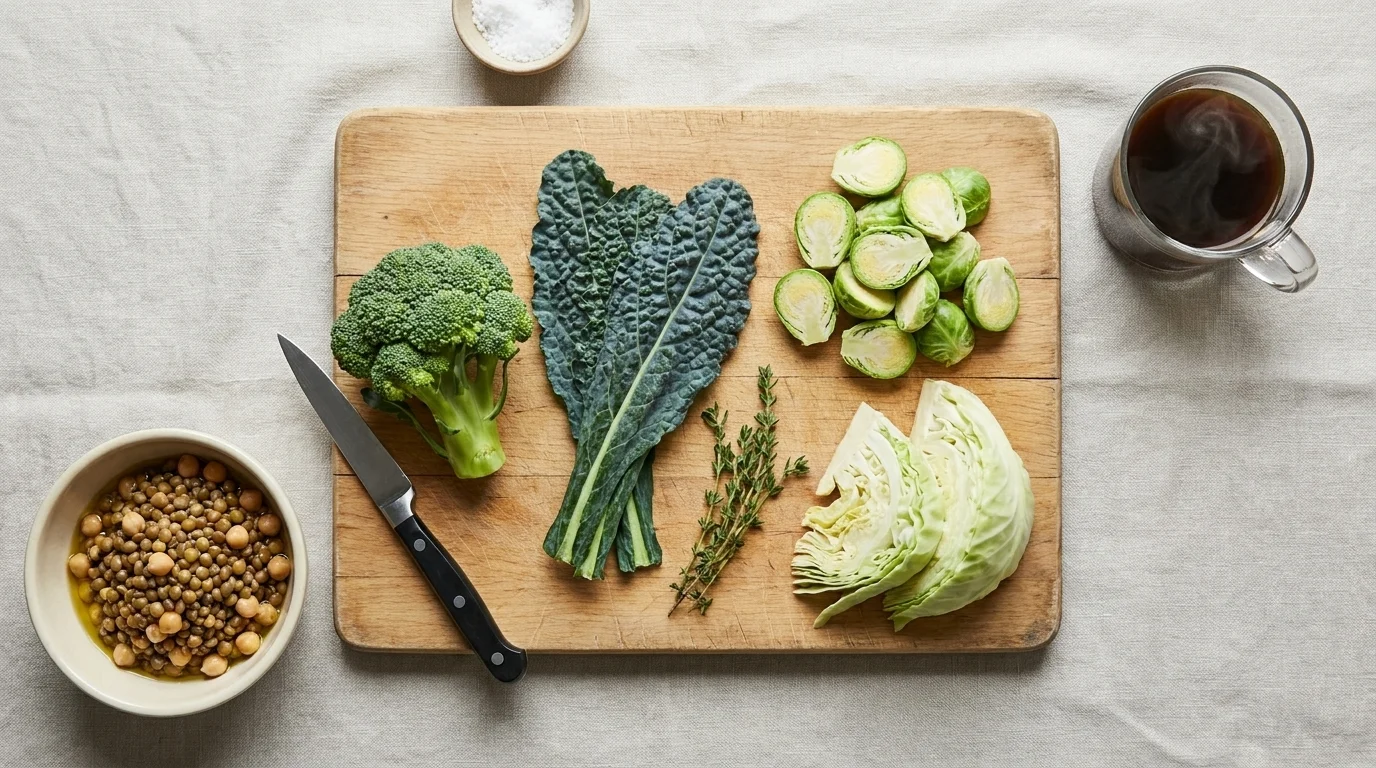
- Cruciferous vegetables — broccoli, kale, Brussels sprouts, cabbage, arugula. Sulforaphane and related compounds induce Phase II conjugation enzymes in observational and short-term human data.
- Coffee — consistently associated with lower liver enzyme levels and reduced risk of advanced liver disease across large prospective cohorts. The mechanism is not fully settled. The signal is.
- Adequate protein — glutathione, your principal Phase II conjugation co-factor, requires cysteine. Cysteine comes from dietary protein. Most adults need 1.2 to 1.6 grams per kilogram of body weight per day.
- Soluble fiber — beans, oats, fruit, vegetables. Binds bile-conjugated metabolites in the gut for fecal excretion. This is the actual mechanism behind "fiber helps with toxin elimination" — it is bile binding, not a magic cleanse.
- Limit alcohol. Alcohol is processed by the same Phase I CYP450 enzymes that handle many drugs and environmental compounds. Heavy alcohol intake meaningfully impairs liver function.
None of these foods is a "superfood." The dietary pattern that includes them — broadly Mediterranean-shaped, rich in vegetables, fish, legumes, whole grains, modest alcohol — is what the liver actually thrives on.
Related Article: The Ultimate Guide to Holistic Nutrition for Vibrant Health
What detox marketers cannot legally claim, after Teami
After the FTC's Teami action, the regulatory floor is clear: a consumer detox product cannot lawfully claim weight loss, cancer-fighting effect, cardiovascular benefit ("clear clogged arteries"), migraine treatment, or infectious-disease prevention without disclosed clinical evidence. If you see those claims on a tea, a cleanse, or a supplement, treat them as a flag — that is exactly the pattern the FTC ruled unsubstantiated and refunded consumers over.
A short BS-detector you can use in five seconds at the supermarket:
- Does the product name a specific toxin? "Toxins" is not a specific toxin.
- Does it cite human trial data? Not "studies show" — a named study with a journal name.
- Is the active ingredient something that produces predictable physiological effects you would want to be aware of? Senna and other stimulant laxatives, diuretic herbs, and high-dose caffeine all fail on undisclosed bowel and fluid effects.
- Does it overlap with the FDA's tainted-products list? The FDA's database of supplements tainted with undeclared pharmaceuticals (sibutramine, sildenafil, fluoxetine) is searchable. Brands that have been listed once are not necessarily disqualified, but the pattern is worth knowing.
What to do instead
If you want to take care of your liver and the rest of the system that handles detoxification — and most people who pick up a juice cleanse genuinely do want this — the answer is unromantic. Eat a fiber-rich diet built on vegetables, fruit, whole grains, legumes, and lean protein, with the cruciferous and coffee and protein notes above. Hydrate enough that your urine is pale yellow most of the day. Sleep seven to nine hours on a consistent schedule. Move regularly — three to five sessions a week of any kind. Moderate alcohol — under the seven-drink-per-week threshold for women and fourteen for men, with two alcohol-free days each week.
If you have a specific symptom — persistent fatigue, unusual bloating, jaundice, changes in stool color or frequency, dark urine — bring it to a clinician, not a tea. Each of those symptoms has identifiable, evaluable causes, and a doctor can investigate them. A "detox" product replaces that investigation with an unverified promise, and the result is often a delay in finding what is actually going on.
Related Article: The Role of Nutrition in Supporting Your Overall Well-Being
A note on what is and is not in this piece
Three days of fresh vegetables, fruit, and water will not hurt most healthy adults. If a short reset helps you re-anchor a dietary pattern after a vacation or a stressful stretch, the practice is yours to keep, with the honest caveat that the published evidence does not support it as toxin removal or metabolic reset. The mechanism is simpler — for a few days you stop eating ultra-processed food and sleep better, and you feel better, and you attribute the feeling to the cleanse. The feeling is real; the explanation is not what is on the box.
This piece is general nutrition information from a registered dietitian who covered the wellness beat for a long time. It is not medical advice, and it does not replace your own clinician for diagnosed conditions, prescriptions, or supplement decisions that interact with medications. Bring the question to the room where your bloodwork lives.
Frequently Asked Questions
No commercial product has been shown to detoxify the liver. A healthy liver does this continuously through Phase I (CYP450 oxidation) and Phase II (conjugation) pathways. The NIH's LiverTox database lists hundreds of herbal and dietary supplements — many marketed as 'liver cleanses' — implicated in drug-induced liver injury. Herbal and dietary supplements account for roughly 16% of all DILI cases in the U.S. DILI Network registry, with green tea extract the single most commonly implicated agent.
There is no peer-reviewed evidence that any commercial detox tea removes a defined toxin or produces lasting weight loss. In 2020, the FTC alleged that Teami, LLC's '30 Day Detox Pack' claims were unsubstantiated; a $15.2 million judgment was entered, $1 million was paid, and more than $930,000 in refunds were sent to 20,000+ consumers. Influencers including Cardi B were named in the complaint. Any short-term weight loss from detox teas is fluid and stool loss driven by laxative or diuretic ingredients.
A 2025 Northwestern study published in Nutrients found that just three days of a vegetable-and-fruit juice-only diet measurably shifted the gut and oral microbiome in an unfavorable direction — beneficial Firmicutes decreased and inflammation-linked Proteobacteria increased, with markers of increased gut permeability. The whole-food plant-based arm of the same trial showed the favorable shifts the juice arm did not. The trial is small (n=14) and not yet replicated, but it inverts the 'a short cleanse can't hurt' framing many juice cleanses lean on.
Detoxification is the body's continuous biochemical conversion of fat-soluble compounds — medications, alcohol byproducts, environmental chemicals — into water-soluble metabolites that can leave the body. The liver runs this in two phases: Phase I via the CYP450 enzyme system (oxidation), and Phase II via glucuronidation, sulfation, and glutathione conjugation. The water-soluble products exit through four routes: kidneys to urine, liver to bile to stool, lungs as exhaled CO2, and a small fraction through sweat.
It does not pause and restart. Your liver and kidneys process metabolites continuously, around the clock. There is no biochemical 'reset' period the body needs help reaching. The system either works or it is impaired by a clinical condition — and a working system does not require help from a tea, juice, or supplement. If you have symptoms that suggest impaired liver function (jaundice, dark urine, severe fatigue), see a clinician rather than starting a cleanse.
There is no published evidence that detox products treat acne, bloating, or fatigue. Each of those symptoms has specific, evaluable causes — dietary patterns, hormones, sleep, GI conditions, medication side effects — that a clinician can investigate. A 'detox' product replaces that investigation with an unverified promise. The risk is not just spending money on something ineffective; it is delaying the workup that would have identified what was actually going on.
No. Medical detoxification is a supervised clinical service that manages withdrawal from alcohol or opioids, delivered by licensed providers with medications to manage the physiological process. Wellness 'detox' is a marketing category for teas, juices, supplements, and short-restriction diets with no shared definition, no FDA pre-market review of efficacy, and no peer-reviewed evidence for the toxin-removal claim. The two share a word and nothing else.
Eat a fiber-rich diet built on vegetables, fruit, whole grains, legumes, and lean protein; hydrate enough that your urine is pale yellow; sleep seven to nine hours on a consistent schedule; move regularly; moderate alcohol; and bring specific symptoms (persistent fatigue, GI changes, jaundice) to a clinician rather than to a tea. Cruciferous vegetables, coffee, and adequate protein specifically support the liver's normal Phase I and Phase II function — that is the honest version of 'foods that support detoxification.'
Two reasons. First, there is no peer-reviewed evidence that they remove a defined toxin or produce lasting weight loss. The canonical 2015 systematic review in the Journal of Human Nutrition and Dietetics (Klein and Kiat) concluded there is 'no compelling research' to support detox diets for weight management or toxin elimination, and no randomized trial of a commercial detox diet has changed that picture. Second, the body's actual detoxification system — liver, kidneys, lungs — runs continuously without external help; there is no biochemical 'reset' period a healthy system needs help reaching.
The honest version is 'support liver function,' not 'detoxify.' Cruciferous vegetables (broccoli, kale, Brussels sprouts) contain sulforaphane and related compounds that induce Phase II enzymes. Coffee is consistently associated with lower liver enzyme levels and reduced advanced-liver-disease risk in prospective cohort data. Adequate protein supplies cysteine, the precursor for glutathione, a principal Phase II conjugation co-factor. Soluble fiber from beans, oats, and fruit binds bile-conjugated metabolites for fecal excretion. Limiting alcohol is the single largest controllable lever for liver health.