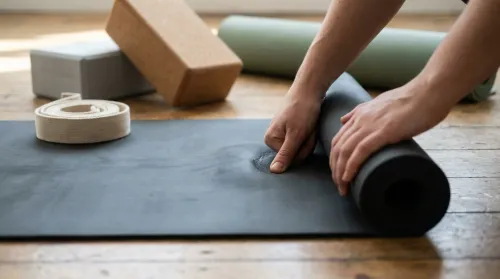
Hot Yoga Class


The three questions a first-timer brings me before their first hot yoga class are always the same: how hot is the room, what do I wear, and will I pass out on the mat. A hot yoga class earns that nervousness — you are walking into a room heated well past comfortable and asking your body to move through it — but almost none of the fear survives contact with the facts. I am a strength coach, not a studio selling you a membership, so I read the research before I write about it. I will tell you what a hot yoga class genuinely does for your body, what it does not, and exactly how to walk in prepared. What follows is the full walkthrough of a first class: the real, evidence-checked benefits, the temperature and gear specifics, and the safety facts the studio's landing page tends to skip.
What Is a Hot Yoga Class?
A hot yoga class is a session of yoga postures and breathwork performed in a room deliberately heated to roughly 90–105°F, usually lasting 60 to 90 minutes. The heat is meant to loosen muscles, raise your heart rate, and produce heavy sweating from the first few poses onward.
"Hot yoga" is an umbrella, not a single class. It covers any yoga taught in a heated room — vinyasa flows, power classes, gentle stretch sessions — run anywhere in that 90–105°F band. It is worth separating from Bikram, the original heated format: a fixed 105°F room and the same 26-pose sequence every single time. All Bikram is hot yoga; most hot yoga is not Bikram. I contrast the two properly further down.
Why heat the room at all? Warm tissue is more pliable, the effort feels more intense, and you sweat hard — studios lean on all three. Notice I said the heat feels more intense and makes you more flexible in the moment. Whether it makes the session objectively better is a separate question, and I will get to it. For now, treat the heat as a condition of the room, not a proven upgrade.
If you are brand new, this is a beginner-friendly place to start once you respect the room — you set the pace, you rest when you need to, and no one is watching you. For more entry points, browse our wellness and yoga category.
What the Science Actually Says About Hot Yoga
Here is where most hot yoga writing oversells, so here is the honest version. In October 2025, Sports Medicine – Open published the first large systematic review of hot yoga, pulling together 43 studies — a reference none of the pages currently ranking for this topic cite. It is the best evidence we have, and it is worth reading before you believe any benefit claim.
The measured effects are real. Across the included studies, five years of regular Bikram practice was associated with bone-density gains of +7% at the femoral neck, +2% at the total hip, and +1% at the lumbar spine in pre-menopausal women. Flexibility improved by +16% to +33%. Single-leg balance rose +228% versus +29% in controls. Total cholesterol dropped −16 mg/dL and LDL −18 mg/dL. Perceived stress fell from 20.7 to 12.9, and in moderate-to-severe cases depression scores fell from 36.9 to 19.9. A separate 2023 randomized controlled trial in 290 adults found hot yoga improved well-being against a wait-list control — one of the larger controlled samples in the field.
Now the part that is oversold. The review's own conclusion is blunt: "Claims that hot yoga provides greater health benefits than other forms of yoga or traditional exercise are at present unsubstantiated." Hot yoga is not proven superior to regular yoga. The heat adds sweat and perceived intensity; it has not been shown to add outcomes. And much of the underlying research uses small samples and weak designs, so hold even the good numbers loosely. If stress relief is what draws you to the heat, the yoga is doing that work — and you can reach the same calm through managing stress off the mat too. One figure to flag before you lean on it: a small trial recorded blood pressure easing from 126/82 to 121/79 mmHg, but with only 10 participants that is a hint, not a finding.
Does hot yoga burn more fat? The sweat myth
You will step off the mat lighter, and the scale will confirm it. That number is water, not fat. A hard class can cost you well over a liter of sweat, and you replace every gram of it by dinner. Sweat measures how hard the room made your body work at cooling itself; it does not measure calories burned or fat lost. If fat loss is the goal, hot yoga is a fine addition to a program — but the heat is not a shortcut, and no coach worth trusting will tell you otherwise.
What Actually Happens in Your First Hot Yoga Class
You arrive early, move through standing, balancing, and floor poses in the heat, sweat heavily throughout, and finish flat on your back in savasana.
Before you walk in, do three things: arrive about 15 minutes early so you are not rushing, drink some water in the hour beforehand, and tell the instructor it is your first class. That last one matters — a good teacher will keep an eye on you and quietly signal when to back off.
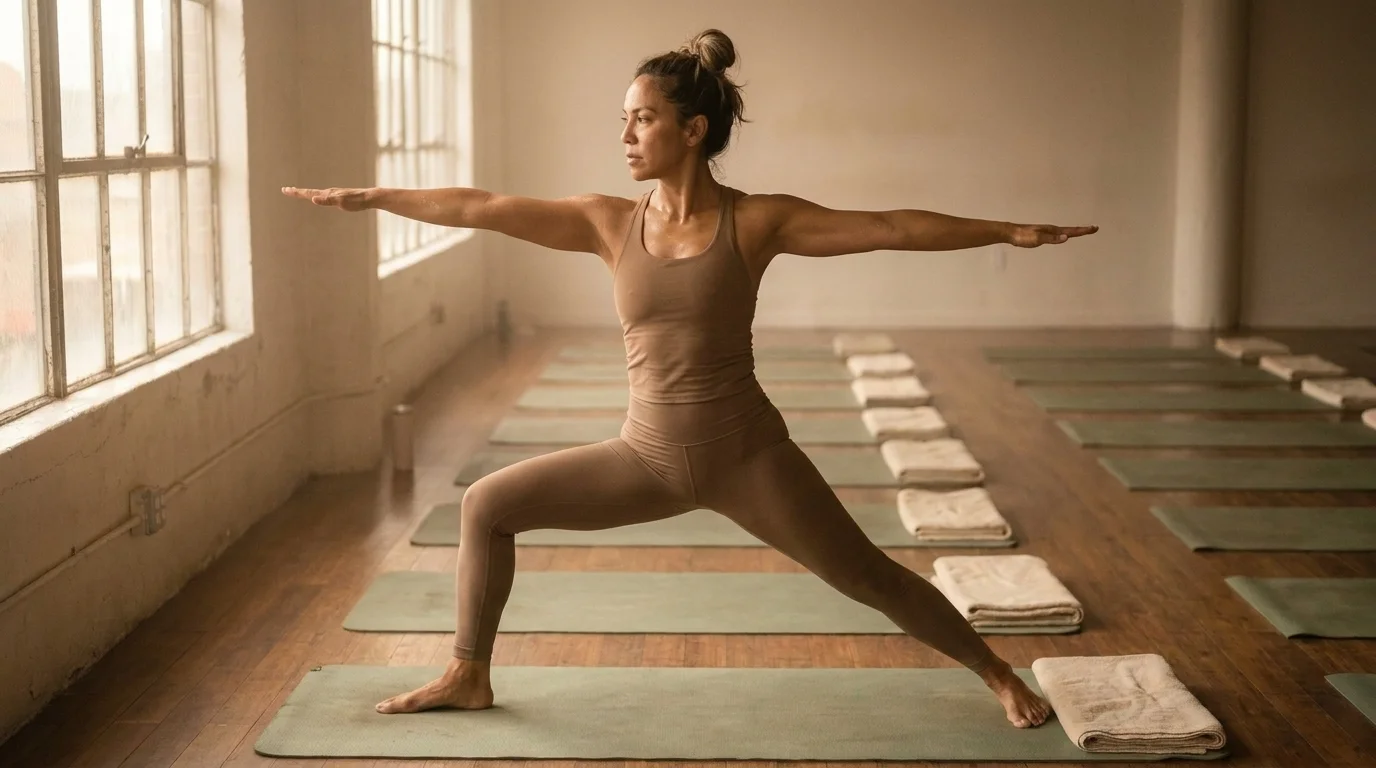
The class itself follows a predictable arc. It opens with a few minutes of seated or standing breathwork to let you register the heat. Then a standing sequence — sun-salutation-style flows, lunges, warriors — builds heat you barely notice you are adding to. Balancing poses come next, when the sweat is really going and your focus is the only thing keeping you upright. Floor work follows: seated folds, twists, gentle backbends, the pace slowing. It ends with savasana, a few minutes lying still while your heart rate drops and the room stops feeling like a wall.
What surprises first-timers is the entrance — the heat lands like a physical object the moment you open the door — and how fast you start sweating, often before the first pose is over. If you feel light-headed, that is information, not failure: sit down, breathe, and drop into child's pose whenever you want. No one is keeping score.
Here is the external marker of a good first class: you paced yourself, you rested more than you pushed, and you left curious instead of wrecked. Ego is the thing that gets beginners hurt in a hot room. Leave it at the door with your shoes.
How Hot Is a Hot Yoga Class?
Most studios heat the room to between 90 and 105°F with roughly 40 to 60% humidity. Bikram-style classes run at a fixed 105°F.
That range is not arbitrary. Below about 90°F you lose the pliability and sweat response the format is built around; much above 105°F and heat strain climbs faster than most people can safely manage. The humidity is the part beginners underestimate. At 40–60% relative humidity your sweat evaporates slowly, so your body's main cooling system works at a disadvantage and the same air temperature feels far hotter than a dry sauna at the same reading. That is why 100°F in a hot yoga room is a different animal from 100°F outside on a dry day.
Studio specs vary — some run a full 105°F at around 60% humidity, others sit at the cooler end near 90°F — so ask before you book if heat worries you. And expect your first class to feel hotter than your fifth. Heat acclimatization is real: over a couple of weeks of consistent exposure your body gets better at sweating efficiently and holding its core temperature, and the room stops feeling like an ambush.
What to Wear and Bring to Your First Class
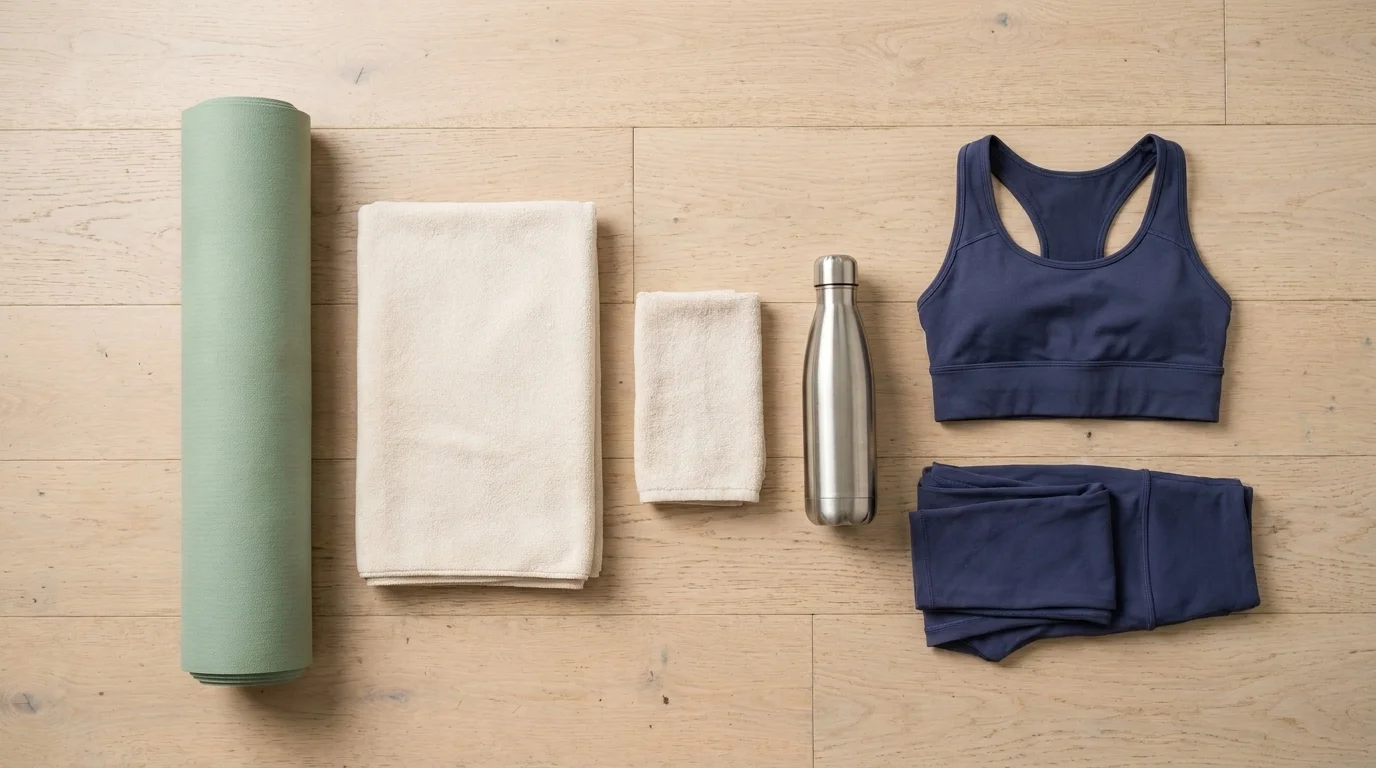
Dress for a room that will make you sweat within minutes. Light, breathable, moisture-wicking fabric is the whole rule: a sports bra and leggings, or shorts and a fitted tank. Skip cotton — it soaks up sweat, turns heavy and cold, and clings in a way that makes every pose harder. Fitted beats baggy, because loose fabric slides when your skin is wet.
Your hot yoga kit
- A non-slip yoga mat — the grippier the better.
- A mat-sized towel to lay over it; once you are sweating, that towel is what keeps your hands and feet from sliding out of a pose.
- A small hand towel for your face.
- A water bottle you have pre-filled — more on how much to drink below.
- A dry set of clothes to change into, because you will not want to leave in what you wore.
A few practical do's: eat something light one to two hours before, not right beforehand — a heavy stomach and a hot room do not mix. Take off rings, watches, and anything that traps heat against your skin. And if the heat makes you nervous, claim a spot near the door where the air moves a little more. For a deeper breakdown of mats, towels, and the rest, see our guide to the right gear, or browse the wellness and yoga category.
Hot Yoga vs. Regular Yoga vs. Bikram
People use these three names interchangeably, and they should not. Here is the difference at a glance.
| Regular yoga | Generic hot yoga | Bikram | |
|---|---|---|---|
| Temperature | Room temperature | 90–105°F | Fixed 105°F |
| Humidity | Ambient | ~40–60% | ~40–60% |
| Poses / sequence | Varies by style | Flexible, teacher's choice | Set 26-pose sequence, every class |
| Intensity | Low to high, you choose | Higher perceived intensity from the heat | High and fixed |
| Best for | Any level; heat-sensitive students | Sweat and heat with a familiar flow | Traditionalists who want the same class each time |
Regular yoga is simply yoga at room temperature, in any of its many styles. Generic hot yoga takes a flow — often vinyasa or power — and runs it in that 90–105°F band, with the sequence left to the teacher. Bikram is the strict original: a fixed 105°F room and the identical 26-pose sequence (the "26&2" lineage) every session, no variation.
What does the heat actually change? More sweat and a higher perceived intensity — and, as the evidence section covered, not a confirmed jump in results over the same poses done cool. So choose on preference and tolerance, not on a promise of better outcomes.
If you are new and unsure how you handle heat, start with a beginner-friendly heated class in the cooler part of the range, not full Bikram. Bikram's fixed 105°F and rigid sequence are a lot to meet on day one. You can always work up to it once your body knows the room.
Who Should Skip Hot Yoga (or Get Cleared First) — and How to Hydrate
This is the section the studio's website leaves out, and it is the one that matters most. Heat plus exertion is a real physiological load, and the systematic review documents genuine reported harms — heat illness and exercise-associated hyponatremia (dangerously low blood sodium from overdrinking), alongside rarer cardiac events. None of that means hot yoga is dangerous for a healthy adult who respects the room. It means a few people should check with a doctor first, and everyone should hydrate on purpose rather than by instinct.
Who should get medical clearance first
Talk to your physician before your first class if you are pregnant, have a cardiovascular condition or uncontrolled blood pressure, are prone to dehydration, or know you do not tolerate heat well. This is not me diagnosing you off a screen — I am a strength coach, not your doctor — it is the honest triage a good coach gives anyone before loading a new stress. If a doctor clears you, walk in. If they hesitate, that hesitation is worth more than any class.
How to hydrate for hot yoga (the numbers)
Here is the protocol most first-timers never hear. Pre-load about 5 mL of water per kilogram of body mass in the couple of hours before class — for most people that is 300 to 400 mL, not a frantic liter at the door. Afterward, replace 1 to 1.5 times what you lost; a typical hot session costs around 1.5 liters of sweat, so sip steadily over the next few hours rather than chugging. And do not pour down more than about 3 liters in a short window — over-drinking is how you tip into hyponatremia, which is more dangerous than being a little thirsty.
If dizziness, nausea, a headache, or cramping show up mid-class, stop. Rest, sip water, and step out of the room if you need to. Leaving early is not weakness; it is the single smartest thing a beginner can do in a hot room.
The Honest Bottom Line
A hot yoga class is far more approachable than it looks from the parking lot. Learn the room, pack the right kit, and hold the evidence honestly — real benefits, no miracle, and a handful of clear safety rules — and the nervousness fades fast. I will not sell you the heat as a shortcut, because the science does not. But as a way to move, sweat, and settle your nervous system, it holds up. Book a beginner-friendly class, arrive early, pre-hydrate on the 5 mL/kg rule, and rest whenever you need to. Then explore more in our wellness and yoga category.
Frequently Asked Questions
It may. A 2025 Sports Medicine – Open review cited bone-density gains of about +7% at the femoral neck after five years of regular Bikram practice, likely from the weight-bearing poses. The evidence is still limited and drawn from small studies, so treat it as promising rather than proven.
Not meaningfully. Yoga builds endurance, mobility, and body control, but it rarely supplies the progressive mechanical overload that muscle growth requires. If hypertrophy is your goal, pair yoga with a structured resistance-training program and let each do the job it does well.
Gentle, low-impact styles are the usual recommendation, and warmth may ease stiff joints. Choose a slow beginner-level class rather than an intense heated flow, move within a comfortable range, and clear it with your doctor first if your joints are actively inflamed.
Not proven to be. The 2025 systematic review found that claims of hot yoga's superiority over regular yoga or ordinary exercise are currently unsubstantiated. The heat adds sweat and perceived intensity, not confirmed extra health benefits — so pick the format you will actually keep doing.