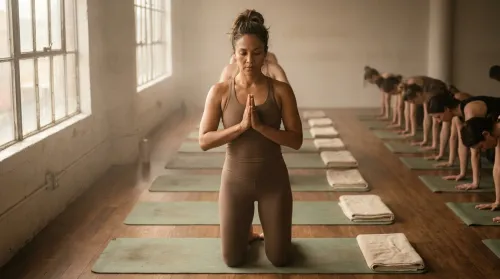
Yoga Gear


Most yoga gear advice tells you which brand to buy. Almost none tells you what each piece actually does for your joints, your alignment, and your progression. But that function is the only thing that matters when you're standing in a shop deciding where your money goes. I coach strength for a living, and I trained yoga in a Krishnamacharya-lineage studio. So let me save you the first mistake: the number printed on a mat label measures height, not support.
Industry trackers estimate more than 34 million Americans practice yoga. That means a lot of people are assembling a home kit right now off marketing copy instead of function. But we can finally reason from evidence instead of vibes. The first-ever systematic review of yoga props, 44 studies deep, concludes props improve accessibility, alignment, and safety.
So here's the whole thing. A complete checklist first, then what each item does and how to choose it by real spec. After that, how to match your gear to how you actually practice.
The Complete Yoga Gear Checklist (Start Here)
A complete home kit runs a mat, two blocks, a strap, and a bolster. Add a mat towel, a blanket, grippy socks, and a bag or wheel. But only the mat is truly non-negotiable to begin. Everything else earns its place as your practice tells you what it needs.
Here's the full list in buying order, so it doubles as a priority guide:
- Yoga mat (buy first) — your foundation; grip so you don't slide and support so your joints aren't grinding on the floor.
- Two blocks (buy first) — bring the floor up to your hands so you can hold a position instead of straining toward it.
- Strap (buy first) — lengthens a bound stretch without you yanking your own shoulder to close the gap.
- Bolster (buy later) — passive support for restorative and yin poses. Here the whole point is to hold still and let the tissue settle.
- Mat towel (buy later) — grip insurance the moment you start to sweat.
- Blanket (buy later) — height under the hips, warmth in savasana, padding under the knees; the cheapest high-utility prop you'll own.
- Grippy socks (optional) — traction if you practice on a hard or slick floor.
- Bag or wheel (buy later) — a bag to carry the kit, or a wheel if you're chasing backbend range.
This is decision support, not a store shelf. Every item below gets judged on what it does for your body, not whose logo is on it. If you're new to the wellness and yoga lane, start at the top of the list and add downward.
The Yoga Mat — Why Density Beats Thickness
The mat is the one piece you can't practice without. So it's worth understanding before you spend a dollar on anything else.
How thick should a yoga mat be?
5–6mm is the all-around standard. Drop to 3mm when you want floor connection for balance and travel. Go 6–8mm only if you specifically want extra joint cushioning. Those bands are consistent across current mat guides. 5–6mm is what the market treats as "thick" and all-around. And 3mm gives the strongest floor connection while 6–8mm trades stability for padding. Here's the catch with the thick end. The more mat sits between you and the ground, the less you can feel it. And balance work suffers for that.
Density vs. thickness: what actually protects your joints
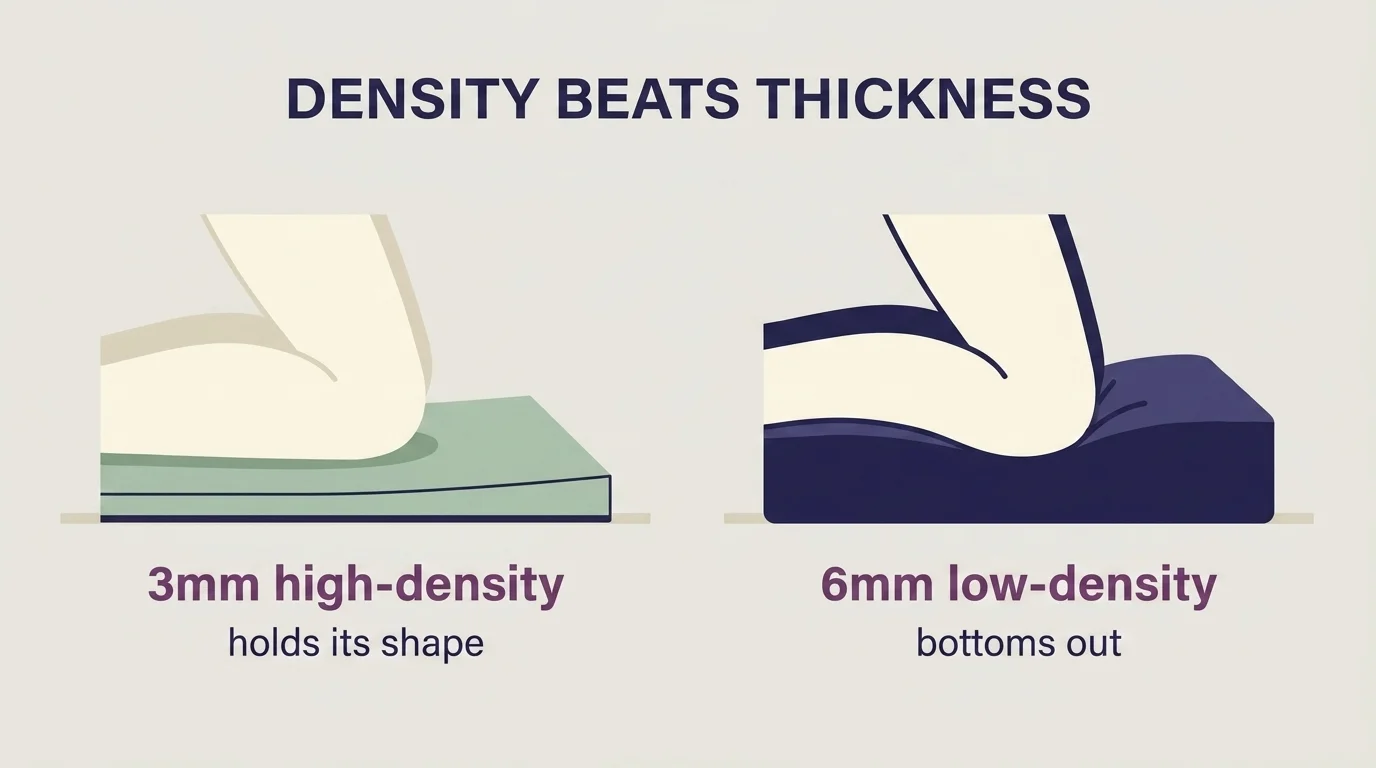
Thickness and support are not the same thing. Conflating them is why people buy a plush 6mm mat and still finish class with sore wrists. As the mat guides put it, millimeters tell you height, not support — two mats labeled "6mm" can feel completely different depending on density and how the foam compresses under load. My read as a coach: density beats millimeters for joint protection. A firm, high-density 3mm mat can protect your knees and wrists under bodyweight better than a soft, low-density 6mm one. That soft mat bottoms out to the floor the instant you kneel on it.
Here's the cue you can test in the store — press your thumb hard into the surface. If it compresses to the floor under your thumb, it'll do the same under your kneecap in a low lunge. The external marker is simple. On a good-density mat, your hand stays where you place it and doesn't sink and shift.
Materials sort the same way, by function rather than brand. PVC is dense and durable. TPE is lighter and bouncier, and it's often marketed as eco. Natural rubber gives a grounded, sticky grip. And a cork-topped surface grips better the more your hands sweat. Match the material to how you practice, not to the color you liked. And here's the honest limit on all of this. If you already have knee, wrist, or lower-back pain, see a clinician before you load a pose. No amount of mat cushioning is a substitute for that, and I'd never tell you it is.
Blocks and Straps — Props as Progression Tools
Blocks and straps aren't crutches you graduate out of. They extend your usable range and let you build mobility under control. At every level, that's a progression tool. That's not just my coaching bias. The 2026 review found that "existing evidence underscores the vital role of yoga props in enhancing accessibility, alignment, and safety in yoga practice,". And a 2025 study reframed props as tools for building a sustainable long-term practice rather than beginner training wheels.
Foam or cork yoga blocks?
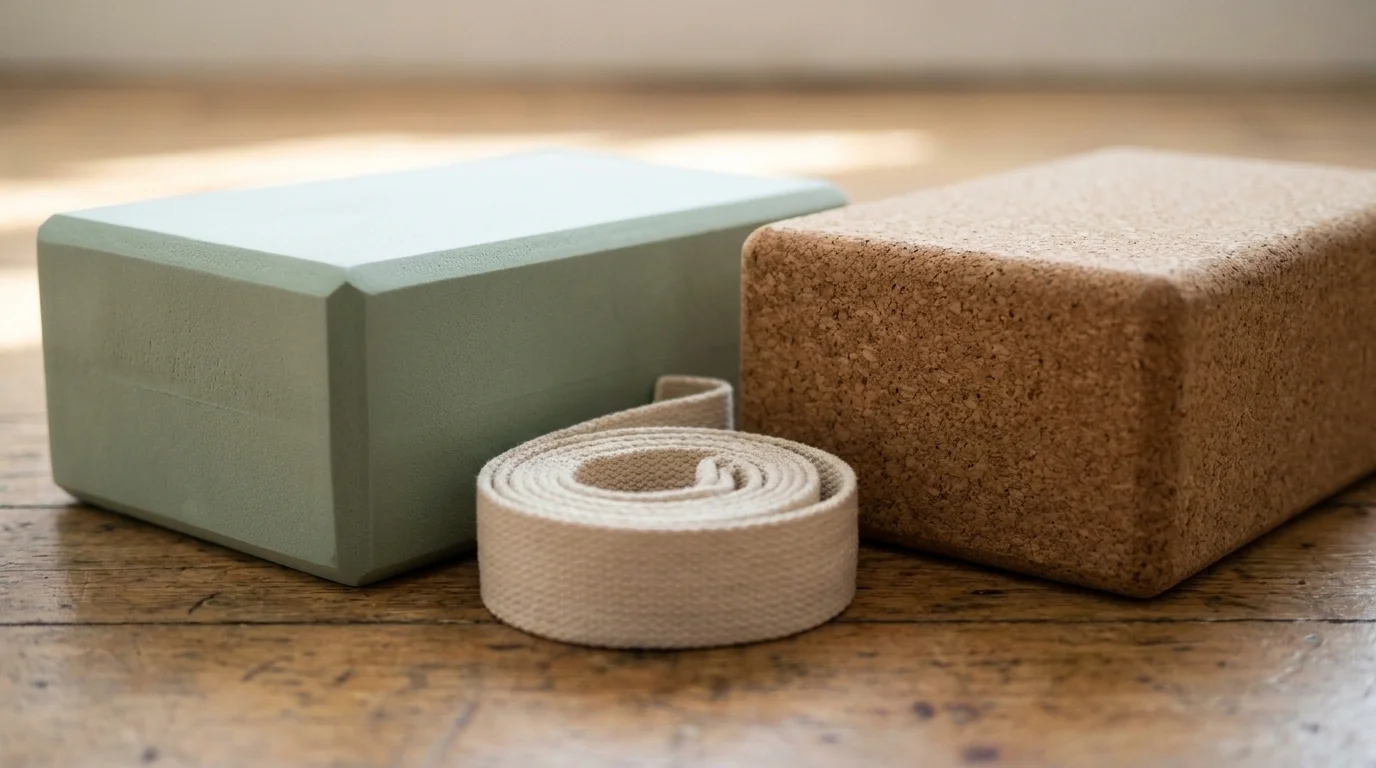
Cork blocks weigh roughly 700–900 g and foam blocks come in under about 200 g. And that weight difference is the whole decision. The heavier cork sits solid under your hand for standing balances and hot-yoga poses. You don't want the block skittering away. The lighter foam is softer and more portable. That makes it the better choice for restorative propping and travel. Buy two, not one — most poses that use a block use it under both hands or want a spare height. Choose by the practice, not the price tag.
What length yoga strap do you need?
Match the strap to your height: 6 ft if you're under 5'4", 8 ft for most people in the 5'4"–6' range, and 10 ft if you're over 6'2" or working with limited flexibility. When you're on the fence, size up. You can always loop a long strap, but you can't add length to a short one. The point of the strap is the same as the block. It lengthens a bound stretch so you can actually hold the shape and breathe in it. That beats compensating with a rounded spine to reach your foot. Give a strap-assisted stretch six to eight weeks of consistent work before you expect to close the gap without it. Nothing about range of motion changes in a week.
Bolsters, Blankets, and Towels — The Comfort and Sweat Layer
Bolsters and blankets support the restorative and yin end of practice, where you hold a shape passively. A grippy towel manages sweat so your mat stays safe when the room heats up. These are the buy-later layer — add them when your practice actually turns toward stillness or heat.
Rectangular or round bolster?
The shape decides the job. A rectangular bolster gives stable, flat support for savasana and reclined poses, while a round bolster gives a contouring lift that opens the chest for backbends. If most of your restorative work is lying flat and settling, buy rectangular. Buy round if you're using it to arch and open. Either way, it's a prop you add when your practice leans toward restorative and breath-based practice, not on day one.
Blankets are the sleeper pick. Height under the sit-bones lets your hips actually stack over your knees. There's warmth across the body in savasana. And a folded cushion under the kneecaps in any kneeling pose. It's the cheapest prop that solves the most problems. A moisture-wicking mat towel is grip safety, not luxury. In hot or fast vinyasa work, a sweat-slick mat loads wrists and shoulders wrong. That happens the moment a hand slides. Grippy socks are an optional traction aid if you practice on a hard floor without a mat.
How to Choose Yoga Gear by Practice Style
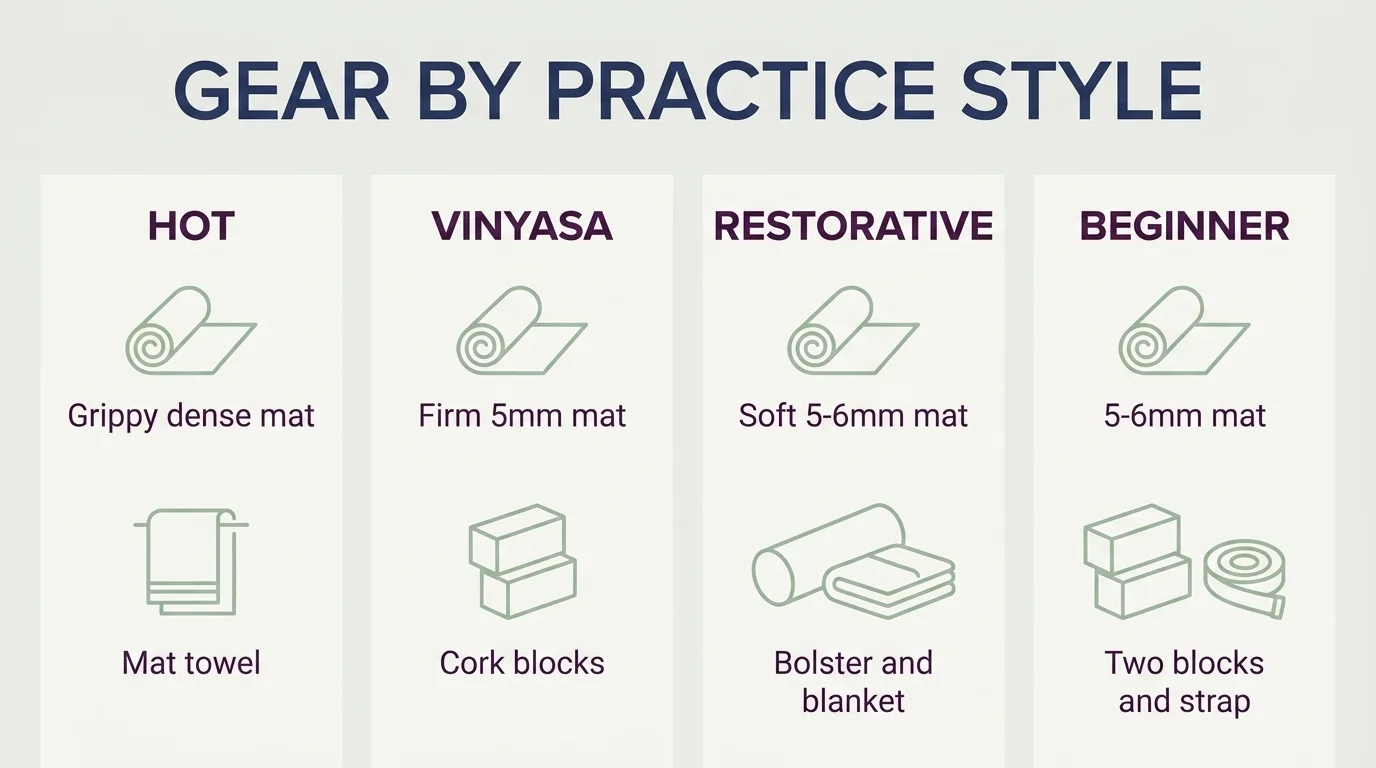
Your practice style, not your budget, should pick your gear. A hot practice and a restorative practice need almost opposite kits. Here's the map, filled from the specs above:
| Practice style | Recommended mat | Blocks | Essential extras |
|---|---|---|---|
| Hot / Bikram | Grippy, high-density (cork-top or rubber) | Cork (won't slide when wet) | Mat towel is mandatory; skip the blanket |
| Vinyasa & Power | Grippy 5mm, firm density | Cork for stable standing work | Mat towel; a strap for the bound shapes |
| Restorative & Yin | 5–6mm for comfort, density secondary | Foam for soft propping | Bolster + blanket; foam blocks |
| Gentle / Beginner | 5–6mm all-around, decent density | Two blocks, foam or cork | Strap; add the rest later |
The logic per row is short. Hot practice is decided by grip and sweat management. So a hot yoga class rewards a sticky mat and a towel over cushioning. Restorative practice is decided by support and warmth. So bolsters and blankets matter more than grip. Most home practitioners blend styles across a week. That's why the safe all-around default is a 5–6mm grippy mat, two cork blocks, and an 8 ft strap. It handles nearly everything you'll do until your practice specializes.
The Beginner Starter Kit and Budget Tiers
What yoga gear do beginners actually need?
A mat to start, then two blocks and a strap next — everything else is practice-dependent. That buy-first tier is a decent-density mat, two blocks, and one strap. It unlocks nearly every pose a beginner will meet in their first months. The blocks bring the floor up to you, and the strap closes the gaps your flexibility hasn't yet. You do not need the full checklist on day one. Anyone selling you an eight-item "starter bundle" is selling volume, not necessity.
Where your budget matters most
The buy-later tier — bolster, mat towel, blanket, bag or wheel — comes as your style demands it, not before. On budget, think in tiers instead of exact prices: an entry, a mid, and an invest option for each item. Spending up genuinely buys you something on the mat and the blocks. That's where density, grip, and durability are the whole value, and a cheap version wears out or slides. It buys you almost nothing on the blanket and the socks, where the entry option does the job forever. The rule that keeps you out of trouble: pay for density and grip, not for logos.
Gear for Women, Men, and Which Brands to Trust
Yoga gear isn't really gendered — fit and sizing differ, but the props don't. A block is a block. What actually changes with body size is mat dimensions and strap length. Taller practitioners, who skew male, want a longer and wider mat. Their hands and feet shouldn't hang off the edge. They also want an 8–10 ft strap. The "for women" and "for men" labeling you see is mostly apparel cut and colorway, not function.
On brands, I'd rather give you criteria than a shopping list, because the criteria outlast any brand's current lineup. Look for high-density construction and grip you can verify in reviews or in hand. Also look for honest disclosure of what the material actually is, and a real warranty. A company that publishes its density and material specs is telling you it expects you to judge on function. That's the one to trust.
One seasonal note, since a lot of gear moves as gifts in the fourth quarter. A beginner starter kit or a single quality mat makes a genuinely good gift. It lowers the barrier to starting without betting on someone's taste in apparel. Give the mat, not the leggings.
Choosing Gear That Earns Its Place
Choose your yoga gear for what it does, not what it costs or whose logo it wears. That means density and grip over millimeters and marketing. It means props as progression tools that make range of motion safe and repeatable. And it means a kit matched to how you actually practice. If you're starting out, the buy-first three do the work: a decent-density mat, two blocks, and a strap. Add the bolster, the towel, and the blanket when your practice tells you to. Don't add them because a bundle told you to. Pick your row from the practice-style table, and build your starter kit around it. Then explore more in the wellness and yoga library when you're ready to go deeper.
Frequently Asked Questions
The difference is mostly framing, and the terms overlap. "Props" usually means the alignment tools you position your body with — blocks, straps, and bolsters. "Accessories" leans more commercial: towels, bags, and socks. "Equipment" is just the umbrella word for all of it. Don't overthink the labels; judge each item on what it does for your practice.
No, you don't need special clothes to start yoga. Anything you can move and breathe in works — fitted enough that the fabric doesn't fall over your head in a forward fold, stretchy enough that it doesn't fight a deep lunge. Fit matters far more than brand or a "yoga" label. Save the apparel budget for a mat that actually supports your joints.
Yes, you can start yoga at home with no gear at all — a towel or carpet and your own bodyweight will get you through your first sessions. A mat is the first upgrade worth making, because it gives you the grip to hold poses safely and some joint support on hard floors. Everything after the mat is optional until your practice asks for it.
The best place to buy yoga gear is anywhere that publishes real specs — specialty yoga retailers, sporting-goods stores, and reputable online sellers all work. Prioritize sellers that list a mat's density and material, not just its thickness and color, so you can judge function before you buy. A seller that hides its specs is hoping you'll shop on looks.
To care for a yoga mat, wipe it down after any sweaty session and deep-clean it periodically — but check the material first, because natural rubber and cork don't tolerate the same cleaners as PVC. Air-dry it flat, out of direct sun, and roll it top-side out so the edges lie flat next time. Good care preserves grip and meaningfully extends the mat's life.