
Navigating Holistic Wellness: Embracing a Well-Balanced Lifestyle for Beginners


I see a predictable failure pattern with people new to holistic wellness: they read that they should fix their nutrition, sleep, stress, relationships, and spiritual life, try to overhaul all of it at once on a Monday, and quietly quit by the second Thursday. If that's you, the problem wasn't your willpower — it was the plan. Holistic wellness is the right idea: caring for the whole person rather than chasing one symptom. But like any training goal, you don't build it by doing everything at once. You build it by changing one thing, letting it stick, and adding the next. And the good news is the broader culture has finally caught up to that — 2026's dominant wellness mood is a backlash against extreme optimization in favor of sustainable, real-life balance. Start-small is officially back in style.
Here's the actual map: what holistic wellness is, the eight dimensions it covers, and — the part nobody tells beginners — exactly where to start.
What is holistic wellness?
Holistic wellness is an approach to health that addresses the whole person at once — as WebMD frames it, considering "the whole person — body, mind, spirit, and emotions — in the quest for optimal health." Or, in St. Catherine University's words, it "simultaneously addresses the physical, mental, emotional, social, and spiritual components of health." The key word is simultaneously: it assumes these parts of your life are connected, so a chronic sleep problem isn't just a physical issue, and money stress isn't just a financial one. They bleed into each other.
The 8 dimensions of wellness
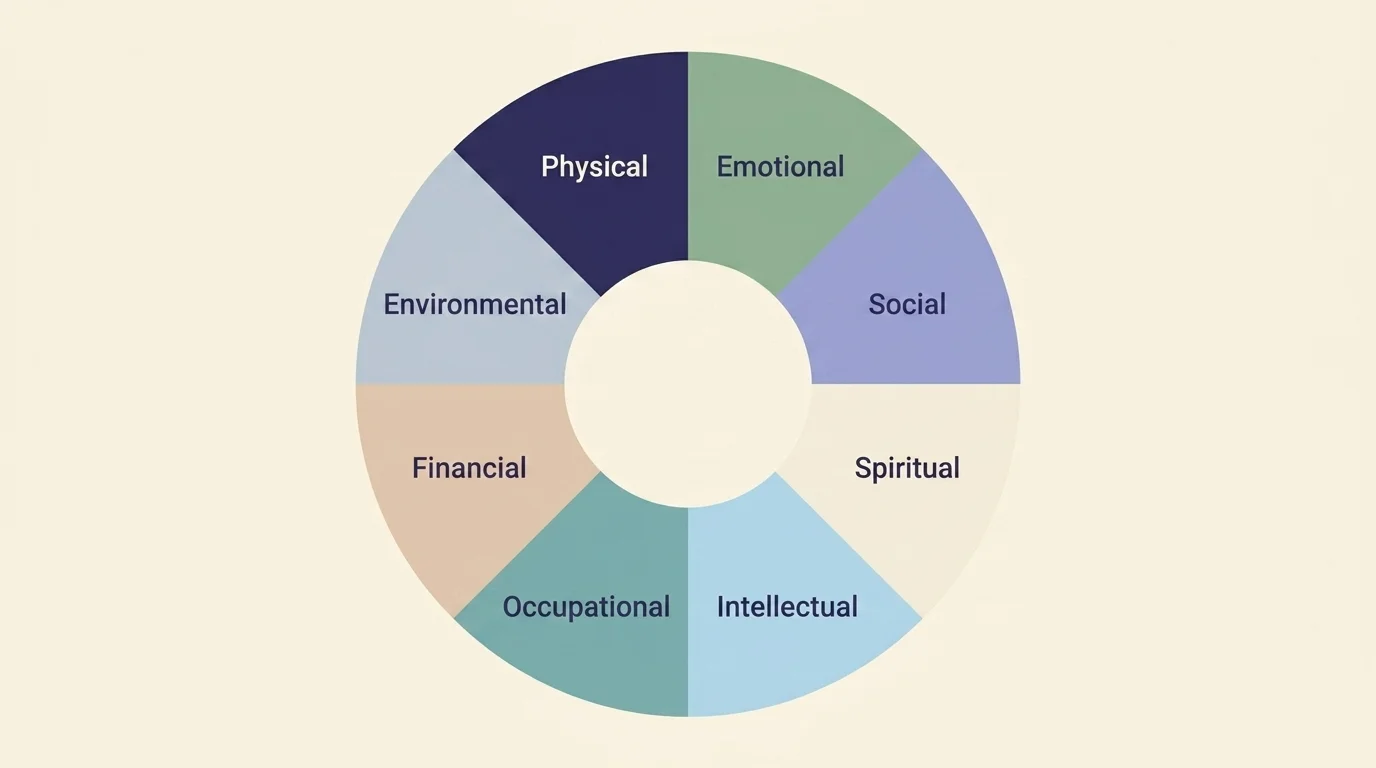
If "the whole person" feels too vague to act on, there's a useful, well-established map. The 8 Dimensions of Wellness model was developed by Dr. Margaret (Peggy) Swarbrick and adopted by the U.S. Substance Abuse and Mental Health Services Administration (SAMHSA). The eight, with the one thing each really asks of you:
- Physical — movement, sleep (aim for 7–9 hours), and what you eat.
- Emotional — noticing and handling your feelings instead of outrunning them.
- Social — real, supportive relationships.
- Spiritual — a sense of meaning or purpose, religious or not.
- Intellectual — staying curious and mentally engaged.
- Occupational — finding some satisfaction and balance in your work.
- Financial — a manageable, low-stress relationship with money.
- Environmental — surroundings that support rather than drain you.
The reason this map matters is the part the public-health literature emphasizes: "if you neglect one dimension of wellness, eventually other dimensions of wellness will suffer." They're a system. Which is also exactly why you don't need to train all eight at once.
Related Article: Embracing Cultural Diversity in Health and Wellness: Insights and Practices from Around the World
Where to start: pick your weakest dimension
Here's the coaching move, and it's the same one I'd use for a lifting program: don't train everything, train the limiting factor. Look at the eight dimensions above and find the one that's most obviously dragging on the rest right now. For most beginners it's physical (usually sleep) or social (isolation). That's your starting point — not because the others don't matter, but because progress in your weakest link tends to lift the whole system, and early wins are what keep you going.
Resist the urge to score yourself a 3/10 on all eight and try to fix everything. One dimension. One change. That's the whole strategy, and it's the opposite of how most "transform your life" content tells you to begin.
Concrete first steps
Whatever dimension you pick, make the first change small enough that it's almost embarrassingly easy — that's a feature, not a compromise. Some genuinely good starting points by dimension:
- Physical: protect a consistent sleep window before you touch your diet; aim toward the standard 7–9 hours. Or add one 20-minute walk most days.
- Emotional: ten minutes of daily mindfulness or a few lines of journaling — enough to notice what you're feeling, not a meditation retreat.
- Social: one real conversation a week that isn't logistics.
- Financial: one no-spend habit or a single automated transfer to savings.
Pick exactly one. Run it for two to three weeks until it's automatic and you're not white-knuckling it. Then add the next. The marker that it's working isn't a dramatic transformation — it's that the habit has stopped requiring a decision.

Related Article: Physical Fitness Traditions from Around the World
Holistic wellness practices worth exploring
Beyond the basics, there's a wide menu of practices people fold into a holistic lifestyle — yoga, breathwork, meditation, acupuncture, aromatherapy, massage. I train both barbell and breath, so I'm not here to dismiss any of it. But let me be a coach about it: these are complements, not replacements, and they're worth exactly as much as they actually do for you. Try the ones that interest you, keep the ones that demonstrably help your sleep, stress, or mood, and drop the ones that are just adding items to a to-do list. And for any genuine medical problem — pain, a diagnosed condition, persistent low mood — see a clinician first; complementary practices sit alongside real care, not instead of it.
The 2026 shift: start small, don't biohack everything
If you've felt behind because you're not tracking nine biomarkers and cold-plunging at 5 a.m., good news: that era is ending. The Global Wellness Summit's 2026 trends name an "over-optimization backlash" and "Ready Is the New Well" — a move away from extreme tracking toward sustainable, personalized, real-life balance. The whole industry is enormous (a roughly $6.8 trillion economy) and happy to sell you the deluxe overhaul, but the actual direction of travel agrees with the boring truth: the wellness that works is the wellness you'll still be doing in a year. Personalized and small beats comprehensive and abandoned.
The honest timeline
Holistic wellness isn't a 30-day transformation, and anyone selling you one is selling you the Thursday-quit. It's a whole-person system you build one dimension at a time. Find your weakest link, change one small thing, give it a few weeks until it's automatic, then pick the next. Do that patiently and the eight dimensions start reinforcing each other instead of competing for your willpower. That's not a slower path to balance — for almost everyone, it's the only one that actually arrives.
Frequently Asked Questions
A holistic approach cares for the whole person at once — body, mind, spirit, and emotions — rather than treating a single symptom in isolation, on the understanding that these parts of your life are connected and influence each other.
Physical, emotional, social, spiritual, intellectual, occupational, financial, and environmental — a model developed by Dr. Peggy Swarbrick and adopted by SAMHSA. They're interdependent, so neglecting one eventually strains the others.
Start with one small change in your weakest dimension rather than overhauling everything. For most people that's sleep (aim for 7-9 hours) or social connection. Run one habit for two to three weeks until it's automatic, then add the next.
Pairing consistent sleep and regular movement (physical) with ten minutes of daily mindfulness (emotional) and one real social connection each week — improving several dimensions together instead of chasing one symptom.
They run on shared machinery: movement releases mood-lifting endorphins, diet affects cognition, and chronic stress shows up physically. Improving one dimension tends to lift the others, which is why a whole-person approach works better than fixing pieces in isolation.
Yoga, breathwork, meditation, acupuncture, aromatherapy, and massage are common complements. Treat them as additions, not replacements — keep the ones that demonstrably help your sleep, stress, or mood, and see a clinician for any genuine medical problem.
Pick your weakest dimension, make the first change almost embarrassingly small, run it for a few weeks until it's automatic, then add the next — and lean into 2026's 'start small' shift rather than trying to optimize everything at once.
Check Out These Related Articles

Aesthetic Harmony: Integrating Design Principles with Holistic Wellness Concepts
Japanese Zen Embodied: The Art of Integrating Mindfulness into Everyday Life

Amazonian Wisdom Unveiled: Exploring Unique Healing Traditions from the Rainforest